The Bibb finally bolted. Four plants produced almost exactly two pounds of leaves — right around 20 servings. The Bibb wasn’t transplanted until late April, which was way too late, so I’m ok with that yield.
The tomatillos are now almost six feet tall. The shorter of the two has a fruit about the size of a ping pong ball, pictured below.
The peppers haven’t been digging the rain, I don’t think. At least two of the fruits have extensive black on them, which I’m guessing is some sort of rot. One of the plants is struggling with wilted and blackened leaves. Not good. It may be that the least resistant of the ten varieties are struggling — hopefully everything else can shrug it off.
The tomato and tomatillo plants are growing in every direction, so they got some twine to try to organize the chaos. The cabbage worms look to be at least briefly defeated, but the aphids have now found the purple basil. The lettuce and dill are gradually fading, though it was still a good harvest this week. The cilantro and parsley went ballistic and received big haircuts. The first peppers have made their appearance.
Everything has been staked. The layout got spread out somewhat. Aphids (on the lettuces) and cabbage worms (brussels sprouts) made their first appearances and were rewarded with a dose of this organic solution. [pic of cabbage worm from itsnotworkitsgardening.com]
Evil!
Marigolds are supposed to be a very beneficial companion plant, so twelve got spread around in the earthboxes. Scallions deter aphids, so some of those got pulled from the main bunch and distributed in with the lettuces. [wikipedia list of companion plants here. Companion plant theory is here.] In the early ’90’s I had read about companion planting in an old Mother Earth News Almanac (1973 edition, 1977 printing), I’ve been meaning to try it whenever I got around to planting vegetables. It only took me 20 years to put it into practice.
First picture, a view of the earthboxes on May 3:
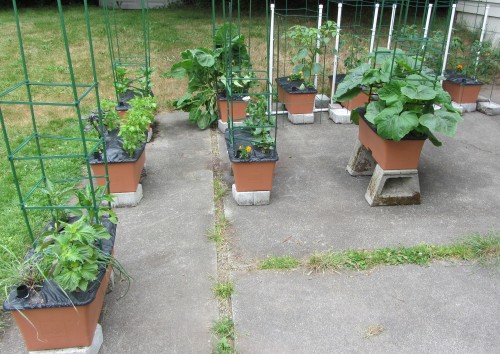
June 9 view. The zucchini got a “throne” to lift it higher off of the ground. The little spots of color are marigolds. Note the new pvc supports for the tomato cages:
Progress!
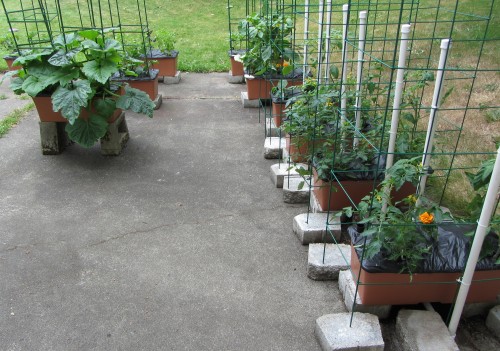
June 9 view from the back garage door looking toward the back yard:
Our neighbor Kurt has started EarthBoxes! (It’s like a disease, only healthier.) His first post on the subject is here. We share an interest in low-labor container gardening it seems.
Well really, I just try to avoid weeding whenever I can.
The tomato plants got a bird net over their cages this week — four of the six plants are now producing fruit. (The Glacier, Stupice, Siletz, and Sungold. The Roma and Brandywine are holding out, which is to be expected.) The zucchini and brussels sprouts got staked with Ultomato cages. I like the idea of the Ultomato cages, and I’ll be looking to buy more parts either in bulk or on clearance at the end of the season. I know that the “arms” are available as a 36-pack, though I’d buy more at the right price. Getting a good deal may require a little digging.
Among the recent dishes to be partly or fully composed of Earthbox ingredients includes a bunch of green salads, guacamole, pico de gallo, dill “crusted” salmon, caprese salad, and grilled bok choi and scallions. The grilled bok choi and scallions were served with chicken kebabs marinated in greek yogurt, lemon, and Tom Douglas’ Bengal Marsala rub. Very tasty! Also this:
The varieties — back to front, starting with the leftmost box. Descriptions from the Seattle Tilth plant sale:
Two Mexican Strain tomatillos. 65 day maturity.
Glacier. 56 day determinate. Grows to 2-1/2 feet high by 3-1/2 feet wide. “Great for containers”.
Siletz. 70-75 day determinate. “One of the most reliable slicing tomatoes you can grow.”
Stupice. 60 day indeterminate. Red, 2″ fruit on 6′ vines.
Sungold. 65 day indeterminate. Apricot-orange 1-1/4″ cherry-tomato fruit on grape like trusses.
Brandywine. 85 day indeterminate. Fruits up 1 pound and 7″ in diameter. (The Brandywines are near the house to try to get some reflected sun off of the house.)
Roma. 75 day determinate.
The tomatoes were selected as a combination of low-risk (Glacier, Sungold) and more speculative (all the longer-timed maturities). I figure we’ll get something, but no idea how much.
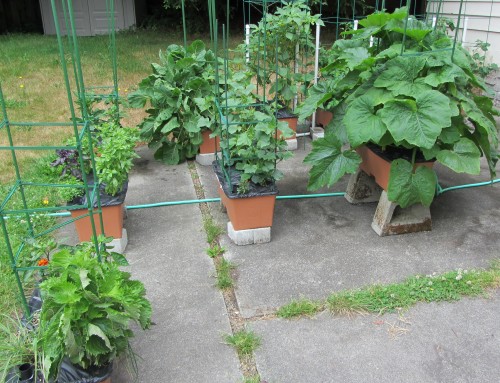
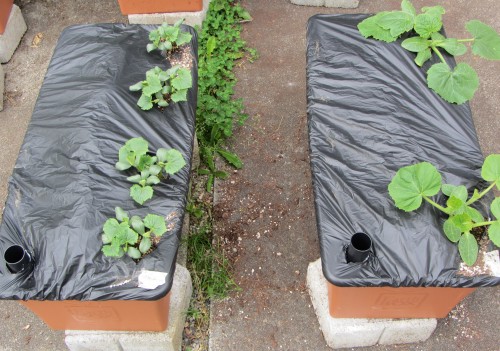
Foreground is the cucumbers and zucchini. The brussels sprouts and bok choi are in the back center box.
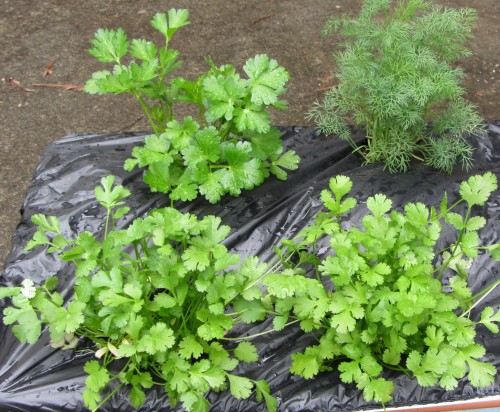
Parsley, dill, and two cilantro. Hiding under the 2nd-story deck.
The tomato cages were purchased as “squares”, and they didn’t fit the earthboxes well. Note the two bars running over the center of the earthboxes — I had to prop them up on blocks to get them that high.
Note the “before” (left), and “after” (right). The blocks could go away now. We’ll see how enthused I get about moving them around again.
Removing the “center bars” also made enough leftover frame to cage the tomatillo. Win win win. I feel clever. Of course, I’d feel way more clever had I purchased stuff that fit easily in the first place..
The spinach responded to the wonderful 80+ degree early-May weather by bolting immediately. Four plants. Zero harvest. The lettuces, cilantro, parsley, and dill are now cowering under the deck, away from the heat of the mid-day sun.
It’s now time to prioritize harvesting whatever hasn’t already mutinied.
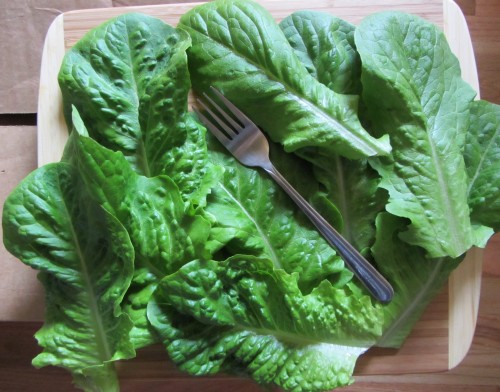
The first salad. Only the romaine was home-grown, but it’s still good to have something to show for the work.
After the break, blossoms from around the back yard, most of which came with the house.
The Seattle Tilth May Edible Plant Sale was yesterday (and today). That brought a lot of new inhabitants for the earthboxes.
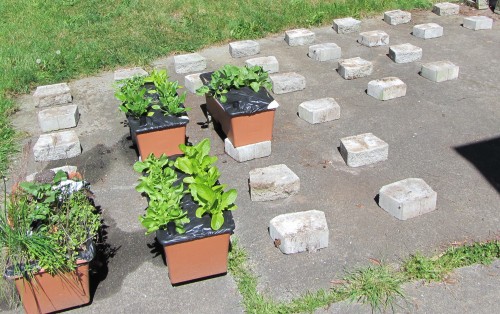
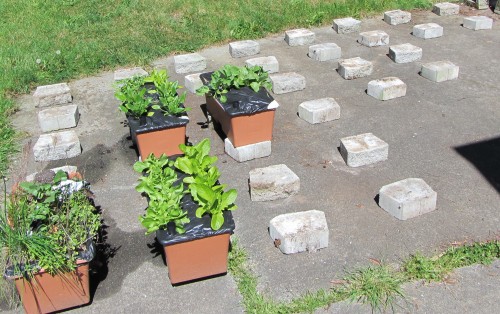
To step back for a moment, I laid out potential locations for the EarthBoxes on Friday. The two boxes in the foreground have casters, the left box has leftover stuff from two years ago and needs to be emptied and restocked. It’s 18 spots, of which 12 would get used:
And the 12 winners. On the far right are the basil, tomotoes, tomatillos, lemongrass, epazote and probably something else I’m not thinking of right now. They still need to come inside at night. The empty hole on the left is the future home of the basil:
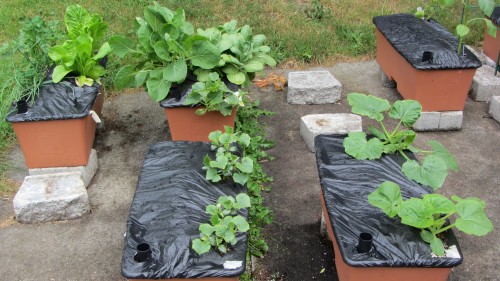
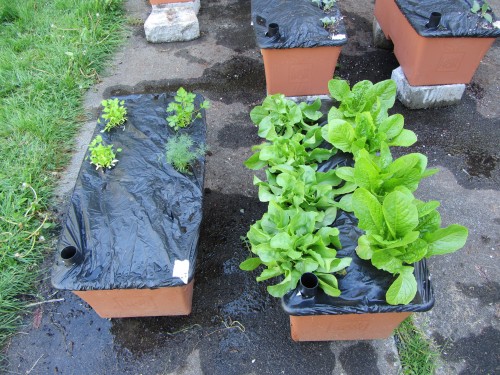
Closeup 1. The boxes with casters. These include most of the lettuces, the flat leaf parsley, dill ,and “calypso” cilantro — all the stuff that will bolt when it gets too hot. Eventually these will be moved somewhere a little shadier:
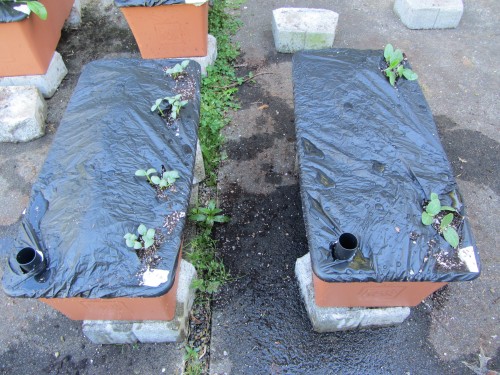
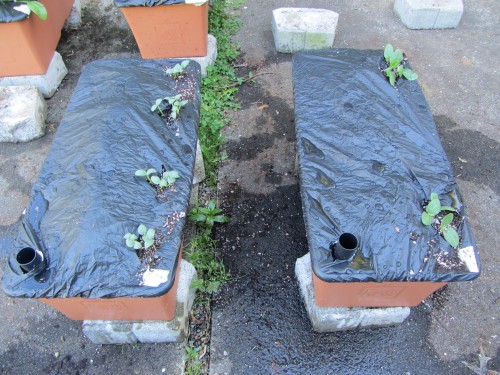
Closeup 2. On the left are the Marketmore 76 cucumbers. On the right are a cocozelle zucchini and a golden bush scallop (patty-pan) zucchini:
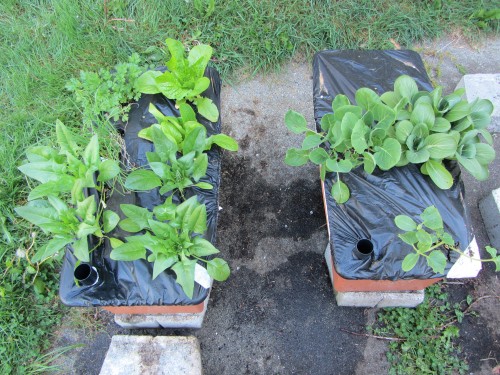
Closeup 3. Left box is parsley, scallions (or chives, going to have to check the label), spinach, and romaine. Most of this box will get replanted when it gets hot. The right box is brussels sprouts, bok choi, and an “extra” lemon cucumber from the plant sale:
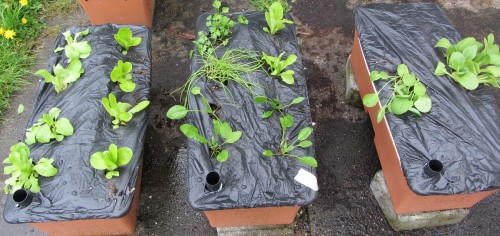
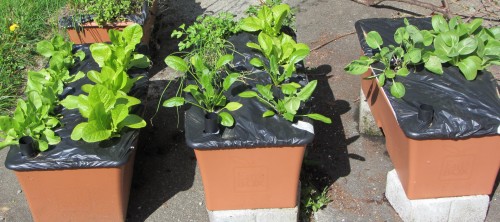
The lettuces in particular are really growing. Far left is the loose leaf lettuce. 2nd to the left (same box) is the romaine. I think the big romaine leaves will be ready for harvesting by as early as this weekend.
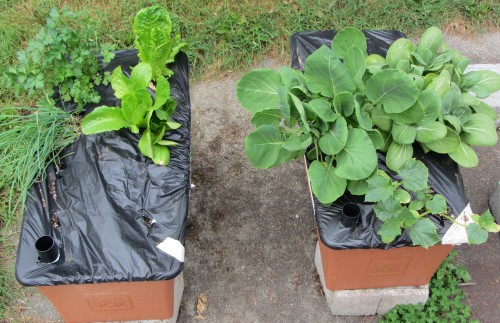
Also: Spinach in the center box, foreground. Center box background is parsley, chives, and more romaine. Right box is brussels sprouts (L) and bok choy (R).
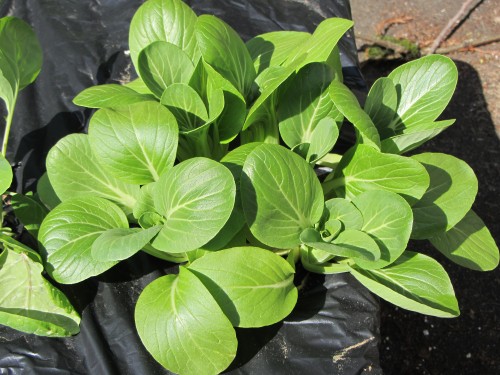
April 30, a closeup of the bok choi. It’s only one plant, though it looks like a few:
It’s amazing to me that it’s only one plant. I’m guessing that harvest will start this weekend too.
I’ve been doing some reading, and it sounds like the lettuces will need to be moved into partial shade whenever it starts warming up. That should delay the bolting that the lettuce will do at some point. (Which makes the leaves bitter.) Good thing they happened to mostly wind up in one of the boxes with casters.
This weekend is the Seattle Tilth vegetable, herb, and flower sale. That’ll be a long day.









 FlatbreadGarden