50/50 Pullman Loaf, A Recipe I’m Happy With

I’ve now reached a point with the weekly sandwich bread bake that I’m basically happy with it. I’m sure I’ll continue to fiddle with it to see how it reacts, but here’s where I’ve settled as a base recipe:

Ingredients

100g starter discard or overnight poolish (either of these are optional but they seem to improve the mouthfeel of the finished bread). The starter discard is 50g bread flour and 50g water. If using a poolish it will be 50g bread flour, 50g water, and a tiny tiny pinch of yeast.

200g Bread flour and 250g fresh-milled whole wheat flour (Red Fife, Turkey Red, or Rogue de Bordeaux berries), (In total it is 500g flour weight total including the starter/poolish).

325g cool water (with the 50 grams from the starter/poolish the total water is 375 total grams. 75% dough hydration).

    15g honey (3% of flour weight)

    15g olive oil (3% of flour weight)

    10g kosher salt (2% of the flour weight)

    1.5 tsp instant (not rapid-rise) yeast.

    Process

    Start by adding the 325 grams of cool water to the bowl of the stand mixer.

    Scoop 100 grams of starter discard into the water.

    Grind the wheat directly into the water/starter mixture. I feel like this helps keep the milled wheat temperature lower than it would be if I just milled it into an empty container. At the very least, it can’t hurt.

    Add the remaining ingredients and mix for one minute to combine. Cover and let rest 20 minutes, up to an hour. Uncover and mix another 6 minutes.

    Spray a pullman pan lightly with Baker’s Joy. (I’ve tried more than a few ways of attempting to prevent the baked loaf from sticking to the pan. Baker’s Joy has been by far the easiest and most consistent solution. If overused Baker’s Joy with give the crust a vaguely weird and sticky quality, so don’t go overboard with it.)

    Transfer the dough to a pullman pan and spread out the dough with wet fingers. Cover, and let rise until 1/2″ to 1″ from the top of the pan. Preheat oven to 350F when the dough is getting close to ready.

    Bake, covered for 30 minutes then remove the cover and bake for another 25 minutes or until the loaf reaches 195-205F.


    I had been using powdered milk in the recipe, but it didn’t seem to be adding flavor. I thought it might also be contributing to the finished loaf being a little crumbly, since when used in moderation the powdered milk is supposed to help with loft. Simpler might be better here.

    This recipe still technically functions as a same-day loaf, given I always have a starter in the refrigerator. The weekly sandwich bake then doubles as an opportunity to remember to refresh the starter. Win-win.

    Happy baking

    Epi De Ble, And Drying Basil For “Italian Seasoning”

    We had a socially-distanced birthday dinner on the covered back deck. Everyone got their own tear-apart Epi De Ble — instead of messing around with whole loaves and bread knives.

    These Epi De Ble were inspired by this King Arthur webpage. Note that two Epi will fit on an 18″ sheet tray, at 150-175 grams of bread flour per Epi. The recipe below makes four Epi.

    Continue reading “Epi De Ble, And Drying Basil For “Italian Seasoning””

    The 2020 Vegetables

    Our patio “Container Garden” consists of twelve EarthBoxes and three City Pickers. This year we’re going to leave a few idle, or fill them with a rotation of short-season veggies and greens. I don’t feel like this is the right summer to be committing to wrangling a jungle of big plants.

    Here’s a picture of the almost-complete garden. you’re looking basically East. The first sun hits the grassy edge of the patio at around 10am and by 11am-1pm (summer day-length dependent) the rear trellises will be in full sunlight:

    200516 overview

    In the front there are (L-R) –   two empty boxes, a box of Taxi and Oregon Spring tomatoes, a box of two San Marzano Romas, and a box of two Oregon Spring. They’re all determinate and should play well together.

    In the mid-left back there are two indeterminate Black Krim tomatoes sharing a box. Behind that under the trellis are Fortex (pole) beans in a City Picker box — 20 plants in a 4 x 5 layout.

    Continue reading “The 2020 Vegetables”

    Our First Asparagus Harvest

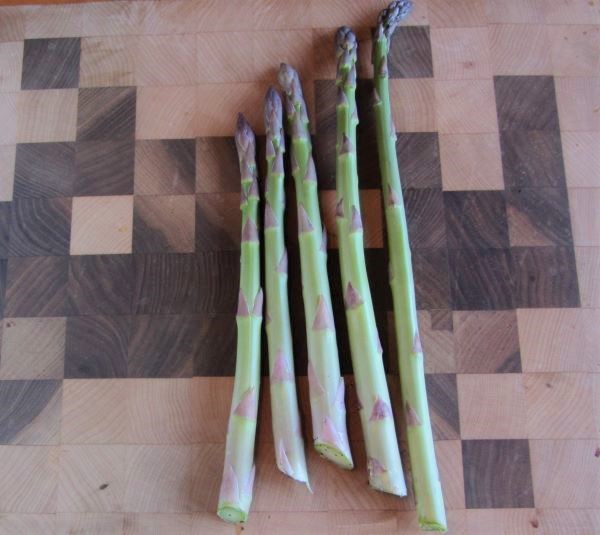
    Three years in, we can now begin to harvest asparagus. For reference, the Space Invader cutting board is 12″ high:

    200412 asparagus

    The asparagus we started in 2016 ultimately didn’t work out due to poor planning and a bad location, so we tried again in 2018. This time around we have a much sunnier spot and raised beds to help the drainage and soil temperature.

    A picture of the raised bed from this Container Garden Update post — June 9, 2019.:

    190609 bed 3

    Dinner will be asparagus with salmon and small potatoes.

    Our French Laundry Menus

    Two of the menus were personalized, which was a nice touch. (Whited Out in the pictures below.) The “25” in the background of the menu commemorates Thomas Keller’s 25 year association with The French Laundry. The other shape in the background is a traditional clothes pin. We received a clothes pin as a souvenir that had “THE FRENCH LAUNDRY” logo printed on one side and “IT’S ALL ABOUT FINESSE” on the reverse.

    The Vegetable-based Menu that we chose not to do:

    191209 Vegetable

    The menu we selected, signed by sous chef Sean O’Hara. If there was an “Option” on the menu – one of the two of us selected it so that we could try everything:

    Continue reading “Our French Laundry Menus”

    2019 Container Garden Recap

    It never really got hot in 2019. The garden responded by not providing much.

    By Year:

    Year Yield, Pounds
    2013 228.0
    2014 269.4
    2015 282.5
    2016 194.3
    2017 238.6
    2018 195.5
    2019 134.1
    Average 220.4

    The totals above are for 11 containers, so 20-25 pounds of produce per box is pretty normal. (“Normal” is around 30 pounds of tomatoes per box, 10 pounds of peppers, and 25 pounds of tomatillos.)

    We don’t count the basil, which is good because this is the first year that it failed. As a guess it was either nematodes or something else in the soil, but the cool summer didn’t do it any favors either.

    The Totals:

    (Plant list here.)

    Marketmore 76 Cucumber (1 box, 4 plants):  17.8 pounds

    Carmen Pepper (2 boxes, 12 plants):  14.1 pounds

    Jimmy Nardello Pepper (1/2 box, 3 plants):  1.0 pounds

    Anaheim Pepper (1/2 box, 3 plants):  1.1 pounds

    Tomatillo (1 box, 2 plants):  8.2 pounds

    Sun Gold Tomato (1/2 box, 1 plant):  9.7 pounds

    Old German Tomato (1/2 box, 1 plant):  0.5 pounds

    Oregon Cherry Tomato (1/2 box, 1 plant):  6.9 pounds

    Taxi Tomato (1/2 box, 1 plant):  23.0 pounds

    Black Krim Tomato (1 box, 2 plants):  13.8 pounds

    Oregon Spring Tomato (1 box, 2 plants):  18.4 pounds

    Roma Tomato (1 box, 2 plants):  13.4 pounds

    Tromboncino Zucchini (1 box, 2 plants):  6.0 pounds


    The yield was low but the few fruits on the tomatoes were larger than usual. Just a very strange year all around.

    On the bright side, the Fortex beans did great. Two boxes on one trellis produced way more than we could consume as the summer went along, so quite a bit wound up in the freezer. One of the bean boxes might be better served housing garlic or another allium.

    Maybe next year we’ll grow cucumbers, determinate tomatoes like Oregon Spring and Roma, and the indeterminate Black Krim tomatoes. And lots of onions and garlic.


    2018 Garden Recap (Redo)

    We lost every blog post after mid-September 2017 in the move to the new host and address. Public Service Message: Back Up Your Files Frequently!

    The final 2018 Garden Yields And Notes:

    195.5 pounds total.  That does not include the basil, beans, or anything from the salad table. A bit of a down year probably caused at least in part by extremes in the weather.

    Tomatoes:

    Black Krim — 19.5 pounds

    Cherry Bomb — 5.9 pounds.

    Hungarian Heart — 5.1 pounds. These were mislabeled at the plant sale. They don’t really have anything going for them and we won’t do them again.

    Oregon Spring — 28.4 pounds — A good indicator of just how “down” the garden was this year. Last year was 48.0 pounds.

    Roma — 2 plants — 23.9 pounds — Down from 31.6 pounds last year.

    Paisano — 16.8 pounds. An experiment looking for a sauce tomato other than Roma.

    Taxi — 5.2 pounds.  Down from 22.7 pounds in 2016.

    Continue reading “2018 Garden Recap (Redo)”

    Some Bread Photos From 2017-2018

    We lost every blog post after mid-September 2017 in the move to the new host and address. Public Service Message: Back Up Your Files Frequently!

    Some bread pictures from 2017-2018:

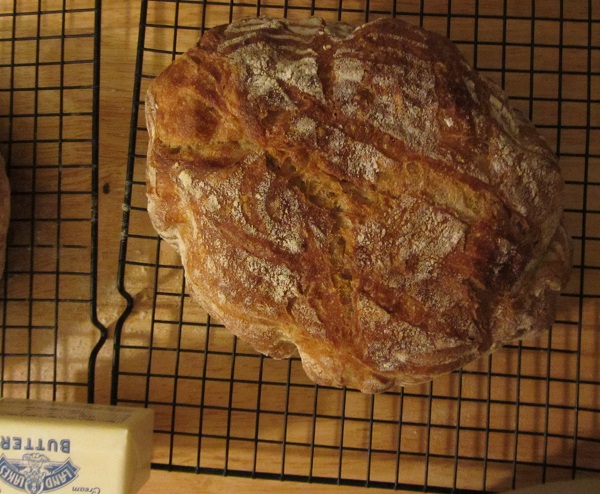
    A medium-or-high hydration rustic loaf. The pattern in the flour is created by proofing the bread in a banneton:

    170704 boule

    The file title of the photo below indicates that at least one of these two loaves used barley flour. I believe the smaller one used ~30% barley flour:

    180121 barley bread

    The photo below is why I don’t try to use parchment when baking No-Knead breads. The parchment didn’t allow the bread to spread out in an organic fashion. It tasted fine. But. Ugly.

    bread parment sling 171230

    I was pretty proud of the way these came out. They’re simple baguettes, around 60-65% hydration.

    171214 bread2-2
    Cell phone picture.

    The pigs in a blanket experiment. It’s basically a simple pizza dough wrapped around hot dogs, sliced, then baked ~425F for 15-18 minutes.

    181014 pigs in a blanket

    Cheesy breadsticks. Parmesan in this case. Always a hit at beer events.

    181122 cheesy breadsticks

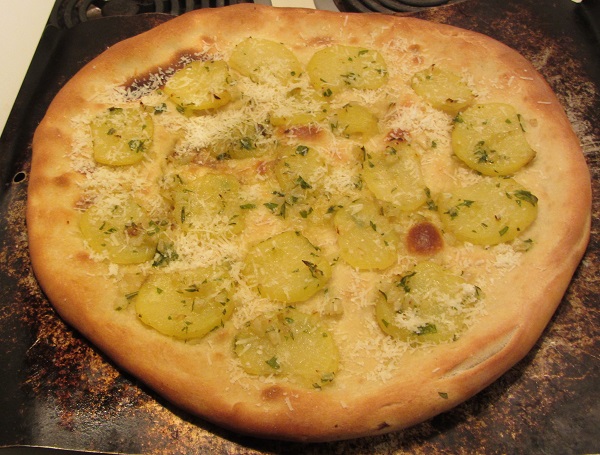
    Lastly, a potato pizza:

    181210 pizza


    2017 Garden Recap (Redo)

    We lost every blog post after mid-September 2017 in the move to the new host and address. Public Service Message: Back Up Your Files Frequently!

    The final 2017 Garden Yields And Notes:

    238.6 pounds total.  That does not include the basil, beans, or anything from the salad table. 

    Tomatoes:

    Black Krim — 20.9 pounds — Rich, dark, earthy tasting fruit. Our favorite.

    Cherokee Purple — 10.5 pounds

    Continue reading “2017 Garden Recap (Redo)”

    GNOIF: GNOIF’s Imaginary Menagerie

    -A.J.

    GNOIF #27 recap — GNOIF:  GNOIF’s Imaginary Menagerie (Fictional Creatures (Easter Bunny))

    Games That Got Played:  The Doom That Came To Atlantic City, King Of Tokyo, Lost Woods.

    Games That Didn’t Get Played:  Batt’l Kha’os, Castle Panic, Cthulu Fluxx, Exploding Kittens, Letters To Santa, Poo, Run For Your Life Candyman, Seven Dragons, Small World, Ticket To Ride Europe (with monsters), Tiny Epic Kingdoms, Ultimate Werewolf.

    It was a smallish crowd and we sort of picked a few games and stuck with them all night. I was pleasantly surprised by Lost Woods:

    Lost Woods is a map exploration game where lost adventurers defeat enemies with powerful weapons and magic to earn gold. Can you escape?

    Players start at camp in the middle of the Lost Woods, equipped with only random household items. Each turn, players move along the map and explore new areas by laying down a card that represents a place on the map. Exploration leads to new weapons, enemies that block the way, gold, magic spells, and a sneaky gnome that steals your gold.

    Enemies are fought with a simple dice mechanic. Each weapon and enemy rolls a single dice, and their power varies depending on the number of sides to the dice, from d4 to d20. Each victory is rewarded with a number of gold pieces.

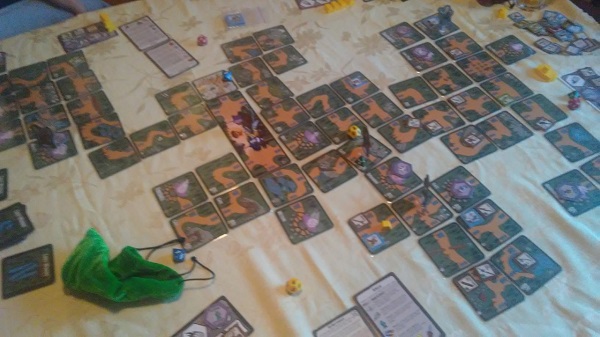
    (Description from BoardGameGeek) Lost Woods uses a tile placement mechanic similar to Betrayal At House On The Hill — players dynamically build the map as they explore. It’s a mechanic I really like, and it winds up looking something like this:

    170415 lost woods

    Each “weapon” has a unique and often silly name. I think the designers missed a “flavor” opportunity when they chose not to do the same with the enemies — the enemies have a small silly picture, but no names.

    The combat mechanic is simple and straightforward in a good way:  Weapons have a strength represented by a d4, a d6, a d8, a d12, or a d20. The enemies have the same range. You roll your weapon die vs the enemy die and the higher number wins. If you win you get some gold, and you can pass on to the next area if you like. If the enemy wins you lose gold and/or weapons. It’s simple, quick, and not at all fiddly.

    We also got multiple plays out of King of Tokyo and The Doom The Came To Atlantic City, each of which need a “Recommended Game” post.

    Thanks to everyone who played!