by A.J. Coltrane
Previous post here. July 14, 2013 here for comparison.
The photos below were taken at sunset —
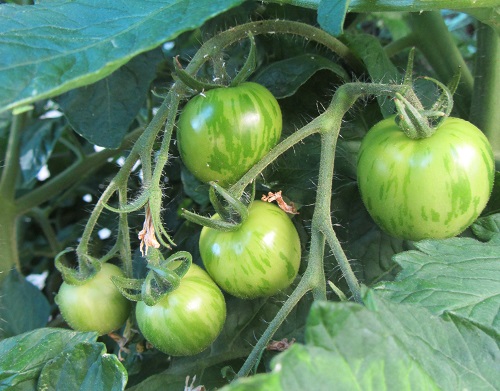
All of the tomatoes are doing well. The Tigerellas are slightly unusual. Note the stripes:

A baking and gardening journal. Mostly.
by A.J. Coltrane
Previous post here. July 7, 2013 update here. (The 2013 post is highlighted by the “zucchini breakage disaster”. And the fact that the post permalink says it’s the year “2103”. Oops. I started to make the same typo this time and caught myself.)
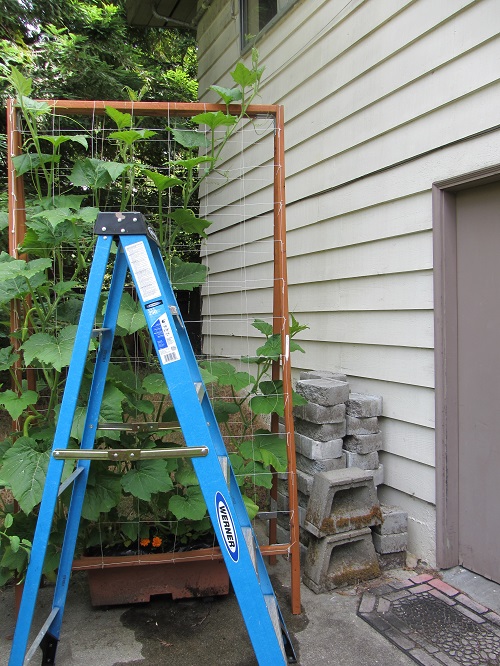
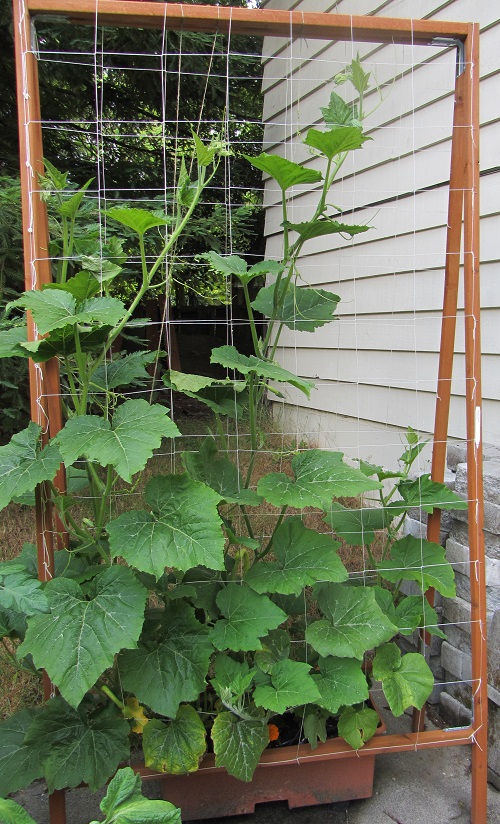
The zucchini have cleared the top of the trellis! I’m now trying to train them over the top and down the other side. We’ll see how that goes.
Continue reading “Container Garden Mini Update — July 7, 2014”
by A.J. Coltrane
In 2013 we used Ultomato stakes in many of the EarthBoxes. One of the early hodge-podge attempts is shown on June 3 of last year, here. We had a couple of boxes where the stakes wound up branching out in many directions, and to some degree it was a struggle to get everything to fit together. More than a few of the “arms” got warped in the process. Even with a “regular”, symmetrical, setup it can be hard to get the poles just the right distance apart for the arms.
What we learned is that the right thing to do is to assemble the Ultomato cage, *then* put it into the EarthBox. Using a “break” in the concrete ensures that all the stakes line up:
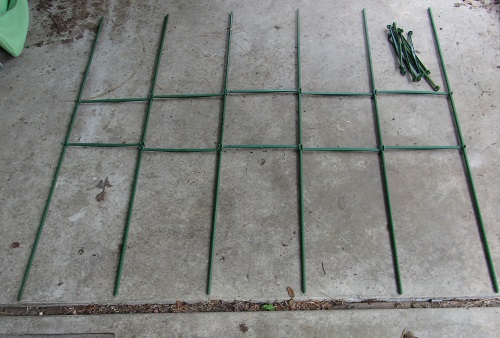
It seems to be easiest to put on the arms open-side up, pushing the stakes onto the arms, rather than the other way around. Like this:
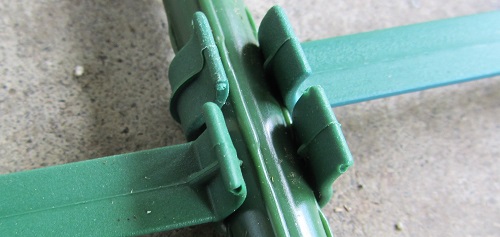
And (Note the bent arms. Those went on last.):
We’d then flip the entire thing over and “close the loop” with the last of the arms. This leaves the open sides of the arms facing out so that if the plants push outwards the arms won’t pop off of the stakes.
The best path to success is to push the center two poles in slightly, then work the corners in a little bit at a time. Once all of the poles are in place it’s easy to push the whole thing firmly down into the box. In the next picture you can see the arms facing “out”.

And sure enough, we learned something this year too. The arms need be attached closer to the top and bottom of the stakes. Once the assembly is in place it’s really hard to put on arms closer to the surface of the box.
Fortunately, we’ve got garden twine.
by A.J. Coltrane
Previous Update here.
For reference, the May 16 picture:

And today, Brussels Sprouts in the foreground:

The basil and tomatoes, the tall plants on the back right are the tomatillos:
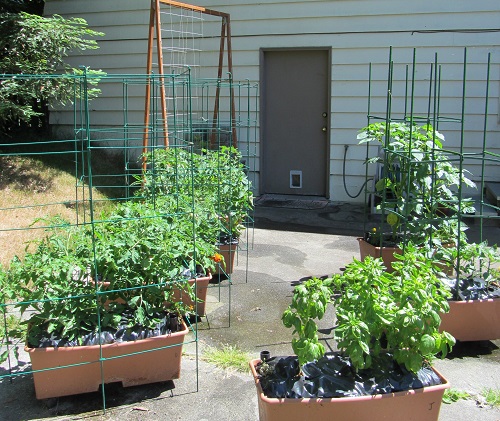
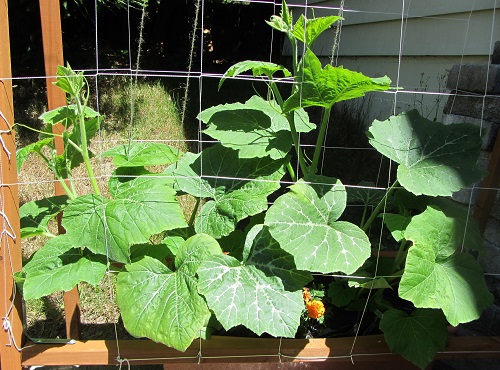
The Tromboncino zucchini are starting to latch onto the trellis:
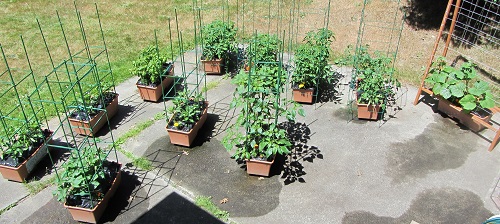
From the deck:
The pea plants are done, pictured is today’s harvest. In total we got around 3 pounds of peas, much of which was eaten right off of the vines. I’m thinking a pea pesto may be on the way:

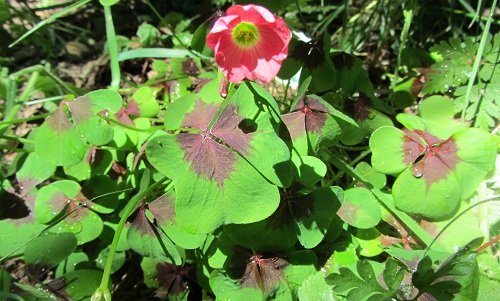
Bonus pic of the blooming oaxalis:
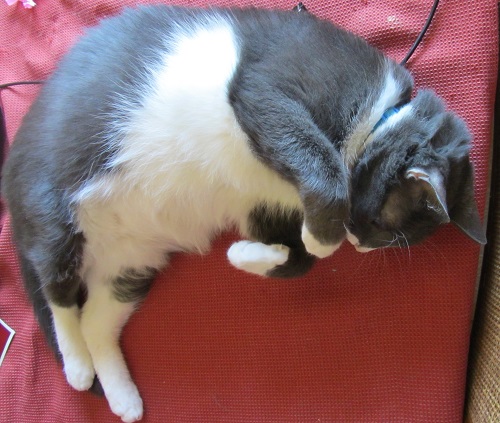
And the boy cat laying in the sun, inviting ear scratches:
by A.J. Coltrane
In an effort to keep cabbage moths off of the Brussels Sprouts:
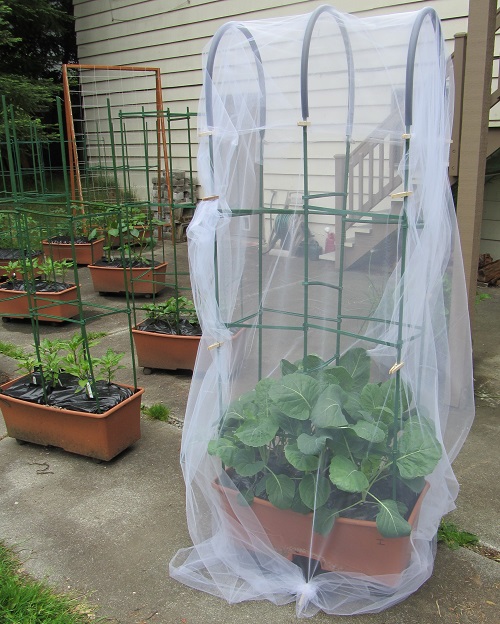
Tulle, Ultomato Cages, an EarthBox, shortened hoop house pvc, and clothespins. It’s a Frankenstein mash-up.
Even with all of that, something is still getting at the ends of the leaves that are touching the tulle — or the tulle is abrading the leaves when the wind blows. Dunno yet, but it bears watching.
by A.J. Coltrane
Previous post here.
The peppers and basil were planted in the EarthBoxes last night. If it threatens to get much under 50 degrees the basil will get rolled into the garage. (Note that the boxes now have casters — we bought them when EarthBox had a Valentine’s Day promotion. Money well spent.)
An overview picture:
Far left: Four boxes of tomatoes (2 plants in each box). Tomatillos in the back box (2 plants)
2nd row from left: Front box – Basil (6 plants). Back box – Peppers (6 King of the North)
3rd row: Front box – 6 pepper plants (hot peppers nearest the camera). Back box – 6 Brussels Sprouts in a tulle hoop house.
Right row: Front box – 6 pepper plants (hot peppers nearest the camera). Back box – 4 cucumber plants. Trellis – 2 zucchini.
Far right container: Shallots, Arugula, Dill, Radicchio.
Compared to last year it came together in a fairly fast and organized way. With a little deduction the containers mostly arranged themselves. Many of last years’ issues had to do with attempting to mix plants varieties within the boxes — this year it’s all “mono-boxes”. We also tried to make sure that all of the fill tubes will be easy to access. (The tubes are arranged in what amounts to two rows, which should help minimize any wasted watering motion.)
In the front yard, the peas are now doing this:
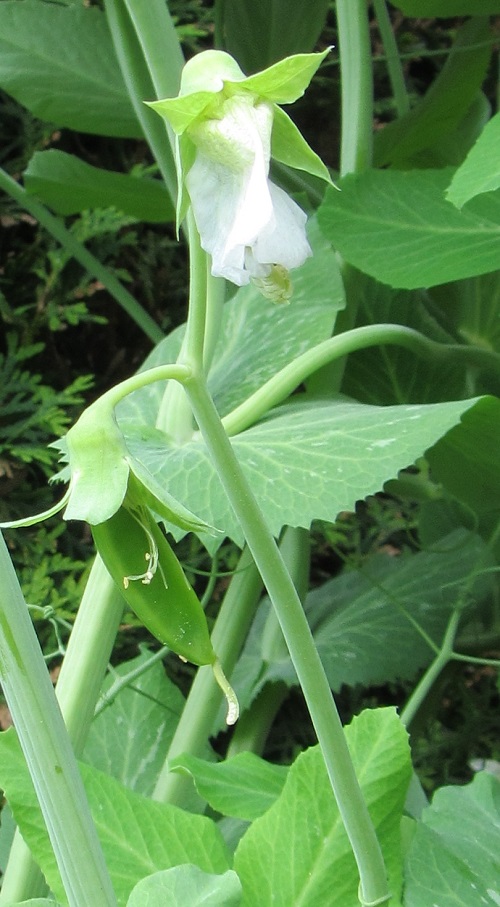
There are maybe two or three dozen pea pods on the vines now. Unfortunately, they’re doing this too:
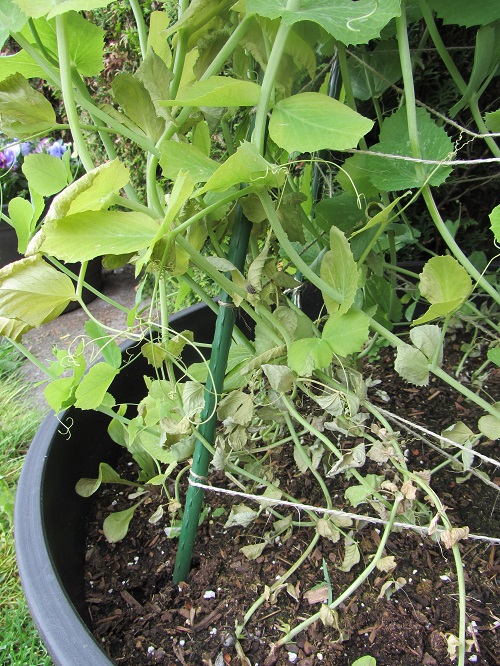
The leaves on the bottom have withered, and the leaves to to left higher up have turned yellow. I *think* it’s root rot, which is supposed to be caused by poor drainage/too much water. I think it’s interesting that the peas made it through a rainy February/March/April and chose now to crap out. If I’ve correctly identified the root rot then it’s now a race to see how many peas we get before the plants collapse.
Which is… fine, I guess. Pea enation virus would have killed them before too long anyway. Now we’ll be able to use the planter for something else.
Final note: So far this year we’ve gotten 11.3 pounds of mostly leafy greens out of the containers. At this time last year we’d gotten 1.3 pounds. Starting earlier seems to have helped.
by A.J. Coltrane
 My ideal gardening book would have a title similar to: Four-Season Urban Container Gardening In The Pacific Northwest, Seattle Edition.
That book doesn’t seem to exist, and for good reason. It’d sell about four copies. Digging around the internet gives a hodge-podge of information, but nothing concise and organized.
I was looking through the book options at the local nursery and came across Food Grown Right, In Your Backyard. It’s written by the co-founders of the Seattle Urban Farm Company, published in 2012. The book has an emphasis on small-scale organic urban gardening. It includes sections on designing the garden space, general gardening knowledge, detailed profiles of popular vegetables and herbs, and (my favorite) tables indicating the appropriate schedule for starting seeds indoors, transplanting, or direct seeding outside. (I loves me some tables and charts, y’know.) It doesn’t talk much about winter gardening, but other than that it’s an excellent all-around resource.
Amazon link here. To date it has received 5 stars out of 5 stars for all 35 Amazon customer reviews.
In a related note, I think I’ll be checking this out in 2014 — Bastille Cafe & Bar has a 4,500 square foot rooftop garden installed and maintained by one of the authors. Bastille offers tours on Mondays, April through September. The cost is $10, which includes a cocktail.
Now if I just need to figure out the best way to succession-plant an EarthBox.. I’ve got some ideas, but searching “succession planting” on the EB forums doesn’t turn up much. Time for a new thread..

 FlatbreadGarden