Two “00” Pancetta Pizzas

by A.J. Coltrane

Pizza #1

A “00” pizza using SeattleAuthor‘s pancetta and a little goat cheese:

151101 pizza

This started out as a 60% hydration pizza. (250g “00” flour, 150g water, 6g salt (2.4%), 1/2 tsp instant yeast.) I kneaded it on low speed for 10 minutes. At that point it was obvious that the dough was going to be unmanageable (again), so I kneaded it by hand while adding a small amount of flour until it became more cooperative.

The dough (with the pancetta) was baked on a pizza stone at 500F for 10 minutes. The goat cheese and herbs were combined, then added to the pizza and allowed to bake for another 4 minutes. (Herbs:  Chives, rosemary, garlic, sage, and lemon thyme, all finely minced together with a little olive oil — flavors I thought would complement the pancetta. I was sort of shooting for a “pistou” type of idea, though there’s likely a better term for whatever it was.)

A significant amount of the pancetta fat rendered out and soaked into the dough. I’m guessing the pools of fat didn’t do much for the appearance, though after the fat permeated the dough it looked fine again.

Overall it came out about like I’d visualized. The shape and thickness were good, and the crust puffed up around the edges well. I was hoping for something closer to little matchsticks for the pancetta, but the larger size was fine anyway. I liked the finished pizza, though others in the crowd weren’t so sure about the concept.

Pizza #2

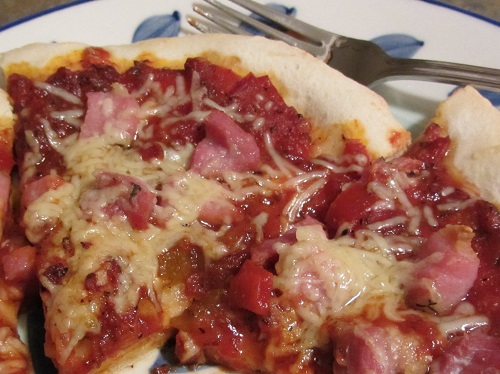
SeattleAuthor’s pancetta with red sauce and parmesan:

151102 pizza

This time I used 250g “00” flour, 142g water (57% hydration), 7g kosher salt (2.8%), and 1/2 tsp instant yeast, all mixed for 10 minutes on low speed in the KitchenAid. The dough was immediately cooperative (the extra salt may have helped), and it shaped more easily too. It’s hard to tell by the photo, but there’s a nice lip around the outside. The pizza was baked on a pizza stone at 500F for 10 minutes with everything except the cheese, then the cheese was added and it went back into the oven for another 3-4 minutes.

The red sauce was made with roma tomatoes and sweet bell peppers from the garden, flavored with salt, pepper, garlic, dried oregano, and some “Italian herb mix”. (How we came into the possession of a bottle of “Italian herb mix” I have no idea.)

There was less fat in finished product #2 — I’d trimmed away some of the really fatty bits before baking. I think the 2nd (red) pizza was the better of the two, though I learned a little something about handling “00” flour from each.

I think I still have enough “00” flour for ~20 more of these pizzas… thank you Iron Chef Leftovers.

————–

Late edit: It was pancetta, not prosciutto. I knew that..
A Salad Table Update

by A.J. Coltrane

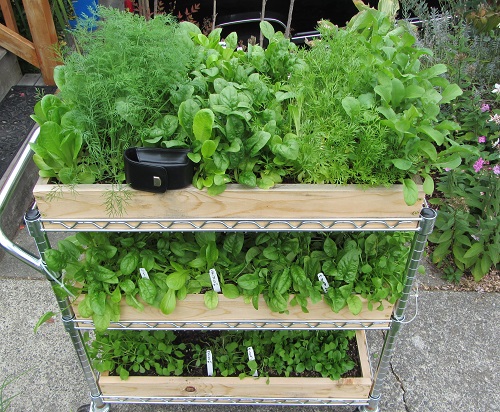
The salad table peaked a little earlier than I had intended. Here’s September 19:

150919 salad table

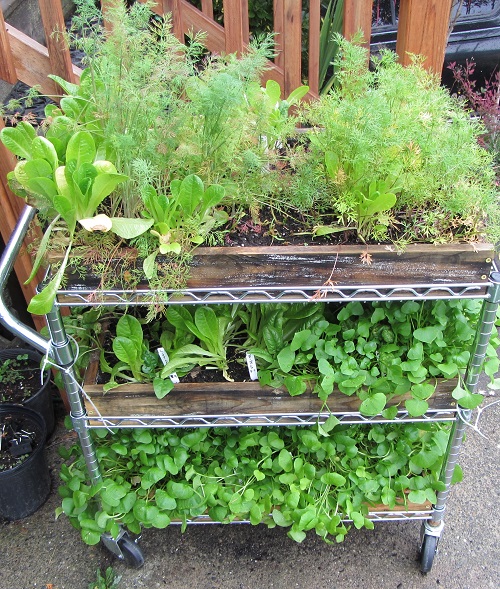
And today (top shelf, L-R:  romaine, dill, blank space where the spinach was, more romaine, frilly cilantro):

151031 salad table

I clearly got overeager — most all of the seeds were planted at once. When October turned out to be warmer than usual it meant that the spinach was done before the cool weather kicked in. I replanted it in the top center of the box on October 10th, but the current growth is still less than 2″ tall — basically invisible in the photo above.

I think I need to get better about succession planting. At the very least, succession planting would ensure that not everything bolted before the short days and permanent cold.

The flip side is the Miner’s Lettuce(!) It’s native to around here, and it’s loving the cool wet weather. I doesn’t even seem to mind the shade in the back of the table. It basically out-competed the mache on the lowest shelf, though we may find some mache buried in the thicket if we “weed” enough:

151031 salad table2

I’ll be interested to see how the Miner’s Lettuce holds up over the winter. I figure we’ll let this combination of plants run until late spring, then try New Zealand spinach and whatever else looks especially bolt-resistant. I’m open to plant-variety suggestions — No reason to fight the hot if the salad greens won’t tolerate it regardless.

Bonus pic of the scary front yard. The “gravestones” are concrete blocks wrapped in foil. The blocks themselves are flat on one end and rounded on two corners. The rounded corners became the “tops”:

151031 front yard

—————–

Visit Dave at Ourhappyacres, host of Harvest Monday.


“00” Chili Pizza

by A.J. Coltrane

I think it’s fair to say that the results I’ve had when using “00” flour have been… uneven. Each time the dough has been stretchy to the point of barely manageable, at best.

I did a little looking around online — it sounds like “00” flour is supposed to be really stretchy, and it doesn’t absorb much water… I’ve been using too much water in the dough. Evidently “Official” VPN pizzas use either 58% or 58.7% hydration. (The actual quantity quoted varies by source. I didn’t look that hard.) (That, and in Reinhart’s “American Pie” he says that in Italy, Bread Flour may be included at 25% of the total amount of flour. Sneaky.)

Also, oil isn’t used in a VPN pizza. However, while searching for the “proper” hydration I found sources that recommend 1-2% oil for home bakers using “00” flour, due to the temperature differences between a home oven and a professional or wood-fire oven. So…

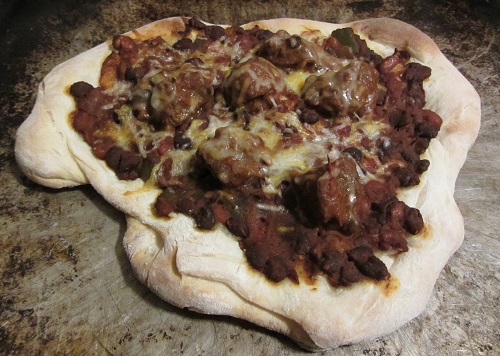
This time I kept it as simple as possible:  240 grams “00” flour, 57% hydration, 1/2 tsp salt, 1/2 tsp instant yeast. Knead on low speed for 10 minutes. I gave it a stretch and fold after an hour, then let it rise for another 45 minutes before shaping. A baking stone was preheated to 500F in the oven, the dough was formed on a pizza peel, and:

151022 Chili Pizza

The chili carmelized and sweetened somewhat in the oven, but it was still tasty and not too dry. The crust had a nice snap that in places was almost reminiscent of tortilla chips. I thought it worked. I know my mouth was watering before I dug in.

(The rest of the recipe:  10 minutes in the oven with the non-meat component of the leftover chili, then the reserved meat pieces and a “Mexican” cheese blend were added and allowed to heat through for three minutes.)

Other notes:

1.  57% hydration seems to be a good starting point for getting the hang of “00” flour. It behaved in a fairly similar fashion to a higher hydration bread flour.

2.  My shaping needs work. The dough was too thick in the center, and the seams from the stretch and fold are clearly visible in the finished product.

3.  I may try adding 1% oil next time, or brushing the rim of the pizza with oil, or both. A little more color would have been nice.

4.  240 grams is plenty for a small diameter pizza. 200 grams might be more appropriate next time.

—–

Overall all it was a good learning experience, and I used up leftover chili in the process. I enjoyed eating it, so win-win-win.

It might be just me, but I think maybe chili is a less “weird” topping on pizza than some other things are.. Like pineapple.

Final EarthBox 2015 Recap — The Tomatoes, Tomatillos, and Basil

by A.J. Coltrane

The 2013 Tomatoes and Tomatillos recap is here. 2014 here.

(Note that this won’t be the last gardening post of the year. It’s the final recap of how the summer went.)

2015 saw a total yield of 145.2 pounds for the eight tomato plants.  That’s an average of 18.2 pounds per tomato plant, or 12.1 pounds of produce per square foot of growing medium.

(For reference:  The 2013 total was 15.3 pounds per tomato plant.  The 2014 total was 17.2 pounds per plant.)

150822 harvest1

The Tomato Varieties:

Black Krim – 22.5 pounds. [75 day, Indeterminate. OP Heirloom. 23.5 pound two-year average.]  Excellent yield, attractive purple appearance, and a wonderful deep tomato taste. Winner.

Cosmonaut Volkov – 18.7 pounds. [68 day, semi-Determinate. OP Heirloom.]  The Seattle Tilth description said the Volkov would be early, and ready by mid-August. We harvested 1.5 pounds before August 29, and the other 17.2 pounds in September or later. The light red fruits were pleasant enough.. I’m not attached to these for 2016.

Oregon Spring – 18.0 pounds.  [60 day, Determinate.  15.7 pound two-year average.]  Starts early and produces all summer. Takes up very little space. The yield could have been better, but we lost at least a pound or two to bugs. One of our favorites.

Sweet Million – 9.9 pounds.  [65-75 day, Indeterminate.]  We chose these as a red cherry tomato to compliment the Sun Golds. The yield was poor, and they tasted more or less like supermarket cherry tomatoes. I thought they were a letdown all around. Not a keeper. We’re open to suggestions for a different cherry variety.

Roma – 22.8 pounds.  [75 day, Determinate. 22.0 pound three-year average.]  The Romas ripened really well this year. We did see a little more blossom end rot than in past years. I’m hoping that pairing them with a smaller determinate next year may help limit the stress. We’ll see. Keeper.

150906 harvest

Sun Golds – 16.2 pounds.  [65 day, Indeterminate. 17.9 pound three-year average.]  Productive and trouble free, and they taste like candy. Keeper.

Taxi – 25.9 pounds.  [65 day, Determinate. 25.3 pound two-year average.]  We’ve paired a Taxi with an Oregon Spring each of the last two years. They’re both early and they reach a similar compact size. No reason to mess with success. The bright yellow fruit and light taste makes for a nice contrast with the other varieties we’re growing. Keeper.

Tigerella – 12.4 pounds.  [65 day, Indeterminate. Heirloom. 14.3 two-year average.]  Here are the comments from last year:  “Average yield, average taste, but they are interesting to look at. Late to ripen. I’d be fine with trying another variety instead.”  I think all of those points held true again, but the yield went from average to fringe-poor. Not a keeper.

—-

The Tomatillos:

This year was a repeat of what we grew in 2014.  The tomatillo box contained contained the “Mexican Strain” and “De Mipa” varieties. The “Mexican Strain” has a vertical habit, and the “De Mipa” sprawls a little more. It seems to be a good combo in the box. Our 2015 yield was 15.1 pounds, the three-year average is 17.0 pounds. I think the “Mexican Strain” plant was a little weaker this year, as compared to last year. Still, I’m happy with a yield anywhere in the 15-20 pound range.

150726 cucumber, tomatillo, tromboncino

—-

The Basil:

2015 yield – 3.1 pounds.  2014 yield – 2.9 pounds. It doesn’t weigh much, but 3.1 pounds of basil is still over $200 worth at retail. Due to a lack of time, we mostly didn’t due the usual upkeep that basil likes, but the yield was fine anyway.

—-

2015 Summary:

We harvested 280.5 pounds of “summer vegetables” out of the twelve EarthBoxes between June 24 and October 4. That’s 23.4 pounds per EarthBox, or 7.9 pounds per square foot of growing medium.

The only really significant thing that we changed was that we built three new trellises and used them with the cucumbers and tomatillos. I think the trellises helped the tomatillos in particular. The cucumbers burned up to some degree in the 90 degree days — one thing we may want to try is shading the root area of the cucumber boxes to see if that helps. The flip side is that it felt like we had a smaller proportion of green tomatoes and peppers at the final harvest.

Overall though, we really didn’t have time to do the pruning that the tomatoes and basil appreciate. It didn’t seem to matter that much. It could be that the weather was so crazy nice that it overcame whatever “user error” we provided.

We’re learning a little bit more every year.

—————–

Visit Dave at Ourhappyacres, host of Harvest Monday.


Bring Your Baguette Dough To Work Day

by A.J. Coltrane

Earlier this week we came into possession of a goodly amount of Chanterelles. As in previous years, that meant we’d pass them along to Iron Chef Leftovers, and he’d cook dinner for us. (More on that later.)

We needed something to sop up sauce, and a regular No-Knead Bread wasn’t going to fit into the schedule, time-wise. I chose instead to go with overnight-rise baguettes. The recipe was a fairly standard french bread dough:  450 grams bread flour, 270 grams water (60% hydration), 10 grams salt (2.2%), and 1/4 teaspoon instant yeast (the same amount of yeast as is in the “regular” No Knead Bread.)

The thing was, I also chose not to do an initial knead.

In the morning the dough wasn’t looking promising. There was very little sign of fermentation, and the dough was nowhere near evenly hydrated — there were clumps of almost dry flour.

151006 dough

So I brought the dough to work with me. About every 90 minutes I did a few stretch and folds on the dough and tried to pinch out the really dry parts, then I snuck off to the washroom to rinse the bits of sticky dough off of my hand. (I needed to keep a non-doughy hand for the restroom door, right?)

By the time I got home, the dough was ready to be shaped. To do that:

1.  On a lightly floured counter, cut the dough mass into three mostly equal pieces, then spread the pieces out into rectangles about 8″ x 6″ x 1/2″

2.  Roll up the rectangles, leaving an 8″ long tube.

3.  Use your hands to roll/stretch the doughs on the counter until they are just shorter than a baguette pan. (Start from the centers and work outward.)

4.  Line the baguette pan with floured linen, place the doughs into the linen, then cover with more linen and let rise for 30 minutes.

5.  While the doughs are doing their final rise, put 3 cups of water into a large dutch oven. (No lid) Place the dutch oven on the bottom shelf of the oven. Preheat the oven to 450F.

6.  When the oven is really steamy, remove the linen from the baguette pan, score the doughs, and bake them for 10 minutes.

7.  After 10 minutes, remove the dutch oven, turn the baguette pan around, and bake for another 7-10 minutes.

151006 loaves

——–

For years, I’ve been messing with different ways of producing steam in the oven. I think I’ve finally found a method that I’m happy and comfortable with — I don’t want to spray the sides of my oven, and the other techniques that I’ve tried haven’t made adequate steam.

But three cups of water in a 7 quart dutch oven seems to work pretty slick. Learning!

151006 slices2

Also, 450F is warmer than I’ve historically baked baguettes. I think the crust came out better than usual, so my current plan is stick with that temperature going forward, or perhaps try an even hotter oven.

————-

The bread was an accompaniment to best Best. Dinner. Evar. Iron Chef Leftovers totally topped himself, and I can say with all honesty that I’ve never had a better meal.

151006 dinner

[Smoked Pork Loin with Chanterelle Cognac Cream Sauce. Chanterelle and Saffron Rissoto.]

———————

I feel like I’m finally starting to get a “system” of steps for baguettes. There’s still a lot of room for improvement, but I feel like I’ve now worked out enough variables that progress should be easier to quantify — I won’t be stabbing in the dark quite as much as I have been.

And as always, failure is an option, but the end results taste good regardless.


EarthBox 2015 Recap — The Cucumbers And Zucchini

by A.J. Coltrane

2013 Cucumbers and Zucchini recap here. 2014 here.

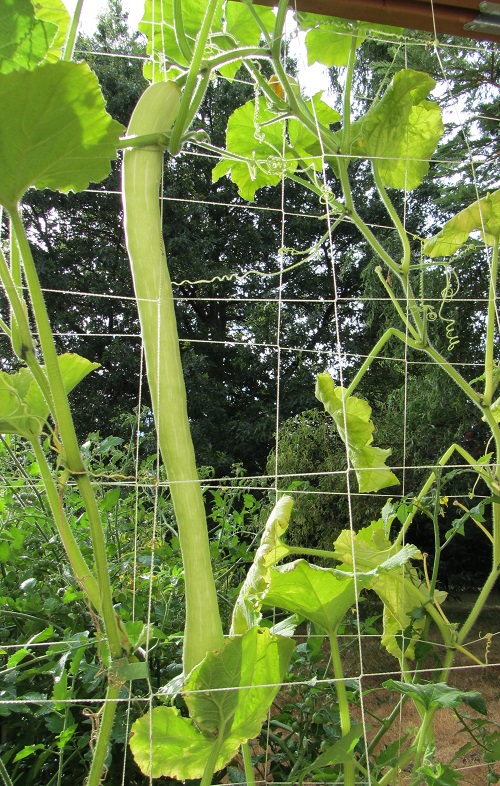
The Tromboncino produced 26.0 pounds this year. The 2014 total was 20.5 pounds. A 27% improvement!

150726 tromboncino1

(For reference – the trellis squares are 8″ x 8″. The fruit is 28″ long.)

Being the closest container to the west side of the house, the Tromboncino have been getting 1-2 hours less sun per day than some of the other, more favorable locations on the patio. Next year we may move them to the northwest corner of patio (the photo below was taken facing west, the northwest corner is at the the top right of the picture – that’s where the late morning sun hits first each day). If we do move the box then we’d turn the trellis 90 degrees so that it would run along the north edge of the patio. The difference in sun might help both the yield and with powdery mildew.

150809 overview

We grew two boxes of cucumbers this year — 8 plants total. I don’t think they liked the unusually hot weather. The cucumbers peaked early and disintegrated rapidly after that. In addition, they all became blocky, instead of long and pretty and straight. Bummer.

EarthBox #1 contained four Marketmore 76 cucumbers — the same thing as each of the last two years:

2013 yield – 56.0 pounds

2014 yield – 44.4 pounds

2015 yield – 28.6 pounds

Hopefully in a “normal” year we’ll see 40-50 pounds or so. That seems reasonable, and it would still be about 15 pounds per square foot of growing medium. I won’t complain if that’s the case.

Interestingly, I didn’t think the Marketmores were very photogenic this year. The last photo happened on June 15:

150607 cucumbers

EarthBox #2 hosted two varieties of pickling cucumber (Calypso and National Pickling), and two Lemon cucumber plants.

Mixing two types of pickling cucumbers with very different maturity sizes was a bad idea. It was basically impossible to tell if we were looking a small National Pickling cucumber (which grow to a 6″ maximum) or a full-sized Calypso (3″ maximum). Together they produced 10.6 pounds. Not great.

The Lemon cucumbers did much better — 20.0 pounds from the two plants. I wish they were a little easier to process after harvesting; it’s way easier to peel a regular cucumber, in contrast to a slippery orb:

150802 lemon cucumber

All up, box #2 yielded 30.6 pounds.  Between the two boxes we got 59.2 pounds of cucumbers(!) It’s too much, really. We’ll likely return to doing one box of cucumbers next year.

Now we just need to figure out what we’ll do with the “extra” box..

—————–

Visit Dave at Ourhappyacres, host of Harvest Monday.


EarthBox 2015 Recap — The Peppers

by A.J. Coltrane

2013 Peppers recap here.  2014 Peppers recap here. There’s a spreadsheet at the bottom of this post showing the total for all three years combined.

150906 harvest3

The 2013 harvest was 22.3 pounds from 11 plants — 2.0 pounds per plant.

The 2014 harvest was 31.0 pounds from 18 plants — 1.7 pounds per plant.

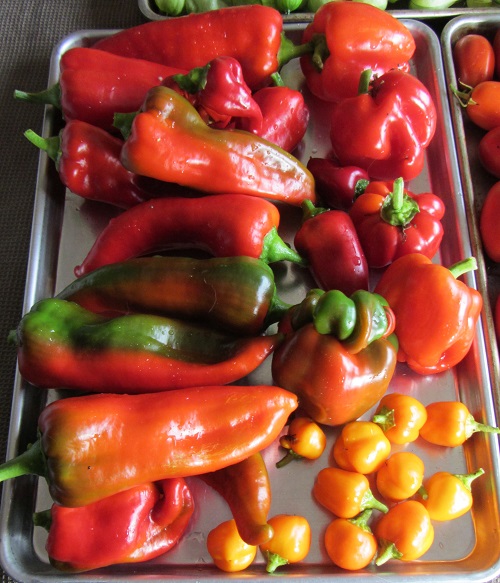
The 2015 harvest was 32.5 pounds from 18 plants — 1.8 pounds per plant. That comes out to 10.8 pounds per box, or 3.6 pounds per square foot of growing medium.

I think it’s pretty safe to say that in the future we can expect the yield to be 1.7-2.2 pounds on average per plant.

The 2015 lineup:

Anaheim College 64 — 1 plant.  1.0 pounds:  That’s less than half of what we got from this variety each of the last two years. We’ll plant these again anyway, I think we just got an uncooperative plant.

Bullnose Bell — 2 plants.  2.3 pounds total. (1.15 pounds per plant):  Basically a really squat bell pepper. Their shape made them relatively time consuming to break down. The yield wasn’t very good, and that’s before accounting for the pithy interior. Not a keeper for 2016.

NuMex — 1 plant.  2.6 pounds:  The NuMex were long and straight and produced a good yield. Keeper.

150829 harvest6

Iko Iko — 2 plants.  4.5 pounds total.  (2.25 pounds per plant):  A bell type. These ripened well and were generally trouble-free.  Keeper.

Early Jalapeno — 1 plant.  0.9 pounds:  Another poor yield from a pepper that usually does well for us. Still, we’re not going to bail on Jalapenos due to one bad year. Keeper.

Carmen — 2 plants. 8.0 pounds.  (4.0 pounds per plant):  Outstanding yield. Super easy to handle and process —  the seeds of each fruit were in a little pod right at the stem. A new favorite! Keeper.

150919 closeup2

King of the North — 6 plants.  9.1 pounds.  (1.5 pounds per plant):  Somewhat below average yield for what is basically a standard “bell pepper”. The bugs got to these a little bit. They usually do better for us. Keeper.

Lipstick — 2 plants.  2.5 pounds.  (1.25 pounds per plant):  We had one “good” plant, and one plant that made deformed fruit. The only other time we’ve grown Lipstick it produced 1.7 pounds. We’ll see if something else grabs us in 2016.

“Yellow Bell” — 1 plant.  1.5 pounds:  Teeny tiny bell peppers that ripened to orange. The interiors were solid seeds — we used a spoon or a melon baller to empty them out. Not a keeper.

150919 jalapeno

One thing we “discovered” this year is that long, straight peppers are far faster and easier to clean — when compared to the bell types. I can definitely see that characteristic being a tie-breaker when we choose what to grow next year.

Here’s the 2013-2015 spreadsheet, sorted by average weight per plant:

Variety Count Weight Ave. Weight
Carmen 2 8.0 4.0
Tequila 1 3.3 3.3
Gypsy 3 7.9 2.6
NuMex 1 2.6 2.6
Iko Iko 2 4.5 2.3
Tequila Sunrise 1 2.2 2.2
Anaheim College 64 3 6.3 2.1
King of the North 12 24.3 2.0
Jalapeno 3 5.9 2.0
Pasilla Bajio 1 1.9 1.9
Karma 1 1.6 1.6
Cute Stuff 2 3.1 1.6
Yellow Bell 1 1.5 1.5
Lipstick 3 4.2 1.4
Gourmet 3 3.7 1.2
Bullnose Bell 2 2.3 1.2
Hungarian Hot Wax 1 0.9 0.9
Thai Hot 1 0.5 0.5
Alma Paprika 1 0.4 0.4
Banana 1 0.4 0.4
“Bell” 1 0.3 0.3
Total 46 85.8 1.9
2013 10 22.3 2.2
2014 18 31.0 1.7
2015 18 32.5 1.8

—————–

Visit Dave at Ourhappyacres, host of Harvest Monday.

Container Garden Update — October 4, 2015

by A.J. Coltrane

Previous post here.  October 4, 2014 post here.  October 7, 2013 post here.

We harvested the last 9.8 pounds of tomatoes this week.

Monday saw us harvest everything except for the non-ripe cherry varieties:

150928 harvest

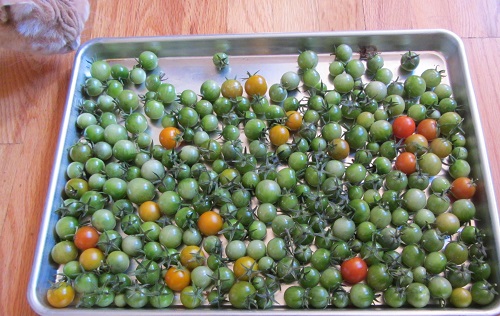
Today we brought in the cherries. The girl cat is checking the sheet tray for potential deliciousness:

151004 harvest

We removed the remaining tomato stems and cages today. Later this week we’ll plant Mache in those four boxes.

—————

This year we only weighed product from the EarthBoxes. We also didn’t count any overwintering veg, since the total was pretty paltry, and I was bummed out by the paltriness. Still, we harvested 282.5 pounds from the EarthBoxes — all of it between June 24 and October 4. That’s about 8.5% more veggies than in 2014.

2013 total weight:  228.0 pounds

2014 total weight:  269.4 pounds

2015 total weight:  282.5 pounds

For reference, 282.5 pounds comes out to just under 8 pounds of product (7.84) per square foot of growing medium. I’d guess that we’re getting close to the upper limit for our situation, short of swapping out the basil for something heavier — and that’s not going to happen.

—————

Each year I’ve done four garden Recap posts, looking at what worked, what didn’t, and what we think we might have learned. I’ll likely do the 2015 version of those posts over the next couple of weeks. As it gets colder I’ll also do updates on the progress of the new salad table and the status of the winter veg.

Wintertime also encourages turning on the oven again. I expect we’ll do more recipe and baking posts.

Looking forward to it.

Roasted Tomatillo-Pork Tacos

by A.J. Coltrane

I used this recipe (“Pork Stew in Green Salsa”) as a jumping off point for Roasted Tomatillo-Pork Tacos. The picture is of my variation, situated on a corn tortilla, topped with sour cream and frilly cilantro:

150929 tomatillo pork

Ingredients

  • 1/4 cup all-purpose flour
  • 1 teaspoon salt
  • 1/2 tablespoon ground black pepper
  • 1 teaspoon ground cumin
  • 1.5 lb boneless pork shoulder roast, trimmed of excess fat and cut into 1-inch cubes
  • 2 tablespoons olive oil, or more if needed
  • 1/2 large onion, chopped
  • 2-3 cloves garlic, minced
  • 2 cups pureed roasted tomatillos
  • 4 seeded minced green tomatoes (I used Romas)
  • 1 jalapeno pepper, seeded and minced
  • 1/2 cup chopped fresh cilantro
  • 1/2 cup water
  • 1 tablespoon Apple Cider Vinegar (pork loves apple)
  • Additional salt to taste

Directions

  1. Stir together the flour, salt, pepper, and cumin in a large bowl. Place the cubed pork into the mixture, and stir well to coat the meat with the seasonings.
  2. Heat the olive oil in a large, heavy pan or Dutch oven over medium-high heat until the oil shimmers. Working in batches if necessary, place the meat into the hot pan in a single layer. Pan-fry the pork until brown on all sides. Remove the pork to a bowl.
  3. Cook and stir the onion in the hot pan over medium heat, adding more olive oil if necessary, until the onion is translucent. Return the meat to the pan and stir in the garlic, tomatillos, tomatoes, apple cider vinegar, and water. Cover and simmer over low heat, stirring occasionally, until the meat is tender, about 1 hour.
  4. Stir in cilantro shortly before serving. Check for salt.

———–

The big changes from the original are:

Roasted tomatillos instead of fresh. I may try it with fresh at some point, but we currently have a freezer stocked with a lot of roasted tomatillos.

The addition of green tomatoes instead of green chiles. We have more than a few green tomatoes on the counter at the moment. (Gotta use everything up.)

More garlic (surprise!). More cumin. No majoram.

The addition of apple cider vinegar, which I think really helps. It brightens the dish and somewhat compensates for using roasted tomatillos rather than fresh.

Less liquid. The target was a taco filling rather than a stew.

Adding the cilantro very late in the cooking process. No point killing it by adding it early.

Half as much meat. It’s still plenty of food for four.

——————

[As an aside, the allrecipes picture uses mint as a garnish, which isn’t anywhere in the recipe. I guess they didn’t want a completely brown picture either. The inclusion of mint in the photo is “cheating” I think. They should have garnished with cilantro, which is actually in the recipe. /rant]

I really enjoyed this take on Roasted Tomatillo-Pork Tacos. It’s an easy one-pot preparation that doesn’t take all night. We’ll be making this one again for sure.

Container Garden Update — September 27, 2015

by A.J. Coltrane

Previous post here.  September 29, 2014 post here.  September 30, 2013 post here.

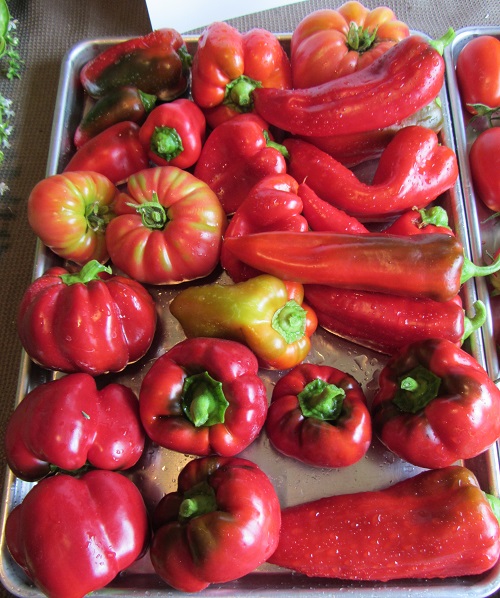
3.4 pounds this week (only counting the EarthBoxes). We harvested the first batch of radishes, and the tomato plants offered up this:

150924 harvest

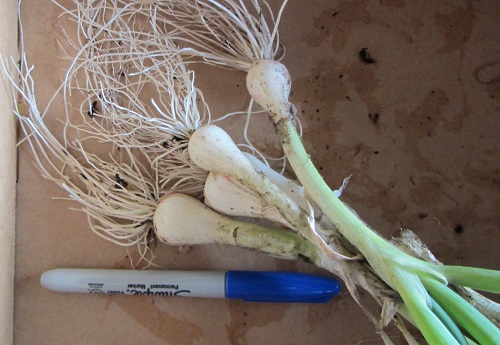
I removed the last of the annual flowers from the whiskey barrels. We’d interplanted scallions/bunch onions with the flowers, and a few of the largest scallions came inside.

150926 harvest


The smaller scallions were replanted for harvest in the spring.

We’re still seeing days in the low-mid 60’s, and the tomatoes are *still* slowly ripening. I’m guessing we’ll harvest the rest of the tomatoes this week. Here’s a view from a 2nd-story window:

150727 overview

Today the whiskey barrels and empty EarthBoxes received the ~100 Guardsman scallion starts that had been growing next to the salad table in the front yard. We also planted seeds of Mache (a.k.a. vit/corn salad), Giants of Colmar carrots, Conservor shallots, Red Baron bunch onion/scallion, Five Color Silverbeet chard, and Dragon Hybrid radishes. In theory we should be able to harvest most of that through the winter.

—————

2013 total weight to date:  185.6 pounds

2014 total weight to date:  246.2 pounds

2015 total weight to date:  272.7 pounds

As a flat guess there are another 10-15 pounds of tomatoes in the EarthBoxes yet to be harvested.

———-

Visit Daphne’s Dandelions, host of Harvest Monday.