Overwintered

by A.J. Coltrane

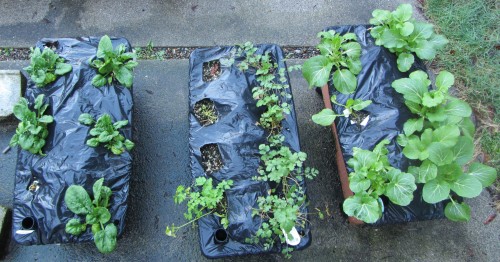
I had tried planting some winter-hardy vegetables in late November as an experiment. Here’s a pic from right before Christmas:

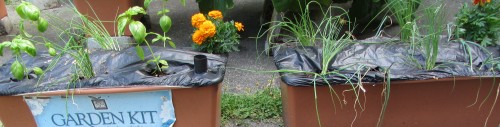
New growth in December. [L-R - Pac Choi, Parsley, Cilantro, Spinanch]. The new leaves look happier than the leaves that were on the plants at the time of transplanting.
New growth in December. [L-R – Pac Choi, Parsley, Cilantro, Spinanch]. The new leaves look happier than the leaves that were on the plants at the time of transplanting.
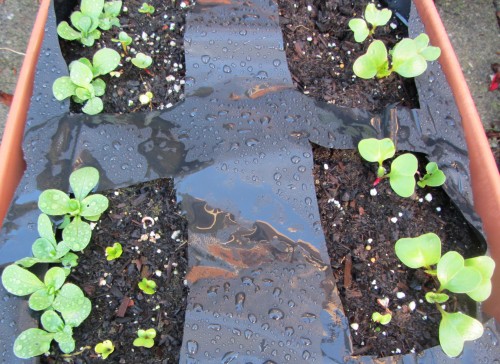
And March 17:


(L-R) Spinach, Parsley, Cilantro, Pak Choi

I think to some degree the Pak Choi smothered the Parsley in the crowded confines of the mini green house. (The three mostly empty cells.) Also, Thanksgiving was too late to start — September would have been better. Next year we’ll probably try hoop houses and cold frames for plant protection  — the mini green house worked just “ok”. Overall it was too cramped and too wet inside. The Pak Choi was attacked by slugs all winter. The Spinach received some slug abuse too, though to a much lesser degree.  Still, the overwintered veg are *way* ahead of the Mache and Radishes in the front yard:

140317 mache and radish

On the far left is Mache, planted January 5. On the right are Cherry Belle Radishes, planted February 10. The tiny plants in the middle are French Breakfast Radishes (March 7.)

Next winter we’ll try to focus on stuff that the slugs don’t love to eat.

The Lighting Rig

by A.J. Coltrane

Approximate dimensions are 26″ long by 22″ high:

140302 lighting

The photo was taken with the window closed and the lights off — otherwise it would have been a big glare of light. The frame is probably a little taller than it needs to be, but that’s a simple fix if desired. The red power switches on the sides are easy to access, and the clamps make it super painless to slide the lamps up and down independently.

It’s two of this clamp lamp, which were ~$12 each at Home Depot.

and

A 1/2 pack of a 4 bulb “daylight” (5k) package. The four-pack was about $9.

So maybe $30 in total. Looking around the internet at T5 packages, there seemed to be a lot of “proprietary bulbs” and “cheap construction”, such as this. Most were in the $50+ range.

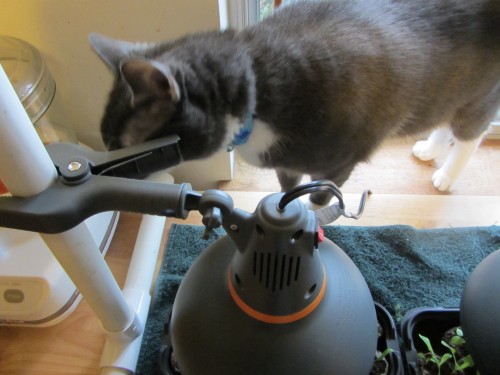
Anyhow, I’m pretty happy with it. The price was right, and it’s very well built. Gratuitous boy cat pic/closeup of the lighting rig:

140302 closeup


More Containers

by A.J. Coltrane

It seems to me that while the EarthBoxes are great for most of the plants that we want to grow, they’re less than ideal for tasks like succession planting herbs, lettuces, and anything else that might normally be “broadcast”.

So we picked up four resin whiskey barrels at a big box store last week. Last night, peas that had been started indoors got their first full evening outside. After “sunset” the wind blew and it rained like crazy. I figured I’d go outside this morning and see pea plants that had been mashed flat by the elements.

Yesterday late-morning it was sunny and mild:

Ultimato stakes with garden twine.

And after a hard night…

*drumroll*

As it turns out, there’s no reason for an “after” picture. The peas look the same, only wet.

The Super Sugar Snap Peas are listed as having a 58 day maturity. But:  “Days to maturity are calculated from the date of direct seeding. Note: In areas with mild winters such as the maritime Northwest, where peas can be planted in February, add 35-40 days.”

Given that we started them indoors on February 5th — I’m guessing April sometime? (I was thinking very early April, now I’m not so sure.)

In retrospect, the EarthBoxes would have worked well for peas. I think next attempt at peas will need to use the EarthBoxes in order to save the big containers for lettuces/ spinach/ mache/ etc.

Whatever, I was just pleased we had something left this morning..

Onions Are Durable

by A.J. Coltrane

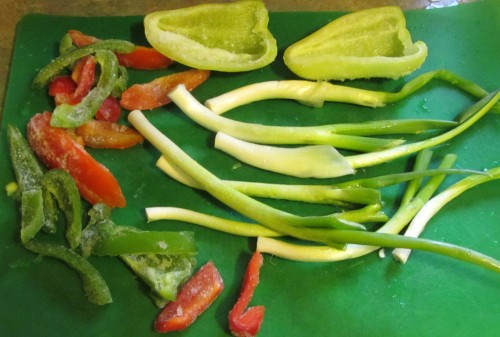
Stir fry ingredients ready to go. Bunch onions from the backyard and King of the North peppers from the freezer:

140210 veg

That’s about 1/4 pound of cleaned onions.

Here are the same bunch onions in July. Tiny!

070713 new plants

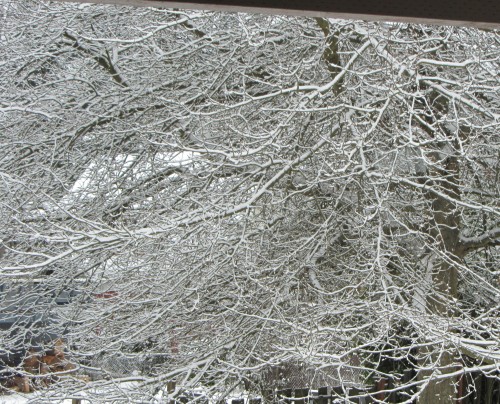
What’s remarkable is that yesterday the neighborhood looked like this:

Cold oak.
Cold oak.

There’s still snow on the ground today. I’d never have guessed it was possible to harvest during snow season, but there it is.

In retrospect, the onions could use more elbow room this fall. I took the “bunch” in “bunch onions” too literally. I’m guessing the right answer is to wait until the basil is done for the year and spread out the onion through the entire box.

The Victorian Kitchen Garden

by A.J. Coltrane

Digging around the internet, I came across The Victorian Kitchen Garden. It’s a 13-episode series that aired on BBC2 in 1987.

From wikipedia:

It recreated a kitchen garden of the Victorian era at Chilton Foliat in Wiltshire, although at the time the series was made Chilton Foliat was in the county of Berkshire. The presenter was the horticultural lecturer, Peter Thoday, the master gardener was Harry Dodson and the director was Keith Sheather…

…The series began in the largely derelict walled garden at Chilton on a freezing January morning and followed Harry and his assistant Alison as they recreated the working kitchen garden.

I’ve watched the first two episodes. I’ve found a few things interesting about the show:

1.  It’s four-season gardening at the 56th parallel. They’re way north of us *and* well inland, and yet they’re still able to have a productive space without electricity. I’ve already gotten ideas from the little bit that I’ve watched.

2.  Harry Dodson was an old man at the time, and he was familiar with gardening techniques that went back to the 19th century.

3.  The show doubles as a look at Victorian era life.


Seed Germination Temperatures and Times. Days to Maturity. And Plant Minimum Temperatures. NW Edition.

by A.J. Coltrane

A couple of spreadsheets with seed germination times and temperatures, days to maturity, and the minimum temperature that the adult plants will tolerate.

The spreadsheets only contain the plants that:

1.  Do well in the Pacific Northwest. That’s where we are.

2.  Do well in containers. That’s how we’re gardening.

and

3.  Represent plants we’ll potentially eat.

I’ll likely add more plants at a later date, either because I overlooked the plant on the first pass, or because somebody else asks for the info. As it was, I made more manageable spreadsheets (and saved work) by not including most of the root vegetables, as well as the veggies that we’re unlikely to consume.

Much of the information is from the Territorial Seed website. The balance was drawn from various online, reasonably reputable sources (other seed houses, edu sites, etc.)

The first spreadsheet is sorted alphabetically:

Continue reading “Seed Germination Temperatures and Times. Days to Maturity. And Plant Minimum Temperatures. NW Edition.”

An Inexpensive EarthBox Hoop House

by A.J. Coltrane

SeattleAuthor brought over Mâche seeds the other day, so it seemed like a good time to make a hoop house to keep the rain off of the seedlings. The hoop house was intended for the front yard, so it had to look decent. I was also targeting the minimum cost that would still allow for a “sound” end result. The finished cost was about $4.

140714 hoop house

Bill of Materials

~8 feet of 1/2″ pvc (black, flexible). Cut into two 4′ pieces. (Of a 100′ roll @ $16. An 8′ length should be comparable in price.)

5′ x 5′  of 4 mil clear plastic sheeting (Of a larger roll. It won’t last forever anyway.)

4 pvc clamps (sold as a bag of 5 for ~$1.60, similar to these)

7/16″ dowel x 4′, cut into 2 @ 10″ and 2 @ 14″. (The EarthBox is shallower on the watering tube side.)

2 clothespins

Assembly

1.  Cut the dowel into four pieces. Cut two ~4′ sections of pvc pipe.

2.  Insert the dowels into each corner of the EarthBox. Slide the pvc lengths over the dowels.

3.  Cover with the plastic sheet and clamp. Pin the extra plastic on the ends with a clothespin. The clothespins can also be used to hold the plastic doors on the ends open.

Done!

—–

The postmortem and assorted thoughts:

I think that there must be a better answer for the clamps, though I didn’t want to spend ~$1 each for good spring clamps. I want something that can easily be moved around, so something like spring clamps would be desirable. Still working on the right answer.

The cost could have been lower — My first thought was to build a wooden frame and attach the pvc to it using clamps. That’s the “normal” way to do it. But then I thought, hey, I can just push the pvc into the soil in each corner of the EarthBox. *Then* I did some looking around online — it appears that toxins from the pvc could potentially (likely?) release into the soil. How to deal with that?

I chose to do something similar to the buried rebar — I purchased some 3/8″ dowels, cut them to 1′ length, and buried the dowels in the corners of the box. I then slid the pvc over the dowels, leaving the pvc above the soil. In retrospect that was a no-brainer, but I was so fixated on the wooden frame/external support idea that it never occurred to me use the area within the EarthBox to anchor the pvc tubing.

I think it’s interesting that if you were to stick wagon wheels on the sides of the hoop house would look a lot like a covered wagon.
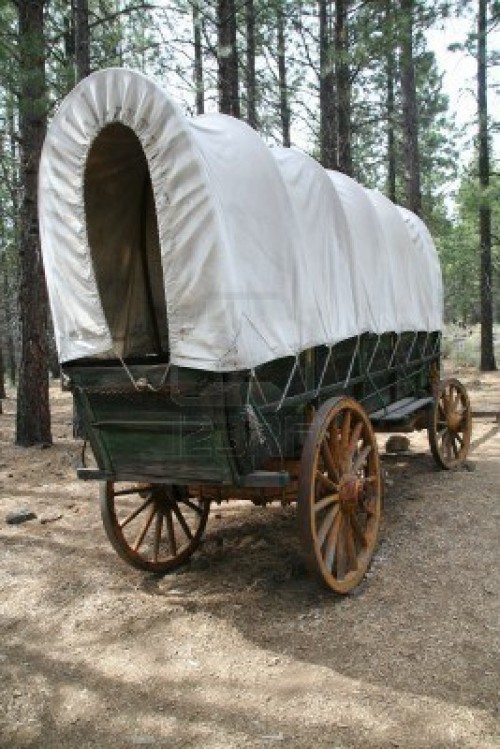
covered wagon

That may mean that it was the right way to do it — form follows function, and both the EarthBox and covered wagon have a similar functions.

Or it’s just a coincidence.

———–

I learned something new. The french “a” thingy is alt and numpad 0226.

Lemongrass Doesn’t Work Well In An EarthBox

A.J. Coltrane

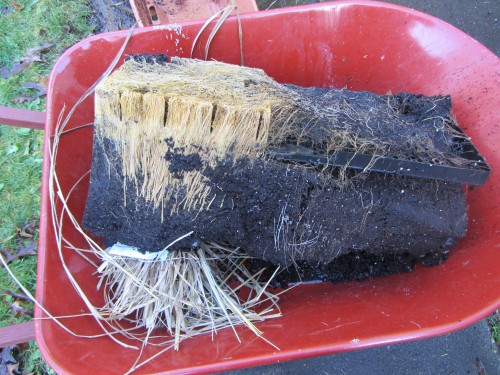
Yesterday was “Ready The EarthBoxes For Planting Day”. The EarthBox holding the lemongrass needed to be dumped upside down into a wheelbarrow because the roots had grown down through the base aeration screen and into the reservoir. The plant had to be cut off of the screen to get it out of the box:

Upside down in the wheelbarrow.

If you look closely, the roots have perfectly formed to the molded shapes on the bottom of the container. The circle (bottom right) is the fill tube, which was almost completely blocked. That explains why it *seemed* to be blocked in late summer:

140104 lemongrass closeup

Lemongrass isn’t supposed to winter over, but I think that it might have lived, at least so far. It’s been transplanted into a planter box along the back fence.

The lesson:  Super invasive root systems won’t work well in the EarthBox, or more accurately —  the lemongrass went gangbusters, but the box isn’t designed for *that*.

Recommended Book — Food Grown Right, In Your Backyard

by A.J. Coltrane

Food-Grown-Right-CoverMy ideal gardening book would have a title similar to:  Four-Season Urban Container Gardening In The Pacific Northwest, Seattle Edition.

That book doesn’t seem to exist, and for good reason. It’d sell about four copies. Digging around the internet gives a hodge-podge of information, but nothing concise and organized.

I was looking through the book options at the local nursery and came across Food Grown Right, In Your Backyard. It’s written by the co-founders of the Seattle Urban Farm Company, published in 2012. The book has an emphasis on small-scale organic urban gardening. It includes sections on designing the garden space, general gardening knowledge, detailed profiles of popular vegetables and herbs, and (my favorite) tables indicating the appropriate schedule for starting seeds indoors, transplanting, or direct seeding outside. (I loves me some tables and charts, y’know.)  It doesn’t talk much about winter gardening, but other than that it’s an excellent all-around resource.

Amazon link here. To date it has received 5 stars out of 5 stars for all 35 Amazon customer reviews.

In a related note, I think I’ll be checking this out in 2014 — Bastille Cafe & Bar has a 4,500 square foot rooftop garden installed and maintained by one of the authors. Bastille offers tours on Mondays, April through September. The cost is $10, which includes a cocktail.

Now if I just need to figure out the best way to succession-plant an EarthBox.. I’ve got some ideas, but searching “succession planting” on the EB forums doesn’t turn up much. Time for a new thread..

The Plant House, One Month Later

by A.J. Coltrane

Previous post here.

It’s been in the 20’s basically every other night over the last ten days or so. Yesterday we had snow. Life goes on in the plant house:

New growth in December. [L-R - Pac Choi, Parsley, Cilantro, Spinanch]. The new leaves look happier than the leaves that were on the plants at the time of transplanting.
New growth in December. [L-R – Pac Choi, Parsley, Cilantro, Spinanch]. The new leaves look happier than the leaves that were on the plants at the time of transplanting.
For comparison, November 2:

(L-R) Pak Choi, Parsley, Cilantro, Spinach

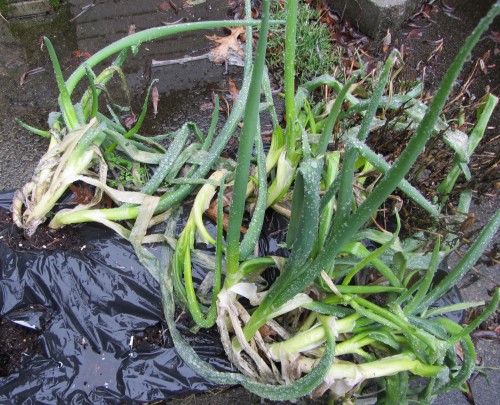
The bunch onions didn’t seem to mind the snow too much:

122113 bunch onions

A few thoughts about the plant house:

1.  Mid-late October is too late to move the cool weather plants into the plant house. Closer to the truth would have be sometime in August, or starting the plants from seeds even earlier. I’m still in the process of figuring out what the “correct” dates will need to be, accounting for the fact that it’s cooler here than in Seattle, though we’re still very near Puget Sound.

2.  During the winter months there’s not enough sun to drive the current plant house location. Tucked up against the west side of the Real House, the plant house *might* get about a 1.5 hours of sunlight on a good day. It’s situated in a location that’s among the hottest during June and July. I’ve been surpised at just how far down the horizon the sun rotates during the winter. A permanent greenhouse installation would likely either need to go in the front yard, or the center of the back yard, or somewhere nearer the south end of the west side of the Real House.

In a related aside, I’m now seeing why ancient peoples would build structures to accurately track the stars, and by extension the seasons and the position of the sun. If your life actually depended upon forecasting the upcoming weather you’d do everything you could to try to be accurate about it. As for me, thank you NOAA weather service.

3.  The 4′ x 4′ dimension of the plant house is small enough that the pac choi are tending to lay up against the walls. It seems everything touching the walls is perpetually too wet and too cold and generally rotting away. Two EarthBoxes is probably closer to the correct amount in a 4′ x 4′ space.

4.  If the goal is winter greens, it might be that the right answer is some form of protected [raised bed/ whiskey barrel/ cold frame] in the front yard. It may be that the EarthBoxes could be adapted by removing the plastic cover… maybe.

I think a four-season harvest is possible, it’s just a matter of figuring out the location, technique, and the appropriate greens.