Pizza Shaping

by A.J. Coltrane

I think the weakest part of my pizza-making process is the last part — shaping the final dough. Here’s the last one:

141213 pizza

It’s a 62% hydration bread flour dough with peppers from the garden, onions, goat cheese, and a jarred marinara. (300g bread flour. 62% water, 4% oil, 2.3% salt. Baked on a perforated pizza pan.)

In this case I floured the counter and patted/stretched out the dough, never lifting it from the surface. The crust came out crisp and crusty. The cornicione (edge) was only slightly poofier than the rest of the crust.

My suspicion is that after patting the dough out on the counter it might benefit from being picked up and stretched.

Which is a good excuse to make another pizza.

Container Garden Update — December 13, 2014

by A.J. Coltrane

We had set up the EarthBoxes with winter greens under the deck.

Unfortunately, the planting happened really late in the year, then we were blasted by 20 degree temperatures at night.

Stuff was recovering somewhat, but it’s all basically stalled. As it turns out, that location seems to receive too little sunlight. The back of the house faces vaguely northwest, when combined with the lower angle of the sun and shortened days there’s not enough sunlight for the plants to do better than break-even at best.

The front of the house faces a little bit to the southeast. The morning sun means that the containers in the front are doing this:

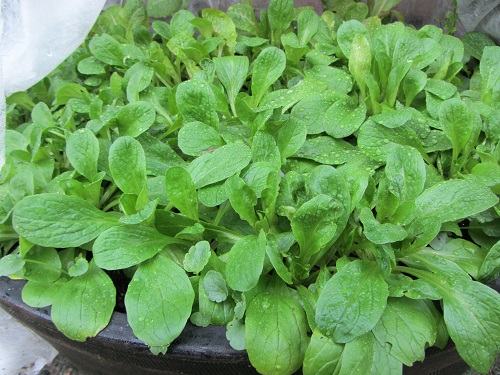
141213 mache

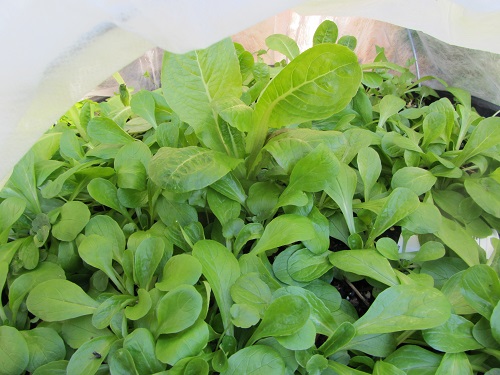
That’s mostly Mache, with some iffy-looking Romaine in the middle and small Cilantro plants in the back.

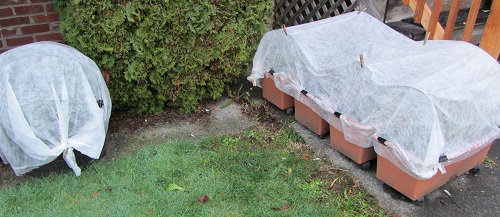
They’re doing tons better, so we moved the four best (most salvageable) EarthBoxes to the front yard for more sun goodness:

141213 containers

The remaining boxes under the deck have been rolled out to a more open location on the back patio. We’ll see how it all shakes out. Right now I’m thinking that the struggling boxes in the back yard will get interplanted with fast-growing cool-weather greens and vegetables in late February or early March. We’ll let the front-yard boxes go until it’s tomato season again.

I don’t think it could have gone a whole lot worse during our first real season of winter gardening, but we’re still getting something. Hopefully it’s up, up, and away from here.

The plant mix definitely needs some work. More on that later.

No Knead Bread — AP vs Bread Flour

by A.J. Coltrane

Last week I had an excuse to make two loaves of No Knead Bread at the same time. I thought it would be interesting to try one loaf using all AP flour, and one loaf using all Bread flour. Furthermore, I’d bake the AP loaf in a smallish dutch oven (4-1/2 quarts), and the Bread loaf in a somewhat oversized dutch oven (7 quarts). In theory the Bread flour loaf would have a stronger gluten network, have more room to expand, and end up as the bigger loaf while possessing a more open crumb.

That’s not what happened. But I did learn a couple of things along the way.

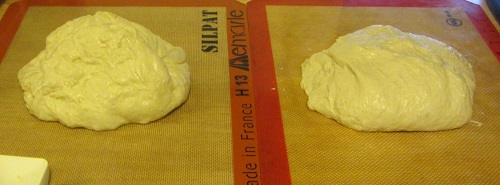
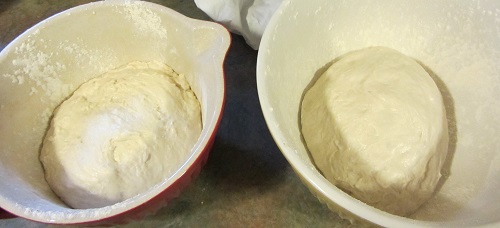
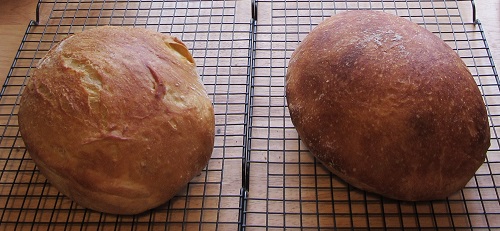
The AP flour is on the left in each photo.

Here they are after an overnight rise, the stretch and fold, and the 15 minutes of rest before they’re to go into the bowls for the final rise. Note how much shaggier the left-hand (AP) loaf looks:

AP Bread Flour 141128

I’ve read that bread flour absorbs more water than AP flour. In this case it meant that the AP dough was stickier and that handling it meant more tearing and abuse. Ultimately it led to the shaggier appearance on the left.

I think it’s pretty neat seeing the difference in absorption illustrated like that — it had always been a somewhat abstract concept to me, but there it is in practice.

That shagginess stuck around after the two-hour rise in the bowls. It looks like the Bread flour dough just wants to be more organized — it’s almost like the increased gluten in Bread flour means that it’s naturally more structured:

AP Bread Flour2 141128

The bowls were then inverted into preheated dutch ovens. I was surprised by the end result:
AP Bread Flour3 141128

The Bread flour loaf wound up much darker. That’s because it spent the uncovered part of the baking time in the hotter part of the oven. In the future I’ll want to rotate the loaves half-way through the uncovered portion of the process (instead of right after removing the lids.)

The finished loaves wound up more or less the same size. The irregularties in the AP dough manifested themselves in the final bread, allowing the loaf to expand in the oven. The Bread flour loaf was *too* regular — the crust never split on its own. In retrospect, it should have been slashed. I thought about it, but didn’t because I wanted a completely equal trial.

I’d gone to a fair amount of care to have two distinct end products. It didn’t work out that way at all, but that’s ok because I learned more in one shot than I’ve learned in a while.

[Recipe link. Or just click on the No Knead tab at the top of this page.]


GNOIF: What We’re Playing

by A.J. Coltrane

We’ve now hosted 15 GNOIFs. We rotate “themes” with the idea that we’ll rotate through the game closet and offer a different mix at every event.

What’s been offered to play (3 or more times offered):

Game Total Offered
Fluxx, Any 12
Mr. Jack, Pocket 9
Ticket to Ride Europe 8
Dominion 7
Mystery of the Abbey 7
Agricola 6
Bang! 6
Forbidden Island 6
Gardens of Alhambra 6
Catan, Settlers 5
Citadels 5
Gloom 5
Guillotine 5
Last Night on Earth 5
Lost Cities 5
Mr. Jack NY 5
Rocketville 5
Small World 5
Ticket to Ride Card Game 5
Betrayal House Hill 4
Cards Against Humanity 4
Dead Fellas 4
Poo 4
Black Rock City 3
Carcassonne 3
Catan, Starship 3
Dracula 3
Family Business 3
Magic The Gathering 3
Munchkin, Zombies 3

Now the more interesting bit.. What’s been played most often (3 or more times offered):

Continue reading “GNOIF: What We’re Playing”

GNOIF: The Nina, the Pinta, and the GNOIF

by A.J. Coltrane

GNOIF # 15 recap — The Nina, The Pinta, and the GNOIF (Colonization/Exploration themes.)

Games That Got Played — Amerigo, Bang!, Citadels, Dominion, Forbidden Island, Pirates Cove, Fluxx (Pirate), SmallWorld, Ticket to Ride Card Game, Ticket to Ride Europe

Games That Didn’t Get Played — Carcassonne, Power Grid, Lost Cities

Another early crowd and we got into a lot of games again. At this point most of the crowd has played Bang!, Fluxx, and Dominion — those games can suck up quite a few players and still be breezy and relatively fast. The other games all had significant first-time learning curves and wound up being somewhat more time intensive as a result. Overall the evening saw a good balance of Light and Serious games.

And here I’d intended to get in my fix of Power Grid…

Two Microclimates Part 2 — The Unhappy Campers A Little While Later

by A.J. Coltrane

[Eleven days ago it got really cold.]

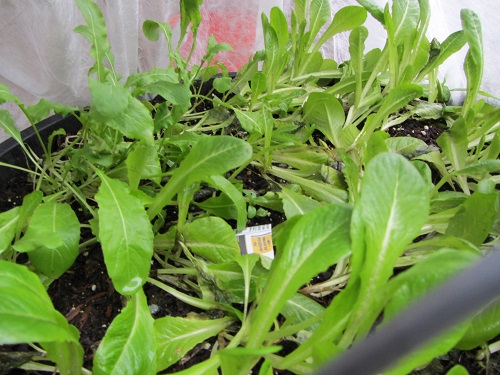
The Romaine then:

141116 romaine3

The Romaine today:

141128 Romaine

It’s not all the way back, but it’s looking way perkier. I removed a few dead or rotted leaves, but not many. The picture is a good representation of what pulled through.

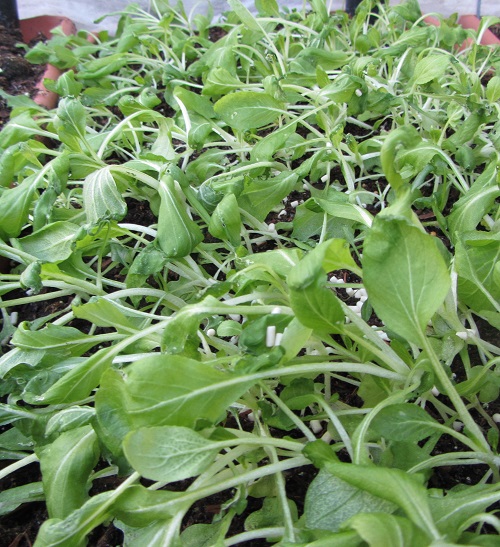
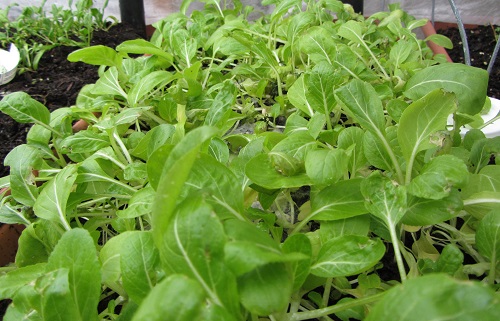
The Pak Choi then:

141116 pak choi

The Pak Choi today:

141128 Pak Choi

Some of the leaves are still a little “fried” looking. Overall the Pak Choi is somewhat more cold tolerant, and it shows.

I’ve been trying to determine the appropriate planting dates for winter veg. As of right now my best guess is:

October 14 – ((Average Germination Days) + (Days To Maturity))

In other words, everything should be done growing on October 14. That might be a week or two earlier than necessary, unfortunately it can’t be tested until next year. If we start with the assumption (this post) of an average of 10 Days To Germination and 50 Days To Maturity, it gives an August 14 planting date for the winter vegetables.

Which means direct seeding everything may be out of the question, since the summer vegetables are still going strong at that date.

I see seedling flats in my future.

Recommended Game — Power Grid

by A.J. Coltrane

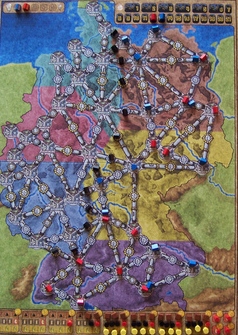
Title:  Power Gridpowergrid map

Game Type:  Auction/Territorial Expansion.

Number of Players:   2-6

Complexity of Rules:  Medium

Time to Play:   120 minutes

The Concept:   Players bid on power plants, with more efficient plants becoming available over time. The object is to be the player that can power the most cities at the end of the game. In order to win it’s necessary to balance resource acquisition against city building and the spending on power plants.

Why I Like It:  The bidding/forecasting element of the game can be intense. The action is relatively deterministic — there aren’t any dice rolls to screw you over if you’re planned well. The only randomness comes from the order that the power plants become available for auction. The game is rated #10 on boardgamegeek, which is no surprise since those voters tend to like games where they can control the outcome.

It’s not a super new game (2004), and it sat in our closet for a year before we got around to playing it, but now it’s one of my favorites, and it’s going to be a fixture at many GNOIFs to come.

The Best Zucchini Bread

by A.J. Coltrane

A recipe we got from a former co-worker of mine. It came with the title: The Best Zucchini Bread. I’ve never had better, so I’m fine with calling it that.

The software:

Bread Ingredient Measure
AP Flour 3 cup
Eggs 3
Canola/Vegetable Oil 1 cup
Brown Sugar 2 cup
Zucchini (grated) 3 cup
Chopped Nuts (optional) ½ cup
Salt 1 tsp
Baking Soda 1 tsp
Baking Powder ½ tsp
Cinnamon 3 tsp
Nutmeg ½ tsp
Vanilla 3 tsp
Topping Ingredient Measure
AP Flour 1/3 cup
Sugar 2 TBP
Brown Sugar 2 TBP
Cinnamon ½ tsp
Butter (softened) ¼ cup

The Steps:

1.  Preheat oven to 325F.

2.  Butter and flour two loaf pans.

3.  Mix the bread ingredients. Divide into the pans.

4.  Using your fingers, combine the topping ingredients. Sprinkle on the batter. Try to cover as much of the surface as possible.

5.  Bake 1 hour. The bread is done when a toothpick comes out clean.

zucchini bread

The First Pass At Crispy Breadsticks

by A.J. Coltrane

Crispy Breadsticks:

Ingredient Measure Baker’s %
Bread Flour 300g
Water 180g 60
Salt 7g 2.3
Instant Yeast ¼ tsp
Olive Oil 12g 4

1.  Mix all ingredients at low speed for 10 minutes.

2.  Let rise overnight.  (This was intended for an overnight rise on the kitchen counter. It rose too quickly for that, so after 6 hours it got a light workout and went into the refrigerator to hang out until after work the next day.)

3.  Roll out the dough into a loose square about 1/4″ thick.

4.  Cut long thin strips with a pizza cutter or dough scraper. Twist the strips and place on a Silpat lined sheet tray.

5.  Bake 1 hour at 300F, turning halfway through.

6.  I sprinkled these with parmesan after they came out of the oven. It wasn’t sticking well, so I put the sheet tray back into the oven for 3-5 minutes, which sort of helped.

7.  Cool on a wire rack.

Notes:

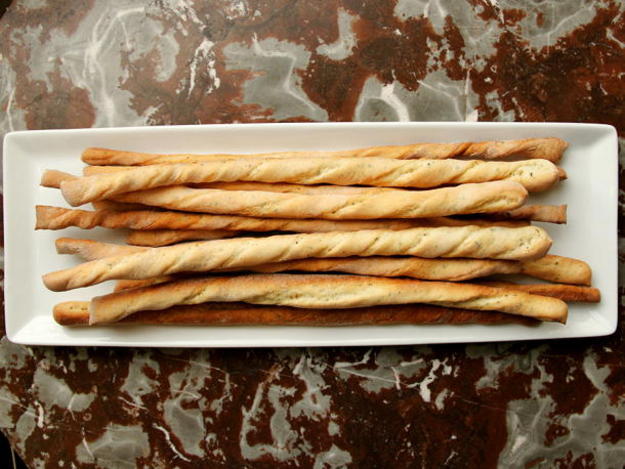
This recipe is an aggregate of a few online recipes, combined with the overnight rise idea for better flavor. (This one was one of the big jumping off points, pictured below.)

141120 breadstick

The result wasn’t as brown as the picture, but the taste and texture were good. I’d guess the fact that I baked two sheet trays at the same time contributed to the light color. Also, they could have been 20% crunchier to be closer to what I’d visualized — both issues possibly sharing the same root cause.

All in all though, a good start, a tasty result, and a very easy recipe.

Two Microclimates

by A.J. Coltrane

The nighttime temperatures dropped down to around 20F this week. There was no gradual decrease from warm, either. The evening temperatures went 40, 40, 40, 40, 20, 20, 20. There’s a marked difference in how the front yard plants have been handling the cold as compared to the back yard plants-

The front yard gets morning sun when it’s clear outside. It may also help that the sun reflects off of the house and onto the containers:

141116 romaine

The containers in the backyard get comparatively little sun. This romaine is still frosty around noon:

141116 romaine3

Front yard again:

141116 romaine2

Back yard (Pak Choi):

141116 pak choi


The back yard stuff is looking vaguely perkier today than it did at the time of these pictures, but still.. Next year (or even later this week) the back yard containers may need to be moved to a sunnier spot. If that means they get rained on, then that’s the way it’s going to need to go. “Zero” sun isn’t cutting it.

I came across this blog recently. OurHappyAcres. Written by a retired IT guy doing four-season organic gardening in southwestern Indiana — Zone 6b. The blog features lots of pictures, and he documents many different “tests”. In addition to the usual suspects he grows a lot of asian greens that I’m not super familiar with. I like his relatively methodical approach to gardening. That, and if something works for him then it should work in the maritime northwest.