The Winter Garden In April

by A.J. Coltrane

The backyard garden hasn’t yet fully transitioned to “summer”. Maybe next week. The whiskey barrels have some energetic flower starts — Territorial Seed’s Bee Mix, Bug Mix, and Nasturtiums (Jewel Mix).

As of March 2nd, these containers only had gravel in the bottom. They’re in the coldest, shadiest part of the yard that will eventually see good sun as the season progresses:
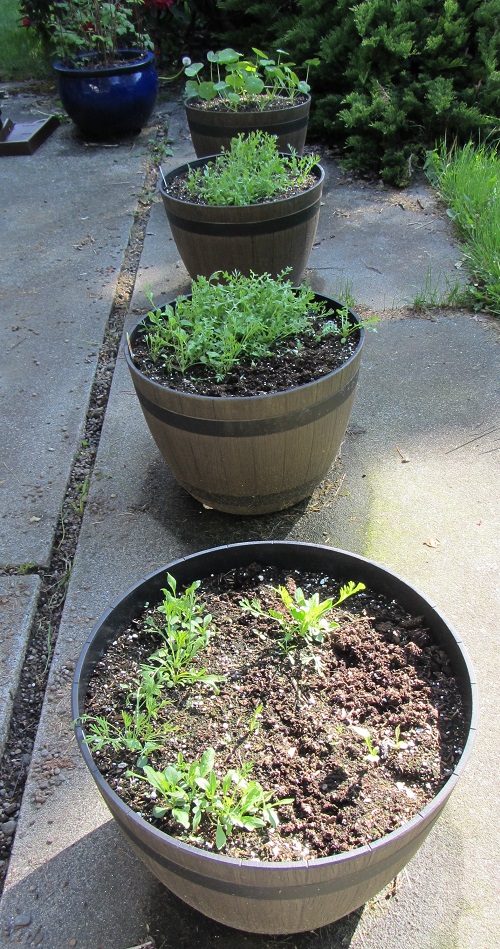
160425 whiskey barrel

(Front to back — a container of Bee Mix, a container of Bug Mix, a container of 1/2 Bee Mix and 1/2 Bug Mix, a container of Nasturtiums. We’re now planted Marigolds – “Brocade Mix” in the spots that haven’t germinated.)

Next, a close-up picture of the Nasturtiums. We planted about nine seeds. Seven of those germinated. It looks like seven plants is going to be plenty:

160425 nasturtium

The raspberry plant (with a blooming rhododendron behind it):

160425 raspberry

The raspberry plant needs some pruning. I’m holding off until I’m dead certain nothing is going to grow out of the older stems.

As far as everything else:  The mache and chard bolted at the first sign of warm weather. I’m hoping we can harvest mache seed at some point — they’re blooming now. The carrots continue to size up, and it looks like we should be able to harvest those in the next 30 days.

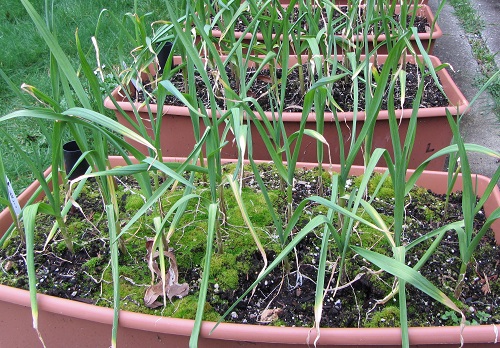
The garlic will need to be harvested in the next 30 days to make room for the summer vegetables as well:
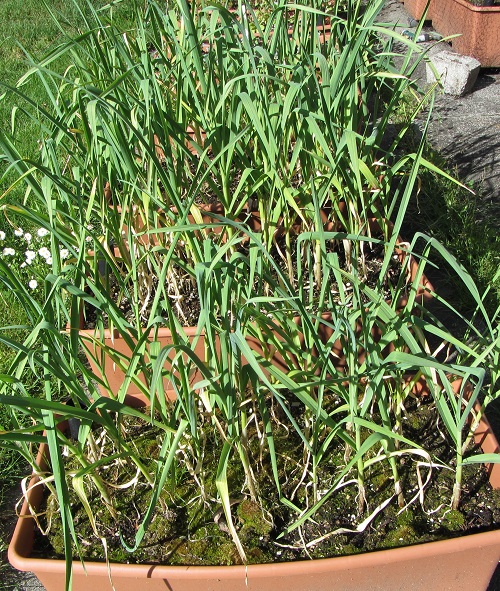
160425 garlic


The actual work on the backyard garden starts soon.

Container Garden Update — April 17, 2016

by A.J. Coltrane

This weekend it was time to harvest the rest of the bunch onions that were planted last fall. It turned out to be just over four pounds:

160417 bunch onion

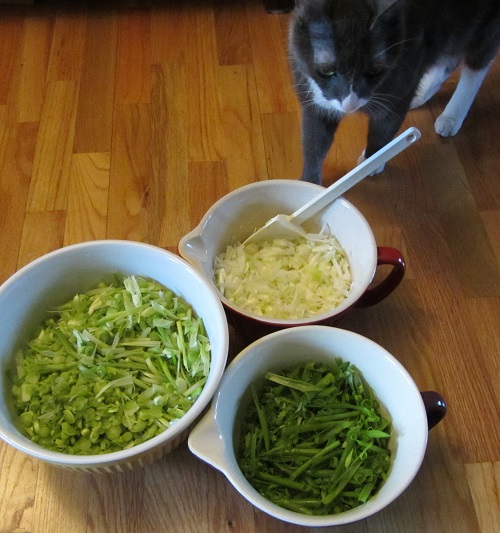
We separated the onions into whites, stems, and greens and ran them through the slicing disk of the food processor. It wasn’t perfect, but it was a huge time savings. The boy cat had to check it out:

160417 processed bunch onion

I think the processor actually did a better job than the photo implies. The bigger pieces mostly wound up on top.

All in all, it turned into about fifty bags at one-half cup per bag.

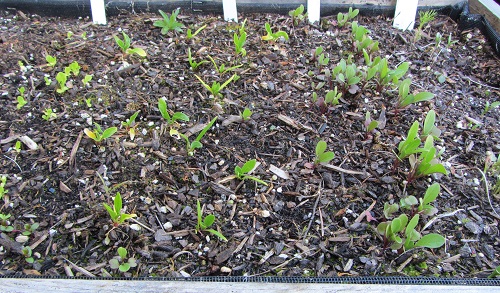
The salad table is finally moving forward. Direct seeding is slow in the spring. It seems the better idea would be to start the seedlings inside and transplant. The “tall” stuff towards the right side is arugula:

160417 salad table

The peas were planted on February 8. They’ve now getting grabby with the netting:

160417 peas

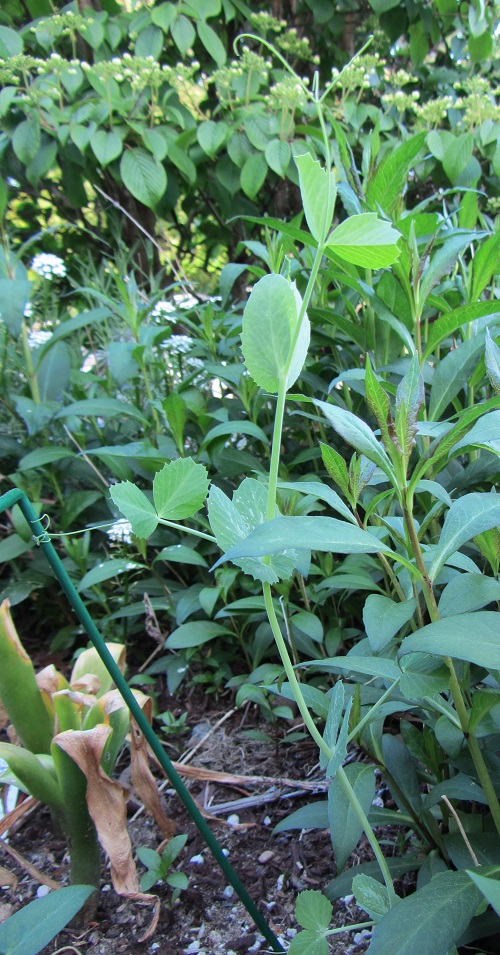
Sometime in February a critter came through and dug in the pots. Look what has popped up on the other side of the walkway:

160417 rogue pea

Can’t stop ’em.


Peter Reinhart’s Challah

by A.J. Coltrane

Easter called for another Challah, this time I tried Peter Reinhart’s, from his book Artisan Breads Every Day. (Last year was his “Double Celebration Challah“. For comparison, here is my 2nd attempt at Rose Levy Beranbaum’s Brioche, a recipe which I found to be a pain to parse.)

This year’s Challah was fairly simple and easy — combine all ingredients, knead, cover, then put it in the refrigerator overnight (or up to three days). The dough is then shaped into braids, braided, covered with egg wash, allowed to rise, covered with egg wash (again) and sesame seeds, allowed to rise (again), then baked:

160329 challah

The recipe is here, on Michael Ruhlman’s website. Note that I halved all of the ingredients — I didn’t need to make two loaves. I don’t know why Reinhart often writes recipes for two (or four, or eleventytwelve) doughs. Though at least this time he used grams, so I didn’t have to mess with figuring out what a one-third portion of 7-1/4 cups of flour computes to.

I like this recipe better than either of the other two that I referenced at the start of this post. The Double Celebration Challah calls for an indeterminate amount of water, 10.5 to 12 ounces — that’s a big range! The Beranbaum Brioche recipe is very poorly worded, and I feel like the recipe is broken into more steps than is necessary.

From a taste standpoint, this Challah was better 2015’s. It may be that including the optional vanilla extract made a difference, though no one mentioned that they detected it. I also think the salt level was very close to correct this time, in contrast to the 2015 bread which seemed to be lacking salt.

Other notes:

  1.  This Challah called for coating the dough with egg wash twice, at one hour intervals. The dough rests uncovered the entire time. It sounds really odd, but it worked.
  2.  Last year’s Challah split — almost exploded. I read somewhere that splitting tends to happen if the braiding is too tight, which definitely could have been the case.
  3.  When it came to the “knead on the counter until the dough is tacky but not sticky” — at least this time the dough was very wet and shaggy at the start of the kneading, and it took a fair amount of flour to get to “tacky”. Maybe it was just humid(?)

Overall it’s a low-hassle, nice tasting bread, and it’s attractive too. I can see making this again even if it isn’t a special occasion.


The Salad Table And Peas On March 9, 2016

by A.J. Coltrane

An update of the salad table and peas, one month later. It’s raining hard today.

Here are the peas, which were planted on February 8. Last weekend we put up the stakes and netting:

160309 peas

I may try running some twine from the pots to the netting to help the peas figure it out. The netting is to the south of the pots though, so hopefully the peas will just sort of lean that way.

The very small arugula:

160309 arugula

The front of the salad table (the peas and netting are about two feet to my left):

160309 salad table

That’s a big pile of miner’s lettuce. It’s proving to be a weed — I may need to put a board or something down widthwise across the table to keep it from completely taking over.

One nice thing about gardening in the winter and spring — no need to be worried about watering.


The Winter Garden In March

by A.J. Coltrane

The winter (backyard) garden… I’m going to call it a success. Not a smashing success though. There’s definitely a theme to what worked and what didn’t.

The garlic is doing well. It still has another couple of months to size up before it needs to make way for the summer vegetables:

160302 garlic

Mache (left) and Dragon Radishes (right). Bunch Onions were interplanted in most of the containers because slugs are supposed to dislike alliums:

160302 mache radish

Mache again. It grew bigger with less competition:

160302 mache

The carrots are still small (and they may be too crowded):

160302 carrot

The last four EarthBoxes to be planted. An assortment of Mache, Chard, Arugula, and Spinach. Squirrels were digging in them so bird netting was draped over everything… I see Mache and a little Chard:

160302 assorted


I think if I’m really going to “winter garden” I need to start seeds no later than sometime in August. (Which is the same thing I said in the November post.) As it is, the backyard gets zero sun all winter. Not much growth happened until the last couple of weeks.

In summary:  The Mache did well. All of the alliums did well. The carrots and radishes did ok. Maybe other stuff with do better with a bigger head start..

The newly acquired “whiskey barrels” are pictured below. Purchased at a big box store, they were somewhat smaller than our existing barrels. I’ve gotten as far as drilling drainage holes and filling the bottom with gravel. They will house “Bee & Beneficial Bug” flowers this summer. And Nasturtiums:

160302 new barrels

————————————–

For reference, here’s the backyard on November 8.


Too Many Seeds, Probably

by A.J. Coltrane

As usual, I may have gotten a little too enthusiastic about shopping for seeds. The new batch from Territorial Seed:

Basil-Sweet 2016
Bee Feed Flower Mix 2016
Bright Lights Swiss Chard 2016
Conservor Shallots 2016
Coriander-Confetti 2016
Dill-Dukat 2016
Flower Mix-Beneficial Bug 2016
French Breakfast Radish 2016
Garden Cress 2016
Giant Musselburgh Leek 2016
Giants Of Colmar Carrots 2016
Miners Lettuce 2016
Nasturtium-Jewel Mix 2016
New Zealand Spinach 2016
Red Baron Onion 2016
Roodnerf Brussels Sprouts 2016
Roquette Salad Arugula 2016

It’s a mix of things that have worked well in the past and some new things I’m eager to try out-

  1.  Basil plants seem to reach a point in age where the leaves just don’t taste as good. I’d like to try “succession planting” basil this year to see if we can harvest nothing but optimum leaves.
  2.  We purchased four more, somewhat smaller “whiskey barrels” over the weekend. This summer they’re going to house a combination of Bright Lights Chard, Bee Feed Flower Mix, Beneficial Bug Mix, Nasturtiums (which are edible as well as attractive), and a hodge-podge of whatever else might fit.
  3.  The Garden Cress, Arugula, Miner’s Lettuce, Confetti Coriander (cilantro, this variety is supposed to be slow to bolt), Dill-Dukat (ditto), and New Zealand Spinach (which likes hot weather) will go into the salad table with the existing Miner’s Lettuce. The Garden Cress and New Zealand Spinach are new. I have high hopes for the New Zealand Spinach in particular. We’ll see how the Garden Cress does, it may want more consistent water than will be provided.

Of course, we still have little bits of packages to use up. I have them rubber banded together in groups, this first group is “Salad Table” (the “year” is the year the seed was packed for.)

Dill–Dukat 2014
Coriander-Confetti 2014
Romaine Jericho 2014
Romaine Little Gem 2014
Romaine Winter Density 2014
Roquette Salad Arugula 2014
Spinach-Savoy 2014

And a “Spring 2016?” group of packages:

Radicchio 2014
Parsley 2014
French Breakfast Radish 2014
Cherry Bell Radish 2014
Flower-Brocade Mix 2014

“Fall 2015”:

Romaine Winter Density 2015
Super Sugar Snap Peas 2015
Roquette Salad Arugula 2015
Coriander – Santo 2015
Dill – Fernleaf 2015

Finally, “Winter Backyard 2015”:

Five Color Chard 2016
Mache 2015
Dragon Radish 2014
Mache 2014
Conservor Shallots 2015
Red Baron Onion 2015
Conservor Shallots 2014
Napa Hybrid Carrot 2014

The “Winter Backyard 2015” group is currently growing in the whiskey barrels and EarthBoxes, as well as around 50ish heads of garlic. The mild spring means that the growth rate of the overwintering survivors is really starting pick up.

The transition from winter things to summer things may be “interesting”.

Salad Table Update — February 8, 2016

by A.J. Coltrane

It feels like an early spring around here. The salad table will need to be planted soon:

160208 salad table

The top shelf has some scrawny romaine. There’s also some spindly spinach. The big masses of happy green stuff are Miner’s Lettuce. We like the taste and it appears to be indestructible. I’ll be interested to see if it tries to completely take over the salad table.

In the other containers, the mache and radishes are really starting to take off, after pouting all winter. The carrots still have a ways to go.

Finally… Peas!

160207 peas

Well, soon. Planted today.


The Belgian Beer Fest Breadsticks

by A.J. Coltrane

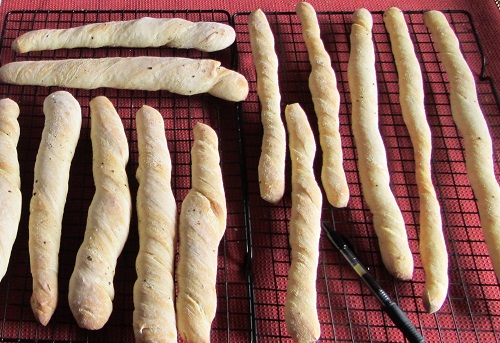
Breadsticks for the recent Belgian Beer Fest, somewhat overexposed:

160201 bread sticks

The Formula (I made 3 batches):  400 grams all-purpose flour, 240 grams cool water (60%), 10 grams kosher salt (2.5%), 8 grams olive oil (2%), 1/4 tsp instant yeast.

  1.  Mix on low speed 10 minutes. Transfer to an oil-coated bowl, lightly coat the dough with oil. Cover. Refrigerate 1-3 days. (I put these in the fridge on Thursday night and pulled them out of the refrigerator at 5 am for an 11 am departure time. I had some time left over, but that’s better than transporting them hot and steamy.)
  2.   Remove from the refrigerator and allow to warm up for 1.5 – 2 hours. (I then slept in until 7 am.)
  3.   Lightly oil the counter if needed to prevent sticking, then pat the dough out to a 12″ wide by 8″ tall rectangle. The dough will be close to 3/8″ thick.
  4.   Sprinkle your “enhancements” onto the rectangle. I used a little bit of all of:  Himalayan Pink Salt, Sea Salt, Cracked Black Pepper, and Semolina. Parmesan would work. So would sesame seeds. Or herbs. Tons of possibilities.
  5.   Use a pizza cutter to cut into 8 pieces, top to bottom, about 1-1/2″ wide. Each piece is now 1-1/2″ x 8″.   OR:
  6.   Use a pizza cutter to cut into 1″ wide pieces.  Each piece will be 1″ x 8″.
  7.   Twist each piece and place on a Silpat lined sheet tray. When I did mine the pieces “grew” another 3-4 inches, making them almost as long as the 13″ width of the sheet tray.
  8.   Cover with a towel and let rest 1 hour.

The thicker doughs were baked at 425F for 22 minutes.  The thinner doughs were baked at 450F for 17 minutes.

The breadsticks came out crispy on the outside and chewy on the inside. The twisting meant that all of the “enhancement” ingredients were mixed through the dough; it made the breadsticks more interesting and added crunch (semolina) to the interior. It also gave the breadsticks natural “breaking” points. I think I liked the skinny ones a little bit better, but that could have just been personal preference.

Overall it’s an easy, versatile recipe. Using the refrigerator for a slow rise means that the dough can be mixed up to 3 days ahead — the dough will wait. If the breadsticks are being served with dinner cut the salt back to ~2% — the 2.5% salt was intended to stand up to the bold flavors of the beer and help cleanse the palate.


Just Follow the Instructions

By Iron Chef Leftovers

So last night I cracked open a Maine Brewing Company “Another One” and a Nantahala Brewing (they are from North Carolina) “4 Food Drop” and then realized that there was humor in that there beer:

The beer told me to have another one, so I did. Now I have to get out the ladder. #dowhatthebeertellsmetodo


Get it? I thought it was funny.

What I Had In Mind Focaccia

by A.J. Coltrane

A two-hour focaccia:

150117 focaccia

I feel like this may have been the best “quick” focaccia yet.

The Tweaks:

  1.  3% olive oil in the dough. That’s lower than in oil than most of the focaccias I’ve made in the past. The crumb was lighter than in past attempts, and the bread got a lot more “lift”.
  2.  The dough was allowed to rest for 30 minutes before it was moved to the pan. I think this also improved the finished crumb structure.
  3.  A 450F oven. (Rather than 425F.)  The crust came out quite a bit browner and crisper as a result.

It made a terrific dinner with a bit of cheese and SeattleAuthor’s charcuterie:

150117 charcuterie

The formula:  400 grams Bread Flour, 280 grams room-temperature water (70% hydration), 12 grams olive oil (3%), 9 grams kosher salt (2.25%), 1 teaspoon instant yeast.

  1.  Combine ingredients in the mixer and mix on low speed for 10 minutes.
  2.  Lightly coat the dough and bowl with oil, cover, and let rest 30 minutes.
  3.  Line a 9 x 13 pan with parchment. Lightly oil the parchment.
  4.  Transfer the dough to the oiled parchment, pulling it gently to the edges of the pan.
  5.  Cover and let rise ~1.5 hours.
  6.  Drizzle the top with olive oil. I used a rosemary-oregano olive oil that we received as a holiday gift.
  7.  Oil your fingers and dimple the top.
  8.  Bake 22 minutes at 450F.  Remove to a cooling rack when done.


For comparison, here’s a 100% hydration, 6% olive oil focaccia from 2014. It couldn’t be dimpled because it was already collapsing under its own weight. It was baked at 425F and even with the higher oil content it was a lot lighter in color. Here’s another that was baked at 425F. And another. None of them are all that brown.