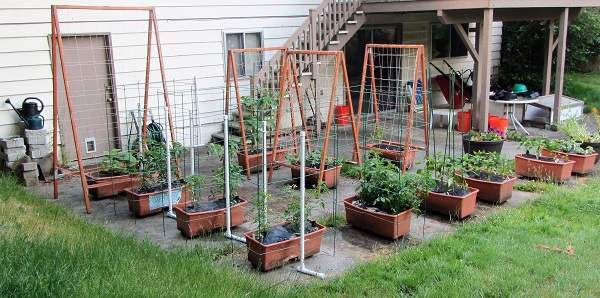
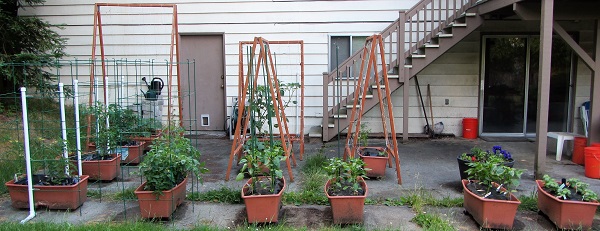
The left column has three boxes of tomatoes, with the Tromboncino zucchini in the big trellis at the back. Continuing to the right in the front row- the next box over has the Oregon Spring tomatoes. The rest of the front row (L-R) is three pepper boxes and then a box of basil. The rear trellis contains the tomatillos, the center trellis has cucumbers, and the rightmost trellis has the surviving melon plant and a new Siletz tomato plant.
The tomatillos are chest-high:
The Oregon Spring are doing their usual early thing. There are lots of blooms and a few fruit:
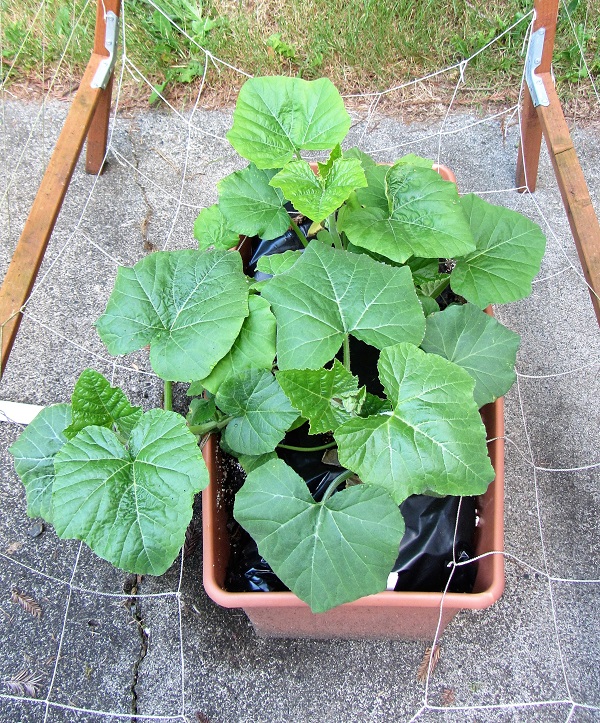
The Tromboncino will need to be trained to the trellis soon:
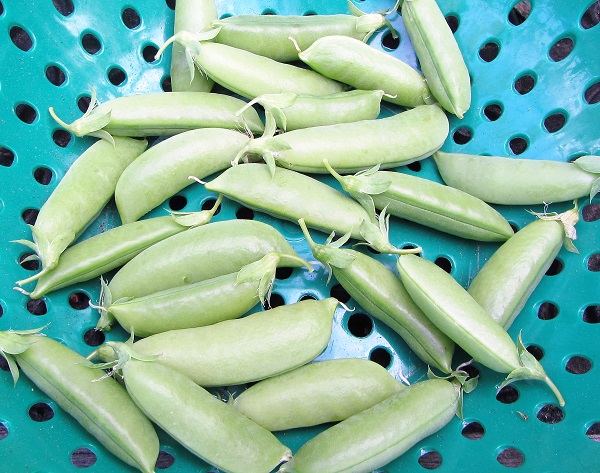
Moving to the front yard — we got another good batch of (very big and fat) peas:
There are still more on the vines, though the vines are beginning to look a little “cooked”:
The lettuces in the top of the salad table are doing well:
The front yard now has four little volunteer pansies:
—————————
Visit Dave at Ourhappyacres, host of Harvest Monday.
We chose to simplify a little bit this year and go more with things we know “work”, are easy to process, and will see quick use if they make it as far as the freezer. We added a few new things too, including melons. The descriptions below are copied from the Tilth Plant Sale PDF.
The boy cat checking out the non-pepper group of boxes.
Melons –
4 of- Minnesota Midget Cantaloupe: 65 days. Open pollinated heirloom from 1948 when it was introduced in Minnesota. Measures 4 inches across at maturity, when the rind is a soft yellow and slightly soft at the stem end. Sweet orange flesh with a good muskmelon flavor. The compact vines produce decent yields. Slice into thin delectable servings with an herb infused soft cheese and salted pistachios for a fantastic summer appetizer.
We were going to try these melons last year, but we missed the Tilth plant sale. This will be our first attempt at growing these. From what I’ve read the vines are supposed to get about 4′ long, and the fruits will likely need a pantyhose or sock support or something similar. Hopefully it’s a warm summer, otherwise we may be underwhelmed. 4 plants is one full box.
Sweet Peppers –
6 of- Carmen: 60 – 80 days. Lusciously sweet when left to fully ripen to a deep red, this pepper is perfect for chopping and tossing straight into a salad. A great container plant and a good addition to a sunny veggie bed. 6 inch fruits on an upright plant.
6 of- King of the North: 76 days. Open Pollinated. Here is a sweet bell pepper that will mature in short season climates. Its crisp, blocky fruit will turn from medium green to red if left on plant longer. Excellent raw in salads or dips. Great to use as stuffed pepper or in tempura recipes.
Jimmy Nardello: 76 days. Open pollinated heirloom. Thin-walled 8″ long curved tapering pointed fruits turn deep red when ripe with shiny wrinkled skin. Great eaten raw and super tasty when fried–very prolific! This seed variety is considered by Slow Food USA to be an endangered member of their “Ark of Taste.”
Sweet Chocolate: 60 days. Open pollinated. Early sweet, lobed, thick-walled fruits. Ripen from dark green to a rich chocolate color. Cold tolerant.
The Carmen and King of the North do well every year. They’re versatile in the kitchen, they’re easy to process, and they’re relatively work-free. One box of each.
The Jimmy Nardello is a pepper I’ve been reading about for years. Tilth finally had them in stock this year. I have high expectations.
Sweet Chocolate is another pepper we’ve been meaning to try and represents a little more variety in the pepper boxes.
Hot Peppers –
2 of- Anaheim College 64: 74 days. Open pollinated. Medium hot flavor make these short season peppers a hit for dips, sauces, stuffing with cheese or roasting. They are just like the anaheims you find in the store but without having traveled all those miles to get to you!
Anaheims are very mild hot pepper — we still have bags of Jalapenos and Serranos in the freezer, as well as dried Thai Chiles. We have no shortage of hot stuff, so we took a pass on the lava and went mellower.
We have two open slots for peppers, to be filled in the near future.
Tomatillos –
2 of- Verde: 70 days. Open pollinated. A classic deep green tomatillo with high yields, ‘Verde’ is ready when the husks have split and are drying. Very intense rich flavor which pairs well with sweet summer tomatoes and makes a fantastic salsa. The high yields will allow you to freeze them as you pick, saving some for winter sauces and stew ingredients. Give tomatillos room to spread and they will favor you with their riches.
Our favorite type of Tomatillo. Larger fruits = less handling. We grow these in an A-frame trellis and run extra twine for support for the branches. 2 plants fills one box.
Zucchini –
4 of- Tromboncino (aka Zucchini Rampincante): 60-80 days. Open pollinated heirloom. A Tilth favorite, the flesh of this variety has a smooth buttery texture and a mild flavor—the taste of summer! The 12 to 18” long fruits are “trombone”- shaped and can grow in curly cues or hang like bells on a trellised vine. Harvest when they are a pale, grass green or leave a few fruits at the end of the season to mature to a buff color and enjoy them as you would a winter squash.
Historically we’ve done two Tromboncino plants in one box. I sort of screwed up when I picked up four. This variety is relatively mildew resistant and they grow vertically up a trellis, so I’m hoping that four plants will work anyway. We’re partial to the taste and texture of Tromboncinos. We’re unlikely to ever grow “standard” zucchini again.
Tomatoes (2 tomato plants go in one box) –
2 of- Oregon Spring: 60 days. Determinate. An extra-early variety that sets loads of meaty fruits weighing 3 to 5 oz., with excellent flavor. Compact plants set fruits even in cool weather and continue to yield all season long. Nearly seedless. A perfect choice for ketchup and sauces.
2 of- Roma: 75 days. Determinant. Premium canning tomato, ideal for sauce and paste. Pear-shaped scarlet fruits are thick and meaty with few seeds.
2 of- Black Krim: 75 days. Open pollinated heirloom. Indeterminate. From the Black Sea region of Russia, these 10-12oz beefsteak type tomatoes have a strong, rich flavor that is common with black tomatoes. One seed catalog noted that the fruit is best when half green and still firm. Very productive. Reportedly is a consistent favorite at tastings, so why not give it a shot?
Old German: 75-85 days. Indeterminate. Fruits are golden with reddish streaks. Produces large, rich and full bodied tomatoes. Great for fresh eating tomato, salads, and salsa.
Cherokee Purple: 85 days. Open pollinated heirloom.Indeterminate. Slightly flattened, 6-8 ounce tomatoes with a purple cast. Shoulders will remain green when ripe. Deep, rich, smoky flavor that’s not too acidic. For fans of the black/purple tomatoes, Cherokee Purple is one of the best This seed variety is considered by Slow Food USA to be an endangered member of their “Ark of Taste.”
We chose not to do eight different tomato plants this year. We passed on Taxis because their yellow sauce is very sweet and requires cutting with other red sauces. We also passed on Sungold (or “Sun Gold”). The small fruits of Sun Gold require a lot of fiddly work and the orange sauce is very very sweet.
The Oregon Spring are early and dependable. They taste good and they’re high-yielding. Normally we’d pair these with a Taxi.
The Black Krim win basically every taste test we do, and the deep purple fruits make great sauces.
The Romas were selected specifically for sauces. I thought we’d have more success this year if we did a mono-box and they didn’t have to compete with anything bigger or unruly.
We wanted one more “black/purple” tomato. We’ve grown Cherokee Purple in the past and enjoyed them, so that was the selection. Looking at the PDF, we may want to try “Carbon” next year.
The Old German sound like a great fit due to their size, versatility, and color. We’ve never grown these, but on paper they’re a winner.
That leaves one box left over, which will contain six sweet basil plants once the weather warms up.
I had forgotten I intended to do this. A few months back, I picked up an amazing few fresh porcinis and fresh english peas and made a risotto (the base recipe is here). Here is my result, in pictures.
Ingredients
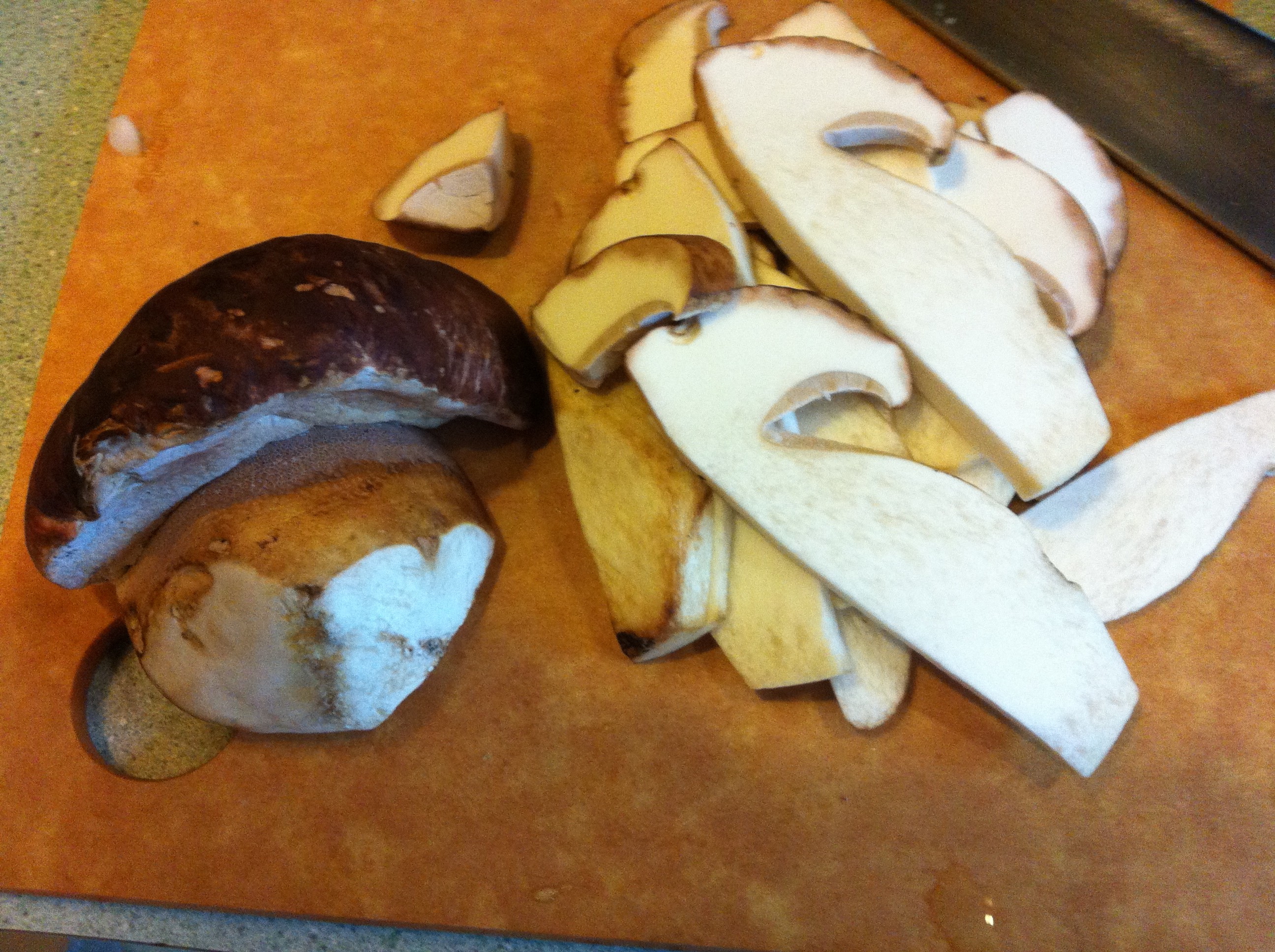
Fresh Porcini
Arborio Rice
Onions and Olive Oil
Chicken Stock
Reggiano
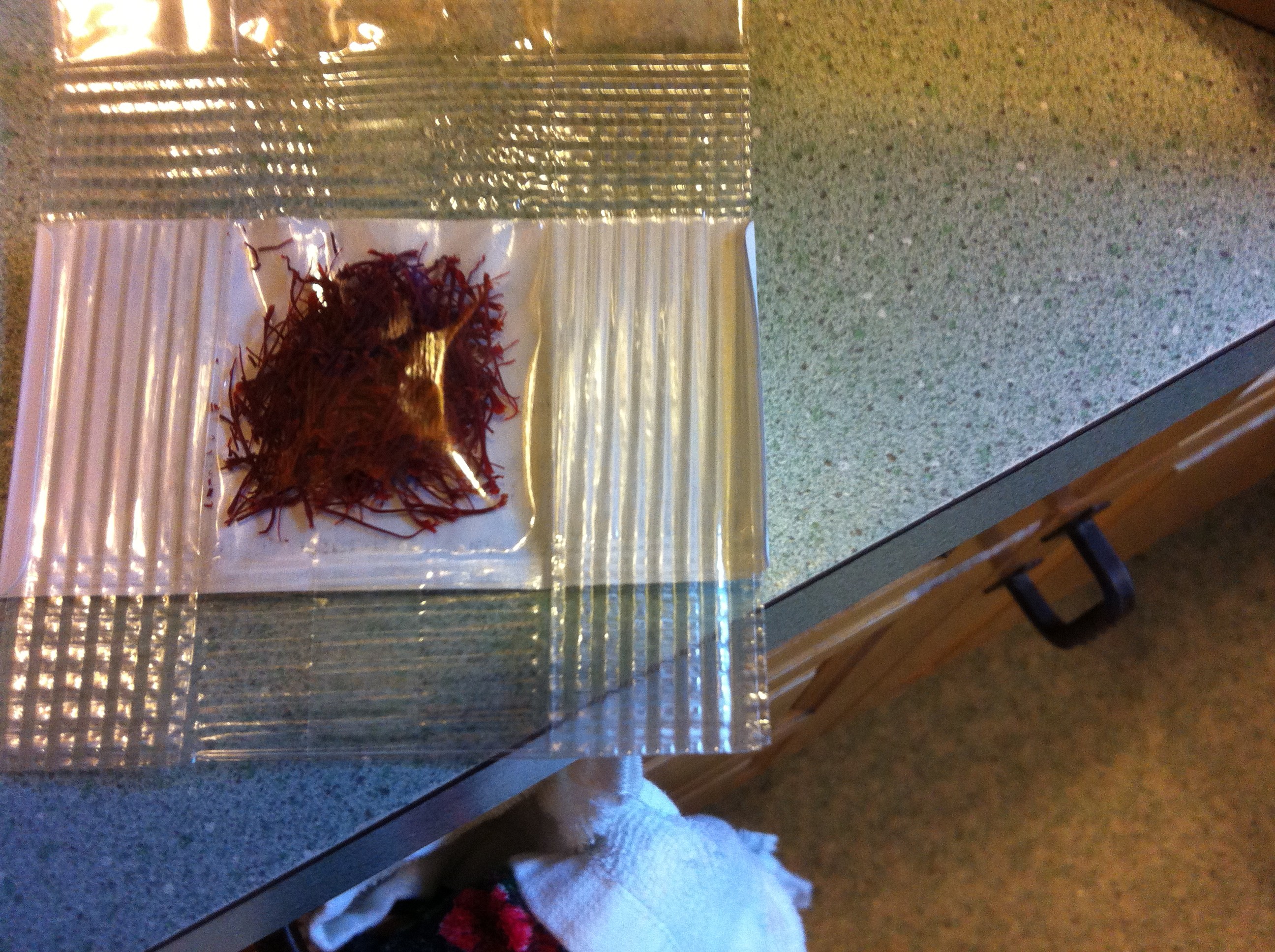
Locally Grown Saffron
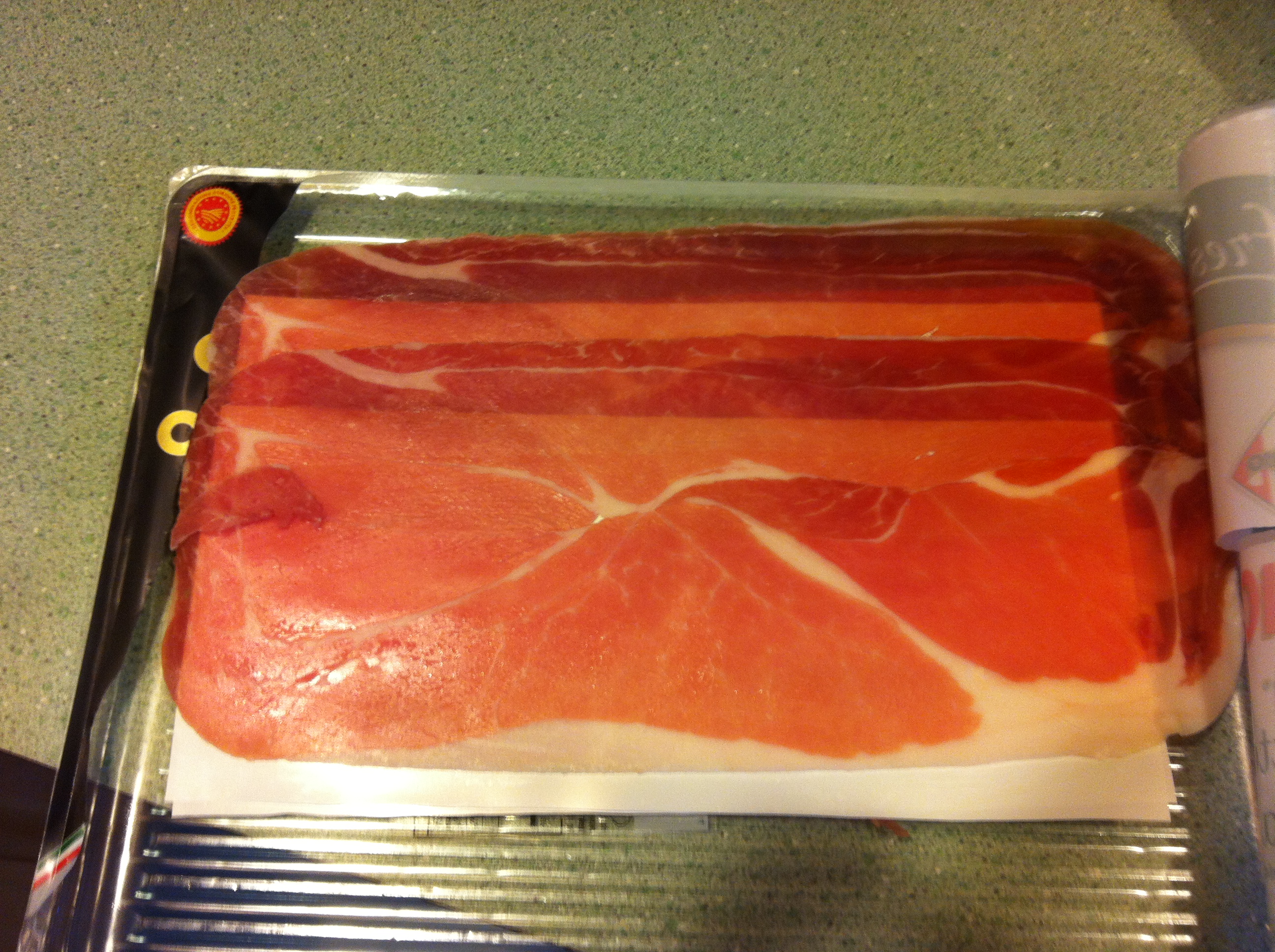
Prosciutto
White Wine
Engilsh Peas
Alder Smoked Sea Salt
Cooking
Sweat the Onions
Grate the Reggiano
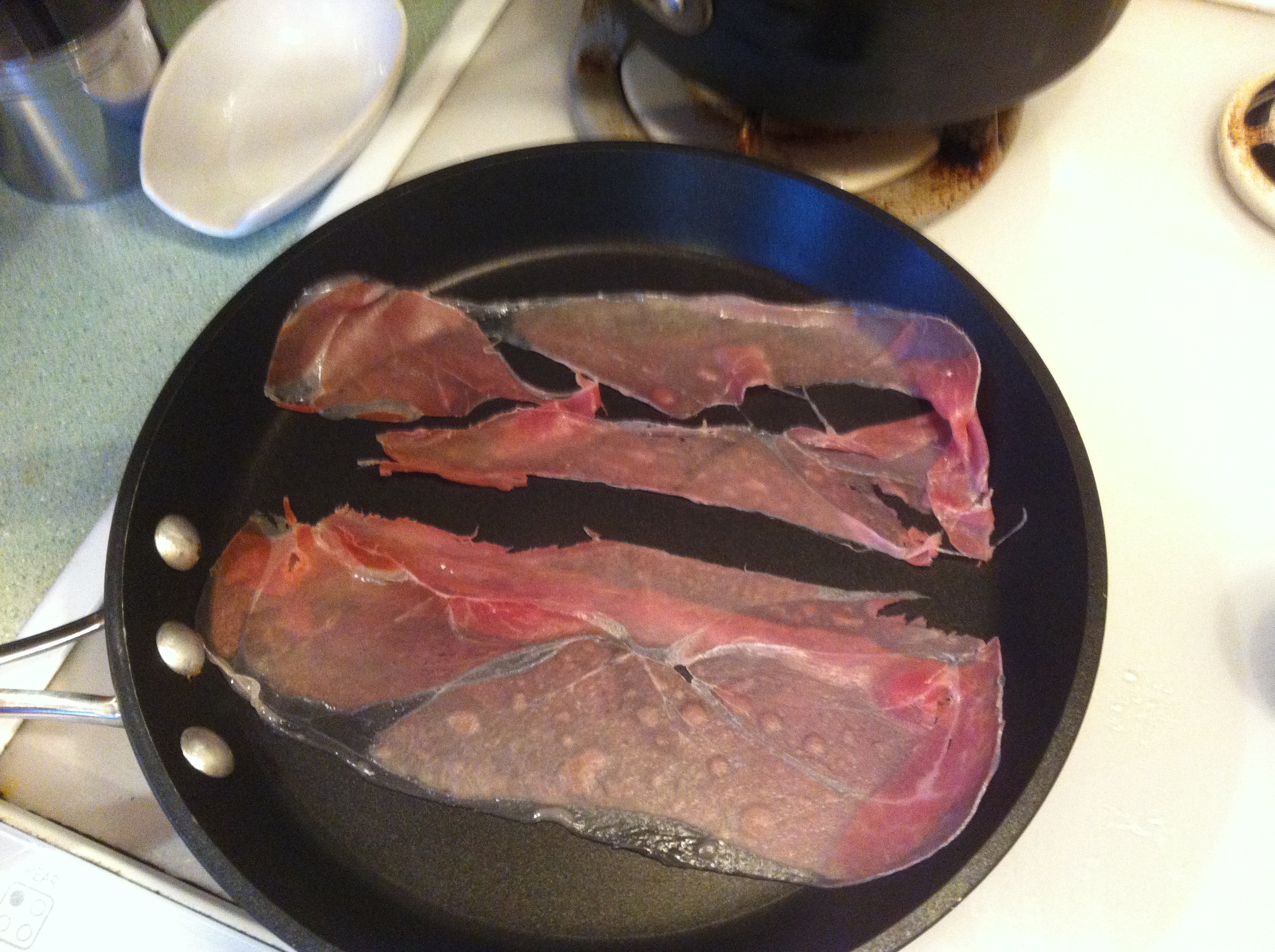
Crisp the Prosciutto
Sautee the Porcini
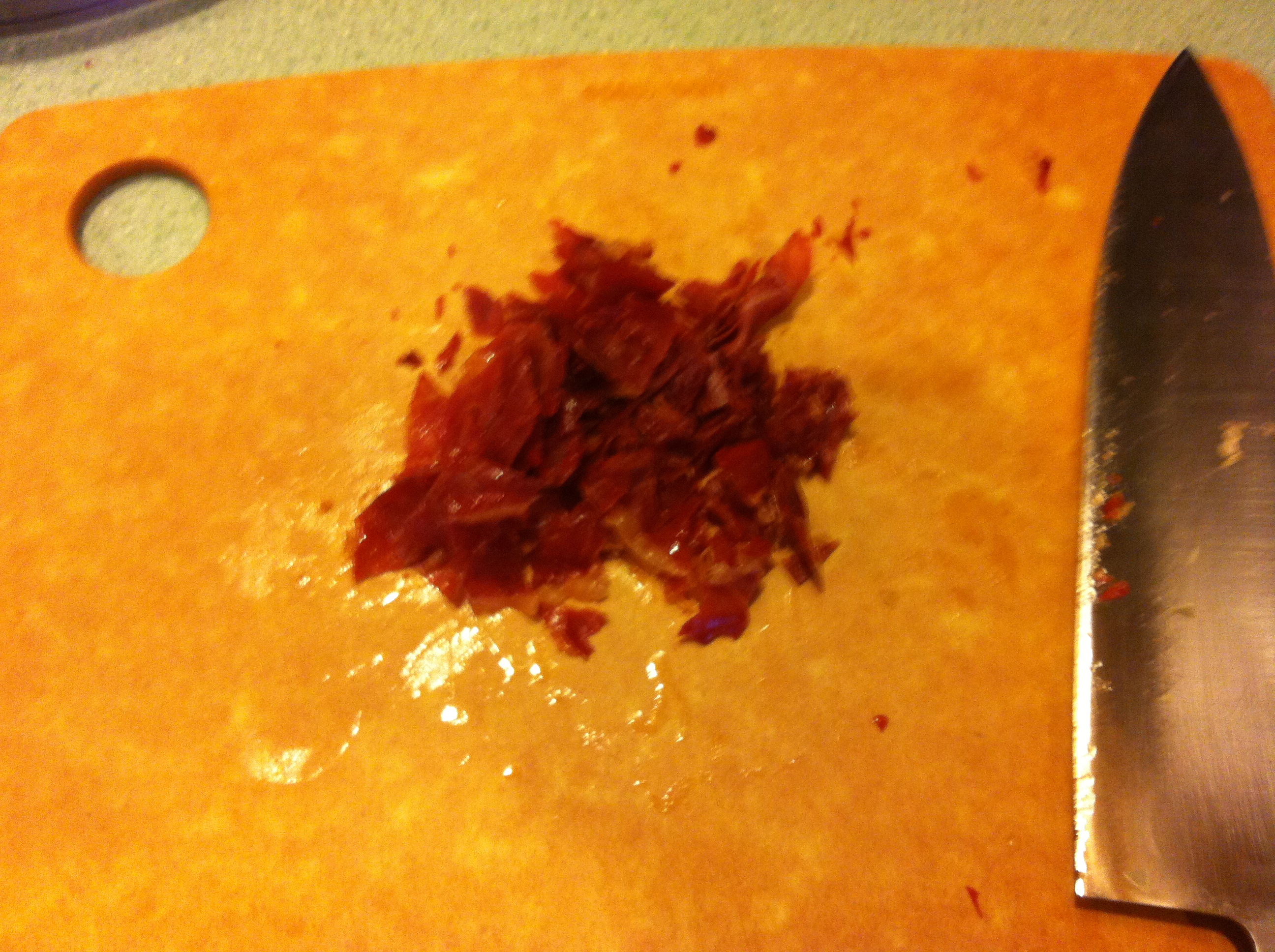
Chop the Prosciutto
I forgot to include a picture of cooking the risotto, so sue me.
Assembly
Combine the salt, risotto, reggiano peas and porcini off heat and stir to combine
Sprinkle with minced prosciutto and serve to happy wife.
Could you imagine having to cook a meal for a man who many consider the best chef on the planet? How about one involving 50 courses? That is what the folks over at Modernist Cuisine did earlier this month when Ferran Adria came for a visit. The video montage looks amazing, I just wish I knew exactly what everything in it was. There is just some of the most beautiful food you will ever see here.
What happens when a coffee expert drinks cheap coffee in a blind tasting? Well, you get some interesting reactions. There are a couple surprises in here, so I am not posting any spoilers. From Buzzfeed:
Top Chef has apparently abandoned the all-star concept and is instead going with a head-to-head competition involving former contestants. From reading the description, it sounds like this is going to be Top Chef Chopped with a twist, that being:
Rivalries will be intensified as “Top Chef Duels” ups the ante and allows the competing chefs to each pick one mini-duel based on the other’s perceived weaknesses in the kitchen.
I like that they are getting both regular and all-star contestants, but I would have liked to have seen all the matchups as regular vs. masters.
Here are the matchups:
Episode 101: Richard Blais (Top Chef Chicago runner- up and Top Chef All-Stars winner) vs. Marcel Vigneron (Top Chef Season 2 runner up) – I like this matchup with two molecular gastronomy guys going at it. I would have loved to see either Blais or Vigneron against Wylie Dufresne, but this one is going to be good. I think Blais wins it in a close battle.
Episode 102: Shirley Chung (Top Chef New Orleans finalist) vs. Brooke Williamson (Top Chef Seattle runner up) – Chung didn’t impress me on TS-NOLA and I thought that Williamson was going to win TS-Seattle, so I think it is pretty clear how I think this is going to end up. I would have loved to see Williamson against Naomi Pomeroy or Anita Lo here.
Episode 103: Mike Isabella (Top Chef All-Stars runner up) vs. Antonia Lofaso (Top Chef Chicago finalist) – both of these two are very underrated cooks and I think this is going to end up being a fun matchup and I think Isabella is going to prevail. Would love to see one of them against someone like Jon Waxman.
Episode 104: CJ Jacobson (Top Chef Miami contestant) vs. Stefan Richter (Top Chef Season 5 runner up) – there is going to be a ton of trash talk in this competition and I think that CJ takes this one with Stefan complaining the whole time. Would be cool if this one had Jacobson or Richter against Tom Colicchio.
Episode 105: David Burke (Top Chef Masters Season 5) vs. Takashi Yagihashi (Top Chef Masters Season 4) – master vs. master here, I think that Yagihashi takes it. Would have liked to see one of them square off with one of the Voltaggios or Sheldon Simeon.
Episode 106: Tiffani Faison (Top Chef Season 1 runner up) vs. Dale Talde (Top Chef Chicago and Top Chef All-Star contestant) – another tough call with two great chefs, but I think Talde will squeak out a victory. How about a battle against Chris Cosentino here?
Episode 107: Nyesha Arrington (Top Chef Texas contestant) vs. Jen Carroll (Top Chef Las Vegas finalist) – Nyesha annoyed the crap out of me and doesn’t strike me a great chef but Jen Carroll is, so I don’t think this one will be close. Fun would be Carroll against Rick Moonen. Really fun would be Carroll against Eric Ripert, her mentor.
Episode 108: Stephanie Izard (Top Chef Chicago winner) vs. Kristen Kish (Top Chef Seattle winner) – another really great battle, although I think that Kish got an easier road to winning TS-Seattle by plowing through last chance kitchen. Izard is the better cook and I think she wins, but I would love to see either of them square off against Mary Sue Milliken or Tracy Desjardins.
Episode 109: Kevin Gillespie (Top Chef Las Vegas fan favorite) vs. Art Smith (Top Chef Masters Season 1) – the battle of the beards and finally a master vs. regular battle, and they definitely got the matchup right. Both of these guys do home-style southern so it should be fun and probably involve a ton of pork products. I think Gillespie wins though.
Episode 110: Championship Finale – has me wondering how this is going to work. You have 9 winners from the previous episodes. If I had to guess who takes the competition overall not knowing how this is going to be presented, I am putting my money on Stephanie Izard.
Those who love me know of my man-crush on Alton Brown. Not only is he responsible igniting my interest in the science of food, he made the single best cooking show ever with Good Eats. I had the pleasure of meeting him several times over the years and he is a genuinely sincere and funny guy.
AB recently launched a web series that is a short bunch of how-to videos, like how to hard cook an egg in an oven (really useful if you need to cook a couple dozen eggs at once). His latest is how to make cat-poo flavored dog treats. I will admit, I am intrigued and am considering making them to try them out on friends’ dogs. The video is below and the link to the recipe is here. The bonus is that he shoots the short with his own dog, Sparky, guest-starring and calls the cat box the “stinky cheese shop.”
Soups are a great meal since they don’t generally require a ton of ingredients, are easy to make in a large quantity, are easy to make from a technical standpoint and don’t require a ton of attention. One of the simplest and most delicious soups I have ever come across is the creamy nettle soup at the old Le Gourmand space in Ballard. This soup was so good that I think it might actually be the best thing that I ever had there. Unfortunately the restaurant is long gone, but the chef, the great Bruce Naftaly, still runs cooking classes and shows you dishes that he served in the restaurant. Since we are approaching the tail end of nettle season, I figured that this would be a good one to put out there, especially considering the somewhat unpredictable Northwest spring weather. Not sure where to get nettles? Try Foraged and Found – they are at the U-District Farmer’s Market on Saturdays and Ballard on Sundays. You probably only have 1 or 2 weeks left in nettle season though, so you many want to hurry.
The Software
1 tablespoon of unsalted butter
1 medium leek, dark green part removed, quartered and rinsed and cut into ½ inch pieces, about 8 oz.
½ yellow onion cut into 6 parts, about 8 oz.
2 shallots peeled and quartered, about 4 oz.
1 Yukon gold potato, quartered, about 6 oz.
2 cups chicken or vegetable stock
¼ cup cilantro, roughly chopped
6 oz. nettles, washed
Salt and pepper
Nutmeg
The Recipe
In a heavy bottomed stock pot, melt the butter until it stops foaming over medium heat. Add the shallots, leek and onions and stir. Cook for about 15 minutes or until they soften, stirring occasionally. If the veggies begin to brown, lower the heat slightly, you are looking to sweat them, not brown them. When the veggies are soft, add the potato and stock. Cover and cook over medium heat for about 20 minutes or until the potatoes are cooked (you can pierce them with the tip of a knife with no resistance). Add nettles and cover, cooking for 6-7 minutes until the nettles are wilted (this will also take out the stinging quality of the nettles). Remove from heat and puree in 2 batches, adding ½ of the cilantro to each batch. When done pureeing the soup, if the soup is too thick, stir in water or stock in small quantities until the desired thickness is achieved. If it is too thin, add some additional cooked potato puree to thicken it. Season with salt and pepper to taste. Serve hot or warm with a few grinds of fresh nutmeg and some nice bread.
Notes
If you can’t find nettles, use spinach instead. It won’t be as good but you will be able to make the soup all year round. The recipe will feed 4-6 people and scales really easily and can be served as either a main course or an appetizer. It will keep in the fridge for 2-3 days but freezes well and reheats easily, so it makes for a nice meal in a hurry. This soup is ultra creamy and luxurious, and, best of all, involves no actual dairy and can be made completely vegan by using veggie stock and olive oil instead of chicken stock and butter.
It is a good thing Jamie Oliver can cook and knows how to run a restaurant empire because he would be starving in the streets if he relied on his “mastery” of the Cantonese language.














 FlatbreadGarden