Six Minute Pizza

by A.J. Coltrane

Historically I’ve baked pizza for sixteen minutes at 500F. The process would be to bake the dough and toppings except cheese for ten minutes, then add the cheese and bake for another six. For years I had an ancient oven to work with that only went to 500F. These days all the cool kids are using short baking times, so…

This is the first attempt at a six minute pizza. That’s total cooking time. It’s not revolutionary, but it’s different from what I’ve been doing, so it may rate a few posts as I figure out what I think I’m doing.

012313pizza

This pizza uses my “normal” (Smitten Kitchen) recipe. After kneading the dough spent two hours on the counter, then overnight in the refrigerator, then two more hours on the counter to come up to room temperature. The toppings are simply red sauce, low-moisture mozzarella, and sauteed red onion.

I preheated the oven to 550F. While the oven was preheating I stretched out the dough by hand, placed it on a perforated pizza pan, then topped it.

Basil was added after it came out of the oven.

012313pizza dressed

Overall the color was ok, the bottom turned fairly brown.
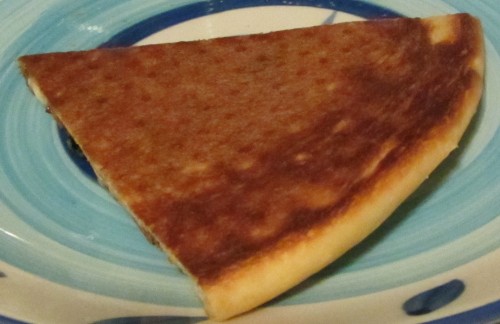
012313 pizza underside

Things to try going forward will include using a pizza stone, with or without the pan. The broiler may factor into things as well.

Bonus cat pic:

012313 cat-girl

Assorted Pics That Don’t Really Rate A Full Post On Their Own

by A.J. Coltrane

1.  I made this pizza a few days before I went to Zeek’s  pizza. It’s puffy in places, which is why it burned a little bit:

120312pizza

The Zeek’s people had a longish lightweight crowbar looking thing that they were using to punch down the “puffs” as they cropped up. It seemed like they had the doors to the ovens open quite a bit while doing they were busy punching the dough down. I wonder what temperature the pizzas were actually cooking at.


2.  Far and away the most symmetrical No Knead Bread I’ve ever made:

1212bread

Purely by accident of course.


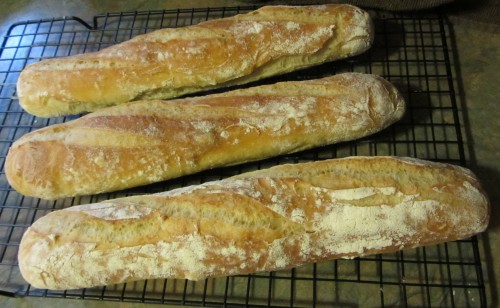
3.  More baguette experiments. I’m still not getting loaves that are as attractive as I’d like, though I feel I’m on the right track:

1212baguettes

The “right” answer seems to be to visualize the dough with two imaginary lines running lengthwise along it, dividing it into 3rds. The slashing needs to all happen within the middle 3rd.


4.  A basket that was purchased for transporting bread. It was a little small for the purpose, and somebody had other ideas as to its intended use:

cat-boy

5.  Who knew a Sham-Wow let to dry on the edge of the tub could be so comfortable?

cat-girl


Last Night’s Pizza

by A.J. Coltrane

Not the world’s most awesome title for a post. I’d guess most people would just “twitter” their pictures of the pizza.

First off though, a piece about Marv Albert at Grantland. Marv finally got to broadcast an NBA game from Brooklyn, which is where he grew up. As kids, Marv and his brothers would turn down the volume on the TV and do play-by-play of the baseball games. He’d lug a tape recorder to almost any sporting event and “call” the game. There’s this bit too:

“Kenny Sears’s stale jokes put the other players to sleep,” Marv wrote in the Lincoln Log in 1957. Now, fast-forward three decades. Remember when Michael Jordan hit six first-half 3-pointers in the ’92 Finals and gave that I-can’t-believe-it-either shrug? It’s often forgotten that the guy he was shrugging at — his co-conspirator, you might say — was the NBC announcer whom he liked so much that he’d feel hurt if he didn’t get asked for an interview. The guy MJ was shrugging at was Marv.

There’s more. It’s an interesting piece.

Onto the pizza. Before:

After:


Sopressata, sausage, red onion, mozz, goat cheese.


A Pizza And A Pizza(?)

by A.J. Coltrane

Two “pizzas” using the same basic recipe. Both received a 20-minute autolyse prior to combining all of the ingredients. (In other words, I mixed together only the flour and water and let that rest for 20 minutes before continuing with the process.)

This one was hand stretched then baked on a perforated pizza pan. During the stretching I intentionally left some “lip” around the edge. The center got quite thin.

Red sauce, sausage, and sopressata.
With mozz.


The “pizza” pictured below was evenly spread in a lightly oiled pan and allowed a 45-minute rise. Even though I made a point to dimple the middle of the dough it still had a focaccia feel to it — the center of the dough rose quite a bit.

Mushrooms, a fair amount of olive oil, and (I think) a bit of very thinly sliced onion. Fresh basil and parm went on late so that they’d just heat through.

Again, it’s basically the same “recipe”, handled somewhat differently but producing two very different results. This stuff fascinates me.

Yeast, Bacteria, Temperature, And Taste

by A.J. Coltrane

While browsing pizzamaking.com I’d been noticing a bunch of references concerning the effect that temperature has on flavor during fermentation, though I hadn’t been able to find real, concrete specifics.

While looking for that information and re-reading Rose Levy Beranbaum’s The Bread Bible, I came across this [pg 30]:

…When chilled, the yeast goes into dormancy, slowing its activity and producing more alcohol. The decreased activity gives the bacteria a chance to feed on the sugar, develop more, and produce more acetic acid. Temperatures of 40F to 50F are ideal for the formation of acetic acid; 55F to 90F results in the formation of blander lactic acid. Acetic acid imparts a far more sour quality to bread than lactic acid. As an added benefit, acetic acid also strengthens the dough’s structure, although too much of this acidity would ultimately weaken it. Some bakers prefer the milder flavor provided by lactic acid.

Emphasis mine. The angels weren’t singing or anything, though right now I’m thinking it’s a key component of flavor development that I’d initially overlooked/undersold.

On a not-unrelated point, within the last year Iron Chef Leftovers and I attended a bread-baking class taught by a local professional baker. The guy kind of wrinkled his nose when one of the students expressed a high opinion of Peter Reinhart’s level of knowledge and contribution to the craft. (I don’t think it was one of us, though we had previously attended a class taught by Reinhart and learned quite a bit.)

Anyway:  a quote from Reinhart’s Artisan Breads Everyday [pg 52].

Pain a l’Ancienne Rustic Bread

I first introduced the concept of cold-fermented wet dough in The Bread Baker’s Apprentice. While the idea isn’t new or original, it has blossomed during the past few years into various no-knead, overnight rise permutations…

Maybe it’s just me, but it feels to me like Reinhart is taking credit in a backhanded kind of way for the no-knead idea and the general increase in popularity in the use of the refrigerator to retard fermentation. “it has blossomed the last few years into… (these other guy’s come-lately stuff)”. It’s a fairly common thread that runs through his writing — I can see now why the guy might have wrinkled his nose.

It’s just me, right?

—–

Note: The Bread Baker’s Apprentice is still highly recommended.

High Gluten Flour And The Autolyse Step

by A.J. Coltrane

Bread experts will often recommend an autolyse step when making breads and pizza. Typically this involves combining the flour and water, and perhaps some of the yeast, then letting the flour hydrate for about 20 minutes. Quoting thefreshloaf(dot)com:

How do you use the autolyse technique? Simply combine the flour and water from your recipe in your mixing bowl. Cover the bowl with plastic or a damp towel. Walk away for 20 minutes to half an hour. That’s it.

While you were away the flour was absorbing the water and the gluten strands have begun to develop. Now you can mix in your preferment, your salt, and the remainder of your yeast and, with very little mixing, achieve a high level of development with considerably less work. The crumb of your dough is also likely to come out much whiter since it has not been highly oxidized by all the beating and whipping.

Better bread, less work. What’s to complain about?

Check out the link, it’s an excellent reference.

Historically I’ve mostly used All Purpose (lowish gluten) flour. Recently though, I bought a bag of King Arthur Bread Flour. The KA flour is very high in gluten. I figured I’d try making a pizza using the KA flour and include an autolyse step for even more gluten development.

After the autolyse the dough wasn’t kneading very well in the Kitchenaid, so I removed it partway through for some hand-kneading.

It was like kneading a pot roast, or a big knotted muscle. I now understand why people call it “strong flour”. The dough ball could have done pushups.

I liked the end result. Sopressata and shallots with mozz:


I used the Smitten Kitchen recipe, mostly.

Crab Rangoon Pizza

by A.J. Coltrane

Inspired by a “greatest pizza in the US” type of show:  It’s Crab Rangoon pizza!

For the uninitiated, Crab Rangoons are fried potstickers filled with cream cheese, crab, and scallions.

Crab Rangoons in their native habitat.

To make this into a pizza topping I combined the cream cheese with heavy cream, horseradish, shallots, and salt in a food processor. Then the crab was added and given a quick buzz to incorporate.

These ratios.

For the other “prep”, I coated wonton strips with a little canola oil and baked until lightly browned. (no pic, see below)

You can see the cooking aid to the back left. The lurid chili oil is to the back right.
Mozz on cream cheese. White on white.

I lightly coated the top and bottom of the pizza dough with canola oil and par-baked it on a screen for 8 minutes at 500F.  Then I added the cream cheese mixture and some shredded mozz and cooked for another 7 minutes.

I took it easy on the chili oil initially to make sure it stayed edible.

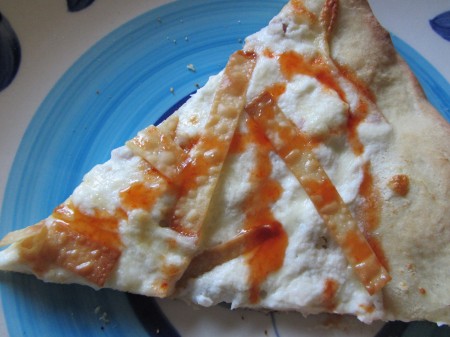
After the pizza came out of the oven it got topped with the wonton strips and sweet chili oil (sriracha, honey, and lime juice).

The chili oil wasn’t too hot, so the slices got more of it.
The underside.

It was no more work than a regular pizza, this one is going into the “making it again” file.

Leftover Calzone Ingredients? More Pizza!

by A.J. Coltrane

I just liked the way this one looked… It reminded me of the pizza that I loved when I was small.

Baked on a screen.

It’s the leftover calzone ingredients from the other night:  sausage, bacon, sauteed onion, sauteed red pepper, “pizza sauce” with additional oregano and roasted tomato flakes, and mozz.

Up close and personal.

And a bonus picture of the princess.

Calzones On The Grill

by A.J. Coltrane

It’s too hot to turn on the oven, so… Calzones On The Grill!

The dough recipe:  1-1/2 cups flour, 1/2 cup water, 1 tsp salt, 1 tsp instant yeast, and 1-1/2 tsp extra-virgin olive oil. (Essentially the Smitten Kitchen pizza dough recipe, goosing the yeast slightly.) An Allrecipes.com recipe calls for brushing the calzones with melted butter before baking, and that 350F is a good target for the grill temperature.

That all sounds reasonable. And reasonably easy. So here’s my first attempt at grilled calzones, or any calzones, really — I think it’s remarkable that it’s taken me this long to fold pizza in half before baking.

The dough was given a bulk rise for almost two hours, then divided in half. Each half was rolled into balls and allowed to rest for about 20 minutes. During that time I browned off some mild italian sausage, then cooked the rawness out of a diced red pepper and some yellow onion in the sausage fat.

The dough balls were rolled out and topped with a streak of red sauce and some grated mozz. The sausage, red pepper, onion, and some crumbled leftover pepper bacon were added, then topped with more sauce and mozz.

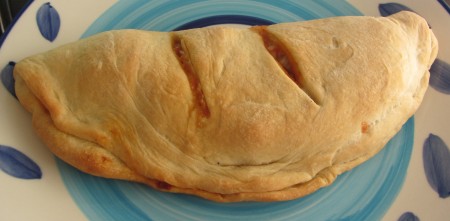
The packages were folded over and crimped, brushed with melted butter, and slit with a knife.

I turned on the left of the three grill burners and carefully placed the calzones over direct heat for a few minutes, then moved the packages to the far right of the grill — far away from the direct heat.

All that was left at that point was to cook the calzones for about 30-35 minutes. Naturally this involved drinking a beverage while periodically checking to make sure the thermometer said something like 350F.

The interior. (The last two photos were taken in direct sunlight. I rolled out a bit of a roll of paper towels and filtered the sunlight through the white towels. A paper towel improvised light diffuser! *I* thought it was pretty clever.)

In retrospect, I might have added a little sugar or honey to the dough to promote more browning. I didn’t do that because I was concerned about the end result being too brown. It worked out ok though — I may have to figure out more stuff to grill.

——–

Late edit:  CSE’s 500th published post! Woof!

Two Links About Pizza

by A.J. Coltrane

Two links to Serious Eats —

The very cool Del Popolo food truck serves wood-fired pizza out of a 5,000 lb oven — the oven is inside the truck! Includes a slide show and an interview.

This is an older post that I just ran across today:  Donna Currie has a 12-part post discussing many different baking surfaces for home oven pizza. Includes a slideshow overview highlighting the pros and cons of each surface. There’s a lot of useful information both in the posts and in the comments. Well worth the reads.

…and a bonus animal pic!

Late Afternoon Sun On The Kitchen Table