by A.J. Coltrane
I thought I’d try Batali’s pizza dough recipe from “Italian Grill”. As it turns out, I’ve already blogged about his Food Network recipe here, and here. I compared it to other recipes I was familiar with here.
First off, the two recipes — “IG” is from his book “Italian Grill”. “FN” is from the Food Network website.
| Ingredient | Batali (IG) | Batali (FN) |
| AP Flour | 3-1/4 cups | 3-1/2 cups |
| Water | 1 cup | ¾ cup |
| Wine | ¼ cup white | ¼ cup white |
| Salt | 1 TBP | 1 tsp |
| Sugar | 1 TBP | 1 TBP honey |
| Instant Yeast | 2 tsp | 2 TBP |
| Olive Oil | 2 TBP + 1 tsp | 1 TBP + 1 tsp |
There’s one striking difference. Doing the math — the “IG” formula comes out to ~18 grams of salt, somewhere in the range of 4-5% of the weight of the flour. That *has* to be a typo, as the finished product would be borderline inedible.
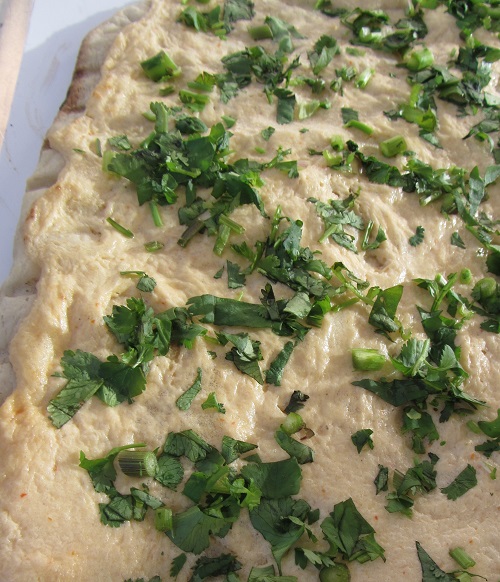
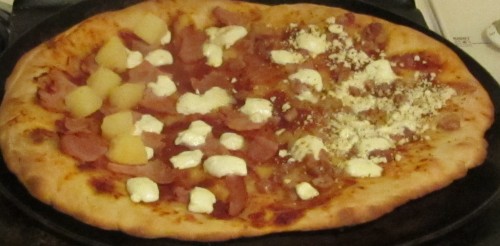
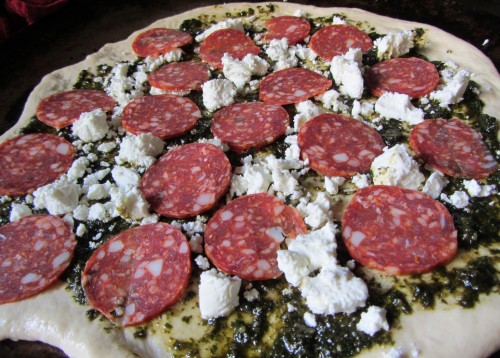
Next — Converting the “IG” formula to weights and comparing it to the pizza pictured below:
| Ingredient | Batali (IG) | This One |
| AP Flour | 390g | 400g |
| Water | 236 | 200g |
| Wine | 59g white | 40g rose |
| Salt | 18g | 9g |
| Sugar | 1 TBP | 1 TBP |
| Instant Yeast | 2 tsp | 2 tsp |
| Olive Oil | 2 TBP + 1 tsp | 2 TBP + 1 tsp |
The table above assumes 4-1/2 ounces of flour per cup measurement. (The King Arthur Flour website was used for that conversion.)
This is one instance that I’m super glad I used a scale for measuring the salt, rather than following the recipe.
As a matter of fact, unless I’ve completely screwed up the conversions, the Batali “IG” formula is effectively a 75% hydration dough. (236+59)/390 = 75.6%. It’s possible to get a dough that wet on to a grill without mishap, but I’ve tried it. It’s really tricky. I used a 60% hydration at least in part to avoid a circus.
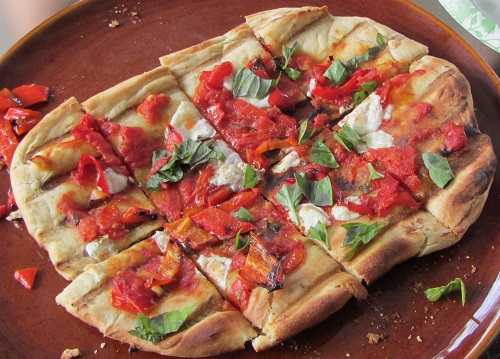
The Verdict: Batali’s Food Network recipe is a winner. The “Italian Grill” recipe needs… help. Plus the editors not to screw it up.
—
I feel like I’m dissing the X-Man. (Unfortunately I couldn’t find that “Singles” scene on YouTube.)




 FlatbreadGarden