Batali’s Pizza Dough, Again

by A.J. Coltrane

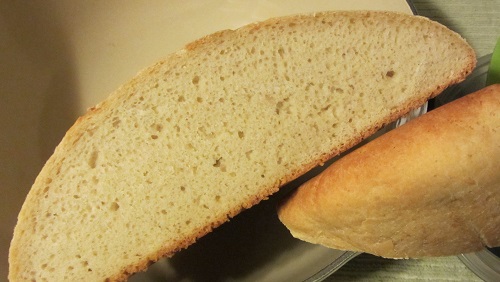
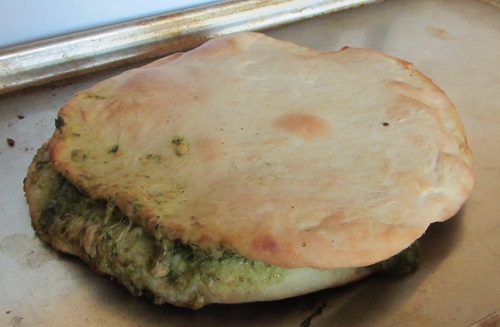
I thought I’d try Batali’s pizza dough recipe from “Italian Grill”. As it turns out, I’ve already blogged about his Food Network recipe here, and here. I compared it to other recipes I was familiar with here.

First off, the two recipes — “IG” is from his book “Italian Grill”.  “FN” is from the Food Network website.

Ingredient Batali (IG) Batali (FN)
AP Flour 3-1/4 cups 3-1/2 cups
Water 1 cup ¾ cup
Wine ¼ cup white ¼ cup white
Salt 1 TBP 1 tsp
Sugar 1 TBP 1 TBP honey
Instant Yeast 2 tsp 2 TBP
Olive Oil 2 TBP + 1 tsp 1 TBP + 1 tsp

There’s one striking difference. Doing the math — the “IG” formula comes out to ~18 grams of salt, somewhere in the range of 4-5% of the weight of the flour. That *has* to be a typo, as the finished product would be borderline inedible.

Next — Converting the “IG” formula to weights and comparing it to the pizza pictured below:

Ingredient Batali (IG) This One
AP Flour 390g 400g
Water 236 200g
Wine 59g white 40g rose
Salt 18g 9g
Sugar 1 TBP 1 TBP
Instant Yeast 2 tsp 2 tsp
Olive Oil 2 TBP + 1 tsp 2 TBP + 1 tsp

The table above assumes 4-1/2 ounces of flour per cup measurement. (The King Arthur Flour website was used for that conversion.)

This is one instance that I’m super glad I used a scale for measuring the salt, rather than following the recipe.

As a matter of fact, unless I’ve completely screwed up the conversions, the Batali “IG” formula is effectively a 75% hydration dough. (236+59)/390 = 75.6%. It’s possible to get a dough that wet on to a grill without mishap, but I’ve tried it. It’s really tricky. I used a 60% hydration at least in part to avoid a circus.
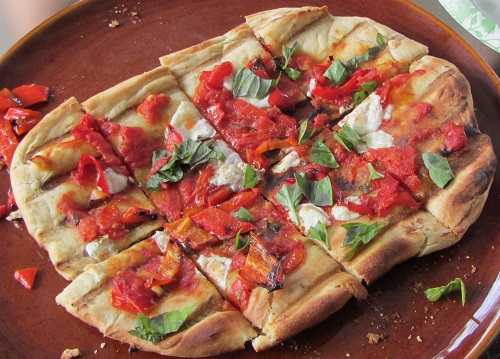
Tomatoes marinated in garlic, oil, and red wine vinegar, then grilled and mashed into a paste. (Roma and Glacier tomatoes.) Finished with mozz and Basil.

The Verdict:  Batali’s Food Network recipe is a winner. The “Italian Grill” recipe needs… help. Plus the editors not to screw it up.

I feel like I’m dissing the X-Man. (Unfortunately I couldn’t find that “Singles” scene on YouTube.)
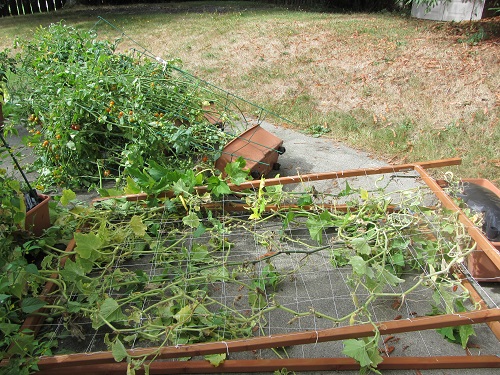


Container Garden Mini Update — September 2, 2014 — Gravity, Dangit!

by A.J. Coltrane

Previous post here.

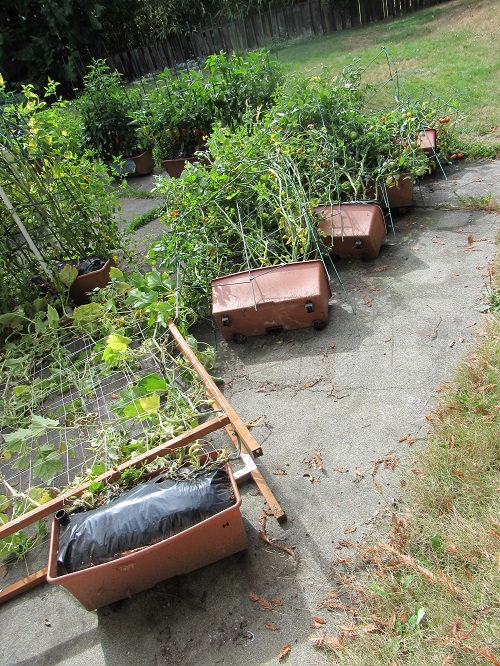
Alternate titles:  “Dominoes!”   or …  “Total Carnage!”

We chose not to add any supplementary support to the tomato cages this year. Last year, everything was fine, why wouldn’t it be this year?

Because today it got windy. Then it got really windy. Windy enough that I went to the back window to check on the plants…

I watched the garden as the wind howled from a strange direction. The zucchini trellis toppled over. It struck the nearest tomato cage, which collapsed into the next cage…:

140902 carnage

Then 10,000 houses lost power.

With help, we lifted everything to vertical. I tied the cages to cinder blocks, then installed the pvc supports that I had thought were important last year, but not this year…

Another view:

140902 carnage2

We lucked out — everything landed on everything else. I doubt we lost more than a couple of pounds of produce, though it’s going to be “fried green tomatoes week”. We got a full sheet tray of not-ripe fruit. It seems that none of the vines snapped, though we’ll know for sure soon.

It’s raining freakishly hard tonight. The thunder just made the cats scatter. The peppers were looking bedraggled after the wind, we’ll see what we have left tomorrow. It could have been much worse.


Container Garden Update — September 1, 2014

by A.J. Coltrane

Previous post here.

September 1, 2013 post here.

Last year the yield was 64 pounds in the month of August. The year it was 95 pounds of produce for the month, including 20 pounds yesterday, though looking at last year’s pics – it may be that this year’s plants are closer to “done”. Yesterday’s harvest:

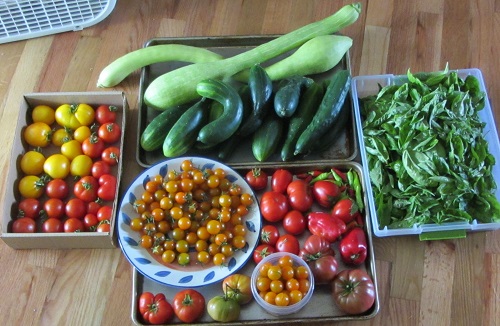
140831 harvest2

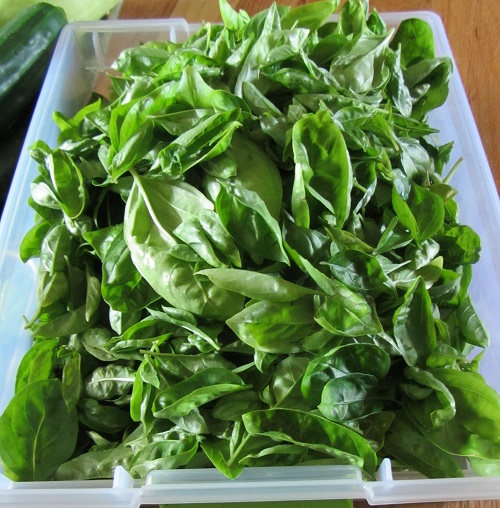
A closeup of the basil. It fills the box, but it’s only 3/4 of a pound — though that’s around $50 retail:

140831 harvest2 basil

One of the two midweek harvests:

Continue reading “Container Garden Update — September 1, 2014”

Pot Luck Focaccia

by A.J. Coltrane

Another variation on a high hydration focaccia, using this one as a jumping off point.

The goal this time was to make a focaccia that could stand on its own at a potluck. As compared to the linked (non-assertive) bread, this one features more salt, more oil, and the addition of rosemary to the top.

All I had in the house was AP flour. I would have preferred Bread Flour for this one, but I wasn’t going to make a trip to the store for it.

The recipe:

Ingredient Measure Baker’s %
AP Flour 500 g
Water 500 g 100
Salt 12 g 2.5
EV Olive Oil 30 g 6
Instant Yeast 1.5 tsp


1.  Combine all ingredients in a mixer and combine on low speed for 10 minutes. Lightly oil a parchment lined sheet tray.

2.  Let the dough rest for 20 minutes, then pour it into the sheet tray, gently coaxing the dough towards the edges of the pan. Cover and let rest 2 hours. Chop rosemary.

3.  Preheat oven to 425F.

4.  When the oven is hot, drizzle a small amount of oil on the dough. Sprinkle chopped rosemary on top.

5.  Bake for 15 minutes, turn the tray 180 degrees and bake for another 10 minutes.

If it’s a two-hour dough I’m always suspicious of the ability of the finished product to be interesting on it’s own. That’s not enough time for good stuff to happen, chemically speaking. On this variation I turned to the “volume knobs” of oil and salt — the oil was increased from 4% to 6%, and the salt was increased from 2% (the “standard”), up to 2.5% of the weight of the flour. The small amount of additional salt helps the bread stand up to other big flavors.

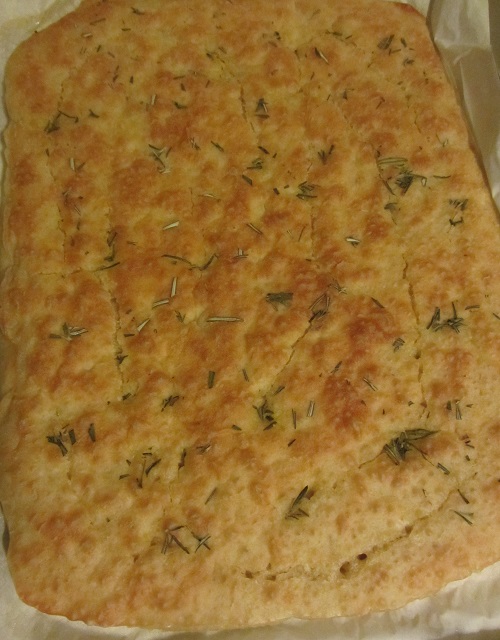
140828 focaccia

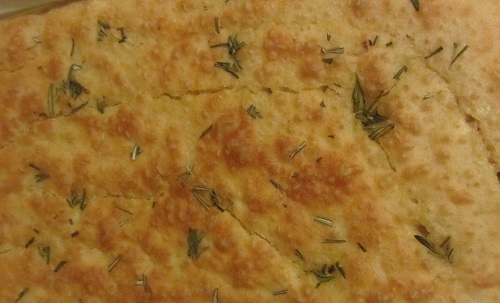
Something I ran into with both of these high-hydration doughs was that the raw doughs couldn’t support the weight of a drizzle of oil. This may be because the house was 80F+ on both attempts. Each time the top of the dough was saturated with tiny delicate bubbles. Spreading the oil around on the surfaces was out of the question. I wound up drizzling a thin stream of oil, which looks like little canals or “breaks” on the finished focaccia.

A close up:

140828 focaccia close up

(Rushed 5 a.m. photography. Not terrible, considering.)

What I think I learned:

1.   100% hydration doughs might not be the best idea when the house is over 80 degrees. Something like 75-80% hydration would have been “safer” way to go.

2.   The dough was basically a batter. The finished bread likely would have benefited from a pan smaller than a sheet tray. As it was, the edges were pretty thin, which could have led to uneven baking.

3.   When I initially pulled the bread out of the oven it was fairly pasty looking. At the risk of drying out the bread, I popped it back in for 4 minutes — that’s what gave it a better color.

Fortunately all of that worked out, though I had my doubts.

I think it’s time to steer back towards “sane hydration” land for a while.

Oil Instead Of Butter – Sandwich Loaf

by A.J. Coltrane

Many sandwich bread recipes call for butter, milk, and/or buttermilk. In theory this one is a little bit healthier, it uses extra virgin olive oil as the fat.

The formula:

Ingredient Measure Baker’s %
AP Flour 500g
Water 325g 65
Salt 10g 2
Olive Oil 20g 4
Instant Yeast 1.5 tsp

It’s basically the same formula as this recent focaccia. The only real difference is that it uses 65% hydration rather than 75%.

The mixture was kneaded for 8 minutes. A small amount of oil was added to coat the mixing bowl, then the dough was allowed to rest for two hours. From there it’s mostly the No Knead Bread recipe — place a 5 quart dutch oven into the real oven and preheat to 425F (No Knead bread is cooked at 450F). Turn the dough out into the dutch oven. Bake, covered for 20 minutes, uncover and cook for another 20 minutes. Cool on a wire rack.

140824 sandwich bread

Crusty but not too crusty. Chewy but not too chewy. It retains the sandwich ingredients without leaking or falling to pieces. A perfectly fine sandwich bread.

Container Garden Update — August 24, 2014

by A.J. Coltrane

Previous post here.

August 25, 2013 here for comparison.

Yesterday was a big “haircut day” for the tomatoes. As it turns out, at least one “haircut day” from last year was on August 25th. This year’s decision to give them a haircut was made without looking at last year’s notes. It’s interesting to me how closely the timing worked out.

It seems to me that the great majority of the mold on the tomato plants occurs on the “side shoots” — the leaf-only branches that are at a 90 degree angle to the main stem. The “sucker” branches (that come out of the side shoot/main stem intersection, and grow additional fruit), and the main stems are almost entirely mold free. This is true regardless of the location “side shoot”. The mold is both on exterior, well ventilated side shoots and on leaves that are buried in the interior of the leaf canopy. It’s like the plant figures that if it’s not a fruit producing node then it’s now time to shut down those natural defenses and spend that energy somewhere else.

Lots of pictures this week, mostly of denuded tomato plants.. starting with Wednesdays harvest:

140820

Saturday. That’s a big tomatillo in the bottom right corner:

Continue reading “Container Garden Update — August 24, 2014”

Another Simple (3 Hour) Focaccia

by A.J. Coltrane

Served at this tomato tasting. Most recent Rosemary Focaccia here.

I’ve gradually been dialing back the amount of oil that I’ve been putting into focaccias…

Background:  When I started making focaccia I always measured the oil by volume. At some point I decided that seemed like a silly way to do it — if I already had the scale out, why dirty another measuring cup? My starting point for “oil by weight” was 10%+, as well as a pretty generous dose on top. The link above uses 8% oil. The focaccia below used only 4% with a very, very light drizzle of oil on top.

To go even further off track for a moment — I’m intending to do a post about how different bread types are related to each other based upon their contents. The thing is, I’m not entirely sure anymore what exactly I’m “making”. I have a starting idea, but that’s about it. Though I guess it really doesn’t matter so long as it tastes good.

The bread below uses 100% hydration — the weight of the water is equal to the weight of the flour. That’s among the highest hydration doughs that I’ve posted. This Berenbaum recipe used 113% hydration, but that’s (I think) the highest hydration dough I’ve done (and it uses 9% oil).

I was hoping to achieve a relatively spongy texture — lots and lots of little, fairly uniform holes. The ingredients:

Ingredient Measure Baker’s %
Bread Flour 520 g
Water 520 g 100
Salt 11 g 2
Olive Oil 20 g 4
Instant Yeast 1.5 tsp

Recipe:

1.  Combine all ingredients in a mixer and combine on low speed for 12 minutes. Lightly oil a parchment lined sheet tray.

2.  Let the dough rest for 20 minutes, then pour it into the sheet tray, gently coaxing the dough towards the edges of the pan. Cover and let rest 1.5 hours.

3.  Preheat oven to 425F.

4.  When the oven is hot, drizzle a small amount of oil on top of the dough.

5.  Bake for 15 minutes, turn the tray 180 degrees and bake for another 10 minutes.

That’s it. It’s seriously simple. The only “trick” is make sure that all of the flour incorporates into the dough — it will tend to want to stay on the sides of the mixing bowl. I used a spatula to scrape down the sides a couple of times during the mixing, then aggressively combined the remaining raw flour after removing the bowl from the mixer.140818 focaccia

Postmortem:  I feel like this one came out about as well as it could have for a 3-hour dough. Using bread flour rather than AP flour was (I believe) the right choice. Adding toppings (salt, herbs, or onion) might have made it more interesting, but the object was to complement the tomato tasting, and in that respect it was basically what I had targeted.

Multiple thumbs up.

Container Garden Update — August 19, 2014

by A.J. Coltrane

Previous post here.

Silly August 18, 2013 post here. (Includes two cat pics and must have been written on very little sleep.)

The plants continue to look more and more haggard as the fruit production ramps up. There’s now mold on the zucchini leaves, some of the tomato plants, and the Brussels Sprouts (of all things). SeattleAuthor shared the hypothesis that the mold may be partly due to the humidity we’ve been seeing. That’s possible — there’s a small holly tree start across the yard that is covered in mold too.

But the production is going gangbusters:

Monday the 11th:

140811 harvest

Thursday the 14th:

Continue reading “Container Garden Update — August 19, 2014”

Pesto Naan Gone Wrong

by A.J. Coltrane

Cedar’s on Brooklyn has an awesome Pesto Naan. Really, everything there is tasty and very reasonably priced. Try anything from the tandoori oven, but don’t go when it’s dinnertime. To quote Yogi Berra: “Nobody goes there anymore. It’s too crowded.”

I thought I’d try to replicate their Pesto Naan, only without the tandoori oven. I selected the Joy of Cooking recipe as a jumping off point and came up with this:

Ingredient Weight Volume Baker’s %
Bread Flour 400g ~3 cups 100
Greek Yogurt 264g ~1-1/3 cups 66
Kosher Salt 8g 2
Instant Yeast 1 tsp
Additional Water as needed

The Joy recipe calls for adding 1-2 tablespoons of water as necessary to make the dough come together. I added 2-3 tablespoons.

I kneaded the dough on low speed for 8 minutes, then set it aside to rest for 1-1/2 hours. While the dough was resting I made a simple pesto. So far so good. Time to preheat the oven to 450F.

I divided the dough into two pieces and rolled each piece out thinly. I then spread the pesto over one round, topped it with the other round and sealed the package.

It sealed ok, but then I decided *that* wasn’t good enough. I tried rolling out the package at little more and managed to irreparably split the seam. Bad idea #1.

At that point I said “Ok screw it. Let’s put it in the oven and see what happens.”

Unfortunately I selected the perforated pizza pan that I like so much. Unfortunately as the pesto heated up it exuded a bunch of oil. Unfortunately that oil leaked out the sides of the naan and caught fire on the bottom of the oven.

“That’s a lot of smoke.”

“Where’s the fire extinguisher?!”

It wasn’t a *big* fire, but it was big enough to be a concern. I grabbed the nearest towel and yanked the mostly cooked dough out of the oven. No sense feeding more fuel into the fire. Plus, I’d put some energy into the naan! I was torn between dosing the fire extinguisher into the oven or just riding it out. I couldn’t figure out how to work the fire extinguisher, which was just as well. The fire burned itself out in 3 or 4 minutes.

“Well heck, the fire is out. I’ll leave the oven turned off and put the naan back into the oven to finish cooking — on a sheet tray this time.”

140725 pesto naan

The bottom was a little too dark, but overall it was a winner.

As an added bonus I’d managed to throw a piece of orange plastic into the oven as part of the rush to yank out the naan during the fire. Chiseling melted plastic out of the oven is so much fun!

Note to self:  No perforated pans next time.