Well now I know: Sowing seeds in late September or early October yields basically nothing for months.
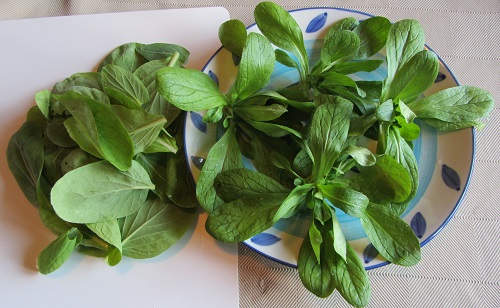
Pak Choi (left), Mache (right).
Pictured is a sample of some of the greens that were sown late last year. It’s about enough for a couple of salads and a nice stir-fry.
Very little growth happened between October and February. I’m guessing the slugs and the cold “got” about the same amount of stuff as is currently in the containers — with the exception of the Pak Choi and Mache, most everything else is still pretty small. Hopefully we’ll see an explosion of growth over the next 30-40 days, because after that it’s time to prep for the summer veg.
I’m inclined to give it one more try next winter, though I’d better get it Right if it’s going to be worth the effort.
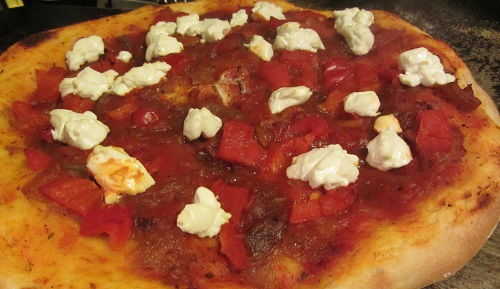
In between watching and recording 30-something college basketball games over the last few days — a two-hour pizza happened:
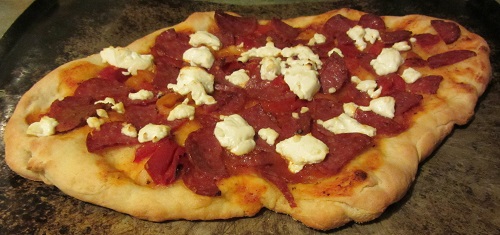
Goat cheese, red sauce, roasted red pepper, and soppressata.
50% bread flour, 50% “oo” flour, 60% hydration with a splash of white wine. 2% kosher salt. Baked on a stone preheated to 500F.
The “oo” flour continues to be super extensible. I thought maybe cutting in some bread flour would make it more controllable. It didn’t seem to have much impact.
As for other possible improvements — I think maybe I need to be slightly freezing the meat before slicing it. It would benefit the pizza if the soppressata was even thinner than I’ve been able to get it.
Overall though, I feel like I’m really starting to get the hang of the pizza peel and stone. It’s resulting in better pizza crusts. The pizza peel isn’t now as intimidating as I used to think it was.
I’m finally getting comfortable enough with the baguettes to bring them places and introduce them to friends.
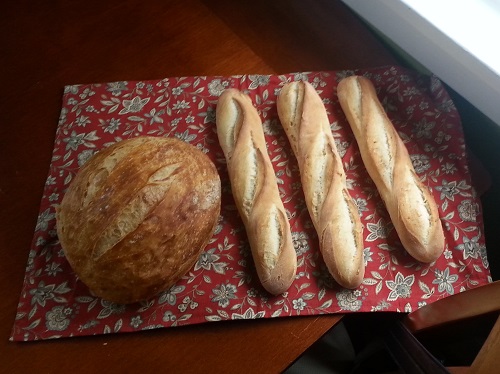
That’s a No Knead on the left that I lightly slashed a couple of times. It wound being a fairly attractive example of the type.
I made six baguettes altogether, in two batches of three. The pictured breads are the from the first batch. The 2nd batch was more irregular and was quietly sliced and served in baskets.
I used a “poolish” when making the baguettes — 200 grams of water and 200 grams of bread flour were combined a day ahead of time and allowed to sit at room temperature. That’s done to allow enzymes time to break starches down into sugars, and in theory it helps the structure of the finished product.
The next day I added the poolish to the mixer, along with an additional 200 grams of bread flour, 52 grams of water, 8 grams of kosher salt, and one teaspoon of instant yeast. (That’s 63% hydration, 2% salt, and a normal amount of yeast for a 2-hour rise. Pretty standard.)
The dough was allowed to rise for an hour, then was divided and shaped into baguette shapes. After another 45 minutes of rising the doughs went into a preheated 450F oven for 22 minutes. I tried adding steam but I don’t think that I used enough water/surface area to have much impact — there wasn’t much steam going on. Overall the whole structure of the baguettes wasn’t very “open”.
Still, the breads were well received, and I got at the three relatively photogenic baguettes out of the deal, so I’ll call that a win.
I think the next real breakthrough will come when I get a better handle on the steam thing.
We’ve never missed a Hops & Props. [2012 post here.] Our group has evolved as some younger members hit drinking age, and the event itself has changed over the years too.
The first year, it felt like nobody really knew about it. It was mostly a beer-snob crowd. The next couple of years saw a lot more “beer tourists” come to the event — the crowd got younger, more attractive, and sloppier.
The tickets aren’t cheap: $85 for non-museum members. I think that’s driving what we saw this year. The event had almost a hybrid beer-event/wine-event feel. As compared to a typical beer event the crowd was wealthier, more female, and by far better dressed. There were more than a few really expensive Cougars of the type you’d usually see at a wine thing.
It was dark and therefore blurry.
It seems to me that the food has gone vaguely downhill annually since the first year. As an example, the 2012 post linked above shows full sized corn dogs. This year, one offering was a mini fringe-average corn dog. On the flip side, I think they had a broader variety of foods, from egg rolls to clam chowder to buffalo wings.
Still, a fun event, and highly recommended. Just make sure to buy tickets immediately when they’re available. This year it sold out in less than a week.
———-
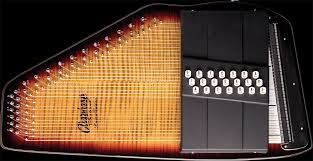
Last night I had a dream in which I invented a revolutionary new instrument. It was a sealed yellow plastic box, maybe 2′ long by 1.5′ wide by 1′ deep, with about 20 closely spaced plastic strings strung in parallel along the top. It also had around 20 buttons that when depressed would select a chord, the chord would be voiced when the strings were strummed.
The box was shaped like this:
You may have already seen one of these in real life:
The only real difference was that in the dream I had the chord-selecting buttons off to the side of the strings, rather than on top of them.
I’m continuing to work through the 22 pounds (10 kg) of “00” flour that Iron Chef Leftovers gave me. That’s actually more than it sounds like — a typical pizza uses ~300 grams of flour.
Caramelized onions, roasted red peppers, red sauce with a little sausage, and feta. The onions are hiding under the sauce, away from the heat.
The dough formula: 350g flour, 210g water (60% hydration), 7g kosher salt, 10g olive oil, 1 tsp instant yeast, and a splash of white wine. Baked in a 500F oven on a baking stone for 12 minutes total. The cheese was added with 4 minutes to go.
The post-mortem: 350 grams of flour makes for a fairly thick pizza. Most likely I’ll cut it back to 250-275 grams next time.
The “00” flour is crazy extensible. The dough was kneaded for 10 minutes, and did a “stretch and fold” on it probably 20 times after removing it from the mixer and it was still super duper stretchy. This time I patted it out on the counter, then carefully tossed it between my hands. There were some really thin places in the finished dough, so I clearly need more work on technique.
The pizza was very light and airy, which was probably partly due to all the “stretch and folds”, and partly the “00” flour. It was fully cooked, though next time I think I’ll let it go another 2-3 minutes for more color and snap. The caramelized onions really “made” the pizza. Tasty!
Bonus girl cat pic. She’s nestled in somebody’s lap, and on her favorite blanket to knead. Check out those claws:
(a.k.a. — Part III of Where I’m At With Writing About Things. This time, Food.)
Food. By far the subject receiving the most attention at Cheap Seat Eats, including an incredible 237 “Beer of the Week” posts written within a 10-month window by Iron Chef Leftovers. (October 2013 to July 2014.) Add to that 142 “Recipe” posts, 92 “Gardening” posts (all since April 2013), and 60 “Food Humor” posts… we’re clearly inspired by food and food related things.
For me, the Food posts represent the best use of the blog as a journal of what worked and what didn’t, whether it’s when baking, cooking, or gardening. The pictures make for a great “memory jog” when I look back at the old material, and I think they add visual interest.
Going forward, I know I’ll be writing posts focused on baking and gardening specifically. I feel like I’m just starting to get an idea of what I’m doing with respect to those two subjects — there should be plenty “burnt toast” pictures in the future.
Territorial Seed sent a 2nd Spring Catalog. NW Edible just posted “To Do In The Northwest Edible Garden: February 2015”.
I am *so* not ready for spring.
Maybe eventually I’ll stop being surprised by the seed catalog and instead view it as the first sign of the changing of the seasons. As of right now we have zero seedlings started inside, though almost all of the EarthBoxes contain cool-season greens and vegetables. The planned winter harvest never happened. Very few of the plants grew large enough to be useful, and I’ve learned that I’m not real inclined to go tromping out into the cold and rain to gather a few spinach leaves or whatever. The upshot is that we now have many plants in varying stages of development, and I’m hoping that they’ll go nuts over the next few weeks.
What will we plant this spring? The leftover seed from 2014. Last January we spent around $50 on seeds. As everyone but me was aware, that’s a lot of seed. I’d guess half of it is still stored in the wine refrigerator. We’ll need to figure out where there’s room to sow — the overwintered plants include cilantro, parsley, pak choi, spinach, mache, scallions, garlic, arugula, and a hodge-podge of other stuff. A few carrots and maybe some radishes overwintered as well. At this point I’m inclined to give the overwintering plants and dormant seeds until around late February to start doing something. At that point we’ll plant as much of the remaining seed as will fit.
On the bright side, there’s no shortage of seed to fill the containers.
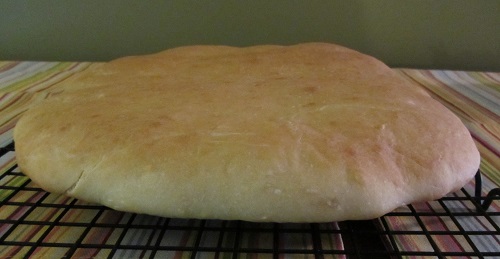
When we’re feeding a crowd I’ll make a big-*ssed sandwich — it’s basically the same size as a sheet tray (18″ x 13″). For the last GNOIF it was … either a ciabatta with a little bit of oil in the dough, or a focaccia with no oil on top and no dimples. It wasn’t the platonic ideal of either, but I’m calling it a ciabatta this time around.
Ingredient
Measure
Baker’s %
AP Flour
300g
50
Bread Flour
300g
50
Water
420g
70
Salt
15g
2.5
Instant Yeast
1 tsp
Olive Oil
24g
4
I wanted to encourage a lighter bread than the usual focaccia. The changes were:
1. The incorporation of bread flour into the formula.
2. I chose not to top the dough with oil before it went into the oven. Also, no dimpling the surface.
3. Before kneading, the flour, water, and 1/8 tsp of yeast were combined and allowed to rest for an hour. This is called an “autolyse.” It allows for the gluten strands to start setting up, and yeast doesn’t have to compete with salt for the available water.
Very foreshortened. It’s 13″ wide and 18″ long.
4. Normally when I proof the bread I’ll do it directly in a parchment-lined sheet tray. I’ll cover that with another inverted sheet tray. It dawned on me that the rise might be improved by using steam in the oven, which is how I’ve been baking baguettes… But then why not just leave the inverted sheet tray as a cover for the first 10 minutes of baking, similar to the No-Knead Bread dutch oven technique?
I mean really, why did that take so long to occur to me?
The finished bread was 2-3″ tall, which is about half again as tall as the focaccias have been. It was lighter and less oily too.
Periodically I decide I want to make tortillas from scratch. The results tend to be uneven, probably because I’m only trying it periodically.
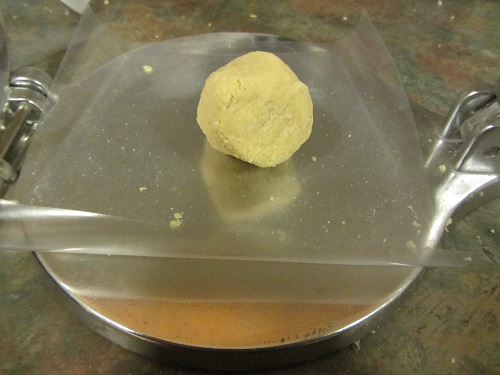
Tonight’s came out better than usual and were less hassle. I think there are two reasons for that — I didn’t make them as wet as usual, and I didn’t squeeze the tortilla press super hard. The drier, thicker tortillas separated from the plastic much more easily than in previous attempts.
I used a sandwich-size freezer bag. The thicker plastic seemed to help as well.
Cast iron skillets really hold the heat and lead to good color on the tortillas. (These are all 5-6″ in diameter.)
Combined with slow-cooker pork shoulder, cheese, and salsa:
Very tasty!
Bonus hunter pic:
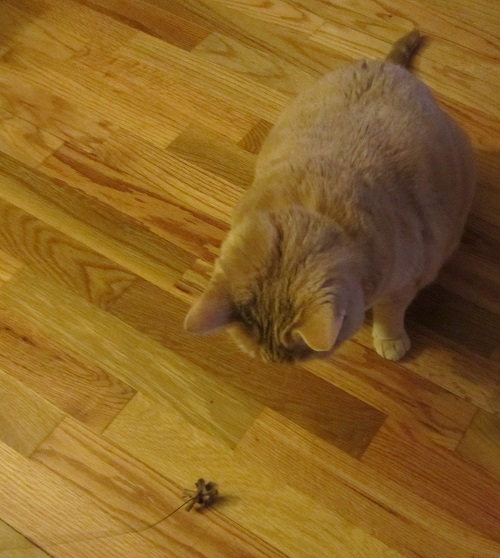
The toy is a Cat Dancer. The girl cat completely loses her mind. (Link for reference. Shop around.)
The middle of December saw the Not-Pretty Baguettes.
Tonight’s are much more photogenic:
The crumb was decent but not exceptional. This may be to be expected given the relatively small diameter of the breads:
Notice how the open spaces are directly down the center — the area that was slashed.
It’s basically a classic baguette formula: 100 parts bread flour, 60 parts water, 2 parts salt:
1. Before I left for work I combined 200g bread flour and 200g water with ~1/16 tsp of instant yeast.
2. When I got home I combined the preferment in the KitchenAid with an additional 130g flour, 7 grams of kosher salt, and 2/3 tsp of instant yeast. The combined dough was mixed for 8 minutes on low speed.
3. The dough was allowed to rise for 30 minutes, then divided, shaped, and placed into a towel-lined (and covered) baguette pan. The doughs were allowed to rise in the baguette pan for 30 minutes..
4. A loaf pan with 1/4″ of water was preheated in a 450F oven for 15 minutes. (45 minutes of rise time in the baguette pan for the doughs, total.) The breads were then baked for 22 minutes. At the 11 minute mark the loaf pan (with remaining water) was removed, and the baguette pan was rotated 180 degrees.
Progress!
—-
I recently received a copy of Advanced Bread and Pastry. It confirmed something that I suspected. (Paraphrasing) “High protein flours brown more readily than low protein flours.”







 FlatbreadGarden