Tomato Bread

by A.J. Coltrane

We had company the other night, and I wanted to make a short-notice bread.  Lacking the time for the flavor to develop on its own, I decided to use tomato puree from the freezer in place of some of the water.

I went for a slightly higher “hydration” bread, with the expectation that the puree wasn’t 100% water. So:

400g bread flour, 166g puree, 94g water. (65% hydration). 8g salt. 1 tsp instant yeast. The dough was mixed for 10 minutes on low speed, followed by a 90 minute rise.

A dutch oven was preheated to 425F. The dough got 22 minutes covered and 15 minutes uncovered. (A longer time uncovered might have created a super dark bread, due to the sugars in the tomato puree.)

150416 tomato bread

The picture makes it look smaller than it really was, though it didn’t rise or spring as much as I would have anticipated, and the crumb was relatively tight.

I’m of the suspicion that the actual water content was around 50% or so. Next time I’ll look at the dough rather than just doing the math and walking away — even 25 grams of water might have made a big difference.

Still, it was attractive and it tasted good. Another lesson learned.

Container Garden Update — May 18, 2015

by A.J. Coltrane

Previous post here. May 16, 2014 post here.

We spent five hours on Saturday building three new trellises and attaching the netting, assembling Ultomato cages, and caging & staking all of the plants as needed:

150518 garden

It looks really different than last year. The 8′ trellis contains the Tromboncino. The 6′ trellises are for cucumbers and the tomatillos.

I still need to add the tomato cage supports (pvc lengths with elbows.)

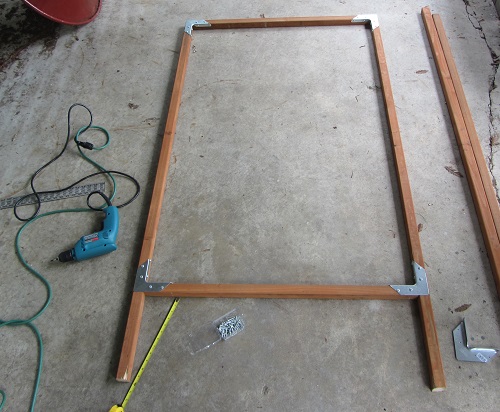
For reference, pictured below is a partly-completed trellis. It’s 6′ tall, the crossbars are 3′. Home Depot sells the RTA12 corner supports and associated screws. The tops get connected with 3 galvanized hinges that are 1-1/2″ on each side of the hinge:

150518 trellis

Five hours was longer than we’d planned for. Everything took some time and it added up. Fortunately we won’t need to build any more trellises any time soon.

Next time I think I’ll spread the staking out over a few days. Oof.

Container Garden Update — May 11, 2015

by A.J. Coltrane

I’ll stick with “Container Garden”, though right now it’s basically “EarthBox Garden” again.

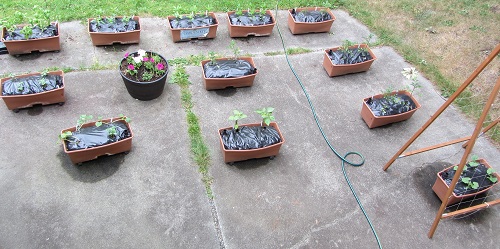
The vegetables were purchased on Saturday, May 2. The cucumbers and zucchini were transplanted on May 3. On the night of May 5 it got down to right around 40 degrees, so I rolled those three EarthBoxes into the garage for the evening. (The other stuff was already coming in every night.) By the middle of last week it looked like we didn’t have any more really cold nights coming up, so on the Thursday the 7th I transplanted everything else after work. As of yesterday, it’s all settling in:

150510 front view

Front Row: Determinate tomatoes (Cosmonaut Volkav & Roma), Sweet Peppers (King of the North), Peppers (Lipstick, Iko Iko, Carmen), Peppers (mix of sweet & hot), Basil

Row Two:  Indeterminate Tomatoes (Sweet Million & Black Krim), Determinate Tomatoes (Taxi & Oregon Spring), Pretty Flower Container, Cucumbers (Marketmore 76)

Row Three:  Indeterminate Tomatoes (SunGold, Tigerella), Tomatillos (Mexican Strain & de Mipa), Cucumbers (Lemon, National Pickling, “Calypso”)

Row Four:  “Tromboncino” zuchinni


Rear view,from a 2nd-story window:

150511 top rear view

Far row: Basil, Peppers, Peppers, Peppers, D. Tomatoes

2nd row:  Cucumbers, Pretty Flower Container, D. Tomatoes, I. Tomatoes

3rd row:  Cucumbers, Tomatillos, I. Tomatoes

Closest:   Tromboncino zucchini


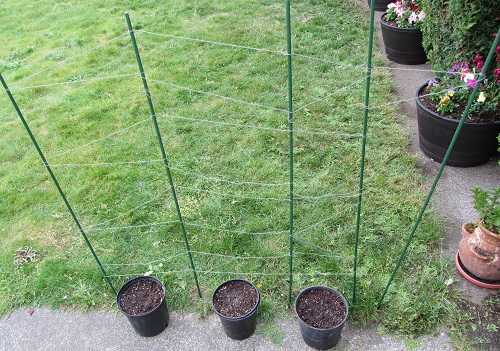
We didn’t want to devote a container to peas, so I threw a few “seeds” into spare pots. They’re just now starting to peek out of the soil:

150511 peas

Those are Ultimato stakes stuck into where the walkway meets the grass. The string may need a little more help, but it’s a start. (I guess I could have used netting, but I already had the string..)

————————————-

Do you like mockumentaries? Does a silly movie about vampires sound like your thing? Then go see “What We Do In The Shadows.” It follows the “lives” of four vampires “sharing a flat in New Zealand”.

Thunderbolts And Lightning, …

by A.J. Coltrane

High winds, intermittent heavy rain, and new plants. Not a good combination. The EarthBox with the tomatillos got rolled under cover next to the house. The tomatoes and peppers are hiding in the cold frame:

150505 Cold Frame

The picture makes the plants look shorter than they really are. As of right now the peppers are spindly enough that they need the protection. I left the lid mostly open so that they wouldn’t cook if the sun came out.


The 2015 Plant List

by A.J. Coltrane

We purchased $135 of vegetable starts on Saturday at the Seattle Tilth edible plant sale. (All descriptions from the Tilth PDF.)

[Comments:  The cucumbers and zucchini have been planted. The tomatillos arrived in tiny pots that instantly dessicated, so they got planted and are rolled into the garage at night. The other plants are still in their original pots — they come into the garage at night too. I came home today to see the wind beating the hell out of everything, so bedtime in the garage came early. The cucumbers and zucchini are low-slung enough that they should be ok.

I think that each year we’ve targeted shorter and shorter maturity dates. There are no more Bradywines. We didn’t do 80-100 day Brussels Sprouts this year. I’m interested to see if we really *are* moving the maturity dates that much — it will likely result in a mathy blog post at some point.]

The List:

Tomatoes (8 total, 2 per box, 4 boxes):

Sweet Million (Cherry) – 65-75 days. Indeterminate. 3 ft. tall plants produce 1-1 1/2 in. fruit in grape-like clusters. 65-75 days. One of the besttasting red cherries with a crisp sweet flavor. Fusarium Wilt (races 1 and 2) and Tobacco Mosaic Virus resistant. Winner of best cherry tomato at the 2007 Tilth Tomato Tasting.

Sungold (Cherry) – 65 days. Indeterminate. Wow! Sungold’s fruity or tropical flavor is a big hit with everyone who tastes it. Apricot-orange round 1 1/4 in. fruit. 10-20 fruits on grape-like trusses. Generally we try to offer open pollinated and heirloom varieties, but we just can’t give up Sungold! Winner of Best Cherry Tomato at the 2005 and 2006 Tilth Tomato Tasting.

Black Krim – 75 days. Open pollinated heirloom. Indeterminate. From the Black Sea region of Russia, these 10-12oz beefsteak type tomatoes have a strong, rich flavor that is common with black tomatoes. One seed catalog noted that the fruit is best when half green and still firm. Very productive. Reportedly is a consistent favorite at tastings, so why not give it a shot?

Cosmonaut Volkov – 68 days. Open pollinated heirloom. Semi-determinate. Ukranian variety named after a Russian Cosmonaut. This tomato delivers that perfect sweet-tart beefsteak flavor in an early-maturing variety. Fruit are large 10oz – 1lb and produce reliably by mid-August.

Oregon Spring – 60 days. Determinate. An extra-early variety that sets loads of meaty fruits weighing 3 to 5 oz. Compact plants set fruits even in cool weather and continue to yield all season long. Nearly seedless. A perfect choice for ketchup and sauces.

Roma (sauce) – 75 days. Determinant. Premium canning tomato, ideal for sauce and paste. Pear-shaped scarlet fruits are thick and meaty with few seeds.

Taxi – 65 days. Open pollinated. Determinate, early, prolific production. The best yellow tomato for short season gardeners. Expect heavy yields of mild, non-acid tomatoes for 3-4 weeks. Grows well in a container.

Tigerella – 65 days. Open pollinated. English Heirloom. Indeterminate. Interesting green turning to red and orange tiger-striped fruit . Very early and prolific – produces throughout the season. Excellent for salads. Low acidity variety.

[Comments:  Six repeats. Cosmonaut Volkov is new. I’ve wanted to try it for a couple of years now. This is the first time we’ve had a space and the variety was available at the sale. The other new tomato is the Sweet Million. It should complement the SunGold nicely.]


Tomatillo (2 plants, 1 box):

De Milpa – 60 days. Open pollinated. Mexican heirloom. “Di milpa” means “from the fields”, as this type commonly grows wild in the cornfields of Latin America. Small fruit but great storage quality, remains green and firm weeks after picking.

Mexican Strain – 65 days. Open pollinated. At 2 inches, these fruit are larger than most tomatillos. They are savory and fresh tasting, great for making salsa verde or adding a Mexican flavor to your dishes. Tomatillos produce tons of fruit on sprawling vines, but don’t usually need to be trellised. Fruits will burst out of husks and fall to the ground when they are ripe.

[Comments:  Both repeats. The Mexican Strain has a vertical habit. The De Milpa sprawls by comparison. They fit well in a box together. It ain’t broke…]


Cucumber (8 total, 4 per box, 2 boxes):

Calypso (Pickling) – 52 days. An early producer with astoundingly abundant yields, ‘Calypso’ is also highly disease-resistant, making it any easy care and dependible pickling cuke. You can expect 1″ x 3″, blocky, medium-green fruits–just the right size for snacking. Preserve some of the harvest for the lean months of winter, give ‘Calypso’ a try!

National Pickling (Pickling) – 52 days. The premium pickling cuke! Bears heavy crops of 6 inch average cucumbers perfect for pickles. Crispy and sweet, this cucumber is also good for slicing.

Lemon (x2) – 70-75 days. Open pollinated heirloom. Dating back to the 1890’s, this old variety is a favorite among many cool season gardeners. 3-4 foot, semi-bush type plants bear loads of apple-shaped cucumbers with lemon-colored skins. Thin skins and mild, sweet flesh make them a joy to eat whole right from the garden! Best harvested when the size of limes. Hermaphrodite – Flowers contain both male and female reproductive parts, which means abundant yields in the garden!

Marketmore 76 (x4) – 63 days. Open pollinated. In the Marketmore series, ‘Marketmore 76’ is very popular with organic growers due to its high level of disease resistance. This dark green slicing variety produces abundant, high quality, uniform fruits about 8 inches long with a wonderful cucumber flavor. This is your classic, all-around cucumber!

[Comments:   The Marketmores have been hugely successful both years, so they get their own box. We had a Lemon cucumber two years ago that did great, so those get 1/2 of a box. Two new varieties of pickling cucumbers fill the 2nd box. Each of the pickling cucumbers is super early. Hopefully we’ll get a staggered harvest from the three broad types.]


Zucchini (4 plants, 1 box):

Tromboncino – 60-80 days. Open pollinated heirloom. A Seattle Tilth favorite, the flesh of this variety has a smooth buttery texture and a mild flavor—the taste of summer! The 12 to 18” long fruits are “trombone”- shaped and can grow in curly cues or hang like bells on a trellised vine. Harvest when they are a pale, grass green or leave a few fruits at the end of the season to mature to a buff color and enjoy them as you would a winter squash.

[Comments:  We have yet to have much success with zucchini. This is the 2nd year of the Tromboncino. They’ll get a more premium location this year, and I’ll probably harvest them more aggressively. They will also be less crowded — the weak sisters are going to get pruned. Hopefully all of that will contribute to us harvesting the same million pounds of zucchini everyone else gets…]


Peppers (18 plants, 6 per box, 3 boxes. The first three are hot, the rest are sweet.):

Anaheim College 64 (hot) – 74 days. Open pollinated. Medium hot flavor make these short season peppers a hit for dips, sauces, stuffing with cheese or roasting. They are just like the anaheims you find in the store but without having traveled all those miles to get to you!

Early Jalapeno (hot) – 66 days. Open pollinated. Hottest and fully ripe when they turn red but most is familiar in the green stage. 2 ft. tall plants produce 3 in. peppers. Will set fruit in cooler conditions better than other hot peppers.

NuMex Highlander (hot) 65 days. An early Anaheim type pepper in the NuMex line developed by the Chili Pepper Institute of New Mexico State University. Produces earlier and has longer fruits than Joe E. Parker. The plants are large and tall and very productive bearing 7 inch long fruit. Try these peppers sliced and stuffed with red rice, goat cheese and parsley for a simple dinner. Or throw on the barbecue and blacken to accompany your favorite grilled fish.

Bullnose Bell (x2) – 58 days. Large Sweet Spanish. Heirloom. An extra early maturing variety that ripens from green to red. Sweet, sweet flesh contrasts with spicy interior ribs–very nice! Originally from India and very prolific!

Carmen (x2) – 60 – 80 days. Lusciously sweet when left to fully ripen to a deep red, this pepper is perfect for chopping and tossing straight into a salad. A great container plant and a good addition to a sunny veggie bed. 6 inch fruits on an upright plant.

Iko Iko (x2) – 65 days. A reliable, sturdy and upright sweet pepper for cooler climates. Produces a variety of colors, from lavender, purple, yellow and lime green when immature to tangerine and red streaked with purple when fully ripe! Lovely specimen plant for containers

King of the North (x6) – 76 days. Open Pollinated. Here is a sweet bell pepper that will mature in short season climates. Its crisp, blocky fruit will turn from medium green to red if left on plant longer. Excellent raw in salads or dips. Great to use as stuffed pepper or in tempura recipes.

Lipstick (x2) – 55 days. Open pollinated. Early and productive, a great choice for a short season! Chunky, triangular peppers with very nice, sweet flavor.

Yellow Mini Bell (x1) from the Master Gardeners plant sale.

[Comments: The King of the North have been our most successful, so they get a full box. The Lipstick, Anaheim, and Jalapeno are repeats. The others are relatively fast maturing varieties that looked interesting.]


and Sweet Basil. 6 plants. 1 box.

[Comments: It’s Basil. We Love Basil.]


That was a way longer post than I’d intended, but now it’s documented for next year.

Nobody Told Me “Enchiladas” Really Means “Leftovers”

by A.J. Coltrane

There’s a first time for everything, and last night’s first time was Enchiladas — the homemade, non-nuked variety.

It’s not like they’re hard to make, but I don’t think I’ve ever had leftover chicken, leftover spicy tomato sauce, cheese that needed to be used, corn tortillas … all at the same time. I’ve always looked at the ingredient list and said: “There’s no way I’m cooking chicken and shredding it just so that I can wrap it up and cook it again.

042815 enchiladas

To be fair, I also skipped the traditional “dip the tortillas in hot oil, then in sauce”. I just used a lesser amount of sauce to make it cleaner and faster. It seemed to work out o.k., and it occurred to me as we were eating: “This is just quick and easy stuff to throw together out of whatever’s in the refrigerator, along with tired corn tortillas.”

I now think Enchiladas were actually “invented” as a way to use up leftovers.

Sneaky.

———————–

feast of santa feThe inspiration for trying to make Enchiladas came from this book:

It was published in 1985, and at least according to the reviews on Amazon the book features a fairly authentic collection of recipes from Santa Fe.

I wonder sometimes if it’s also “trapped in 1985”, though the reviews don’t seem to reflect that.

I’ve had good success with it, using it for everything from sauces to the enchiladas to homemade corn tortillas. It’s cheap, too.

Recommended.

———————-

Happy Too-Early Cinco de Mayo everyone.

“00” Flour Pizza

by A.J. Coltrane

Another “00” flour pizza.

300 grams flour. ~62% hydration. 2% salt. A glug of olive oil. A splash of hard cider. Eight minutes in the mixer. Two days in the refrigerator.

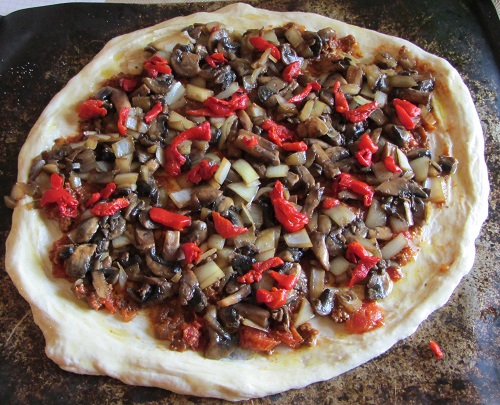
Prior to baking:

150423 pizza

Toppings: A whole bunch of lightly sauteed mushrooms, some lightly sauteed sweet onion, and roasted red pepper on a thickened bolognese.

The “00” flour was super stretchy again. There was no way it was going from the baking peel to the baking stone. I decided to make it less interesting and form the pizza on a baking sheet. The baking sheet went onto a pizza stone in a preheated 500F oven.

The pizza baked for 9 minutes, then parmesan was added and the pizza was allowed to bake another 5-6 minutes.

150423 cooked pizza

The small amount of less-melted parmesan was added after the pizza came out of the oven.

The crust was actually darker than it looks in the picture. I’d brushed the crust with olive oil before baking, and it improved the color and taste.

Despite the large amount of toppings the pizza came out crisp, and with a good snap the crust. I think it helped that the toppings were precooked — they didn’t dump a bunch of water onto the pizza.

Overall it was very tasty, and very filling without making me feel bloated. Two thumbs up.

Start Yer Engines

by A.J. Coltrane

Today was “prep the Earthboxes for summer planting” day. Translated, that means:  “Remove anything leftover, mix in dolomite, saturate the soil, and cover with plastic.

It actually wound up being a little easier this year, since I’d already removed the fertilizer strips from all but one box. The carrots, radishes, cilantro, and parsley got harvested:

150419 Harvest

Sort of a hodge-podge of stuff. The red “roots” on the top right are “Dragon” radishes that never got very big in diameter.

We left the three winter boxes with leeks, scallions, and garlic. We’ll harvest those at the last minute — the tomatoes aren’t going to go into the boxes for a few weeks yet.

Time to make a list from the Seattle Tilth plant sale list!

——

By request, the process to set up an Earthbox. (She disabled embedding, hence the link.)

Note that she said that there aren’t measurements for the dolomite and fertilizer. That’s wrong. The measurements are 1 pound of dolomite and either 2 cups of inorganic fertilizer or 3 cups of organic fertilizer.

That, and we saturate the bejeezus out of the box before covering.


Slugs 1, Coltrane 0

by A.J. Coltrane

Little did I know…

In mid-December the winter vegetables were about as big as they were going to get. On March 11 I decided to start harvesting. The March 11 link shows the one harvest of mache before it bolted. The pak choi bolted too. I was surprised that they bolted that fast. I figured we had about a month to enjoy fresh greens. Nope. Just a touch of warmth and *BOOM*! So much for thinking that waiting would allow them more time to grow.

“Oh, Mr. Troll, you don’t want to eat me. I am just a middle-sized billy goat. Wait for my brother, who is much bigger than I am. Then, you would have more to eat.”

The spinach hasn’t bolted yet, though the forecast calls for 70 degrees this weekend. I’m guessing that the spinach, beets, carrots, and parsley need to be harvested before then.  There are also a few dozen little green onions, and some tiny leeks — those should be ok for a while.

The slugs had a wonderful winter. I tried Sluggo but it didn’t seem to do much. The whiskey barrels in particular were ravaged by the slugs. The mache and pak choi were mostly ignored, but the spinach wasn’t so lucky.

So, the Winter #1 Summary:

1.  Everything was planted too late. It needs to happen in mid-August at the latest.

2.  Putting the boxes underneath the back deck facing to the NorthEast means that they won’t get enough sun. Under the deck is a cold microclimate too. Lose-lose.

3.  Near the front door gets marginal sun, but it’s still much better than under the back deck. Containers near the front door are much more easily accessible.

4.  I’m not sure how much the row covers helped. I do know that they made me less inclined to track progress and harvest things. Right now I’m thinking I’m stuck with them, short of getting a full greenhouse.

Basically, Winter #1 was a complete washout. On the bright side, I tried so many different things and screwed it up so many different ways — it’s got to get better and easier going forward.

Winter gardening is certainly its own “thing”.


Peter Reinhart’s Double Celebration Challah

by A.J. Coltrane

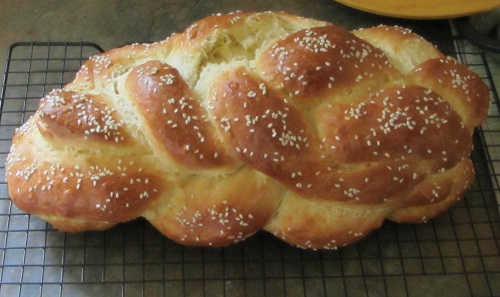
150406 challah2

From the Bread Baker’s Apprentice — Peter Reinhart’s Double Celebration Challah. The “Double Celebration” indicates a double-decker of braided dough — a smaller braid sits on a larger braid. I increased the recipe by 1.5x because we were feeding a crowd:

Ingredient Measure Baker’s %
Bread Flour 27 oz 100
Sugar 3 TBP 5.5
Salt 1.5 tsp 1.4
Instant Yeast 2 tsp 0.85
Vegetable Oil 3 TBP 5.5
Eggs, beaten 3 large 18
Egg Yolks 3 7
Egg Whites, whisked until frothy 3 7
Water (approx) 10.5-12 oz 45

and Sesame Seeds for garnish.

1.  Stir together flour, sugar, salt, and yeast. In a separate (mixing) bowl combine oil, eggs, yolks, and 10.5 oz water. Slowly add the dry mixture to the wet and mix on low speed until the ingredients gather and form a ball. Add the remaining water, if needed.

2.  Mix on medium low speed for 6 minutes, adding more flour if needed to make a dough that is not sticky.

3.  Lightly oil a large bowl. Form the dough into a ball, coat with oil, and let rest one hour, covered.

4.  Remove the dough from the bowl and knead 2 minutes to degas. Return the dough to the bowl and let rest 1 hour.

5.  2/3rds of the dough becomes the big braid, and 1/3rd becomes the small braid. Each of those portions are divided into 3rds again, and rolled out into ropes which are smaller at the ends and larger in the center. The ropes are then braided, tucking the ends underneath. Watch this for help on how to braid. Transfer the big braided portion to a parchment lined baking sheet, top with the smaller braided portion.

6.  Brush the loaf with egg wash, spray with oil, loosely cover with plastic wrap, and let rest 60-75 minutes until the the dough has grown to 1.5x its original size.

150406 challah1

7.  Preheat the oven to 325F. Brush the loaf again with egg wash and sprinkle with sesame seeds. Bake on the center rack for 20 minutes, then turn and bake another 20-45 minutes. The bread is done when golden brown and an instant thermometer reads 190F. (The pictured loaf took 25 minutes after turning.)

8.  Transfer to a cooling rack and wait at least an hour to eat.

———————

The picture at the top of this post is the pretty side. Here’s the other side. The oven spring was so violent that it tore the braids:

150406 challah3

I’ve never seen anything spring like that. I was really surprised at the “time to turn” point — the bread had basically exploded.

The only complication that I ran into was self-induced:  I combined the flour with the minimum (7 oz) quantity of water and let it hang out in the refrigerator for three days before continuing with the recipe. In theory this would allow more flavor to develop. In reality it wasn’t enough water, and the flour became a brick. After a lot of work with a wooden spoon and the KitchenAid I was able to rehydrate the dough with the eggs and the rest of the water. For much of the process I thought the end product might have clumps of under-hydrated dough.

As far as taste — the recipe calls for oil out of respect for Passover. I think next time I’ll use butter. The finished product also needed a little more salt. I’m guessing the issues that I had with hydration resulted in the addition of too much flour, which threw the salt balance out of whack.

All in all though, it wasn’t a bad first attempt, and there’s plenty of room for it to get better.