The Mariners Jekyll and Hyde Pitching Staff

By Blaidd Drwg

Once you get past Felix and Iwakuma, the Mariners starting rotation has been a lovely collection Jekyll & Hyde type pitchers, making them more than frustrating to watch. Don’t believe me, here is what you have to look forward to (stats as of Monday May 13th).

Joe Saunders – pitches like Steve Carlton at home and Steve Blass on the road. Saunders may have the ugliest platoon splits I have ever seen:

W-L GS ERA IP BB SO WHIP ERA BAA
Home 3-0 4 0.93 28.2 7 15 0.82 0.94 .180
Road 0-4 4 12.54 18.2 11 5 2.52 12.54 .424

Now I know it is early in the season and sample size issues still abound here, but if you watch this guy pitch, he looks like 2 completely different pitchers depending on the venue. Now I realize that both the home and road stats will regress to the mean, but it almost feels like Wedge needs to pitch someone else when they are on the road. That is how bad Saunders has looked in those 4 starts. Historically, Saunders was “not bad” at Safeco, which is why I am assuming they signed him, but I am not sure what is going wrong when his is on the road.

Brandon Maurer – pitches like Ricky Vaughn against right handed batters and Vaughn Eshelman against lefties. The guys over at USS Mariner had a good article about this recently. Here is the ugly truth:

AB/H 2B 3B HR BB SO BA OBP SLG
Vs RHB 70/17 4 0 2 3 17 .243 .303 .688
Vs LHB 67/24 7 1 5 7 5 .358 .419 1.135

It is not unusual to see a platoon split with a significant amount of variance for a pitcher against the opposite hand hitter, but this is pretty extreme. The issue, according to USSM is this:

Maurer has four pitches, but he’s primarily a fastball/slider guy. He throws his slider a lot, in fact. Among qualified starters, PITCHF/x only has three pitchers throwing more pitches classified as sliders than Brandon Maurer this year. As you probably know, the slider has the biggest platoon split of any pitch in baseball. There’s a reason every situational reliever in baseball throws a million sliders. It’s why the Mariners have a bullpen full of match-up guys who just come in and throw slider after slider.

The slider is not a good pitch to opposite handed hitters, but it’s great against same-handed hitters. Pitchers who throw a lot of sliders tend to have huge platoon splits. Brandon Maurer has huge platoon splits.

It is obvious Maurer has talent but he needs to learn how to get left handed hitters out at a somewhat better rate if he wants to be successful. The majors are not the place for that. He looks tentative against lefties when he pitches and I really think the Mariners need to do something about that before his confidence is completely shot and teams just stack their lineup with lefties when they face him.

Aaron Harang – well, now that I think about it, he has just plain sucked. If you want a positive spin on this, his ERA in April was 11.37 and in May it is 3.00. That should count for something.

Beer of the Week: Stone Collaboration TBA

By Iron Chef Leftovers

Another Stone collaboration beer, this time with Bear Republic and Fat Head’s Brewing to produce a beer style known as a Texas Brown Ale. What is a Texas Brown Ale you might ask? Well I have never heard of the style, so I will let Stone’s press release talk about it:

This particular beer pays homage to a relatively little–known beer style called Texas Brown Ale, which, strangely enough, has its roots in California. It originated as a hopped up version of a brown ale recipe, and it got pretty popular with a group of NorCal homebrewers in the early 1980s.

“These California guys were tweaking an English-style brown,” explains Matt Cole, Head Brewer of Fat Head’s Brewery. “They added some Crystal and Chocolate malts, and supercharged it with a bunch of Cascade hops to get a bigger version with more hop forward aromas and flavors.”

While delicious, these beers failed to fare well in homebrew competitions, since there was no recognized category they could be entered in. They were far too hoppy and bitter to be considered a traditional brown ale. But when a competition in Houston, TX, accepted entries for what they named the “California Dark” category, the American Homebrewers Association followed suit soon after, though they perplexingly changed the name to Texas Brown Ale.

The beer was sampled out of a 12 oz. bottle and this review is for the 2012 version of the beer – Stone is getting together with the same breweries to brew this beer again in 2013. The skinny on the beer:

Stats: 7.1% abv, 81 IBUs
Malts: Pale 2–Row, Crystal 60, Toasted Wheat, Victory, and Chocolate Malt
Hops: Bravo, Brewer’s Gold, Cascade, and Columbus

tba_collab_2This beer is reddish amber in color with a tan head, not the brown you might expect from brown ale. The nose is a pleasant conglomeration of hops, malt, sugar and molasses. A smattering of light hops appear on the first sip, but fade quickly into a pleasant nut brown profile. The sugar and molasses are there but don’t dominate and subtly compliment the nut brown characteristics of the beer without overpowering it. The finish is like drinking a liquid pecan pie with hints of hops; which makes for a fun and very interesting beer. Considering the hop levels on this beer, I thought the use of them was restrained and very balanced, so much so that occasionally I found myself wanting a slightly bolder hop flavor profile.

I really like TBA and wish there were more breweries doing a style like this.

Stone Collaboration TBA saunters in with an excellent 4 Lone Stars out of 5.

Getting the Call Right

By Blaidd Drwg

What is up with the umpires in MLB right now? Two days last week involved just flat out terrible decisions by the crews involved. I have written about this before – things happen very quickly on a baseball field and calls can get missed or come out wrong. This I understand; the umpires are human and they make mistakes. My issue is when you incorrectly apply a rule or use the replay and still get it wrong.

In case you have been under a rock, here is what happened:

On May 8th in the 9th inning of the A’s-Indians game, Adam Rosales hit a shot to left center field that hit a railing behind the fence and was initially not ruled a home run. Bob Melvin immediately left the dugout and asked for a review, which he was given. Crew chief Angel Hernandez came back out a few minutes later and ruled it a double, even though it was clear to everyone – the players, fans and announcers that the ball did, in fact clear the wall. Well, everyone except the 3 umpires who looked at the replay. Melvin came back out to argue and summarily (and properly) was tossed from the game.

I happened to be watching the Red Sox get pounded by the Twins that evening and was only half paying attention to the TV when they cut into the game about the issue. I looked up at the replay, said, “home run” and immediately tuned back out what the commentators were saying.

My problem here is two-fold – Angel Hernandez made the situation worse by not making himself or the crew available after the game and MLB’s cop-out response to the issue. Hernandez is generally one of the worst umps in baseball and he did nothing to aid that perception by not only getting the call wrong but then not willing to face the music afterwards. At this point, Hernandez needs to be fired – he is horrible at his job and if it was any other profession in America, he probably would have been long gone. MLB’s response was worse:

By rule, the decision to reverse a call by use of instant replay is at the sole discretion of the crew chief. In the opinion of Angel Hernandez, who was last night’s crew chief, there was not clear and convincing evidence to overturn the decision on the field. It was a judgment call, and as such, it stands as final.

I don’t see how replay is a judgment call. This is MLB admitting that the call was wrong but not being willing to do anything about it. Unless Hernandez was looking at a replay from a different game or looking at it on a 13 inch black and white TV with crappy reception, I don’t see any way he could have gotten it wrong.

Here is a montage of the call from all 4 broadcasts – both radio and TV for the A’s and Indians. They all think it is a home run.

On May 9th, the Astros initiated a pitching change. Astros manager Bo Porter brought in Wesley Wright, who took a couple of warm up pitches before Porter came back out and replaced him with Hector Ambriz. Angels manager Mike Scioscia, who probably knows the rules of the game better than any manager, came out to argue that Wright could not come out of the game without facing one batter – Scioscia is right, any pitcher who enters a game needs to face one batter unless he is hurt before the batter is retired or reaches base (which did not appear to be the case here). This is basic rules 101 for umpires and one of the 4 umps on the field – Home Plate – Adrian Johnson, First Base – Fieldin Culbreth, Second Base – Brian O’Nora, Third Base – Bill Welke, should have realized this or at least looked it up if they were not sure. This is a pretty good crew, so it is more inexcusable that they would have botched such a straight forward call.

Picky Eaters vs. Food Allergies

By Iron Chef Leftovers

There is an interesting article in the Chicago Tribune about picky eaters/food allergies and restaurants. It is worth the read just for the chef comments on the situation, but there are a couple of interesting points in the article beyond that:

According to Bethany Thayer, a registered dietitian and director of the Center for Health Promotion and Disease Prevention at Henry Ford Health System in Detroit, frequent exposure to unfamiliar foods by parents often determines if a child stays finicky into adulthood.

Thayer says the more a child watches people they love and trust eat new and different foods, the more likely they are to have an adventurous palate as an adult.

More and more, she says, she sees parents inadvertently supporting a child’s pickiness by serving the same foods over and over again.

I was lucky – dinner in my house growing up rarely came from a box, bag or can and was almost always cooked by my parents. We ate a ton of different things (including fruits and vegetables) and their attitude was, “if you don’t want to eat it, fine, but you are not getting anything else.” I see my brother doing the opposite and letting his kids be picky and not telling them what they are eating. BFD – they are eating rabbit or deer; it is no different than chicken or cow. We ate this growing up and knew what it was. Hell, I usually went to the butcher with my dad to pick out the carcass we were going to buy. Heart, tail, cheek and neck are all just muscles, no different than the steak you are eating, so why the hell do people have a hang-up about them but no problem ordering a rib eye?

Fortunately Thayer offers a solution:

For those adult picky eaters, Thayer suggests changing the texture of the offending food through various cooking or preparation methods, adding a sauce or combining it with a favorite food. She also says, “Don’t give up trying.”

Trust me – if you don’t try something, you really can’t say you don’t like it. You need to go into it with an open mind though. I have seen what happens when people have a pre-conceived notion that the unfamiliar means they won’t like it. Ask them why they don’t like it and they struggle for an answer. If you don’t like something, you should be able to articulate that right away, like I did with durian. If you are not familiar with durian, here is some info.

The first time I tried it, it smelled like the feet of a rotting cadaver. Fine, I have smelled worse (I did grow up in New Jersey after all), but that wasn’t going to stop me. I have had things that smelled awful but were delicious (there are several cheeses that come to mind), so I tasted it. I took one small bite and I had a look of horror on my face. My friend asked me what was wrong. I responded that durian tasted like “a cross between an unwashed foot and rotting corpse (not that I would know what either of those tasted like) if you left it out in the sun; other than that it was fine.” It took me 2 seconds to give an accurate description of why I didn’t like it. I didn’t have to think about it. I’ve got lots of stories like those, but I won’t bore you. I will leave you with this – try something new once a month and do it with an open mind. If you don’t like it, come up with real reasons why you don’t like it. If you aren’t sure if you like it, try it again. Either way, you will be a better person for it.

EarthBox Update — May 12, 2013

by A.J. Coltrane

Previous post here.

Cucumbers and zucchini, May 5.

earthbox midground 050513

May 12.

earthbox midground 051213

May 5 — Left box:  Parsley, scallions, and romaine. (and bolting spinach).  Right box:  Brussels sprouts, bok choi, and lemon cucumbers.

earthbox background 050513

And May 12. The spinach was already bolting (above), but I didn’t realize it. In the photo below it’s gone. It’s time for a bok choi stir-fry.

earthbox background 051213

The romaine pictured below is now two entree salads for tomorrow’s lunch. It all came from the romaine lettuce in the back corner of the photo above.

romaine 051213

Don’t worry, there’s a spreadsheet keeping track of the total harvest.

Recommended Game — Citadels

by A.J. Coltrane

citadelsTitle:  Citadels (now sold with the Dark City expansion)

Game Type:  Card – hand management/ Bluffing/ City Building Game

Number of Players:  2 – 7 (8 with Dark City)

Complexity of Rules:  Low – Medium

Time to Play:  20-60 minutes.

The Concept:  From Boardgamegeek:

“In Citadels, players take on new roles each round to represent characters they hire in order to help them acquire gold and erect buildings. The game ends at the close of a round in which a player erects her eighth building. Players then tally their points, and the player with the highest score wins…

At the start of each round, the player who was king the previous round discards one of the eight character cards at random, chooses one, then passes the cards to the next player, etc. until each player has secretly chosen a character…

The characters then carry out their actions in numerical order: the assassin eliminating another character for the round, the thief stealing all gold from another character, the wizard swapping building cards with another player, the warlord optionally destroys a building in play, and so on.”


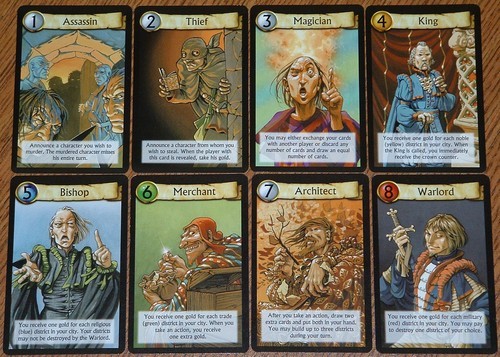
This is the “cheat sheet” that we use when we play — it contains a brief description of each role’s unique abilities. Using a 10-point font it just fits inside the box.

#1 Assassin: Announce a character that you wish to murder. The murdered character misses his entire turn. The murdered player must remain silent and not reveal his character card when called.

#2 Thief: Announce a character from whom you wish to steal. When that card is revealed, take his gold. You may not target the Assassin or the character that the assassin murdered.

#3 Magician: Either exchange your cards with another player or discard any number of cards and draw an equal number of cards.

#4 King: Receive one gold for each of your Noble (Yellow) districts. When the King is called you immediately receive the crown. Exception:  If the King is murdered you receive the crown at the end of the round as his “heir”.

#5 Bishop: Receive one gold for each of your Religious (Blue) districts. Your districts may not be destroyed by the Warlord.

#6 Merchant: Receive one gold for each of your Trade (Green) districts. After your action, you receive one extra gold.

#7 Architect: After your action, draw two district cards and keep both. You may build up to three districts during your turn.

#8 Warlord: Receive one gold for each of your Military (Red) districts. At the end of your turn, you may pay to destroy one district that is not your own. The cost to do so is one gold less than the cost of building the district. The Warlord may not destroy the 8th (“winning”) district in a city.

citadels - roles

Why I Like It:  It’s an easy game to teach and learn, but it has enough strategy (and bluffing) to keep it interesting — the Architect and Merchant are often “best plays” every turn, but that also makes them obvious targets to be assassinated and lose their turn. The game can be shortened by playing to fewer than eight districts. There isn’t much downtime, which I value in any game I play of anything.

prison and palace

To (maybe) quote Sid Meyer: “A game is a series of interesting decisions.”  Citadels qualifies on that front. We’ve had a lot of fun with it.

Link to a Sid Meyer speech at the Game Developers Conference. There’s some fascinating stuff.

The Mariners and the Merry Month of May

By Blaidd Drwg

This may be the worst scheduling job in the history of sports. Take a look at the Mariners schedule for the past few weeks:

April 29th – May 1st – at home
….fine so far

May 2nd – off day
May 3rd – May 5th – at Toronto
…ok an East Coast swing

May 6th – off day
May 7th – May 8th – at Pittsburgh
…the off day after a 3 game set is odd, and I hate the 2 game series, but what can you do.

May 9th – off day
…oh look, another off day. 3 off days in one week. Remember this for later.

May 10th – May 12th – at home
…really, a 5 game East Coast road trip? WTF.

May 13th – off day
…another $#@#^@ off day!!!????

May 14th – May 16th – at New York
…another $%&#^@$*(&@#@ East Coast trip?????? How drunk were the schedule makers when they did this.

May 17th – May 20th – at Cleveland
…yeay, a 4 game set against the Indians, with 3 day games.

May 21st – May 22nd – at Los Angeles
…really? No off day, fly to LA and play 2 games.

May 23rd – off day
…you put the $@%&&@$ off day in the wrong spot you $@&$@#^ idiots.

May 24th – May 28th – back home.

The M’s enter a stretch where they play on 20 consecutive days starting on May 24th. Granted 15 of those are home games, but still, it feels like the schedule makers were on something when they came up with this. I give up. I know that there are a lot of moving parts in schedule making, but that is just crazy.

Beer of the Week: Epic Brewing Galloway Porter

By Iron Chef Leftovers

Did you know that they brew beer in Salt Lake City? The better question is did you know they brew really good beer in Salt Lake City? Epic Brewing is the one responsible for that. Not only do they brew some pretty good conventional style beers, they brew some pretty good experimental ones also. In a recent beer tasting, I sampled the Galloway Porter from Epic. The beer was poured from a 22oz. bottle, but I am not sure what the price was.

From the Epic website:

A dark, full-bodied and drinkable beer, Galloway Porter highlights rich roasted chocolate and coffee-like malt flavors and aromas. It has a very mild hop addition so that the chocolate malt flavor can shine through, 5.4% alcohol by volume.

94d43e327d9303539cb1e2aac7032668_MThe beer is almost jet black with a slight sliver of brown near the top. Lots of toffee and chocolate on the nose; it reminds me more of a stout than a porter. The beer has tons of chocolate and roast malt hitting the palate and remaining for a significant amount of time, with a lingering roasted, almost slightly burnt finale. Toffee also joins the roast in the finish as the beer warms, giving it an almost confection like ending. Dark and heavy, with all of the complexity of a good stout, this beer is not for the faint of heart.

This is definitely a beer that you don’t want to give to someone who does not like dark beers, but for those who do, the complexity and balance make it worth running out to try.

Epic’s Galloway Porter saunters in at 4 bovines out of 5.

EarthBox Update — May 6, 2013

by A.J. Coltrane

Link to previous post.

The spinach responded to the wonderful 80+ degree early-May weather by bolting immediately. Four plants. Zero harvest. The lettuces, cilantro, parsley, and dill are now cowering under the deck, away from the heat of the mid-day sun.

It’s now time to prioritize harvesting whatever hasn’t already mutinied.

The first salad. Only the romaine was home-grown, but it’s still good to have something to show for the work.

salad 050613

After the break, blossoms from around the back yard, most of which came with the house.

Continue reading “EarthBox Update — May 6, 2013”