The winter (backyard) garden… I’m going to call it a success. Not a smashing success though. There’s definitely a theme to what worked and what didn’t.
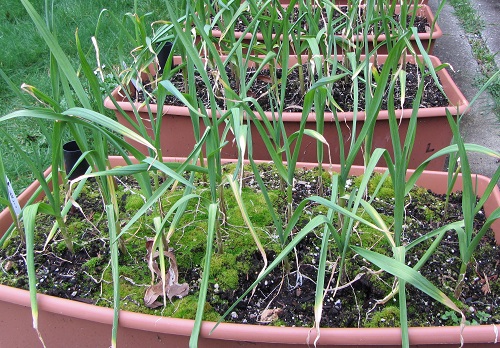
The garlic is doing well. It still has another couple of months to size up before it needs to make way for the summer vegetables:
Mache (left) and Dragon Radishes (right). Bunch Onions were interplanted in most of the containers because slugs are supposed to dislike alliums:
Mache again. It grew bigger with less competition:
The carrots are still small (and they may be too crowded):
The last four EarthBoxes to be planted. An assortment of Mache, Chard, Arugula, and Spinach. Squirrels were digging in them so bird netting was draped over everything… I see Mache and a little Chard:
I think if I’m really going to “winter garden” I need to start seeds no later than sometime in August. (Which is the same thing I said in the November post.) As it is, the backyard gets zero sun all winter. Not much growth happened until the last couple of weeks.
In summary: The Mache did well. All of the alliums did well. The carrots and radishes did ok. Maybe other stuff with do better with a bigger head start..
The newly acquired “whiskey barrels” are pictured below. Purchased at a big box store, they were somewhat smaller than our existing barrels. I’ve gotten as far as drilling drainage holes and filling the bottom with gravel. They will house “Bee & Beneficial Bug” flowers this summer. And Nasturtiums:
GNOIF #21 recap — GNOIF Throws Together A Posse (A fairly random cross-section of games.)
Games That Got Played: Dark Gothic, Forbidden Island, Letters To Santa, Seven Wonders.
Games That Didn’t Get Played: Castle Panic, Poo, RoboRally, Small World, Ticket To Ride Card Game, Tiny Epic Kingdoms.
#21 — GNOIF is old enough to drink(!) Last minute invites meant that lots of people already had plans. Turnout was small, which was ok. We got in some good gameplay.
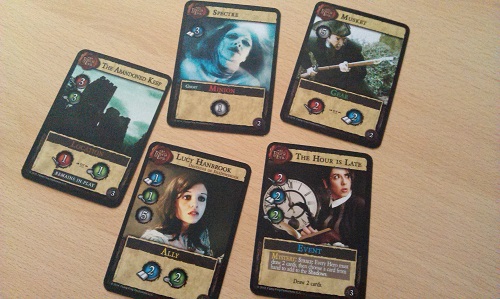
Dark Gothic is the “new thing” — it’s a deck building “colonial horror” themed game. Each player starts with a slightly different deck and a different hero ability. That adds some welcome asymmetry to a genre that can get a little static in terms of strategy. The object is for the players to sort of work together to defeat evil villains before too many “bad things” happen. There’s still one winner.. so players cooperate, but not too hard. The game is by the same studio that does Last Night On Earth, and the “photo” artwork is excellent. It’s one of my new favorites. BoardGameGeek page is here.
A few Dark Gothic cards.
I enjoyed Seven Wonders as well. My “Recommended Game” summary is here.
Thanks to the few intrepid folks who showed, and thanks to everyone who brought awesome beer and food.
As usual, I may have gotten a little too enthusiastic about shopping for seeds. The new batch from Territorial Seed:
Basil-Sweet
2016
Bee Feed Flower Mix
2016
Bright Lights Swiss Chard
2016
Conservor Shallots
2016
Coriander-Confetti
2016
Dill-Dukat
2016
Flower Mix-Beneficial Bug
2016
French Breakfast Radish
2016
Garden Cress
2016
Giant Musselburgh Leek
2016
Giants Of Colmar Carrots
2016
Miners Lettuce
2016
Nasturtium-Jewel Mix
2016
New Zealand Spinach
2016
Red Baron Onion
2016
Roodnerf Brussels Sprouts
2016
Roquette Salad Arugula
2016
It’s a mix of things that have worked well in the past and some new things I’m eager to try out-
Basil plants seem to reach a point in age where the leaves just don’t taste as good. I’d like to try “succession planting” basil this year to see if we can harvest nothing but optimum leaves.
We purchased four more, somewhat smaller “whiskey barrels” over the weekend. This summer they’re going to house a combination of Bright Lights Chard, Bee Feed Flower Mix, Beneficial Bug Mix, Nasturtiums (which are edible as well as attractive), and a hodge-podge of whatever else might fit.
The Garden Cress, Arugula, Miner’s Lettuce, Confetti Coriander (cilantro, this variety is supposed to be slow to bolt), Dill-Dukat (ditto), and New Zealand Spinach (which likes hot weather) will go into the salad table with the existing Miner’s Lettuce. The Garden Cress and New Zealand Spinach are new. I have high hopes for the New Zealand Spinach in particular. We’ll see how the Garden Cress does, it may want more consistent water than will be provided.
Of course, we still have little bits of packages to use up. I have them rubber banded together in groups, this first group is “Salad Table” (the “year” is the year the seed was packed for.)
Dill–Dukat
2014
Coriander-Confetti
2014
Romaine Jericho
2014
Romaine Little Gem
2014
Romaine Winter Density
2014
Roquette Salad Arugula
2014
Spinach-Savoy
2014
And a “Spring 2016?” group of packages:
Radicchio
2014
Parsley
2014
French Breakfast Radish
2014
Cherry Bell Radish
2014
Flower-Brocade Mix
2014
“Fall 2015”:
Romaine Winter Density
2015
Super Sugar Snap Peas
2015
Roquette Salad Arugula
2015
Coriander – Santo
2015
Dill – Fernleaf
2015
Finally, “Winter Backyard 2015”:
Five Color Chard
2016
Mache
2015
Dragon Radish
2014
Mache
2014
Conservor Shallots
2015
Red Baron Onion
2015
Conservor Shallots
2014
Napa Hybrid Carrot
2014
The “Winter Backyard 2015” group is currently growing in the whiskey barrels and EarthBoxes, as well as around 50ish heads of garlic. The mild spring means that the growth rate of the overwintering survivors is really starting pick up.
The transition from winter things to summer things may be “interesting”.
It feels like an early spring around here. The salad table will need to be planted soon:
The top shelf has some scrawny romaine. There’s also some spindly spinach. The big masses of happy green stuff are Miner’s Lettuce. We like the taste and it appears to be indestructible. I’ll be interested to see if it tries to completely take over the salad table.
In the other containers, the mache and radishes are really starting to take off, after pouting all winter. The carrots still have a ways to go.
Part one of a two parter! In the immortal words of Mel Allen, “How about that?”
In the history of baseball, there have been 43 instances of a player hitting 50 or more home runs in a season. For reference, here is the breakdown of those seasons:
Number of HRs
Number of Times Accomplished
73
1
70
1
66
1
65
1
64
1
63
1
62
0
61
1
60
1
59
1
58
4
57
2
56
3
55
0
54
7
53
1
52
6
51
5
50
6
Here is the same list with one additional column – Number of Times Lead League. That column represents the number of times that the corresponding number of home runs was the highest total in the AL or NL in its respective season.
Number of HRs
Number of Times Accomplished
Number of Times Lead League
73
1
1
70
1
1
66
1
0
65
1
1
64
1
0
63
1
0
61
1
1
60
1
1
59
1
1
58
4
3*
57
2
1
56
3
3
54
7
6
53
1
1
52
6
5
51
5
5
50
6
3
The asterisk is an unusual case – in 1997, thanks to a mid-season trade, Mark McGwire was in the unusual position of leading MLB in home runs with 58 without leading one of the individual leagues – he would hit 34 for the A’s, which ranked 9th in the AL in 1997, and 24 for the Cardinals, which ranked outside of the top 10. For the sake of this article we won’t consider that one.
This leaves 9 times that a player topped 50 HR’s without leading the league, which leads to my favorite list, the players who did not lead the league when hitting 50 HRs:
Year
Player
HR
Rank
Leader (HR)
1998
Sammy Sosa
66
2nd (NL)
Mark McGwire (70)
2001
Sammy Sosa
64
2nd (NL)
Barry Bonds (73)
1999
Sammy Sosa
63
2nd (NL)
Mark McGwire (65)
2001
Luis Gonzalez
57
3rd (NL)
Mark McGwire (70)
1961
Mickey Mantle
54
2nd (NL)
Roger Maris (61)
2002
Jim Thome
52
2nd (AL)
Alex Rodriguez (57)
1996
Brady Anderson
50
2nd (AL)
Mark McGwire (52)
1938
Jimmie Foxx
50
2nd (AL)
Hank Greenberg (58)
1998
Greg Vaughn
50
3rd (NL)
Mark McGwire (70)
I feel bad for Luis Gonzalez and Greg Vaughn. They both had the misfortune of hitting a ton of HRs in years where two other player hit a ton more home runs than they did. Of course, then you have Sammy Sosa. Sosa lead the league twice in home runs – in 2000 and 2002, with totals of 50 and 49 and managed to lead the NL in HRs exactly 0 times in years that he hit 60+ home runs. Talk about bad timing.
Double X, also known as Beast – and a beast he was.
The player that intrigued me the most is Jimmie Foxx and his 1938 campaign. In that season, Foxx would reach 50 home runs for the second time, to go along with 139 runs, 197 hits, 175 RBI, 119 BB, a .349 BA, 1.166 OPS, 182 OPS+ and 7.6 WAR to win his 3rd MVP award, missing out on the triple crown in only the home run category. It would be the second time that Foxx missed out in one category – he finished 2nd in the AL to Dale Alexander in 1932 in BA by .003 points. You shouldn’t feel too bad for Foxx though, he did win the 1932 MVP award (posting an insane 10.5 WAR, a number that has only been reached 36 times in baseball history) and he did manage to secure the Triple Crown the following season as well as also winning an MVP. The 1930’s were good for offense, what can I say, but Foxx is still arguably one of the greatest hitters in baseball history. If that isn’t enough, Foxx was also good enough to appear as a pitcher in 11 games in his career, including 9 in 1945, including 2 starts, when he was 37 years old. He posted a 1.59 ERA (albeit with not so stellar peripheral stats). It is also worth noting that when Foxx retired, he was #2 on the all-time career HR list, 170ish HR’s behind some guy named Ruth. For nearly 20 years, the 500 HR club was Foxx, Ruth and Mel Ott.
So why is this part 1 of a 2 parter? Well, it goes back to the guy who had a slightly higher BA in 1932 than Jimmie Foxx. Part 2 is going to answer the question I had when I was writing this piece – “Who the hell is Dale Alexander and why have I never heard of him?”
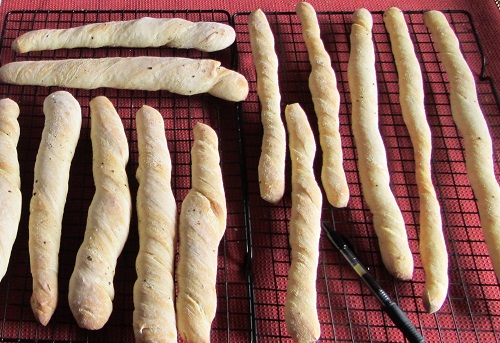
Breadsticks for the recent Belgian Beer Fest, somewhat overexposed:
The Formula (I made 3 batches): 400 grams all-purpose flour, 240 grams cool water (60%), 10 grams kosher salt (2.5%), 8 grams olive oil (2%), 1/4 tsp instant yeast.
Mix on low speed 10 minutes. Transfer to an oil-coated bowl, lightly coat the dough with oil. Cover. Refrigerate 1-3 days. (I put these in the fridge on Thursday night and pulled them out of the refrigerator at 5 am for an 11 am departure time. I had some time left over, but that’s better than transporting them hot and steamy.)
Remove from the refrigerator and allow to warm up for 1.5 – 2 hours. (I then slept in until 7 am.)
Lightly oil the counter if needed to prevent sticking, then pat the dough out to a 12″ wide by 8″ tall rectangle. The dough will be close to 3/8″ thick.
Sprinkle your “enhancements” onto the rectangle. I used a little bit of all of: Himalayan Pink Salt, Sea Salt, Cracked Black Pepper, and Semolina. Parmesan would work. So would sesame seeds. Or herbs. Tons of possibilities.
Use a pizza cutter to cut into 8 pieces, top to bottom, about 1-1/2″ wide. Each piece is now 1-1/2″ x 8″. OR:
Use a pizza cutter to cut into 1″ wide pieces. Each piece will be 1″ x 8″.
Twist each piece and place on a Silpat lined sheet tray. When I did mine the pieces “grew” another 3-4 inches, making them almost as long as the 13″ width of the sheet tray.
Cover with a towel and let rest 1 hour.
The thicker doughs were baked at 425F for 22 minutes. The thinner doughs were baked at 450F for 17 minutes.
The breadsticks came out crispy on the outside and chewy on the inside. The twisting meant that all of the “enhancement” ingredients were mixed through the dough; it made the breadsticks more interesting and added crunch (semolina) to the interior. It also gave the breadsticks natural “breaking” points. I think I liked the skinny ones a little bit better, but that could have just been personal preference.
Overall it’s an easy, versatile recipe. Using the refrigerator for a slow rise means that the dough can be mixed up to 3 days ahead — the dough will wait. If the breadsticks are being served with dinner cut the salt back to ~2% — the 2.5% salt was intended to stand up to the bold flavors of the beer and help cleanse the palate.
So last night I cracked open a Maine Brewing Company “Another One” and a Nantahala Brewing (they are from North Carolina) “4 Food Drop” and then realized that there was humor in that there beer:
The beer told me to have another one, so I did. Now I have to get out the ladder. #dowhatthebeertellsmetodo
Basically, you collect creature and hero cards, assemble a mini-deck of 7-10 creatures and one hero, then battle computer-run decks. When in combat the object is to either eliminate all of the opposing creatures, or reduce the opposing hero to zero hit points. There’s a campaign with around 100 nodes to clear. After that their idea is that you’re hooked enough to spend money in the pay-to-win endgame.
The creature and hero cards fall into one of four factions — human, faen (elf), mortii (undead), and neander (beast). Heroes are functionally “generals” — they don’t directly fight, but they can buff your creatures, or damage or impede the opposing creatures. Cards from the same faction tend to have synergies, such as “all cards of this type get +100 damage”. The cards can be upgraded (leveled), and can be augmented with collectible runes.
A couple of minuses:
Deck Heroes can be played as free-to-play, though the progress gets pretty slow after a while.
The art can be sexist, with ridiculous boobs everywhere. Here’s one of the tamer cards:
Flame Brave is a caster. The pictured card is level 0, with 238 attack and 849 health. A level 10 version of that card would have 428 attack and 1399 health.
All of the cards gain more and better abilities as they level up. Her level 0 version also deals 150-250 damage to one random enemy creature. At level 5 she gains the “deal 210-350 damage to all enemy creatures”. Then at level 10 she gets “inflicts ‘flaming’ on all enemy creatures, causing them to lose 120 HP after their action.”
Overall Deck Heroes has some decent depth and strategy for an Android title.
Recommended game if you can put up with the artwork.
A friend of mine recently posted on Facebook about how the Pats have been to 12 AFC championship game and the Broncos to 9 in the last 3 decades. That is a pretty good run, but it got me thinking, what about Super Bowls? I decided to shrink the window and only look at the last 21 years. Why, you might ask, well, I figured I would be looking at the expansion era in the NFL, which started in 1995 and from 1991-1994, the Buffalo Bills were the AFC representative in the Super Bowl, so 1995 seemed like a good place to start.
So since 1995, there have been 8 AFC teams that have represented the conference:
Team
Number Of SB Appearances
% of AFC Total
Patriots
7
33%
Steelers
4
19%
Broncos
3
14%
Ravens
2
10%
Colts
2
10%
Raiders
1
5%
Chargers
1
5%
Titans
1
5%
There is a bit of rounding there, but, counting this year because it will be either the Pats or Broncos representing the AFC, the Pats, Broncos and Steelers represent 15 out of the last 22 AFC champions, or 68% of the appearances, with the other 32% represented by the remaining 5 teams on the list, meaning there are 8 AFC teams that have not made the Super Bowl in the last 21 years. What about the NFC you might ask? Well, in the same time period, no NFC team has been to more than 3 (Seattle, GB and the Giants are all at 3) and only 3 teams have been to more than 1 (SF, the Rams and the winner of the Carolina/Arizona game this weekend). Talk about dominance vs. parity.
So it got me thinking, if the Pats, Steelers and Broncos have been to that many Super Bowls, how have the fared in AFC Championship game appearances? Well those numbers are quite scary:
Team
Number of AFC Championship Appearances
% of Total Possible Appearances
% of Conference Total
Patriots
11
52%
26%
Steelers
8
38%
19%
Colts
5
24%
12%
Broncos
5
24%
12%
Ravens
4
19%
10%
Jets
3
14%
7%
Chargers
2
9%
5%
Titans
2
9%
5%
Raiders
2
9%
5%
The list of teams that have been to the Super Bowl is no less dominating when you factor in the AFC championship game. Heck the only team that has been to the AFC championship game that has not been to the Super Bowl in the last 21 years are the Jets, losing all 3 times they appeared in the conference championship.
So next time someone wants to talk about the “dominance” of the Seahawks, just remember, the last time that the Patriots were NOT in the AFC championship game was 2010 (they lost to the Jets in the divisional round) and the last time they did not make the playoffs was 2008, when Brady was out the entire year and they still finished 11-5 and managed to not make the playoffs because of tie-breakers for their division and the wild card. Actually the last time the Patriots failed to win 10 games was 2002 (they were 9-7) and the last time they didn’t make the playoffs was last century, when they finished 5-11 in 2000, with some coach named Belichick, who was in his first year with the team and that Brady guy was their third string QB, behind Drew Bledsoe and the combination of John Friesz and Michael Bishop.
You won’t find a bigger hater of the Pats than me, but, damn, even I have to concede that is a long time to be that dominant.
I feel like this may have been the best “quick” focaccia yet.
The Tweaks:
3% olive oil in the dough. That’s lower than in oil than most of the focaccias I’ve made in the past. The crumb was lighter than in past attempts, and the bread got a lot more “lift”.
The dough was allowed to rest for 30 minutes before it was moved to the pan. I think this also improved the finished crumb structure.
A 450F oven. (Rather than 425F.) The crust came out quite a bit browner and crisper as a result.
It made a terrific dinner with a bit of cheese and SeattleAuthor’s charcuterie:
The formula: 400 grams Bread Flour, 280 grams room-temperature water (70% hydration), 12 grams olive oil (3%), 9 grams kosher salt (2.25%), 1 teaspoon instant yeast.
Combine ingredients in the mixer and mix on low speed for 10 minutes.
Lightly coat the dough and bowl with oil, cover, and let rest 30 minutes.
Line a 9 x 13 pan with parchment. Lightly oil the parchment.
Transfer the dough to the oiled parchment, pulling it gently to the edges of the pan.
Cover and let rise ~1.5 hours.
Drizzle the top with olive oil. I used a rosemary-oregano olive oil that we received as a holiday gift.
Oil your fingers and dimple the top.
Bake 22 minutes at 450F. Remove to a cooling rack when done.
For comparison, here’s a 100% hydration, 6% olive oil focaccia from 2014. It couldn’t be dimpled because it was already collapsing under its own weight. It was baked at 425F and even with the higher oil content it was a lot lighter in color. Here’s another that was baked at 425F. And another. None of them are all that brown.








 FlatbreadGarden