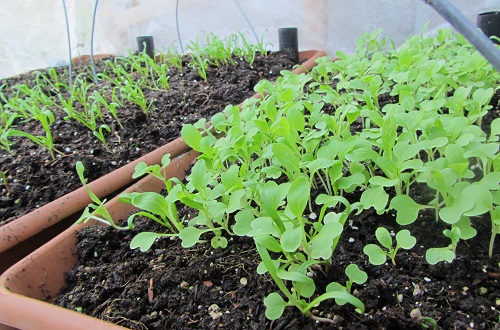
Two Microclimates Part 2 — The Unhappy Campers A Little While Later

by A.J. Coltrane

[Eleven days ago it got really cold.]

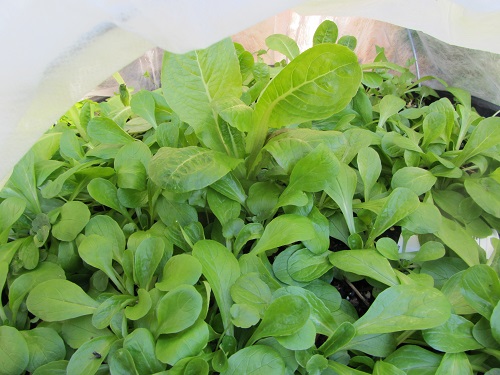
The Romaine then:

141116 romaine3

The Romaine today:

141128 Romaine

It’s not all the way back, but it’s looking way perkier. I removed a few dead or rotted leaves, but not many. The picture is a good representation of what pulled through.

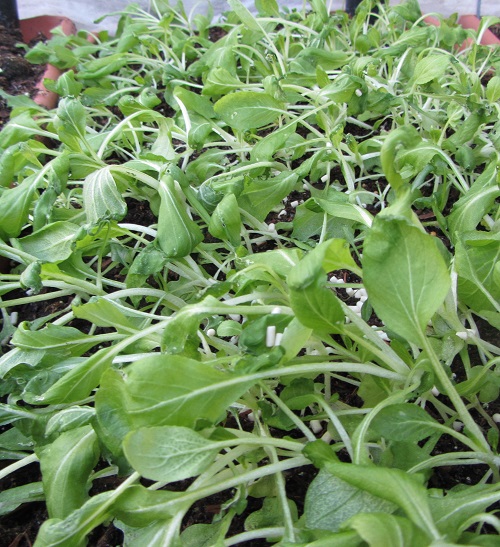
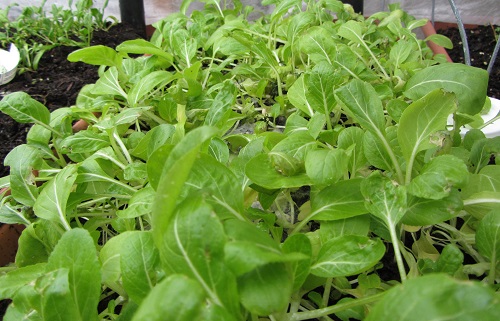
The Pak Choi then:

141116 pak choi

The Pak Choi today:

141128 Pak Choi

Some of the leaves are still a little “fried” looking. Overall the Pak Choi is somewhat more cold tolerant, and it shows.

I’ve been trying to determine the appropriate planting dates for winter veg. As of right now my best guess is:

October 14 – ((Average Germination Days) + (Days To Maturity))

In other words, everything should be done growing on October 14. That might be a week or two earlier than necessary, unfortunately it can’t be tested until next year. If we start with the assumption (this post) of an average of 10 Days To Germination and 50 Days To Maturity, it gives an August 14 planting date for the winter vegetables.

Which means direct seeding everything may be out of the question, since the summer vegetables are still going strong at that date.

I see seedling flats in my future.

Two Microclimates

by A.J. Coltrane

The nighttime temperatures dropped down to around 20F this week. There was no gradual decrease from warm, either. The evening temperatures went 40, 40, 40, 40, 20, 20, 20. There’s a marked difference in how the front yard plants have been handling the cold as compared to the back yard plants-

The front yard gets morning sun when it’s clear outside. It may also help that the sun reflects off of the house and onto the containers:

141116 romaine

The containers in the backyard get comparatively little sun. This romaine is still frosty around noon:

141116 romaine3

Front yard again:

141116 romaine2

Back yard (Pak Choi):

141116 pak choi


The back yard stuff is looking vaguely perkier today than it did at the time of these pictures, but still.. Next year (or even later this week) the back yard containers may need to be moved to a sunnier spot. If that means they get rained on, then that’s the way it’s going to need to go. “Zero” sun isn’t cutting it.

I came across this blog recently. OurHappyAcres. Written by a retired IT guy doing four-season organic gardening in southwestern Indiana — Zone 6b. The blog features lots of pictures, and he documents many different “tests”. In addition to the usual suspects he grows a lot of asian greens that I’m not super familiar with. I like his relatively methodical approach to gardening. That, and if something works for him then it should work in the maritime northwest.

Final EarthBox 2014 Recap — The Tomatoes And Tomatillos

by A.J. Coltrane

Previous post here. 2013 recap here.

Tomatillos — 21.2 pounds. Both of the tomatillos survived 2014. In 2013 one of the two plants died off midsummer. This year it may have helped that one variety had a vertical habit, and the other was sort of “droopy”. We also gave them “their own space” well away from the tomato plants. The total yield increased almost 50%, up from the 14.6 pounds in 2013. For reference, the two types were “De Mipa” and “Mexican Strain”.

140628 tomatillo

As far as support – the Ultomato stakes weren’t really up to the task, especially for the vertical tomatillo plant. We’ll need to consider something else for next year.

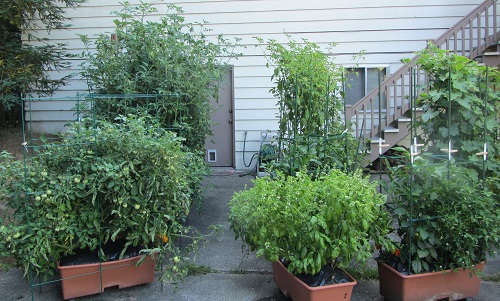
We expanded from 6 tomato plants up to 8 in 2014. For comparison, the 2013 yield was 91.5 pounds, the 2014 yield was 138.0 pounds. On a per plant basis the yield improved from 15.5 pounds up to 17.25 pounds. (Note the “terracing” of the tomato plants on the left. The tomatillos are in the back center.)

140724 overview

Black Krim — 24.5 pounds. [75 day, Indeterminate. Heirloom] Won every taste test. The richest “tomato” flavor. Terrific yield. Winner.

Glacier — 10.8 pounds. [56 day, Determinate. 13.9 pounds in 2013.] Didn’t win any taste tests, or even finish very highly. Somewhat “watery” when compared to the other varieties. The lowest yield of 2014’s tomatoes. I’m inclined to try something else next year.

Mountain Princess — 11.6 pounds. [68 day, Determinate. Heirloom.] Relatively poor yield despite a prime location. Unexceptional taste. I don’t think they’re a keeper.

Oregon Spring — 13.4 pounds. [60 day, Determinate.] Ripened early. Did well in the taste tests. Good “tomato” flavor. Keeper.

Roma — 17.2 pounds. [75 day, Determinate. 26.0 pounds in 2013.] Lower yield than 2013 but the fruit was larger and more of it ripened.

Sungold — 18.4 pounds. [65 day, Indeterminate. 19.2 pounds in 2013.] Another taster favorite. Super performer and distinctly different and sweeter from anything else we grew in 2014. “Candy.” Keeper.

Taxi — 25.9 pounds. [65 day, Determinate.] Great yield. Attractive and it did well in the taste tests. Keeper.

Tigerella — 16.2 [65 day, Indeterminate. Heirloom.] Average yield, average taste, but they are interesting to look at. Late to ripen. I’d be fine with trying another variety instead.

A few pounds of tomatoes got crushed when the cages blew over. Overall though, 2014 saw improved yields and riper fruit. Cherokee Purple might be something to try in 2015, given how well the Black Krims were received.

EarthBox 2014 Recap — The Oddballs

by A.J. Coltrane

Previous post here.

2013 Oddball Recap post here.

We’re getting closer to a four-season harvest from the EarthBoxes. As we’ve moved along we’ve learned that many of the Oddballs actually do best as cool-weather or winter plants. The overall yield should continue to improve as we figure out how to more tightly schedule the various plantings — in the last two years there have been long “fallow” periods. As it is, September/October planting for winter harvest is really too late.

The Oddballs Sorted By Temperature Preference —

Cool Weather:  Arugula, Bok Choi, Carrot, Cilantro, Dill, Garlic, Mache, Parsley, Radish, Romaine Lettuce, Spinach.

Warm Weather:  Basil.

Warm or Cool Weather:  Brussels Sprouts, Scallion, Shallot.

Comments —

Note that up through spring 2014 we were using the EarthBox covers and cutting holes in them for the cool-weather plants. This fall we removed the covers, allowing for the boxes to be planted at much, much higher densities. Hopefully that will help increase the yield.

Arugula — 0.1 pounds. It would have been 1-2 pounds, but a late spring planting combined with unseasonably warm weather caused it to bolt just as it was maturing. Arugula is interplanted with Spinach and Romaine in a few of the half-barrels and ready for harvest between now and the spring.

Basil — 2.9 pounds. Basically 50% of last year’s 6.3 pounds, but we used one box this year instead of two, so there it is. At 2013 retail prices 2.9 pounds is $195 worth of basil.

Bok Choi/Pak Choi — 3.3 pounds. The harvest was overwintered Bok Choi. There is now an EarthBox full of Pak Choi, and the veg is ready for eating. We’ll thin it through the spring.

Brussels Sprouts — 0.0 pounds so far. Planted in the early summer, I’d guess there are around three pounds on the plants, ready whenever.

Carrot — 0.0 pounds. Planted this fall for winter/spring harvest. Two types, though the better winter type is underdeveloped due to Territorial Seed’s failure to ship. At all. In effect, they lost my order. Hopefully that will be the first and last time they screw up.

Cilantro — 0.9 pounds. “Santo” (regular) Cilantro was planted in September along the backs of  a couple of the half-barrels. One EarthBox has “Confetti” Cilantro. None of these are ready yet. I’ll be interested to see if they get big enough to be usable this winter. Interplanted in various containers with Mache, Dill, Romaine, and Spinach.

Dill — about 0.5 pounds. Bolted in the spring. Planted too late in the fall. Right now there are two big plants and a one-pound log of dill butter in the freezer.
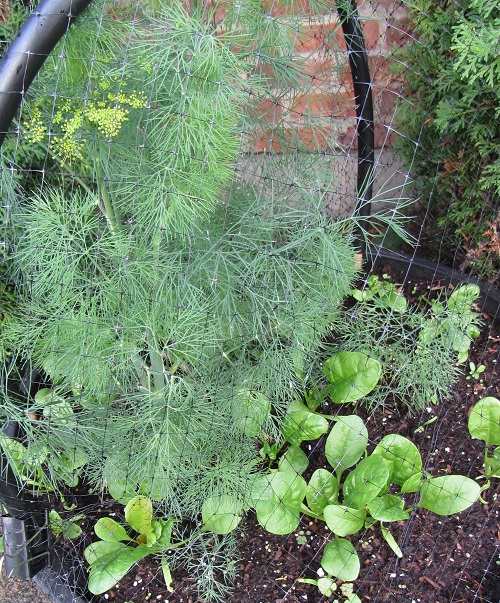
141004 dill spinach

Garlic — 0.0 pounds.  Three heads were received as a gift from a neighbor and planted a few weeks ago. They’re growing like crazy and should represent a good spring harvest.

Mache — 0.3 pounds. We planted a little bit in January and it did fine. There just wasn’t much of it, least partly because we used the EarthBox covers. Mache is now interplanted in many boxes and barrels with “vertical” stuff. It seems like the germination rate hasn’t been very good, either because the seeds are over a year old, or the temperature wasn’t right, or… I won’t be surprised if it continues to germinate as it gets colder.

Parsley — 0.3 pounds. A big bunch of these that were planted in the spring made it all summer before finally bolting in August. The location was somewhat protected and only got morning sun. That’s what I was hoping was going to happen with the half-barrels in the front yard. It’s something to build on.

Radish – 0.8 pounds. We tried a few of two different varieties in the early spring – “French Breakfast” and “Cherry Belle”. Both did fine, though the French Breakfast may be better suited for being “cramped”. This fall we planted “Dragon”. The Dragon are supposed to be better at holding in the ground. The spring types are intended to be pulled as soon as they’re mature, otherwise they get hot/ pithy/ woody.

Romaine — 3.4 pounds. A good yield before it bolted. Had we trimmed these more aggressively the we probably could have gotten about twice as much. Currently ready to harvest – interplanted in a few half-barrels with Arugula, Cilantro, and Mache.

Scallions — 0.5 pounds. a.k.a. “Bunch Onion”. A spring harvest of a few overwintered plants. It went well enough that there’s now an EarthBox jammed full of seedlings.

Shallot — about 0.5 pounds. Many of these rotted in a half-barrel. It seems alliums don’t like wet feet. I figured this fall we’d try growing them in an EarthBox, and use seeds rather than bulbs, since seeds are so much cheaper. We’ll see what we get. The worst case scenario is an inexpensive failure.

Spinach — 1.7 pounds. Spring harvest of overwintered plants, mostly. Lots and lots of spinach is interplanted throughout the boxes and half-barrels. I read somewhere that the crinkly (savoyed) types do better in cold, though I have yet to read that twice, so it needs verifying.

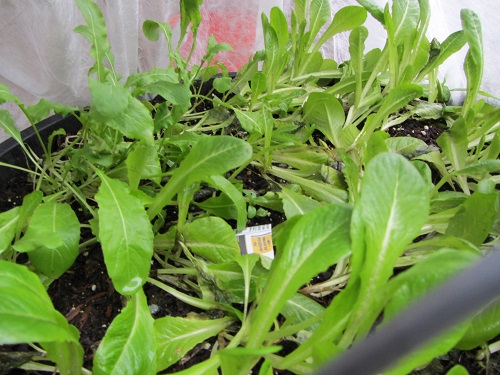
EarthBox 2014 Recap — The Cucumbers And Zucchini

by A.J. Coltrane

2013 Cucumber and Zucchini recap here.

This summer, the cucumbers and zucchini boxes both blew/fell over. Nothing was damaged, but that’s the end of “it won’t happen to me” around here.

140810 zucchini

We went with the vining Tromboncino zucchini this year. We were rewarded with 20.5 pounds of fruit, up from 12 pounds of “regular zucchini” in 2013. Ultimately I’m not sure that we like zucchini enough to try to eat 20 pounds per year..

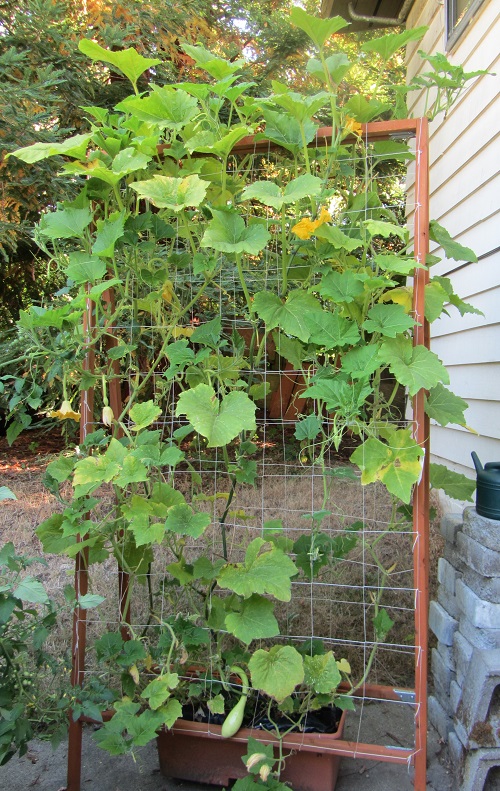
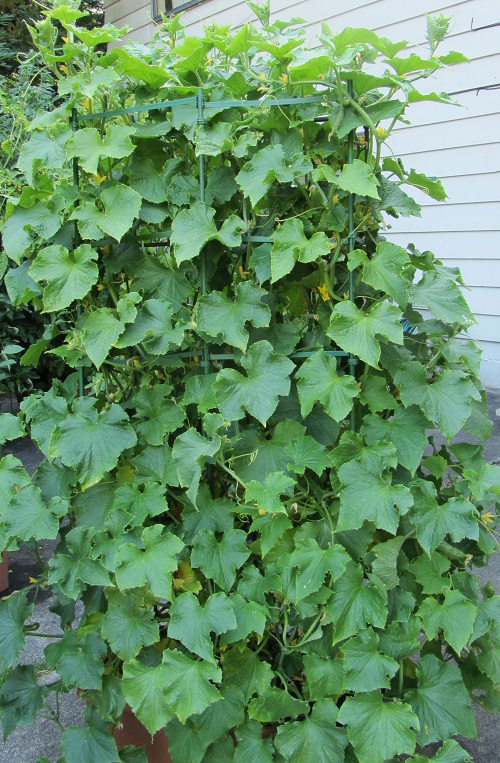
140724 cucumber

Forty-four pounds of Marketmore cucumbers in 2014. That’s down from 56 pounds in 2013, but still well more than we could ever eat. In both years the fruit quality really began to fall after about middle/late August. August 31 might represent a good date to just bag it, pull the plants, and start winter veg. (We got 10 pounds of mostly misshapen produce from September onward in 2014.)

When they’re going good though, they’re very good:

140803 cucumber

It’s my understanding the some commercial growers will do an early and late crop of cucumbers to help keep the fruit quality high. I don’t know how realistic that is with our setup, but it may be worth considering. My suspicion is that for us the net amount of “good” fruit would be very comparable, and that it might not be worth the effort.

Right now I’m leaning towards taking a year off of the zucchini in 2015, though that’s going to be dependent upon finding something we’d rather use the space for that isn’t totally redundant. The Marketmore 64 cucumbers have been very successful both years, though I’d dig it if we could find something with a longer “tail” — a variety that would continue to produce good fruit into September.

In any event, we’re not going to use Ultomato cages for the cucumbers next year. We may wind up using the big trellis for cucumbers in 2015 — that sort of makes sense.

EarthBox 2014 Recap — The Peppers

by A.J. Coltrane

2013 Pepper recap here.

The final 2014 harvest:

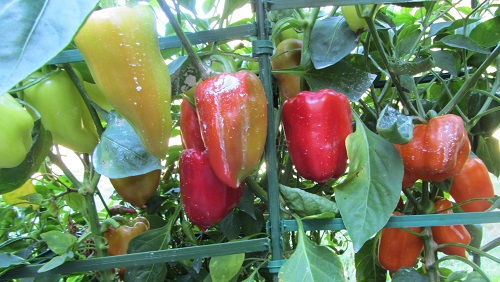
140928 peppers

The 2013 harvest came to 22.2 pounds of peppers from 11 plants — 2 pounds per plant. This year we bumped it up to 18 plants and got 31.0 pounds. That’s 1.7 pounds per plant — a 15% reduction in yield, though that’s close enough to call it the same. About half of the fruit ripened this year, which was a big impovement over last year’s ~20%. (The tomatoes ripened better as well. Not a coincidence I’d bet.)

The table:

Hot Variety Count Weight/per Total Weight
Anaheim College 64 1 2.4 2.4
Hungarian Hot Wax 1 0.9 0.9
Jalapeno 1 2.8 2.8
Thai Hot 1 0.5 0.5
Sweet Variety Count Weight/per Total Weight
Alma Paprika 1 0.4 0.4
Cute Stuff 1 1.6 1.6
Gourmet 2 1.1 2.2
Gypsy 2 2.8 4.7
Karma 1 1.6 1.6
King of the North 5 2 9.9
Pasilla Bajio 1 1.9 1.9
Tequila Sunrise 1 2.2 2.2

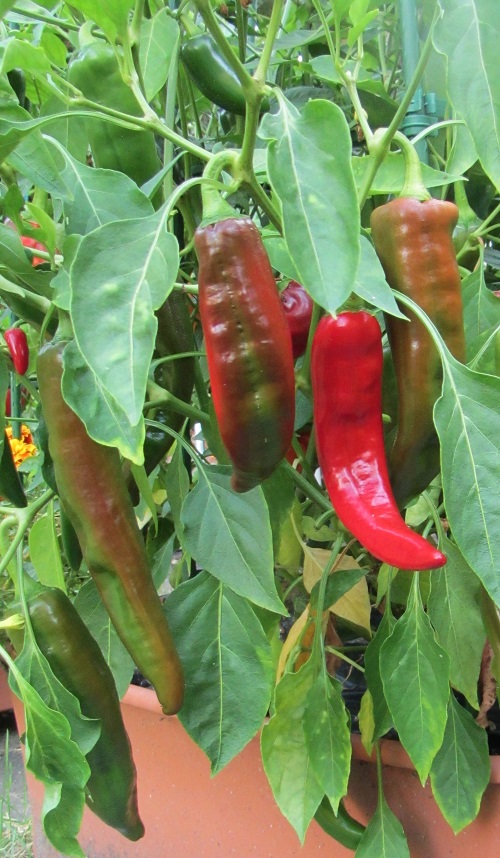
I’m thinking that somebody mis-labeled the Pasillas (the center front sheet tray pictured above). The Tilth description says that they get 8″-10″. We got little 1″-2″ fireballs that looked more like Thai Hot peppers. It could be that the Pasillas were actually Thai Hot peppers. The foliage was super similar, and completely tangled up.

140906 thai hot

We lost a few more sweet peppers than I would have liked to (I think) earwigs. The diatomaceous earth that was applied late in the year may or may not have slowed down the bugs.

140906 Gypsy

Peppers are one of those plants that we can never grow too many. They’re attractive, low maintenance and always enjoyed at the table. Overall I was happy with the outcome.

140921 anaheim

I’m thinking maybe we increase it to two jalapeno plants in 2015.

Container Garden Update — October 19, 2014

by A.J. Coltrane

Previous post here.

Row covers:

141019 cold frames1

Everything is arranged under the deck. The afternoon and evening sun hits the boxes — I *think* there’s adequate light.

The south end. These boxes get direct afternoon sun for a couple of hours, at least:

141019 cold frames2

The bit of green visible through the row cover:

141019 pak choi spinach

Pak Choi in the right-hand box, interplanted with spinach. The box on the left is a mono-spinach box.

One more overview:

141019 cold frames3

The cold frame separates the two “banks” of boxes. There is another box with carrots inside the cold frame.

In theory the row covers will break the worst of the wind and rain. The microclimate should be vaguely warmer, calmer, and drier.

It may be that the “right answer” is to build cold frames to go over the row covers. Maybe next year.

—–

Row cover link. The 5′ width fits nicely over the 9 gauge wire frames. It cut easily to the length needed.


Winter Planting Lead Time

by A.J. Coltrane

I’m attempting to at loosely nail down the timing for starting winter vegetables, with the thought that we could harvest all winter and into the spring, rather than just waiting for the spring growth.

The idea is to select winter hardy plants and have them mostly full-grown by whenever the cold and lack of sunlight stops their development. It then becomes an issue of figuring out when that “growth stops” date is. It’s gotta be sometime in the next four weeks, right?

The table below is intended to take at least some of the “figuring” out of the equation. The “Days” is days to maturity.  The dates in bold along the top are potential “growth stops” dates. Most of the plants that we’ve selected are 30-50 days to maturity, with a few outliers running as much as 75 days or longer, so I’ve centered the table on 50 days:

Days Sep-10 Sep-24 Oct-1 Oct-14 Oct-28 Nov-14
25 Aug-16 Aug-30 Sep-6 Sep-19 Oct-3 Oct-20
30 Aug-11 Aug-25 Sep-1 Sep-14 Sep-28 Oct-15
35 Aug-6 Aug-20 Aug-27 Sep-9 Sep-23 Oct-10
40 Aug-1 Aug-15 Aug-22 Sep-4 Sep-18 Oct-5
45 Jul-27 Aug-10 Aug-17 Aug-30 Sep-13 Sep-30
50 Jul-22 Aug-5 Aug-12 Aug-25 Sep-8 Sep-25
55 Jul-17 Jul-31 Aug-7 Aug-20 Sep-3 Sep-20
60 Jul-12 Jul-26 Aug-2 Aug-15 Aug-29 Sep-15
65 Jul-7 Jul-21 Jul-28 Aug-10 Aug-24 Sep-10
70 Jul-2 Jul-16 Jul-23 Aug-5 Aug-19 Sep-5
75 Jun-27 Jul-11 Jul-18 Jul-31 Aug-14 Aug-31

As an example, assuming a 50-day maturity, and targeting October 28 for “growth stop” gives September 8 as the date to sow the seed. Ideally the plant will be 90%+ developed whenever the brakes hit.

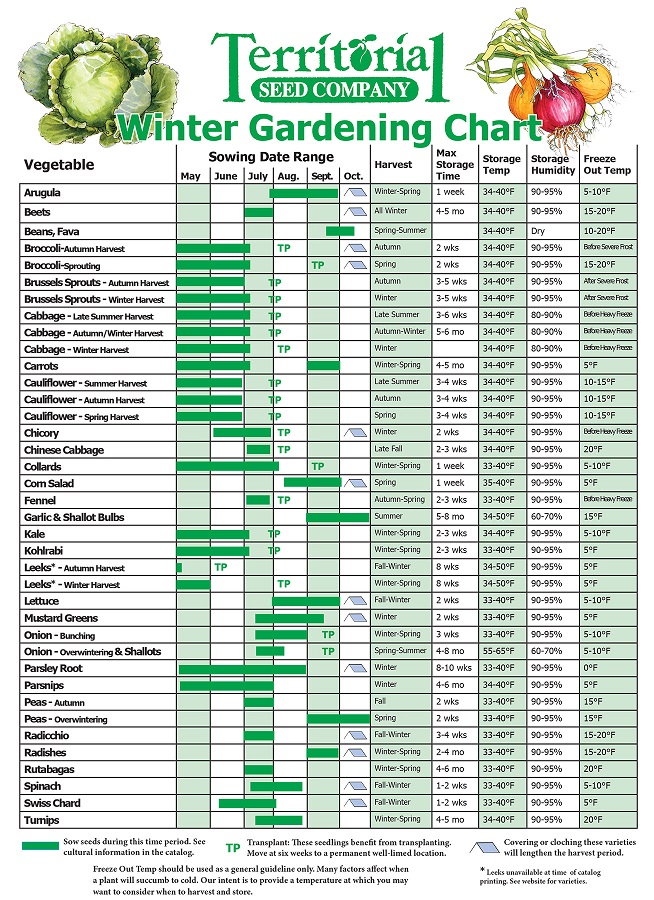
Of course, I could have just consulted this. (link)

winter-gardening-chart-2013

The thing with the Territorial Seed Co. table is that the harvest dates are all over the place. That’s likely because they’re actually doing it “right”, or it’s how the majority of their customers choose to do it, but I’m hoping that “the other way” works too. We’ll see.

Container Garden Update — October 4, 2014

by A.J. Coltrane

Previous post here.

October 7, 2013 post here.

141004 watering cans2

We still had summer vegetables growing at this time last year. They’re long gone by now this time around, replaced by winter vegetables:

Bunch Onions
Bunch Onions

I’m still figuring out when to start winter veg, and what varieties do best in cold/long storage conditions. As an example, small, fast, round radishes do best in the spring and are intended to be harvested promptly after they’re ready. Longer maturity “carrot-shaped” radishes tolerate being held in the ground much better. Actual carrots have 4 or 5 different broad types as well. This is all new to me — just like I assumed that *all* vegetables did well in the heat of summer, it never occurred to me that different varieties of certain vegetables prefer either fall/winter or spring.

It may be that the vegetables in the EarthBoxes have been direct-seeded too late in the year. In the future we may start them in pots a month or so earlier an then transplant when the summer veg has been cleared out of the way. As it is, the plants in the whisky-barrel containers are well ahead of the EarthBox plants. Pictured below are spinach and cilantro that were started about a month ago (I should have labeled the date next to the new sowing.) I left the dill in place that’s now around two months old.

141004 dill spinach

They’re covered with bird netting because something — I think squirrels — had been digging in the newly exposed dirt. The carrots below are protected from flies with tulle:

141004 carrot

That’s carrots in the foreground, bunch onions under plastic in the middle, and romaine/arugula in the whisky barrel. I’m guessing that the whisky barrels don’t drain well enough for the alliums, which led to the shallots rotting this spring.

Other recently planted boxes include mache/parsley (interplanted); mache/cilantro (interplanted); spinach; pak choi; more bunch onions; mache; dill; and leeks. This afternoon at least one of the tomato boxes is going to become shallots.

It seems everything is doing better in the cold frame, so the open boxes got plastic-covered hoop houses. More pictures next week. Hopefully there will be something to show.