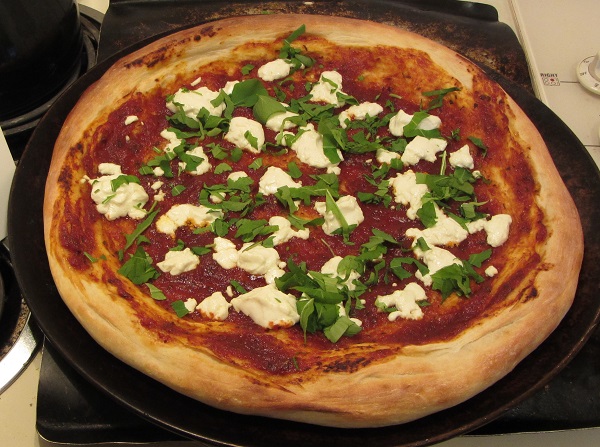
A From-Scratch Gluten-Free Flatbread Recipe I’m Pretty Happy With

A friend of mine expressed interest in a recipe for a gluten-free flatbread, since they weren’t happy with any of the pre-made mixes they’d tried. That sparked my interest too — and I spent a bunch of hours digging around forums and websites looking for commonalities and differences among the recipes I could find.
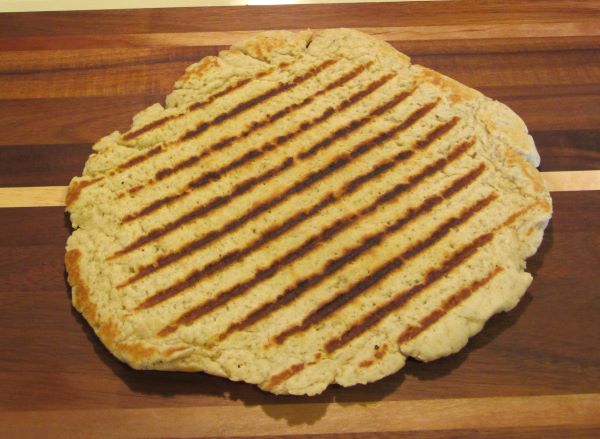
This recipe makes a flatbread that just fits into our grill pan. When the flatbread comes out of the grill pan it’s flexible — to make it crispy on the bottom put the finished bread onto a pizza stone at 450F for 2-3 minutes. The oven is also a good way to warm up any desired toppings.

I’ll post some other thoughts towards the bottom of the post.

The Recipe:

Wet Ingredients:

110g lukewarm warm (~100F)

40g milk powder

8g psyllium husk

10g extra virgin olive oil

Dry Ingredients:

65g Super Fine Brown Rice Flour

20g Tapioca Starch/Flour (same thing)

10g Corn Starch

5g Potato Starch

4g Baking Powder

3g Kosher Salt or Sea Salt

The steps:

  1. Add the lukewarm water to a mixing bowl. Add the powdered milk and whisk to combine.
  2. Add the psyllium husk and whisk to combine. Let rest a few minutes to let the psyllium husk hydrate.
  3. In a separate bowl combine all of the dry ingredients and stir to distribute.
  4. Add the olive oil to the wet, now viscous milk mixture. Whisk to combine.
  5. Add the dry ingredients to the wet ingredients. Starting with a spoon or spatula mix to combine.
  6. “Knead” and press the mixture until it becomes the texture of masa. I use my knuckles to fold and press the dough into the leftover dry bits until it’s completely combined.
  7. Preheat a pan to medium-high. I use the same temperature that I use for hashbrowns. I want brown but not charred.
  8. Cut a piece of parchment to the same size as the pan. Mine is 8″ x 8″.
  9. Oil the parchment and roll out the dough to 1/4″ thick. (picture below)
  10. Oil the top of the dough.
  11. When the pan is up to temperature, invert the dough/parchment onto the pan and peel away the parchment paper. Add more oil to the top if it looks dry.
  12. Bake 3 minutes on side one, then flip and bake on side two another 2-3 minutes. I use two spatulas to flip to try to make sure the bread doesn’t break.

At this point the dough can be topped and reheated in the oven.
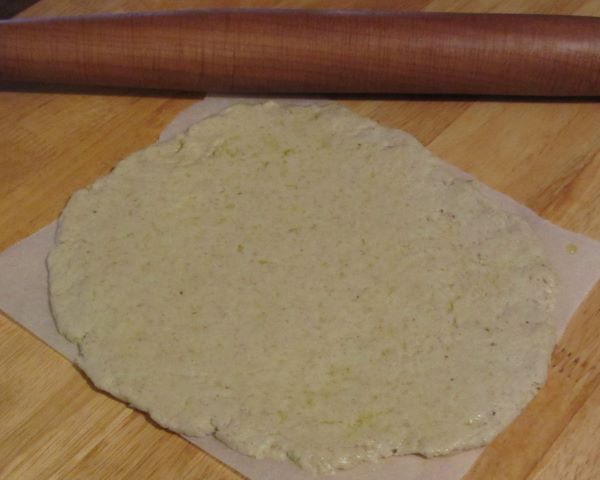
For pretty edges, trim the outside with a knife or pizza cutter. I’m always ok with rustic.

When creating the recipe I wanted to pin-down at least one variable. I decided that 100g of flour + starches would fit pretty well in the pan so that became the “base”. The end result is (65g brown rice + 35g total starches = 100g). More notes on that ratio below. Once I settled on the dry weight only the wet weight required adjusting.

The tapioca / corn starch / potato starch ratio was partly inspired by a forum post on pizzamaking.com, and partly because I was targeting a particular mouthfeel and taste in combination. Every starch has a “signature” taste and mouthfeel, I tried to avoid using too much of anything so that when people eat it they won’t say “that’s tapioca”, or “that’s corn starch”. I started with way too much potato starch, which has a pleasant taste, but too much and it becomes dense and “potatoey”.

Flexible when it comes out of the pan.

Some other commonalities among gluten-free baking recipes, broadly:

2% salt by weight is a very normal amount in all bread baking. This becomes 3g in the recipe above due to all the other stuff in addition to the 100g of flour and starch.

4% baking powder by weight is normal. This one took a little more digging since almost without exception people use volumetric measures.

For gluten-free flatbreads the ratio of flour to starch varies quite a bit but often lands around 2 flour to 1 starch by weight. Water tends to be around the same weight as the combined weight of the flour and starch. “Regular gluten-free breads” tend to be more around 1:1 flour:starch by weight.

One other thing I learned that I didn’t know going in, was that the potential ingredients/exchanges can vary a lot in weight, given the same volume. I always bake with metric weights, so changing one component for another was pretty simple, and I usually didn’t have to mess with the amount of liquid required to get a similar dough ball.

More so than in “regular” (gluten) bread baking, substituting anything will make for a different, or very very different end result. The ingredients themselves have different tastes, or they hydrate differently, or they give a different mouthfeel. I know that this recipe gives consistently pleasing results. Changing anything will basically make it a different recipe. It may still have a good taste and texture, it’ll just be different, and using a substitution may require more fiddling to make it work.

Finally: The most obvious way that this recipe differs from pre-made mixes is it uses psyllium husk rather than xanthan gum, or guar gum. I think the reason so many mixes contain xanthan gum, and by extension so many people include it in their recipes is this: It doesn’t require a separate hydration step and it can be bagged and shipped together with the rest of the pre-made mix. I feel like Xanthan gum has its places but psyllium husk was the better choice for this recipe.

Happy Baking
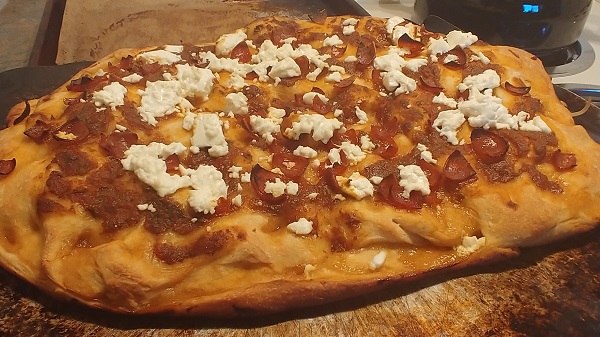
An Italian Tomato Pie – Pizza – Focaccia Made With Fresh Milled Wheat

A weeknight dinner pizza loosely in the style of an Italian Tomato Pie / Focaccia:

Topped with cupping pepperoni, goat cheese, and a red sauce made from our garden’s tomato sauce, basil, and oregano. The dough was very airy and light with mostly small holes in the crumb. It was baked on a sheet tray with lightly oiled parchment paper, so the bottom got a nice crispiness. The top had just a little crunch too. It was definitely rustic.

The Ingredients:

400 grams AP flour. 100 grams Hard White Winter Wheat flour (milled in our Mockmill). 500 grams flour total.

315 grams room temperature water (baker’s percentage 63% hydration)

15 grams honey (3%)

15 grams extra virgin olive oil (3%)

10 grams kosher salt (2%)

2 teaspoons instant yeast (not rapid rise)

The Handling:

Combine all ingredients and mix on low speed for 6 minutes.

Briefly finish kneading and shaping the dough into a ball.

Lightly coat a bowl with oil, cover and let rise 45 minutes.

Stretch and fold the dough, re-form into a ball, cover and let rise another 45 minutes.

Line a sheet tray with parchment and lightly oil the surface of the parchment. Transfer the dough to the parchment and lightly stretch it out, leaving it 1/2 inch to 1 inch thick. 500 grams of flour won’t stretch all the way to the edges of the sheet tray and that’s ok.

Dimple the dough all over with your fingertips. Turn on the the oven to 450F. Cover and let rise one hour.

Top with the tomato sauce and pepperoni. Bake at 450F for 15-18 minutes, or until the top begins to brown and the dough feels like it’s near baked when tapped. It will feel somewhat rigid and hollow. Top with the goat cheese and cook another 3-5 minutes.

Let the pizza rest, then cut into squares.

Thoughts:

If the bottom had cooked any further than it did it would have been overcooked. Adding an extra sheet tray to the bottom half-way through the bake likely would have created a slightly less “done” result. It’s something to keep an eye out for next time.

For an improvised dough, the finished product came out pretty much like what I’d visualized, so I was happy with that. It was very rustic but light at the same time. There were just enough toppings to make it interesting but not so many that the dough didn’t shine through.

One nice thing about using white wheat berries is that they don’t announce themselves like red wheat berries do. It’s more of a subtle backstory that adds depth and “what is that flavor?”

At some point I’ll need to try a 2-3 day cold ferment instead of the weeknight-gotta-get-dinner-on-the-table room temperature approach.

Overall it was somewhat unusual and definitely enjoyable. Win.

Weeknight Flatbread With Rye Flour And Greek Yogurt

A weeknight flatbread recipe that looks and tastes like more effort than it really is-

As an example, an easy flatbread recipe might be something like:

Combine 300 grams AP flour, 185 grams room temperature water (65% hydration), 6 grams kosher salt (2% of the flour by weight), and 1 tsp instant yeast in a stand mixer. Knead on low speed for 8 minutes. Cover and let rest 1 hour. Divide the dough into 3 balls, cover, and let rest another 30 minutes. Heat a skillet over medium high heat. Stretch the doughs out into loose rounds 6-8″ across. Brush each side of the discs lightly with olive oil, and cook 2-4 minutes per side until done and browned to taste. Wrap the finished breads in a clean kitchen towel to keep warm.

Continue reading “Weeknight Flatbread With Rye Flour And Greek Yogurt”

Two Very Different Arugula Flatbreads

We love arugula on pizza and flatbreads. Last night it was time to harvest the arugula from the salad table. (The link shows the salad table one month after the initial planting in 2015, with yet another arugula pizza. I sense a theme. Here’s a link to the Making The Salad Table post.)

The first picture is last night’s arugula pizza with a garden tomato sauce from the freezer, goat cheese, and red pepper flakes. The arugula was strewn on top after baking:

190519 argula pizza2

The sauce was rich and on the sweet side. The frozen tomatoes that we used were labeled “2018 Tomato”, so the base was likely a combination of Oregon Spring and whatever else the garden provided that day. The dough itself was a little on the sweet side too — I substituted out 10% of the water and replaced it with a Riesling.

Another picture. I stretched the pizza by hand rather than rolling it out, making a point to leave it thicker at the edges. The pizza was a little more 3-dimensional than the picture might show:

190519 arugula pizza

This flatbread is topped with pancetta, red onion, and an arugula pesto made with arugula, pine nuts, olive oil, garlic, and brie. The arugula pesto was the sauce, so it was added at the beginning:

190519 arugula flatbread2

Using arugula pesto meant that the end result was light and savory at the same time. The flatbread itself was somewhat crackery which complimented the zip of the arugula and red onion.