Container Garden Update — May 31, 2015

by A.J. Coltrane

Previous post here. June 1, 2014 mini post here. June 7, 2014 post here. (Note the basil, third picture down, front right. More on that below.)

The growth in the garden is accelerating rapidly — here are the first tomatoes (Sweet Million):

150531 sweet million

The potted raspberries have around 100 fruits or so. It’s year three and they’re really getting going. There’s bird netting strung up over the cage:

150531 raspberry

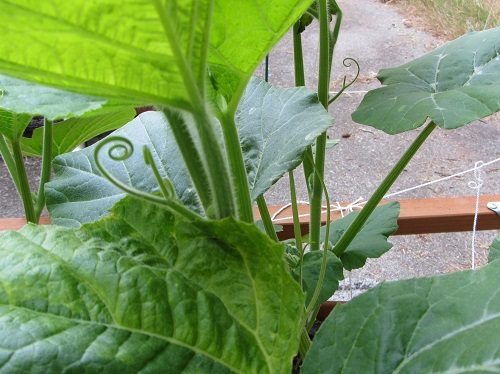
The cucumbers and zucchini simultaneously decided it was time to start getting grabby. The “Calypso” cucumbers:

150531 calypso cucumber

The Tromboncino:

150531 tromboncino

Today saw the first dose of calcium nitrate for the tomato plants (1 tsp down the feed tube). Tomorrow I’m going to try a milk/water solution on the leaves of the zucchini as a preventative against powdery mildew. Hope it works.

—–

As compared to last year, this year’s basil is twisted, floppy, and sickly looking. The plan is now to harvest it next week and try again with better starts. I don’t think we’ll be using Tilth for basil anymore. Bah.

Container Garden Update — May 24, 2015

by A.J. Coltrane

Previous post here. May 30, 2014 post here.

I can’t imagine how blown away ancient man must have been when introduced to the concept of planting seeds. I’d guess that it happened like many other of humanities’ great discoveries — totally by accident. Uneaten seeds were thrown into a “garbage” pile, and after a while the garbage pile sprouted food. I’d like to think it wouldn’t have taken that long to figure out what was going on, but with people being people, who knows?

Just a few pea seeds, almost haphazardly thrown around, and bingo. Total Force Multiplier:

150524 peas

I broke down and attached a spare piece of netting for the peas. I’m sure it’ll improve the results.

As an aside:  We went to the local P-patch today to look around — Lots of peas, lettuces, carrots, and various types of alliums. Some tomatoes and tomatillos. One tiny little bit of corn, and one of beans. A little bit of squash. Not a cucumber in sight. The groupthink seemed almost monolithic in its decision making.

That doesn’t make any sense to me. Our cucumbers out-produce everything expect maybe the tomatoes. Maybe they’ll all plant cucumbers after the peas are done?

My guess is no. The food bank boxes are densely planted and well maintained. The other boxes, not so much. It might be because they’ve got so much space to play with, but to my mind they’re “wasting” a lot of it. There are “big” areas with nothing going on… Today is basically June 1st, shouldn’t there be something growing? (Or maybe it’s just me, and that having to deal with super finite space all the time has made me feel like wasted space = wasted opportunity. It’s really my problem, not theirs…. Nah.)

Back to our stuff. Clockwise from the top left:  a “Calypso” cucumber (the other one got broken by something), Lemon cucumbers, “National Pickling” cucumbers, Lemon cucumbers.

150524 cucumber

For scale reference:  The squares are 8″ x 8″.

The tomatillos. The Mexican Strain is on the right. It’ll have a vertical habit. The de Mipa is on the left — it’ll sprawl somewhat. The de Mipa is “ahead” of the Mexican Strain. That’s the opposite of what happened last year. I think last year’s Mexican Strain was a stronger plant:150524 tomatillo

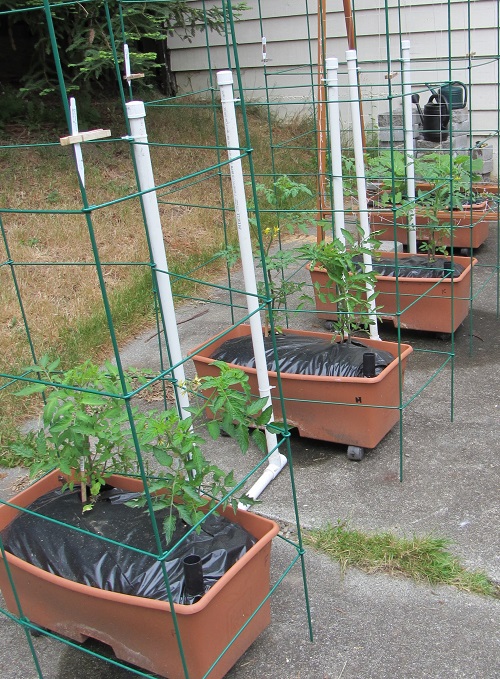
The tomatoes, with the Tromboncino in the back. Nothing is huge yet — the tallest of the indeterminates are about waist high. (The Sweet Millions, middle left.) Note the pvc attached with cable ties for cage support and the labels attached with clothespins. It’s less work, and less thinking every year that we continue to do this — those are old, and preassembled ideas. (Just like the new trellises this year, next year we won’t have to build them again.) I’ll likely reference this photo again in about a month for comparison:

150524 tomato

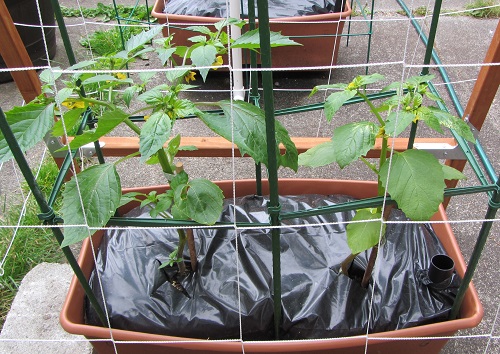
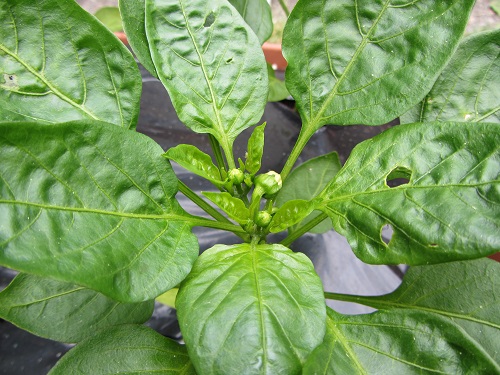
It’s been cloudy the last few days, but it’s not stopping the peppers:

150524 pepper

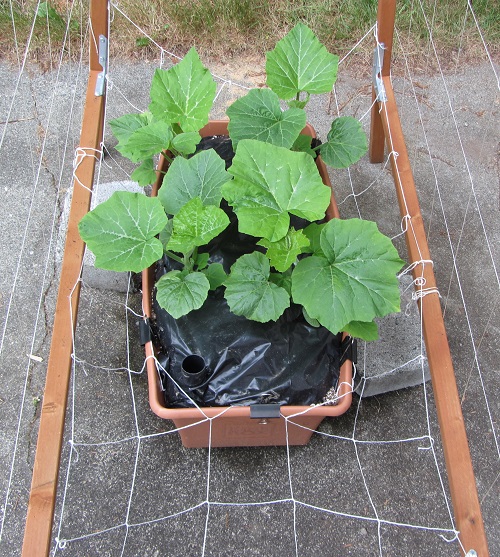
The Tromboncino. There are four plants, one in each corner of the box. They’ll need to be coaxed to the sides and onto the main trellis soon. I added some netting going from the box to the sides, just it case it helps:

150524 tromboncino

Note the repurposed binder clips, holding the net onto the box. Those were used to attach the row covers this last winter. The clothespins now securing the labels did double duty that way too.

I really enjoyed this cat meme. Here you go:

ralph


Container Garden Update — May 18, 2015

by A.J. Coltrane

Previous post here. May 16, 2014 post here.

We spent five hours on Saturday building three new trellises and attaching the netting, assembling Ultomato cages, and caging & staking all of the plants as needed:

150518 garden

It looks really different than last year. The 8′ trellis contains the Tromboncino. The 6′ trellises are for cucumbers and the tomatillos.

I still need to add the tomato cage supports (pvc lengths with elbows.)

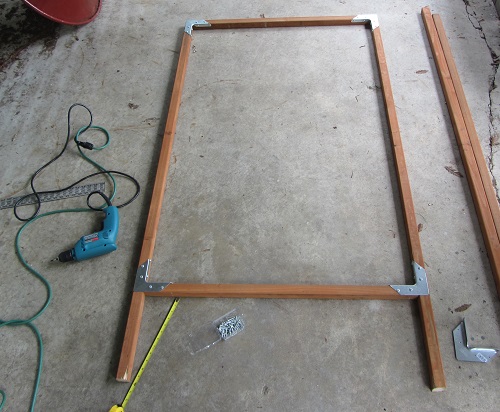
For reference, pictured below is a partly-completed trellis. It’s 6′ tall, the crossbars are 3′. Home Depot sells the RTA12 corner supports and associated screws. The tops get connected with 3 galvanized hinges that are 1-1/2″ on each side of the hinge:

150518 trellis

Five hours was longer than we’d planned for. Everything took some time and it added up. Fortunately we won’t need to build any more trellises any time soon.

Next time I think I’ll spread the staking out over a few days. Oof.

Container Garden Update — May 11, 2015

by A.J. Coltrane

I’ll stick with “Container Garden”, though right now it’s basically “EarthBox Garden” again.

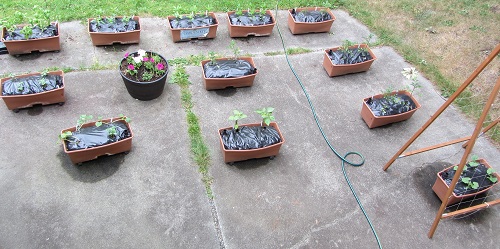
The vegetables were purchased on Saturday, May 2. The cucumbers and zucchini were transplanted on May 3. On the night of May 5 it got down to right around 40 degrees, so I rolled those three EarthBoxes into the garage for the evening. (The other stuff was already coming in every night.) By the middle of last week it looked like we didn’t have any more really cold nights coming up, so on the Thursday the 7th I transplanted everything else after work. As of yesterday, it’s all settling in:

150510 front view

Front Row: Determinate tomatoes (Cosmonaut Volkav & Roma), Sweet Peppers (King of the North), Peppers (Lipstick, Iko Iko, Carmen), Peppers (mix of sweet & hot), Basil

Row Two:  Indeterminate Tomatoes (Sweet Million & Black Krim), Determinate Tomatoes (Taxi & Oregon Spring), Pretty Flower Container, Cucumbers (Marketmore 76)

Row Three:  Indeterminate Tomatoes (SunGold, Tigerella), Tomatillos (Mexican Strain & de Mipa), Cucumbers (Lemon, National Pickling, “Calypso”)

Row Four:  “Tromboncino” zuchinni


Rear view,from a 2nd-story window:

150511 top rear view

Far row: Basil, Peppers, Peppers, Peppers, D. Tomatoes

2nd row:  Cucumbers, Pretty Flower Container, D. Tomatoes, I. Tomatoes

3rd row:  Cucumbers, Tomatillos, I. Tomatoes

Closest:   Tromboncino zucchini


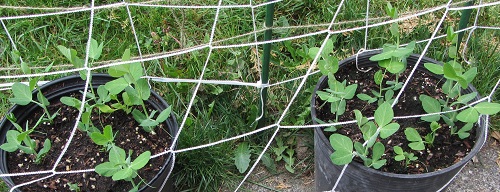
We didn’t want to devote a container to peas, so I threw a few “seeds” into spare pots. They’re just now starting to peek out of the soil:

150511 peas

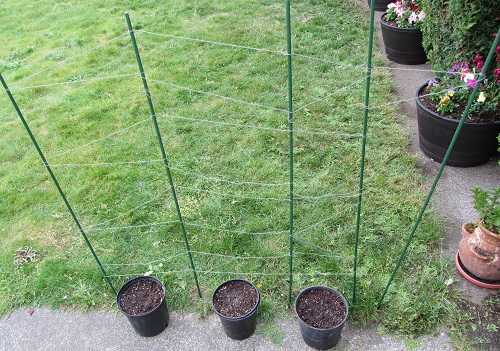
Those are Ultimato stakes stuck into where the walkway meets the grass. The string may need a little more help, but it’s a start. (I guess I could have used netting, but I already had the string..)

————————————-

Do you like mockumentaries? Does a silly movie about vampires sound like your thing? Then go see “What We Do In The Shadows.” It follows the “lives” of four vampires “sharing a flat in New Zealand”.

Thunderbolts And Lightning, …

by A.J. Coltrane

High winds, intermittent heavy rain, and new plants. Not a good combination. The EarthBox with the tomatillos got rolled under cover next to the house. The tomatoes and peppers are hiding in the cold frame:

150505 Cold Frame

The picture makes the plants look shorter than they really are. As of right now the peppers are spindly enough that they need the protection. I left the lid mostly open so that they wouldn’t cook if the sun came out.


The 2015 Plant List

by A.J. Coltrane

We purchased $135 of vegetable starts on Saturday at the Seattle Tilth edible plant sale. (All descriptions from the Tilth PDF.)

[Comments:  The cucumbers and zucchini have been planted. The tomatillos arrived in tiny pots that instantly dessicated, so they got planted and are rolled into the garage at night. The other plants are still in their original pots — they come into the garage at night too. I came home today to see the wind beating the hell out of everything, so bedtime in the garage came early. The cucumbers and zucchini are low-slung enough that they should be ok.

I think that each year we’ve targeted shorter and shorter maturity dates. There are no more Bradywines. We didn’t do 80-100 day Brussels Sprouts this year. I’m interested to see if we really *are* moving the maturity dates that much — it will likely result in a mathy blog post at some point.]

The List:

Tomatoes (8 total, 2 per box, 4 boxes):

Sweet Million (Cherry) – 65-75 days. Indeterminate. 3 ft. tall plants produce 1-1 1/2 in. fruit in grape-like clusters. 65-75 days. One of the besttasting red cherries with a crisp sweet flavor. Fusarium Wilt (races 1 and 2) and Tobacco Mosaic Virus resistant. Winner of best cherry tomato at the 2007 Tilth Tomato Tasting.

Sungold (Cherry) – 65 days. Indeterminate. Wow! Sungold’s fruity or tropical flavor is a big hit with everyone who tastes it. Apricot-orange round 1 1/4 in. fruit. 10-20 fruits on grape-like trusses. Generally we try to offer open pollinated and heirloom varieties, but we just can’t give up Sungold! Winner of Best Cherry Tomato at the 2005 and 2006 Tilth Tomato Tasting.

Black Krim – 75 days. Open pollinated heirloom. Indeterminate. From the Black Sea region of Russia, these 10-12oz beefsteak type tomatoes have a strong, rich flavor that is common with black tomatoes. One seed catalog noted that the fruit is best when half green and still firm. Very productive. Reportedly is a consistent favorite at tastings, so why not give it a shot?

Cosmonaut Volkov – 68 days. Open pollinated heirloom. Semi-determinate. Ukranian variety named after a Russian Cosmonaut. This tomato delivers that perfect sweet-tart beefsteak flavor in an early-maturing variety. Fruit are large 10oz – 1lb and produce reliably by mid-August.

Oregon Spring – 60 days. Determinate. An extra-early variety that sets loads of meaty fruits weighing 3 to 5 oz. Compact plants set fruits even in cool weather and continue to yield all season long. Nearly seedless. A perfect choice for ketchup and sauces.

Roma (sauce) – 75 days. Determinant. Premium canning tomato, ideal for sauce and paste. Pear-shaped scarlet fruits are thick and meaty with few seeds.

Taxi – 65 days. Open pollinated. Determinate, early, prolific production. The best yellow tomato for short season gardeners. Expect heavy yields of mild, non-acid tomatoes for 3-4 weeks. Grows well in a container.

Tigerella – 65 days. Open pollinated. English Heirloom. Indeterminate. Interesting green turning to red and orange tiger-striped fruit . Very early and prolific – produces throughout the season. Excellent for salads. Low acidity variety.

[Comments:  Six repeats. Cosmonaut Volkov is new. I’ve wanted to try it for a couple of years now. This is the first time we’ve had a space and the variety was available at the sale. The other new tomato is the Sweet Million. It should complement the SunGold nicely.]


Tomatillo (2 plants, 1 box):

De Milpa – 60 days. Open pollinated. Mexican heirloom. “Di milpa” means “from the fields”, as this type commonly grows wild in the cornfields of Latin America. Small fruit but great storage quality, remains green and firm weeks after picking.

Mexican Strain – 65 days. Open pollinated. At 2 inches, these fruit are larger than most tomatillos. They are savory and fresh tasting, great for making salsa verde or adding a Mexican flavor to your dishes. Tomatillos produce tons of fruit on sprawling vines, but don’t usually need to be trellised. Fruits will burst out of husks and fall to the ground when they are ripe.

[Comments:  Both repeats. The Mexican Strain has a vertical habit. The De Milpa sprawls by comparison. They fit well in a box together. It ain’t broke…]


Cucumber (8 total, 4 per box, 2 boxes):

Calypso (Pickling) – 52 days. An early producer with astoundingly abundant yields, ‘Calypso’ is also highly disease-resistant, making it any easy care and dependible pickling cuke. You can expect 1″ x 3″, blocky, medium-green fruits–just the right size for snacking. Preserve some of the harvest for the lean months of winter, give ‘Calypso’ a try!

National Pickling (Pickling) – 52 days. The premium pickling cuke! Bears heavy crops of 6 inch average cucumbers perfect for pickles. Crispy and sweet, this cucumber is also good for slicing.

Lemon (x2) – 70-75 days. Open pollinated heirloom. Dating back to the 1890’s, this old variety is a favorite among many cool season gardeners. 3-4 foot, semi-bush type plants bear loads of apple-shaped cucumbers with lemon-colored skins. Thin skins and mild, sweet flesh make them a joy to eat whole right from the garden! Best harvested when the size of limes. Hermaphrodite – Flowers contain both male and female reproductive parts, which means abundant yields in the garden!

Marketmore 76 (x4) – 63 days. Open pollinated. In the Marketmore series, ‘Marketmore 76’ is very popular with organic growers due to its high level of disease resistance. This dark green slicing variety produces abundant, high quality, uniform fruits about 8 inches long with a wonderful cucumber flavor. This is your classic, all-around cucumber!

[Comments:   The Marketmores have been hugely successful both years, so they get their own box. We had a Lemon cucumber two years ago that did great, so those get 1/2 of a box. Two new varieties of pickling cucumbers fill the 2nd box. Each of the pickling cucumbers is super early. Hopefully we’ll get a staggered harvest from the three broad types.]


Zucchini (4 plants, 1 box):

Tromboncino – 60-80 days. Open pollinated heirloom. A Seattle Tilth favorite, the flesh of this variety has a smooth buttery texture and a mild flavor—the taste of summer! The 12 to 18” long fruits are “trombone”- shaped and can grow in curly cues or hang like bells on a trellised vine. Harvest when they are a pale, grass green or leave a few fruits at the end of the season to mature to a buff color and enjoy them as you would a winter squash.

[Comments:  We have yet to have much success with zucchini. This is the 2nd year of the Tromboncino. They’ll get a more premium location this year, and I’ll probably harvest them more aggressively. They will also be less crowded — the weak sisters are going to get pruned. Hopefully all of that will contribute to us harvesting the same million pounds of zucchini everyone else gets…]


Peppers (18 plants, 6 per box, 3 boxes. The first three are hot, the rest are sweet.):

Anaheim College 64 (hot) – 74 days. Open pollinated. Medium hot flavor make these short season peppers a hit for dips, sauces, stuffing with cheese or roasting. They are just like the anaheims you find in the store but without having traveled all those miles to get to you!

Early Jalapeno (hot) – 66 days. Open pollinated. Hottest and fully ripe when they turn red but most is familiar in the green stage. 2 ft. tall plants produce 3 in. peppers. Will set fruit in cooler conditions better than other hot peppers.

NuMex Highlander (hot) 65 days. An early Anaheim type pepper in the NuMex line developed by the Chili Pepper Institute of New Mexico State University. Produces earlier and has longer fruits than Joe E. Parker. The plants are large and tall and very productive bearing 7 inch long fruit. Try these peppers sliced and stuffed with red rice, goat cheese and parsley for a simple dinner. Or throw on the barbecue and blacken to accompany your favorite grilled fish.

Bullnose Bell (x2) – 58 days. Large Sweet Spanish. Heirloom. An extra early maturing variety that ripens from green to red. Sweet, sweet flesh contrasts with spicy interior ribs–very nice! Originally from India and very prolific!

Carmen (x2) – 60 – 80 days. Lusciously sweet when left to fully ripen to a deep red, this pepper is perfect for chopping and tossing straight into a salad. A great container plant and a good addition to a sunny veggie bed. 6 inch fruits on an upright plant.

Iko Iko (x2) – 65 days. A reliable, sturdy and upright sweet pepper for cooler climates. Produces a variety of colors, from lavender, purple, yellow and lime green when immature to tangerine and red streaked with purple when fully ripe! Lovely specimen plant for containers

King of the North (x6) – 76 days. Open Pollinated. Here is a sweet bell pepper that will mature in short season climates. Its crisp, blocky fruit will turn from medium green to red if left on plant longer. Excellent raw in salads or dips. Great to use as stuffed pepper or in tempura recipes.

Lipstick (x2) – 55 days. Open pollinated. Early and productive, a great choice for a short season! Chunky, triangular peppers with very nice, sweet flavor.

Yellow Mini Bell (x1) from the Master Gardeners plant sale.

[Comments: The King of the North have been our most successful, so they get a full box. The Lipstick, Anaheim, and Jalapeno are repeats. The others are relatively fast maturing varieties that looked interesting.]


and Sweet Basil. 6 plants. 1 box.

[Comments: It’s Basil. We Love Basil.]


That was a way longer post than I’d intended, but now it’s documented for next year.
Container Garden Update — December 13, 2014

by A.J. Coltrane

We had set up the EarthBoxes with winter greens under the deck.

Unfortunately, the planting happened really late in the year, then we were blasted by 20 degree temperatures at night.

Stuff was recovering somewhat, but it’s all basically stalled. As it turns out, that location seems to receive too little sunlight. The back of the house faces vaguely northwest, when combined with the lower angle of the sun and shortened days there’s not enough sunlight for the plants to do better than break-even at best.

The front of the house faces a little bit to the southeast. The morning sun means that the containers in the front are doing this:

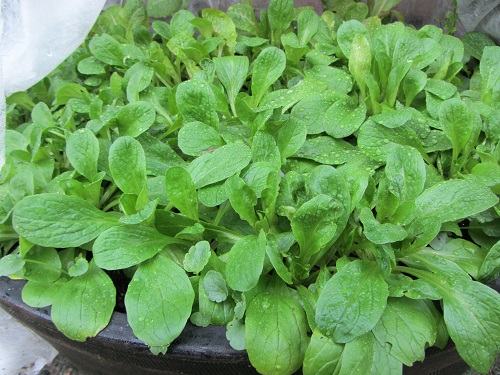
141213 mache

That’s mostly Mache, with some iffy-looking Romaine in the middle and small Cilantro plants in the back.

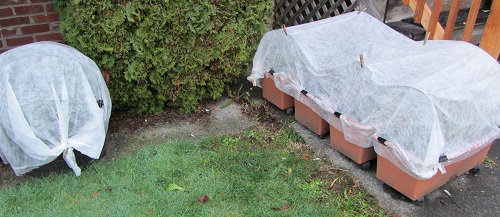
They’re doing tons better, so we moved the four best (most salvageable) EarthBoxes to the front yard for more sun goodness:

141213 containers

The remaining boxes under the deck have been rolled out to a more open location on the back patio. We’ll see how it all shakes out. Right now I’m thinking that the struggling boxes in the back yard will get interplanted with fast-growing cool-weather greens and vegetables in late February or early March. We’ll let the front-yard boxes go until it’s tomato season again.

I don’t think it could have gone a whole lot worse during our first real season of winter gardening, but we’re still getting something. Hopefully it’s up, up, and away from here.

The plant mix definitely needs some work. More on that later.

Two Microclimates

by A.J. Coltrane

The nighttime temperatures dropped down to around 20F this week. There was no gradual decrease from warm, either. The evening temperatures went 40, 40, 40, 40, 20, 20, 20. There’s a marked difference in how the front yard plants have been handling the cold as compared to the back yard plants-

The front yard gets morning sun when it’s clear outside. It may also help that the sun reflects off of the house and onto the containers:

141116 romaine

The containers in the backyard get comparatively little sun. This romaine is still frosty around noon:

141116 romaine3

Front yard again:

141116 romaine2

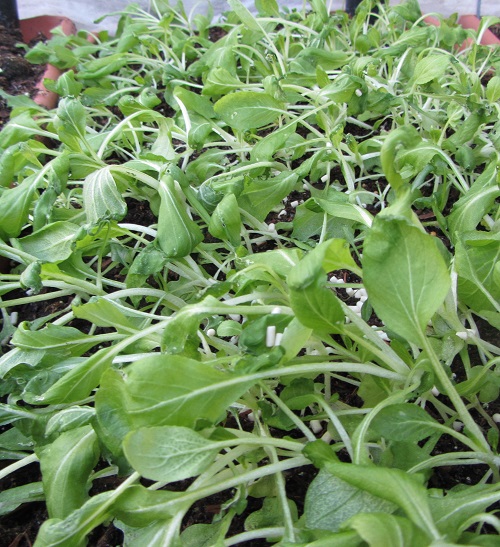
Back yard (Pak Choi):

141116 pak choi


The back yard stuff is looking vaguely perkier today than it did at the time of these pictures, but still.. Next year (or even later this week) the back yard containers may need to be moved to a sunnier spot. If that means they get rained on, then that’s the way it’s going to need to go. “Zero” sun isn’t cutting it.

I came across this blog recently. OurHappyAcres. Written by a retired IT guy doing four-season organic gardening in southwestern Indiana — Zone 6b. The blog features lots of pictures, and he documents many different “tests”. In addition to the usual suspects he grows a lot of asian greens that I’m not super familiar with. I like his relatively methodical approach to gardening. That, and if something works for him then it should work in the maritime northwest.

Final EarthBox 2014 Recap — The Tomatoes And Tomatillos

by A.J. Coltrane

Previous post here. 2013 recap here.

Tomatillos — 21.2 pounds. Both of the tomatillos survived 2014. In 2013 one of the two plants died off midsummer. This year it may have helped that one variety had a vertical habit, and the other was sort of “droopy”. We also gave them “their own space” well away from the tomato plants. The total yield increased almost 50%, up from the 14.6 pounds in 2013. For reference, the two types were “De Mipa” and “Mexican Strain”.

140628 tomatillo

As far as support – the Ultomato stakes weren’t really up to the task, especially for the vertical tomatillo plant. We’ll need to consider something else for next year.
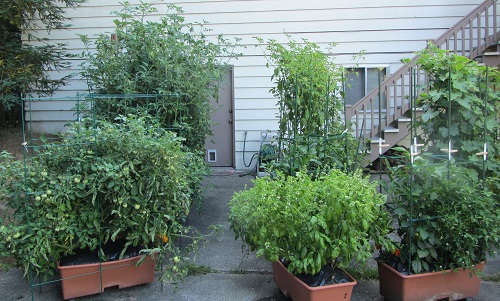
We expanded from 6 tomato plants up to 8 in 2014. For comparison, the 2013 yield was 91.5 pounds, the 2014 yield was 138.0 pounds. On a per plant basis the yield improved from 15.5 pounds up to 17.25 pounds. (Note the “terracing” of the tomato plants on the left. The tomatillos are in the back center.)

140724 overview

Black Krim — 24.5 pounds. [75 day, Indeterminate. Heirloom] Won every taste test. The richest “tomato” flavor. Terrific yield. Winner.

Glacier — 10.8 pounds. [56 day, Determinate. 13.9 pounds in 2013.] Didn’t win any taste tests, or even finish very highly. Somewhat “watery” when compared to the other varieties. The lowest yield of 2014’s tomatoes. I’m inclined to try something else next year.

Mountain Princess — 11.6 pounds. [68 day, Determinate. Heirloom.] Relatively poor yield despite a prime location. Unexceptional taste. I don’t think they’re a keeper.

Oregon Spring — 13.4 pounds. [60 day, Determinate.] Ripened early. Did well in the taste tests. Good “tomato” flavor. Keeper.

Roma — 17.2 pounds. [75 day, Determinate. 26.0 pounds in 2013.] Lower yield than 2013 but the fruit was larger and more of it ripened.

Sungold — 18.4 pounds. [65 day, Indeterminate. 19.2 pounds in 2013.] Another taster favorite. Super performer and distinctly different and sweeter from anything else we grew in 2014. “Candy.” Keeper.

Taxi — 25.9 pounds. [65 day, Determinate.] Great yield. Attractive and it did well in the taste tests. Keeper.

Tigerella — 16.2 [65 day, Indeterminate. Heirloom.] Average yield, average taste, but they are interesting to look at. Late to ripen. I’d be fine with trying another variety instead.

A few pounds of tomatoes got crushed when the cages blew over. Overall though, 2014 saw improved yields and riper fruit. Cherokee Purple might be something to try in 2015, given how well the Black Krims were received.

EarthBox 2014 Recap — The Oddballs

by A.J. Coltrane

Previous post here.

2013 Oddball Recap post here.

We’re getting closer to a four-season harvest from the EarthBoxes. As we’ve moved along we’ve learned that many of the Oddballs actually do best as cool-weather or winter plants. The overall yield should continue to improve as we figure out how to more tightly schedule the various plantings — in the last two years there have been long “fallow” periods. As it is, September/October planting for winter harvest is really too late.

The Oddballs Sorted By Temperature Preference —

Cool Weather:  Arugula, Bok Choi, Carrot, Cilantro, Dill, Garlic, Mache, Parsley, Radish, Romaine Lettuce, Spinach.

Warm Weather:  Basil.

Warm or Cool Weather:  Brussels Sprouts, Scallion, Shallot.

Comments —

Note that up through spring 2014 we were using the EarthBox covers and cutting holes in them for the cool-weather plants. This fall we removed the covers, allowing for the boxes to be planted at much, much higher densities. Hopefully that will help increase the yield.

Arugula — 0.1 pounds. It would have been 1-2 pounds, but a late spring planting combined with unseasonably warm weather caused it to bolt just as it was maturing. Arugula is interplanted with Spinach and Romaine in a few of the half-barrels and ready for harvest between now and the spring.

Basil — 2.9 pounds. Basically 50% of last year’s 6.3 pounds, but we used one box this year instead of two, so there it is. At 2013 retail prices 2.9 pounds is $195 worth of basil.

Bok Choi/Pak Choi — 3.3 pounds. The harvest was overwintered Bok Choi. There is now an EarthBox full of Pak Choi, and the veg is ready for eating. We’ll thin it through the spring.

Brussels Sprouts — 0.0 pounds so far. Planted in the early summer, I’d guess there are around three pounds on the plants, ready whenever.

Carrot — 0.0 pounds. Planted this fall for winter/spring harvest. Two types, though the better winter type is underdeveloped due to Territorial Seed’s failure to ship. At all. In effect, they lost my order. Hopefully that will be the first and last time they screw up.

Cilantro — 0.9 pounds. “Santo” (regular) Cilantro was planted in September along the backs of  a couple of the half-barrels. One EarthBox has “Confetti” Cilantro. None of these are ready yet. I’ll be interested to see if they get big enough to be usable this winter. Interplanted in various containers with Mache, Dill, Romaine, and Spinach.

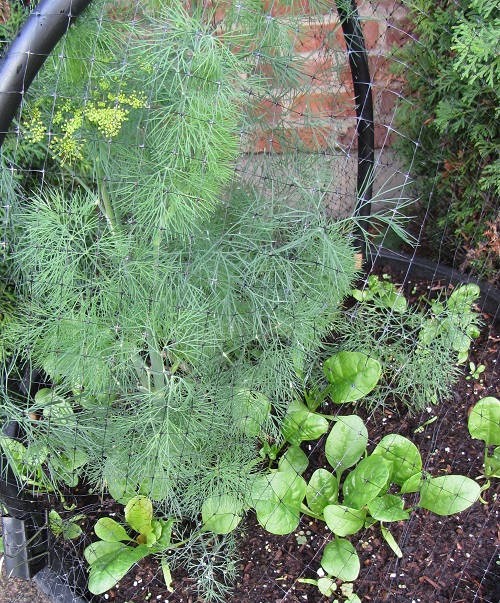
Dill — about 0.5 pounds. Bolted in the spring. Planted too late in the fall. Right now there are two big plants and a one-pound log of dill butter in the freezer.

141004 dill spinach

Garlic — 0.0 pounds.  Three heads were received as a gift from a neighbor and planted a few weeks ago. They’re growing like crazy and should represent a good spring harvest.

Mache — 0.3 pounds. We planted a little bit in January and it did fine. There just wasn’t much of it, least partly because we used the EarthBox covers. Mache is now interplanted in many boxes and barrels with “vertical” stuff. It seems like the germination rate hasn’t been very good, either because the seeds are over a year old, or the temperature wasn’t right, or… I won’t be surprised if it continues to germinate as it gets colder.

Parsley — 0.3 pounds. A big bunch of these that were planted in the spring made it all summer before finally bolting in August. The location was somewhat protected and only got morning sun. That’s what I was hoping was going to happen with the half-barrels in the front yard. It’s something to build on.

Radish – 0.8 pounds. We tried a few of two different varieties in the early spring – “French Breakfast” and “Cherry Belle”. Both did fine, though the French Breakfast may be better suited for being “cramped”. This fall we planted “Dragon”. The Dragon are supposed to be better at holding in the ground. The spring types are intended to be pulled as soon as they’re mature, otherwise they get hot/ pithy/ woody.

Romaine — 3.4 pounds. A good yield before it bolted. Had we trimmed these more aggressively the we probably could have gotten about twice as much. Currently ready to harvest – interplanted in a few half-barrels with Arugula, Cilantro, and Mache.

Scallions — 0.5 pounds. a.k.a. “Bunch Onion”. A spring harvest of a few overwintered plants. It went well enough that there’s now an EarthBox jammed full of seedlings.

Shallot — about 0.5 pounds. Many of these rotted in a half-barrel. It seems alliums don’t like wet feet. I figured this fall we’d try growing them in an EarthBox, and use seeds rather than bulbs, since seeds are so much cheaper. We’ll see what we get. The worst case scenario is an inexpensive failure.

Spinach — 1.7 pounds. Spring harvest of overwintered plants, mostly. Lots and lots of spinach is interplanted throughout the boxes and half-barrels. I read somewhere that the crinkly (savoyed) types do better in cold, though I have yet to read that twice, so it needs verifying.