Recommended Game (Assistant) — Roll20

by A.J. Coltrane

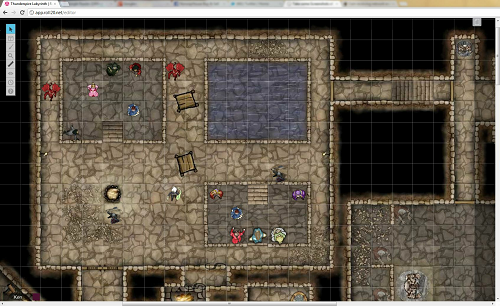
Over the years my old D&D crowd has become scattered around the country and around the world, but we can still play, thanks to Skype and Roll20. (Roll20 supports video chat — our group is more comfortable with Skype.)

ss5

Roll20 allows for most everything we could do if we were playing over the table, including making dice rolls, moving characters and monsters around, and the gamemaster can present downloaded maps:

ss6

Roll20 handles macros too — you can create buttons that handle common dice rolls. I’ve made a macro to roll for Initiative (1d20+3), another for attacking with my sword, and so on. To some degree it takes the fiddly math out of the game. I’m all for that.

Here’s an excellent introduction/tutorial:

It’s free. There’s also subscription service available if you love it and want to support the developers.

Highly recommended.

GNOIF: The Leaning Tower Of GNOIF

by A.J. Coltrane

GNOIF #17 Recap — The Leaning Tower Of GNOIF (Castles, Towers, and Construction themes.)

Games That Got Played:  Avalon – Resistance, Batt’l Kha’os, Cards Against Humanity, Carcassonne, Dominion, Gardens of Alhambra, Guillotine, Jamaica, Seven Wonders

Games That Didn’t Get Played:  Agricola, Castle Panic, Citadels, Infernal Contraption, King of the Elves, Medina, Power Grid

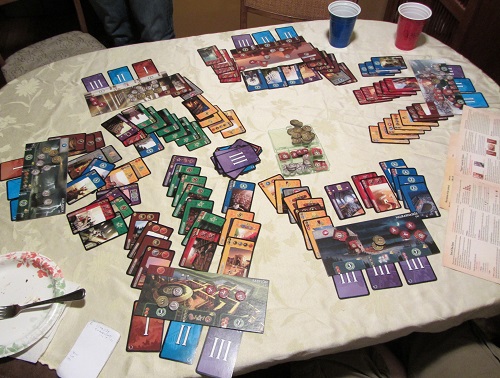
Record-tying and punctual attendance meant that we had four tables going most of the night. I had to get a photo of this epic game of Seven Wonders:

042415 seven wonders

Seven Wonders saw everyone trying different strategies, but at the end only 7 points separated first place from last place.

Because of the success of Bang! we’ve purchased Ultimate Werewolf, which was played at the last GNOIF, and Avalon – Resistance, which was played at this GNOIF. They’re all excellent party games because they’re relatively quick, engage a lot of players, and are very interactive.

Fortunately we’ve hosted enough game nights that people are fairly familiar with many of the games. 20 cats is too many to herd.

Thanks to everyone who played!

Marvel Puzzle Quest — Where The Iso Is Going

by A.J. Coltrane

Character Rankings, based on community voting, from this excellent D3 forum post. There’s a cool heat map of the voting results near the top of the thread, and an excellent discussion on all of the characters. I’m going to focus on Tiers 1-3 or 4 going forward, at least until I get Iso-positive again:

Tier 1
1. 4* Wolverine (X-Force)
2. 4* Thor
3. 3* Thor
4. 4* Nick Fury

Tier 2
5. 3* Daken
6. 3* Black Panther
7. 3* Captain America
8. 3* The Hood
9. 3* Magneto (classic)
10. 3* Blade
11. 3* Wolverine (Patch)

Tier 3
12. 3* Deadpool
13. 3* Hulk
14. 4* Devil Dinosaur
15. 3* Captain Marvel
16. 3* Human Torch
17. 3* Sentry
18. 3* Punisher

Tier 4
19. 3* Falcon
20. 3* Mystique
21. 3* Black Widow (grey suit)
22. 3* Rocket and Groot
23. 3* Loki
24. 3* Colossus
25. 3* Psylocke
26. 3* Daredevil

Tier 5
27. 3* Gamora
28. 3* Doctor Doom
29. 2* Black Widow (original)
30. 3* Iron Man (Model 40)
31. 3* Spider-Man
32. 3* Storm (Mohawk)

Tier 6
33. 2* Ares
34. 3* She-Hulk
35. 3* Ragnarok
36. 4* Invisible Woman
37. 3* Doctor Octopus
38. 2* Storm (classic)

Everything Else
39. 2* Thor
40. 3* Beast
41. 2* Daken
42. 2* Magneto (Marvel Now)
43. 2* Wolverine (Astonishing)
44. 2* Hawkeye (modern)
45. 2* Human Torch
46. 2* Captain Marvel
47. 2* Captain America
48. 1* Juggernaut
49. 2* Bullseye
50. 2* Moonstone
51. 1* Black Widow (Modern)
52. 1* Storm (modern)
53. 1* Iron Man (Model 35)
54. 2* Bag Man
55. 1* Hawkeye (classic)
56. 1* Venom
57. 1* Yelena Belova

If you need roster space and only have room for one 1* character, I’d recommend Juggernaut. Everybody hates pulse damage by the opponent.

Recommended Game — 7 Wonders

by A.J. Coltrane

7 WondersTitle:  7 Wonders

Game Type:  Card Drafting/ City (Civilization) Building.

Number of Players:   2-7

Complexity of Rules:  Medium-Low. With a little explanation it’s a good gateway game. (A gateway game makes for a good introduction to “modern” boardgames, without being too crazy complicated or having a million rules.)

Time to Play:   60 Minutes. The box says 30 minutes, which might be true with just a few players if everyone recognizes all of the cards and their implications on sight.

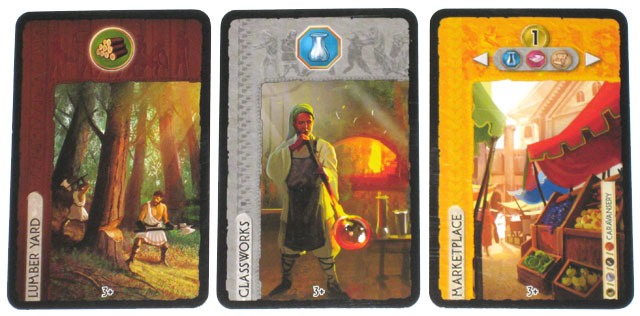
The Concept:   7 Wonders is centered around Card Drafting. What that means is that each player starts with a hand of seven cards, selects one to become part of their civilization, and passes the remaining cards to the player on their left. Rinse, repeat. Many of the cards have a cost (in wood/ clay/ gold, etc.) that needs to be met in order to buy them. The strategy is to purchase cards that help you advance your civilization the most and deny cards that help your neighbors.

7Wonders Cards 2

Why I Like It:  Like any good game, 7 Wonders requires a series of interesting decisions. There are lots of ways to win — players can receive victory points by focusing on any of:  Improving Science, having a powerful Military, becoming an economic juggernaut, building an ancient Wonder, building Civic structures, and more. Or by doing any combination of those things in the right doses. The trick is that it’s a multiple player game — you have to decide how much you want to screw your neighbor at your own expense, and what form that screwing is going to take. You can lose both by ignoring your neighbor, or by giving them too much attention. It’s a balancing act.

I’m big fan of limited downtime, and in 7 Wonders all players make their plays in unison. The decisions to be made aren’t simple, but they’re not crushingly complex either. As a result the game moves reasonably briskly — our 2nd playthrough with three players took an hour, and that was with us consulting the “Description of Symbols” sheet on multiple occasions. The symbols can be somewhat arcane early in the learning process.

7 Wonders is fairly easy to learn, and we’re a long, long way from mastering it. It’s the #17 ranked game on BoardGameGeek and the winner of multiple awards. Highly recommended.

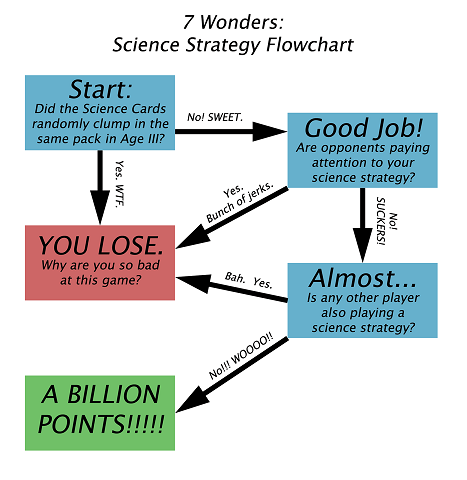
Bonus Flowchart from BoardGameGeek. It’s funny if you’ve played. Focusing science is a high risk/reward strategy:

7 Wonders Flow Chart

Backwards Through The Telescope — Games

by A.J. Coltrane

(a.k.a. — Part II of Where I’m At With Writing About Things. This time, Games.)

I can’t write fiction. I can’t write poetry either.

To some degree it feels like writing the Games posts draws on that same part of my brain, which may be part of the reason why only 71 out of 1,277 CSE posts have been about games. (About 5.5% of the total posts.) Well, maybe that, and it’s easier for me to bake something, take a picture, and do a post-mortem. And I get to eat the something.

I’m even getting a mental block about writing about writing about games..

..I think it’s one thing to break something apart and examine the pieces. It’s something else altogether to describe the whole. Ideally when describing the “hook”, or what makes a game fun — that thing that keeps me coming back to a game — it’d be nice to create a vibrant picture of what it’s like to be playing, and how the game hits the same chemical receptors that create a drug-like high… even if it’s just a nice, low-level buzz. Given my writing ability, I think my best case scenario is “loose approximation of a vibrant picture”. I’m not sure that’s good enough for me to be putting out there.

Another issue is that I tend to fixate on one game for a while. I could write about a game We’re Not Currently Playing, but, out of sight, out of mind, I guess.

In any event, the category Games has seen about one post per month. I can see that increasing a little bit.

Maybe the right answer is to have a “Game Session Sunday”. Pick a Sunday afternoon and a game we like but don’t play much and do a post about it.

Not a terrible idea!


Star Realms Tips And Strategy Guide

by A.J. Coltrane

Star Realms tips, strategy, and collected thoughts.

Opening Game:

1.  In the first two shuffles I like buying either – economy, Red “deck thinner” cards, or cards that can be Trashed for Trade, such as the Ram (3 Trade when Trashed) or Blob Wheel (same). If it’s the Ram or Blob Wheel then I try to immediately flip them for something bigger. The object is to try to get a big economy engine going without committing to a lot of cards that would represent late-game clutter. Generally I only buy Explorers (2 Trade/2 Damage when Trashed) if literally nothing else is available, and Trash them no later than the 3rd shuffle. I think if I need Explorers after the 3rd shuffle I’ve already lost.

2.  Trash Vipers, then Scouts. The tiny amount of damage that a Viper might do isn’t as valuable as the potential 1 extra Trade from a Scout.

Mid Game:

3.  Buy a maximum of 2-3 Red “thinners”. Red cards are good for thinning the deck and that’s about it. Once the deck has been thinned they’re relatively weak cards.

4.  Try to buy a minimum of 3-4 Stations (Bases and Outposts). Bases and Outposts effectively thin the deck for as long as they’re in play, and Outposts function as bonus life every time they’re drawn. I love getting 5 or 6 Stations total, including at least 3 Outposts. That’s a lot of damage prevention.

Late (End) Game:

5.  I think the end game starts at around 30 life (for either me or the opponent). I try to focus on Outposts, card draw, and offense after that point — ideally expensive stuff only. No cheap clutter allowed. Which leads to…

Other Thoughts:

6.  Don’t feel compelled to spend just because you have it. I generally avoid all 1 cost cards after the first shuffle, and by the time the mid game rolls around I try to avoid purchasing anything that costs less than 5. The exception is Outposts. Outposts = extra life. I like extra life. It’s possible I’m too “purchase averse” — it may be as I play more games I’ll reconsider this point, though right now it appears to be working.

7.  Draw > Opponent Discard. In fact, I think Opponent Discard is basically useless, and the cards that have it are relatively too expensive. I say this because I’ve had it happen where I’ve been forced to discard down to two or three cards and redrawn a dozen cards anyway. I actively try to avoid buying Opponent Discard, except lately I’ve been buying a turn 1 Imperial Frigate (if there’s nothing else) and immediately Trashing it for card draw. (With the Frigate I will have paid 3 Trade for 4 damage, 1 Opponent Discard, and 1 Draw. That seems not unreasonable to me. But I’m not going to leave it to suck up space in my deck.)

8.  Pay attention to what cards the hard AI likes. Especially Recycling Station.

9.  Try to focus on buying only one or two factions + a few Red. Faction bonuses are really important. The exception is that sometimes I’ll snap up a 6+ cost stompy Ship or powerful Station, even if it doesn’t “fit”. I’ll also buy Outposts regardless of what it is, though I still try to match factions if possible.

10.  Yellow:  Focus on draw and Outposts.

11.  Green:  I tend to go for off-faction Outposts and Bases. Exception: Blob World is a game-ender.

12.  Blue:  Really needs a blue-heavy thin deck — without faction bonuses Blue isn’t very good. Blue bases help.

GNOIF: New GNOIF On The Block

by A.J. Coltrane

GNOIF #16 Recap — New GNOIF On The Block (Games that have only been played a few times at GNOIF.)

Games That Got Played —  Castle Panic, Dead Fellas, Fluxx, Forbidden Desert, Get Dr. Lucky, Run For Your Life Candyman, Star Realms, Ultimate Werewolf, We Didn’t Playtest This At All.

Games That Didn’t Get Played — Batt’l Kha’os, Carcassonne, Medina, Pirates Cove, Power Grid, Seven Wonders, Small World.

GNOIF turned sweet sixteen, and we celebrated by offering games that hadn’t been seen much in past events. Not too surprisingly, everyone gravitated to stuff that at least a few people knew how to play… and almost all the games played could be categorized as “light”. It seems starting from scratch by reading a big rulebook and then teaching is too slow when there are games that need little introduction. (I started to type “introducation”. That word doesn’t exist, but I think it should. It’s perfect for what I’m trying to describe.)

Which sort of makes it funny that the big hit of the evening was new to everyone. Ultimate Werewolf. One person went into the other room, read the (tiny) rulebook, then taught it to the group of ten players. It has some similarities to Resistance or Mafia, which helped the learning curve.

The concept is that some of the players are Werewolves, some are Villagers, and some are “special” roles such as “Seer”, the “Hunter”, or “The Village Idiot”. Each player’s role is a secret. The Werewolves try to eat the Villagers, and the Villagers try not to get eaten… there’s more to it than that, but that’s the gist of it. Suitable for 5 to 30 players, and best at 10-15 players, it made a good substitute for some of the other “late in the evening” games we’ve been playing, such as Bang! or The Worst Card Game Ever. It was loud, boisterous, and not too heavy on the thinking.

Bonus boy cat pic:

150124 boy cat

He’s long. That’s a dog bed.

The Best And Worst In Board Games

by A.J. Coltrane

Links to three articles about board games at FiveThirtyEight.com, all of them based around BoardGameGeek ratings:


“Designing The Best Board Game On The Planet”

and

“Stop Playing Monopoly With Your Kids (And Play These Games Instead)”

and

“The Worst Board Games Ever Invented”


To quote Sid Meier — I’m of the opinion that  “A [good] game is a series of interesting choices.” Overall the voters on BoardGameGeek tend to agree, and will rank games based around that type of idea. I like to check the BoardGameGeek rating when we’re considering purchasing a game. If the rating is below 7.00 we’ll be hesitant about buying it — a 7.00 rating represents the #275th ranked game on the site.

And we don’t have room in the house for 275 games anyway.

Recommended Game — Star Realms

by A.J. Coltrane

Star Realms — A space-themed deckbuilder available either as an android app or as actual physical cards. The full app version is $5. The base set of cards runs around $15.

Like Dominion, the object of Star Realms is to build an efficient deck from a selection of cards available on the table. You can buy Outposts, Bases, and different varieties of ships, each of which provide some combination of offense, defense, buying power, life restoration, or deck thinning.

In contrast to Dominion, you and your opponent start the game with 50 life (“Authority”). The winner is the last player with Authority greater than zero.

An example of a ship that might be available for purchase, the Ram:

150119 Ram

The Ram costs 3 “Trade” to buy. (The number in the upper right corner of the card.) It does 5 damage. The green circle on the card indicates that the Ram is also part of the Blob faction — if other friendly Blob faction are in play the Ram does an additional two damage. Finally, the Ram can be “trashed” (removed from the game) at a gain of 3 Trade.

Pictured next is an Outpost — War World. A big advantage of outposts and bases is that they stay in play until destroyed, in effect thinning your deck. They also provide some measure of defense.

150119 War World

War World costs 5. It does 3 damage unless it has an ally in play, in which case it does 7. It also has 4 defense, and must be destroyed by the opponent before they’re allowed to damage you.

The app is free to play. Spending $5 upgrades the game to include harder opponent AI options and turned-based asynchronous matchmaking. (In other words, your opponent sends a move, then you log in and play your move, and so on.)

I’ve played both the over-the-table game as well as the online app. The games go fast, and while it’s not quite as “deep” as Dominion, there’s still plenty of strategy, lots to learn, and there’s always the possibility for making a big stompy combination to win the game.

Highly recommended!

Recommended Game – Qvadriga

by A.J. Coltrane

Qvadriga:  It’s turn-based chariot racing for your android phone!

Do you like old-school strategy games? Like, really old school?

Back in the dark ages of board games there existed Circus Maximus.

circus maximus

Published by Avalon Hill in 1979(!), Circus Maximus was cool because you could select and train your horses and riders, bribe the officials, and run your buddies off of the track, all for fame, glory, and riches in ancient Rome.

It’s been out of print forever, but it still has a passionate fan base. These guys are taking it waaay more seriously than I ever did:

circus maximus2

So I was really exited to see a sort-of-port for the phone – Qvadriga:

qvadriga

In Qvadriga you maintain a stable of four chariot teams. Your drivers can gain experience and become more skillful, assuming they survive. The game forces you to balance aggressiveness against keeping your drivers alive — go too fast around a tight corner and the chariot might break apart, leaving your driver dragging behind his horses. At that point you have to hope that he can get to safety before he gets run over. If the driver dies it takes a new hire a while to get competent… Plus you have to buy a new chariot to replace the one you broke, and the good ones aren’t cheap.

Anything goes, you can direct your driver to whip the other drivers, the other horses, or use his chariot to ram into anyone nearby. The game rewards weaving to cut off faster opponents.

There are two campaign modes, one of which allows you to resurrect a driver if he’s killed. The “Epic” mode doesn’t allow for resurrections. Ultimately the object is to become famous enough to be allowed admittance to the Circus Maximus, and then to have the driver with the most career wins of any driver still alive.

It’s $10 on the android store. I went ahead and forked out the $10 because I knew I’d get at least that much fun out of it.

Highly recommended.