Making Room For The Upcoming Harvest Pizza

by A.J. Coltrane

The summer garden harvest will be starting soon, so we’re readying for the needed freezer space by preparing dinners like this one:

160530 pizza

Roma tomato sauce (with oregano, salt, and garlic), peppers, pancetta, and bunch onions all from the freezer. The crust was augmented with porcini powder and minced roasted tomotoes. The “white” is a light dusting of mozzarella.

[The dough:  300 grams AP Flour, 180 grams water (60%), 12 grams olive oil (4%), 9 grams sugar (3%), 1 teaspoon instant yeast.]

A nice weeknight pizza for basically free.

Peter Reinhart’s Challah

by A.J. Coltrane

Easter called for another Challah, this time I tried Peter Reinhart’s, from his book Artisan Breads Every Day. (Last year was his “Double Celebration Challah“. For comparison, here is my 2nd attempt at Rose Levy Beranbaum’s Brioche, a recipe which I found to be a pain to parse.)

This year’s Challah was fairly simple and easy — combine all ingredients, knead, cover, then put it in the refrigerator overnight (or up to three days). The dough is then shaped into braids, braided, covered with egg wash, allowed to rise, covered with egg wash (again) and sesame seeds, allowed to rise (again), then baked:

160329 challah

The recipe is here, on Michael Ruhlman’s website. Note that I halved all of the ingredients — I didn’t need to make two loaves. I don’t know why Reinhart often writes recipes for two (or four, or eleventytwelve) doughs. Though at least this time he used grams, so I didn’t have to mess with figuring out what a one-third portion of 7-1/4 cups of flour computes to.

I like this recipe better than either of the other two that I referenced at the start of this post. The Double Celebration Challah calls for an indeterminate amount of water, 10.5 to 12 ounces — that’s a big range! The Beranbaum Brioche recipe is very poorly worded, and I feel like the recipe is broken into more steps than is necessary.

From a taste standpoint, this Challah was better 2015’s. It may be that including the optional vanilla extract made a difference, though no one mentioned that they detected it. I also think the salt level was very close to correct this time, in contrast to the 2015 bread which seemed to be lacking salt.

Other notes:

  1.  This Challah called for coating the dough with egg wash twice, at one hour intervals. The dough rests uncovered the entire time. It sounds really odd, but it worked.
  2.  Last year’s Challah split — almost exploded. I read somewhere that splitting tends to happen if the braiding is too tight, which definitely could have been the case.
  3.  When it came to the “knead on the counter until the dough is tacky but not sticky” — at least this time the dough was very wet and shaggy at the start of the kneading, and it took a fair amount of flour to get to “tacky”. Maybe it was just humid(?)

Overall it’s a low-hassle, nice tasting bread, and it’s attractive too. I can see making this again even if it isn’t a special occasion.


The Belgian Beer Fest Breadsticks

by A.J. Coltrane

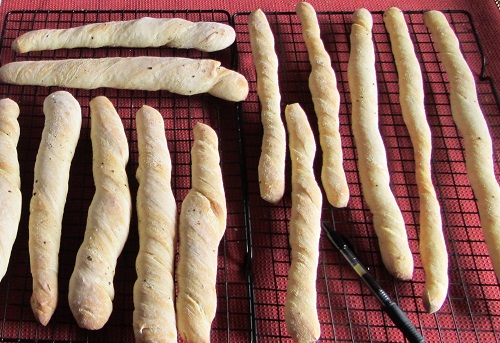
Breadsticks for the recent Belgian Beer Fest, somewhat overexposed:

160201 bread sticks

The Formula (I made 3 batches):  400 grams all-purpose flour, 240 grams cool water (60%), 10 grams kosher salt (2.5%), 8 grams olive oil (2%), 1/4 tsp instant yeast.

  1.  Mix on low speed 10 minutes. Transfer to an oil-coated bowl, lightly coat the dough with oil. Cover. Refrigerate 1-3 days. (I put these in the fridge on Thursday night and pulled them out of the refrigerator at 5 am for an 11 am departure time. I had some time left over, but that’s better than transporting them hot and steamy.)
  2.   Remove from the refrigerator and allow to warm up for 1.5 – 2 hours. (I then slept in until 7 am.)
  3.   Lightly oil the counter if needed to prevent sticking, then pat the dough out to a 12″ wide by 8″ tall rectangle. The dough will be close to 3/8″ thick.
  4.   Sprinkle your “enhancements” onto the rectangle. I used a little bit of all of:  Himalayan Pink Salt, Sea Salt, Cracked Black Pepper, and Semolina. Parmesan would work. So would sesame seeds. Or herbs. Tons of possibilities.
  5.   Use a pizza cutter to cut into 8 pieces, top to bottom, about 1-1/2″ wide. Each piece is now 1-1/2″ x 8″.   OR:
  6.   Use a pizza cutter to cut into 1″ wide pieces.  Each piece will be 1″ x 8″.
  7.   Twist each piece and place on a Silpat lined sheet tray. When I did mine the pieces “grew” another 3-4 inches, making them almost as long as the 13″ width of the sheet tray.
  8.   Cover with a towel and let rest 1 hour.

The thicker doughs were baked at 425F for 22 minutes.  The thinner doughs were baked at 450F for 17 minutes.

The breadsticks came out crispy on the outside and chewy on the inside. The twisting meant that all of the “enhancement” ingredients were mixed through the dough; it made the breadsticks more interesting and added crunch (semolina) to the interior. It also gave the breadsticks natural “breaking” points. I think I liked the skinny ones a little bit better, but that could have just been personal preference.

Overall it’s an easy, versatile recipe. Using the refrigerator for a slow rise means that the dough can be mixed up to 3 days ahead — the dough will wait. If the breadsticks are being served with dinner cut the salt back to ~2% — the 2.5% salt was intended to stand up to the bold flavors of the beer and help cleanse the palate.


What I Had In Mind Focaccia

by A.J. Coltrane

A two-hour focaccia:

150117 focaccia

I feel like this may have been the best “quick” focaccia yet.

The Tweaks:

  1.  3% olive oil in the dough. That’s lower than in oil than most of the focaccias I’ve made in the past. The crumb was lighter than in past attempts, and the bread got a lot more “lift”.
  2.  The dough was allowed to rest for 30 minutes before it was moved to the pan. I think this also improved the finished crumb structure.
  3.  A 450F oven. (Rather than 425F.)  The crust came out quite a bit browner and crisper as a result.

It made a terrific dinner with a bit of cheese and SeattleAuthor’s charcuterie:

150117 charcuterie

The formula:  400 grams Bread Flour, 280 grams room-temperature water (70% hydration), 12 grams olive oil (3%), 9 grams kosher salt (2.25%), 1 teaspoon instant yeast.

  1.  Combine ingredients in the mixer and mix on low speed for 10 minutes.
  2.  Lightly coat the dough and bowl with oil, cover, and let rest 30 minutes.
  3.  Line a 9 x 13 pan with parchment. Lightly oil the parchment.
  4.  Transfer the dough to the oiled parchment, pulling it gently to the edges of the pan.
  5.  Cover and let rise ~1.5 hours.
  6.  Drizzle the top with olive oil. I used a rosemary-oregano olive oil that we received as a holiday gift.
  7.  Oil your fingers and dimple the top.
  8.  Bake 22 minutes at 450F.  Remove to a cooling rack when done.


For comparison, here’s a 100% hydration, 6% olive oil focaccia from 2014. It couldn’t be dimpled because it was already collapsing under its own weight. It was baked at 425F and even with the higher oil content it was a lot lighter in color. Here’s another that was baked at 425F. And another. None of them are all that brown.


A Post-Holiday Pizza

by A.J. Coltrane

The holidays are past, and that means one thing:  It’s now time to empty out the refrigerator before stuff turns.

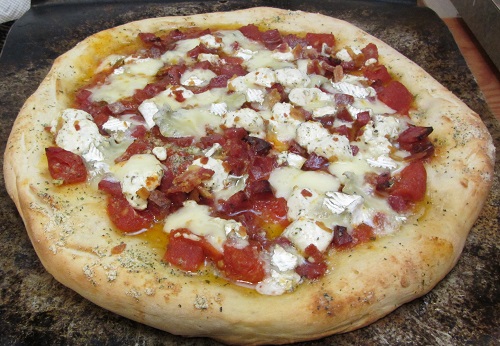
A very fast weeknight pizza:
160111 pizza

The dough:  400 grams bread flour, 120 grams water, 120 grams beer (the beer was a holiday gift — for reference, the water and beer combine to create a very normal ~60% hydration in total, if you don’t count the beer solids), 1 tablespoon dry oregano, 1 tablespoon sugar, 1 tablespoon “garlic infused olive oil” (another holiday gift), 8 grams kosher salt, 1 tsp instant yeast. Mix on low speed for 10 minutes, lightly coat the bowl and dough with oil, cover, and let rise for up to two hours. I only let it go an hour since we were hungry.

The Topping Ingredients:  Garlic olive oil (that same gift as above), TJ’s “Bruschetta” sauce (mostly tomatoes and garlic), SeaStack cheese, herbed goat cheese (both cheeses left over from entertaining guests), diced Boar’s Head salami (another gift), crumbled cooked bacon (we bought too much bacon for guests). The outer crust got Penzy’s “Brady Street Cheese Sprinkle” (another gift — finely grated dried romano cheese with dried garlic, dried basil, and green peppercorns.)

The Process:  

  1.  Preheat a pizza stone to 500F
  2.  Lightly oil a pizza pan. Form the dough on the pan, leaving a lip around the perimeter.
  3.  Lightly oil the entire top of the pizza, including the rim. Spread ~1 cup of the “Bruschetta sauce” on the dough.  Top with diced salami. Dust the “Cheese Sprinkle” around the crust.
  4.  Combine the cheeses and bacon, set aside in a bowl.
  5.  Bake for 10 minutes.
  6.  Top with the cheese and bacon.
  7.  Bake 4 minutes.

There are a few good “weeknight cheats” this time. Substituting beer for the water creates flavor when there’s not enough time for flavor to happen naturally. The addition of sugar adds flavor, somewhat helps the dough rise, and promotes browning. The flavored oil can be thrown around liberally, and that helps too.

The ingredients were excellent. The Penzy’s Sprinkle and flavored oil both added interest to the crust. I’m sure the Penzy’s thing is overpriced, but it’s really good. Romano cheese on the crust may be my new not-so-secret weapon.

Finally… bacon.

Everything exuded some liquid, so the pizza wasn’t crisp. Still, it was very tasty, and made for a good way to Use Things Up.

I’d be ok with eating like that all the time.

A Low-Oil Focaccia

by A.J. Coltrane

A low-oil focaccia to go with stew:

151227 focaccia

I think it’s still technically a focaccia, with oil in the dough and oil on top.

The formula:  400 g bread flour, 280 g water (70%), 12 g olive oil (3%), 10 g kosher salt (2.5%), 1 tsp instant yeast. Mix at low speed for 2 minutes, then next-to-low speed for 10 minutes. Let rest one hour, then stretch and fold. Move the dough to a parchment-lined and oiled pan, gently stretching the dough to the edges of the pan. Cover and let rest until almost doubled. Top with oil and dimple the surface. Bake at 425F for 20 minutes.

The rise was better than usual, partly because of the lowish oil content, and also because I did a stretch and fold on the dough after an hour, before moving it to the focaccia pan.

It’s a good bread for soaking up stew, whether it’s a focaccia or something else again.

—————————–

Pictured is the boy cat in a basket that was to be loaded with bread for transport. Behind him is the “mobile cutting board”. Room temperature butter is balanced on the back left corner of the basket:

151227 boy cat

He had other ideas.

Jeffrey Hamelman’s Sesame Bread Sticks, Mostly

by A.J. Coltrane

They’re only “mostly” Jeffrey Hamelman’s Sesame Bread Sticks because I didn’t have malt syrup in the house, so I substituted honey.

Up close:

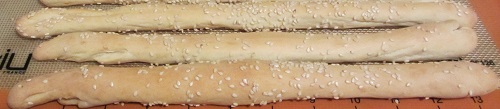
151222 bread stick 2

The (scaled) Recipe:  240 g bread flour, 134 g water (56% hydration), 14 g extra virgin olive oil (6%), 7 g honey (3%), 5 g kosher salt (2%). I used 3/4 tsp instant yeast. There are a couple of slight rounding errors, but the percentages are very close to the original formula.

The Process:  Mix all ingredients except the sesame seeds on low speed for 3 minutes, then raise the speed one notch and mix another 5 minutes. Let rest one hour. Portion the dough into “1.33 oz” (~37 gram) pieces and roll each out to 14-16 inches in length. Roll each piece in a moistened cloth, then roll in a tray of sesame seeds to coat. (I wound up with 10 pieces from the 406 gram recipe.)

Bake at 380F for 20 minutes. If at that point the breadsticks aren’t brown and totally crispy, return to the oven at 350F until completely baked.

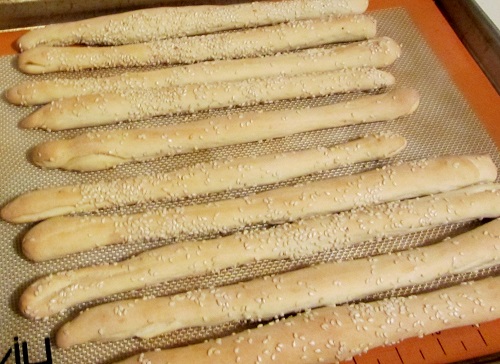
151222 bread stick

For me, “crispy” took another 10 minutes at 350F. I think that happened because I’d only rolled the breadsticks out to around 12-14″ — I’m guessing they were a little thicker than they were supposed to be.

As for the color:  The photographs make the breadsticks look a bit lighter than they came out in reality. Using malt would have created a darker end product. Sticking with 380F for longer than 20 minutes might have helped too.

Overall the recipe (in Hamelman’s book “Bread”) is very clear and concise. Right now I’m leaning towards continuing with “Bread” as my main resource for a while.

Beranbaum’s Bread Bible Basic Brioche — Take Two

by A.J. Coltrane

A brioche for the Pet Store Guy:

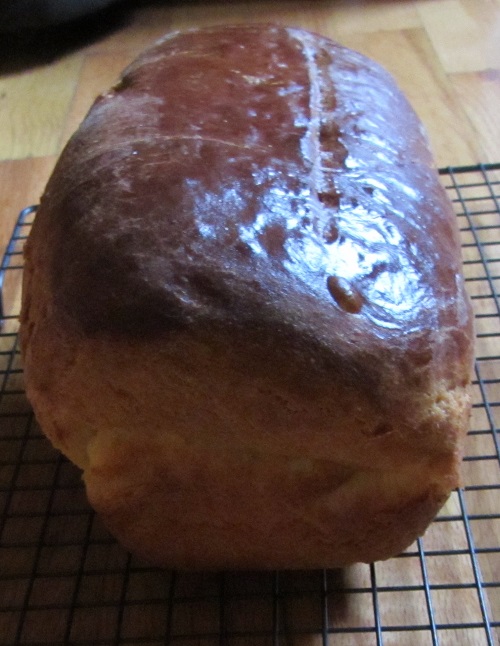
151213 brioche

What’s interesting is that one side expanded more than the other side. Again:

151213 brioche2

The slash was down the middle when I made it — that’s how far the “center” shifted as the bread expanded.

So why did one side rise more than the other?

My first thought would be that the pan needs a lot of butter — any “dry” spots catch on the sides and imbalance the loaf. But it’s happened two tries in a row…

It could be that if any egg wash touches the sides of the pan it makes for an uneven rise…

Alternately, I may be misinterpreting the directions. I’m folding such that the seams run lengthwise inside the loaf. It may be that if I fold so that the seams are crosswise… I’d bet that the same “problem” would persist, only one end would rise more than the other instead…

Of course it could be as simple as “stuff happens”. I thought the first bread was slashed well, but it looks like the slash could have been deeper on the 2nd bread.

I don’t know. It could be different combinations of factors in each loaf.

———

Parting thoughts:

I’m going to have to try more recipes from the Beranbaum book. My feeling is that this particular recipe could be worded better. I think I did everything right, but I spent a whole bunch more time than usual reading the recipe. I think bits and pieces of the recipe are spread around somewhat, and the ingredients are lumped together in a non-intuitive way. I wound up annotating in the book for future reference, which I something I don’t like to do. However, I really like the fact that the measurements are available as metric weights.

All in all, this brioche represents a two day process involving five hours of “work” each day, handling the dough every 1-2 hours. As a flat guess I was “hands on” for more than an hour each day.

In the future:  I’d like to hope it’s possible to get a comparable result without that many steps, but for special occasions, it’s a nice bread.


Calzones Of Unusual Size

by A.J. Coltrane

I may have slightly overestimated how much dough was required for two largish calzones.

I used 600 grams of bread flour (300 grams for each calzone). That may have been at least 100 grams more than necessary.

The Recipe:  600g bread flour, 348g water (58% hydration), 30g olive oil (5%), 12g sugar (2%), 15g kosher salt (2.5%), 1 tsp instant yeast. Knead on low speed for 10 minutes. Let rise 1.5 hours. Divide, shape into balls, and let rise another 30 minutes. Roll out. Preheat oven to 375F. Bake for 30 minutes on a sheet tray, turning halfway through.

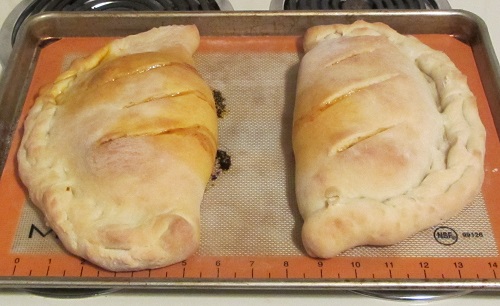
A picture right out of the oven:

151205 two calzones

The filling included pepperoni, meatballs, minced (and sauteed) onion, diced (and sauteed) crimini mushrooms, an aged gruyere grated on the small holes of a box grater, and a roma tomato sauce with diced red peppers, garlic, and herbs.

Here’s one of the two calzones dominating a regular-sized dinner plate:

151205 calzone one

The filling was well received. The calzone “bread” was fairly light — for as massive as the calzones were, they didn’t “eat” like a giant meal.

Still, add a salad and they’d easily feed a family of four.

I thought they were the best calzones I’ve made so far. I think going light on the oil, adding sugar, and being patient with the rise combined to give better results than in the past. (And just like in this grilled calzone post from 2012 — red sauce on the side would have been welcome. Oh well.)


Beranbaum’s Bread Bible Basic Brioche

by A.J. Coltrane

For Thanksgiving I thought I’d try baking Beranbaum’s Bread Bible Basic Brioche.

The recipe is here on Epicurious. The process involves many steps, and I had to re-read it multiple times to parse what she really meant and to make sure that I had the timing right. (For the “loaf”, use Steps 1-6, then skip down to Step 7 in “variations”. Plan to start 1-2 days ahead of when you intend to bake the bread.)

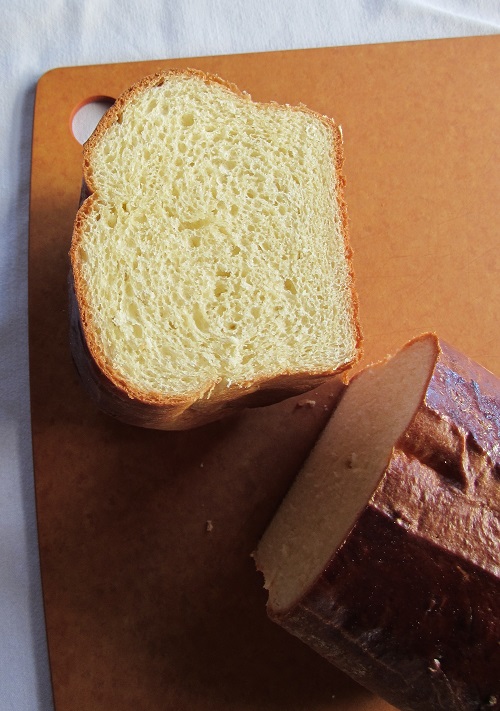
I thought it came out well. Here’s the crumb. (Note the white tablecloth… it was a “nice” dinner):

151126 brioche crumb

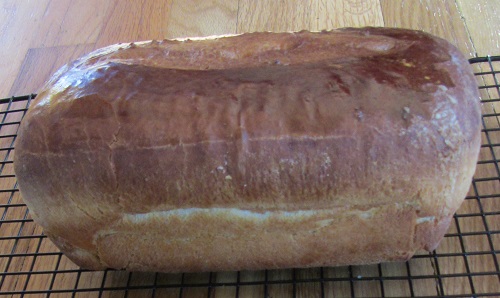
The loaf prior to slicing. The far side didn’t rise quite as much as the near side:

151126 brioche

I used the “optional” eggwash, which is why the top is so shiny.

The recipe makes one 8-1/2″ x 4-1/2″ x 4-1/2″ loaf. That gave me a chance to use a smallish loaf pan that I’ve had forever, but only ever used for marinading or mixing things:

151126 pan

I’ve had that pan so long that I have no idea where it came from. I think I might have inherited it from one of a zillion previous roommates.

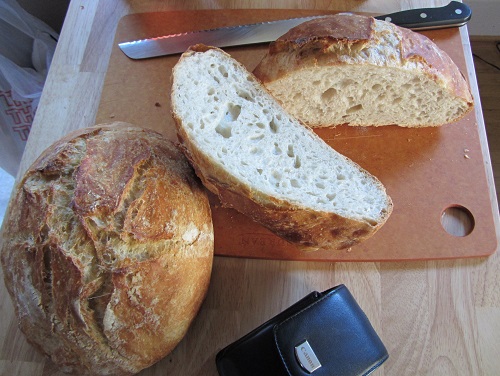
As a bonus, the No Knead breads decided to be cooperative too. I used half AP flour, and half Bread flour. One of the breads split along the slashes, the other was very craggy… rustic!

151126 no knead


Thanks for Iron Chef Leftovers for the invite and the terrific dinner, and to everyone for the great Thanksgiving company.