Quick Chicken Parm

By Iron Chef Leftovers

Chicken Parm is one of my favorite things – how could it not be, breaded chicken, sauce and cheese. Recently, I had a family member have a health scare and it got me thinking, is there a healthier way to make chicken parm and still have it taste great. This is particularly useful if you don’t have any sauce on hand (and you would never buy sauce from a jar, right?) This is what I came up with.

The Software
3 chicken cutlets, 3 oz. each, about 1/8 to 1/4 inch thick, patted dry
2 tablespoons, herb infused olive oil (see note below)
2 oz. mozzarella cheese, either sliced very thin or shredded
1 oz Parmigiano reggiano grated
1 tomato, sliced into 1/8 inch rounds (enough to cover the surface of your chicken)

The Recipe
In a large skillet, heat 2 tablespoons of oil on medium-high heat until just starting to smoke. Add chicken and cook on the first side for 2 minutes and the second for 1-2 minutes until done. Remove excess oil with a paper towel. Heat your broiler. On a baking sheet covered with a sheet of foil, place the chicken, top with tomatoes and then top with cheese. Place under the broiler until the cheese is melted and bubbling, about 2 minutes. Serve to happy guests.

Notes
Start to finish, you can have this on the table in 10 minutes. Notice I did not use salt – there is plenty in the cheese that you won’t need it. Check on your chicken constantly when under the broiler – it can go from bubbly to burn in a hurry. There is no need to preheat the broiler – you are just melting the cheese, not cooking the chicken. If using an electric oven, keep the door slightly ajar, the broiler will cycle off and on if you don’t and it will take a lot longer to melt the cheese. The recipe can be easily scaled and obviously you can add more tomato or cheese if you want. The key to this being a quick recipe is pounding the cutlets thin. If you don’t want to do it, buy your chicken at a butcher shop or megamart with a butcher counter and ask them to do it for you. They should have no problem with doing that.

Notes on Infused oil
To make the herb oil, you can either buy it or make it yourself. I like to throw a sprig of sage, rosemary, tarragon and thyme into about 1 cup of oil with 2 garlic cloves. Heat over medium heat for 15 minutes. Store in an airtight container in the fridge for up to 1 month. If you are feeling really lazy, just toss the herbs and garlic in the oil you are cooking the chicken in and leave them in the pot, following the directions for cooking the chicken in the recipe.

Farro – The Other Brown Grain

By Iron Chef Leftovers

Farro, or emmer as it is also known, is an ancient grain that is popular in Italian cooking and is starting to gain acceptance in the US because of its high nutritional value and diabetic friendly properties. I tend to use is as a substitute for rice and I love its nutty flavor and tend to cook it to an al dente consistency to give it some toothiness. It is a simple grain to cook and it is pretty much like cooking rice.

The Software
½ cup farro
2 cups chicken stock
1 tablespoon olive oil
Kosher salt

The Recipe
In a medium sauce pan, heat the olive oil over medium-high heat until shimmering. Add the farro and toss in the olive oil until coated. Cook over medium-high heat for about 2 minutes, stirring every 30 seconds. Add the stock and a pinch of salt and bring to a boil. Once at a boil, reduce heat to medium low and simmer covered for 30-40 minutes. Check the grain after about 25 minutes – you are looking for a consistency that is slightly chewy, but not crunchy. The farro may be cooked before it absorbs all of the liquid. If it is, drain the liquid and season as needed (a little salt and pepper usually are nice, maybe a couple of teaspoons of nice olive oil). This can be served either hot or cold.

Notes
You can replace the stock with water if you want – the stock adds flavor, but isn’t necessary. Use farro in place of brown rice as a side dish or put it cold on a salad for a nice, nutty crunch. It is also really good with some slivered almonds and dried cranberries as a side dish – just add those in once the liquid is drained and toss.

Mexican Chicken Cacciatore

By Iron Chef Leftovers

Ok, I promise this is the last of the tomato recipes I will post for a while. I just have about 25 lbs. or so of tomatoes that I have been trying to make my way through, so I have been coming up with new and creative ways to use them. The other night, I thought chicken cacciatore, but I had a bunch of other ingredients I wanted to use and I had a hankering for some black beans, so I decided to do a Mexican version of the classic Italian dish.

The Software
8 oz. chicken breast, cut into ½ inch pieces
2 tablespoon olive oil
1 teaspoon cumin
1 teaspoon garlic powder
1 teaspoon salt
1 teaspoon ground adobe or paprika
1 teaspoon dried oregano
½ cup onions, sliced thin
1 large bell pepper, cut into ½ inch pieces
1 tablespoon chile pepper
¾ lb. tomatoes, cut into ½ inch pieces
2 cloves garlic, minced
¼ cup minced cilantro


Mecican Chicken Caccitore – All part of a well balanced meal

The Recipe
Heat a 12 inch skillet over medium high heat. Add 1 tablespoon of oil when hot. Pat dry the chicken and combine in a bowl with the cumin, garlic, salt and paprika. Toss to coat. When the oil is just beginning to smoke, add the chicken to the pan. Sear for 2 minutes until just beginning to brown (you are not trying to cook it, just brown it). Transfer to a bowl. Add one table spoon of oil. Reduce heat to medium and heat the oil for one minute. Add the onions and sauté until they become translucent – about 4 minutes. Add the garlic and stir for 30 seconds. Add the tomatoes and oregano and cook until the tomatoes have just begun to fall apart. Add the peppers and cook for about 8-10 minutes until the tomatoes have completed broken down into a smooth sauce. Add the chicken and cilantro and reduce heat to medium low. Simmer until the chicken is cooked but still tender – 5-7 minutes. Check seasonings, adjust as necessary and serve.

Notes
I served this over yellow rice and black beans, but you could serve this over whatever you would like. I used a pablano pepper, but if you like hotter, use any you would like. If the sauce is too thick, add a little water, white wine or stock. You want it to be moderately thick before you add the chicken. If it is too thin, keep cooking it before you add the chicken until it reaches the thickness you want. I didn’t bother seeding or peeling the tomatoes, but you could do that if you desire. The recipe serves 2 easily – we actually had leftovers.

Quick Tomato Salad

By Iron Chef Leftovers

Since I now need to harvest all of my tomatoes before the cool nights cause them to split (not to mention the basil, tarragon and Vietnamese coriander), dinner pretty much every night in the Iron Chef household is going to consist of something tomatoish. A nice, quick and easy recipe is a tomato salad. It is cool and refreshing for those remaining few warm evenings and it is quick and simple if you don’t want to think about putting together something elaborate.

The Software
½ cucumber, seeds removed, cut into ¼ inch pieces
¼ cup onion, sliced thin or cut into ¼ inch pieces
¾ lb. tomatoes, cut into ½ inch pieces
1 tbsp. basil, minced
1 tbsp. extra virgin olive oil
1 ½ tsp. red wine vinegar
Salt
Pepper


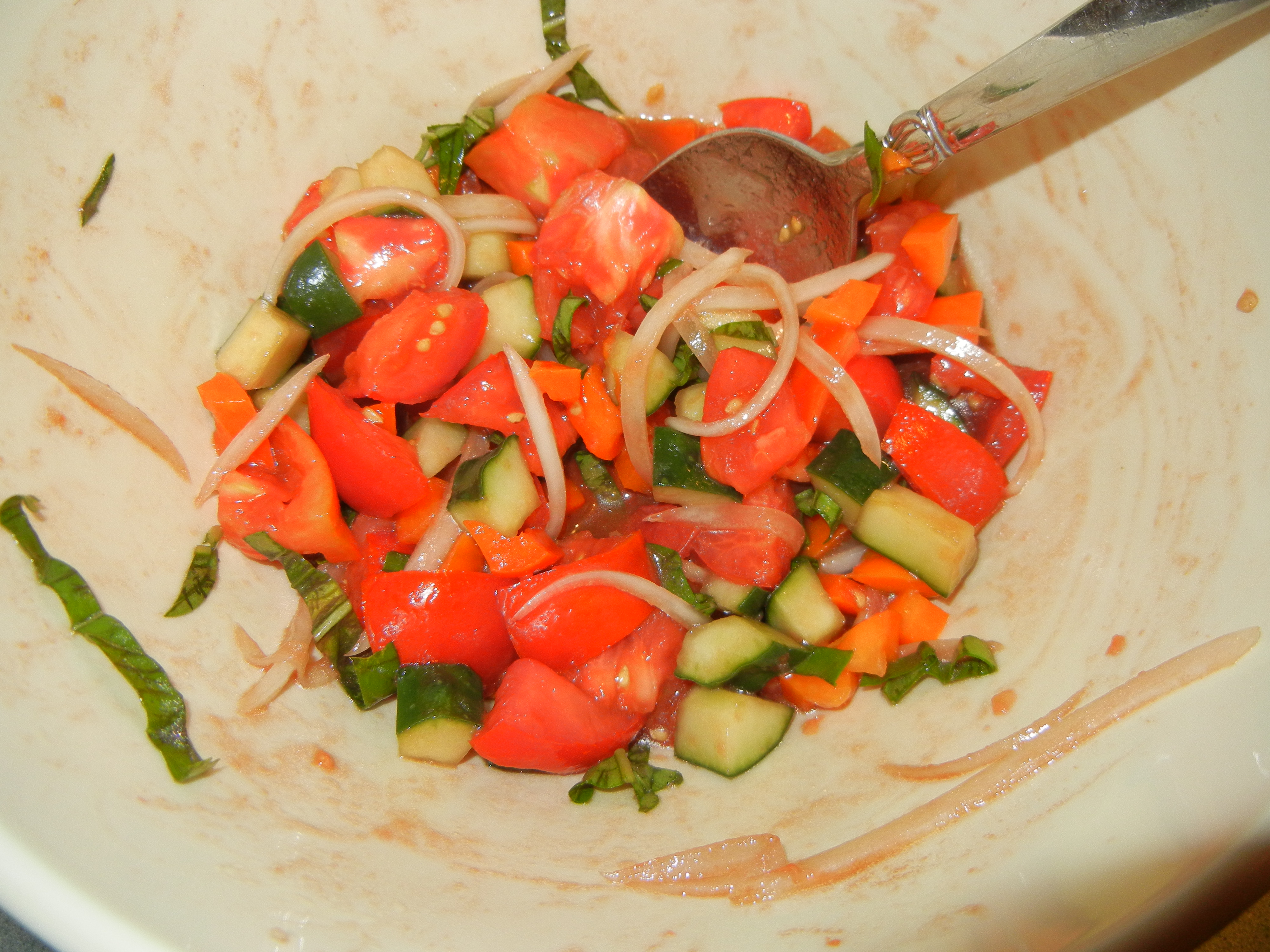
The finished product in all its tomato happiness.

The Salad
Combine cucumbers, onion, tomatoes, olive oil and vinegar into a bowl. Toss to combine and let stand for 7 minutes on the counter. Add basil and salt and pepper to taste. Serve with a crusty piece of bread to soak up the juices.

Notes
That is it, quick and easy. You can skip the sitting for 7 minutes piece and serve right away, but that will mean your onions will be stronger in flavor and you won’t get the really tasty juice to soak up. You can really add anything you want to this, but in season tomatoes bring much more flavor to the party. If you are using out of season tomatoes, use balsamic vinegar instead of red wine to account for the lack of sweetness in the tomatoes. If you tomatoes are like mine, super sweet, don’t use balsamic – it will be too sweet. The recipe feeds two easily and can be scaled as much as you want.

Baked Potato Bread

by A.J. Coltrane

I thought it would be fun to try combining instant mashed potato into a bread, inspired by this Onion-Potato Focaccia.  The catch was, I had two hours from the initial mixing until the bread needed to be out of the oven. Two hours isn’t remotely enough time to naturally develop flavors in the bread, so I loaded the dough with a couple of flavors that go great with a baked potato — sour cream and onion soup mix. The time limit wasn’t going to allow for a focaccia either, so I went with a baguette shape to reduce the process time.

The ingredients:

Ingredient Weight in Grams
Bread Flour 320
Instant Garlic Mashed Potato 80
Water 220
Sour Cream 80
Lipton Onion Soup Mix 1 package
Active Dry Yeast 2 tsp

The sour cream is about 75% water; the total hydration works out to about 70%.  After some staring at the box of onion mix and trying to figure out what a “serving” was and multiplying that by the sodium information I decided the total sodium looked close enough to skip actual “salt” and I’d just see what happened. I did a little “research”, some popular recipes online were using similar ratios of flour to onion soup mix, so I figured it wouldn’t be a total disaster.

I kneaded the dough at low speed for 6 minutes, then covered it and allowed it to rest for 40 minutes. I then shaped it into a baguette and allowed a final proof of 45 minutes. Looking at the surface, I may have vaguely undermixed it.

The baguette then went into a 450F oven for 30 minutes. (In a related note, the silpat is supposed to be rated to 482F, so it was cutting it close.) I removed it from the oven when an instant read thermometer read 200 degrees.

Below is a picture of what happens when you don’t seal the seam very well. It was a fairly wet dough, and once it got on the silpat I didn’t want to degas it too much, so I decided the bit of seam that I saw running down the side of the dough was “good enough”. I shoulda coulda done a better job of tucking the seam on the underside. Oh well.

Three people besides myself ate the bread. I didn’t tell them what was in it. Two correctly guessed the onion, the other correctly guessed the garlic and potato. Nobody got the sour cream, which was hiding behind and the onion and the other stuff. Eating the bread with butter brought out some of the dairy elements of the sour cream; the bread tasted much better with butter — the butter was kind of like the rug that ties the room together.

Note the poor expansion on the top. That’s because the side blew out instead.

That makes sense though, doesn’t it? Butter goes great on baked potatoes too. We were just missing the bacon bits.

High Gluten Flour And The Autolyse Step

by A.J. Coltrane

Bread experts will often recommend an autolyse step when making breads and pizza. Typically this involves combining the flour and water, and perhaps some of the yeast, then letting the flour hydrate for about 20 minutes. Quoting thefreshloaf(dot)com:

How do you use the autolyse technique? Simply combine the flour and water from your recipe in your mixing bowl. Cover the bowl with plastic or a damp towel. Walk away for 20 minutes to half an hour. That’s it.

While you were away the flour was absorbing the water and the gluten strands have begun to develop. Now you can mix in your preferment, your salt, and the remainder of your yeast and, with very little mixing, achieve a high level of development with considerably less work. The crumb of your dough is also likely to come out much whiter since it has not been highly oxidized by all the beating and whipping.

Better bread, less work. What’s to complain about?

Check out the link, it’s an excellent reference.

Historically I’ve mostly used All Purpose (lowish gluten) flour. Recently though, I bought a bag of King Arthur Bread Flour. The KA flour is very high in gluten. I figured I’d try making a pizza using the KA flour and include an autolyse step for even more gluten development.

After the autolyse the dough wasn’t kneading very well in the Kitchenaid, so I removed it partway through for some hand-kneading.

It was like kneading a pot roast, or a big knotted muscle. I now understand why people call it “strong flour”. The dough ball could have done pushups.

I liked the end result. Sopressata and shallots with mozz:


I used the Smitten Kitchen recipe, mostly.

Tomato and Goat Cheese Scramble

By Iron Chef Leftovers

Happy little eggs just waiting to be eaten

If you are like me and decided to grow tomatoes in the Seattle area, you are just beginning to enjoy the fruits of your labor, although you are probably hoping that the 80% of the tomatoes on your plant that are still green will ever ripen. (Quick hint – cut back on watering them, it will cause them to stop producing fruit and try to ripen what is there). That being said, I tend to get more tomatoes than I know what to do with in one sitting, so I get creative with them. Since the ones that I grow at home taste about 100 times better than anything you can get in the store, I use them in just about everything. One of my favorite applications is with eggs. You don’t need to cook them and they add a ton of flavor and brightness to any egg dish. Below is a recent breakfast I made for Mrs. Iron Chef Leftovers with some of the tomatoes and basil from the garden. The recipe feeds one but can be easily scaled.


The lovely raw ingredients. It is making me hungry just looking at them


The Software
2 Large eggs
1 tablespoon diced or minced onion
¼ cup tomatoes, diced
2 tablespoons milk
1 teaspoon basil, chiffanade (probably about 1 large leaf)
1 oz. goat cheese, crumbled
1 teaspoon olive oil
Salt
Pepper

The Scramble
In a medium, non-stick skillet, heat the olive oil over medium heat until shimmering. Add the onion and cook until it starts to become translucent, about 5 minutes. While the oil is heating, combine eggs and milk and beat with a fork until combined, let sit. Add the eggs to the pan when the onions are cooked and turn heat to medium low. When the eggs begin to start to form a curd (i.e. begin to become solid) gently break apart with a silicone spatula into smaller pieces; this will happen quickly, so keep an eye on it. Add the goat cheese and stir until incorporated; maybe 1-2 minutes. Once everything is incorporated, remove from heat and add the tomatoes and basil. Toss to combine and let sit for one minute. Add salt and pepper to taste, plate and serve to a happy wife.

The finished product. You may commence your drooling now.

Notes
You can leave out the cheese or substitute it with just about any kind you want. I happen to love the combination of goat cheese, tomato and basil, but cheddar works well also. The key to this dish is the low heat – it will allow the curds to be fluffy and light. Also, the more liquid you add to the eggs before cooking them, the fluffier they become. If you have particularly juicy tomatoes, remove some of the liquid before adding to the pan, otherwise you will have watery scrambled eggs. I tend to not cook the tomatoes because I like their raw flavor better. If you want to cook them, add them to the onions after they have been cooking for about 3 minutes. This recipe also works as an omelet too, but that is for another show.

Grill Roasted Beef Tenderloin

By Iron Chef Leftovers

Mrs. Iron Chef and I recently entertained her aunt, uncle and a couple of cousins, who had been on a whirlwind tour of the Pacific Northwest, and I decided that they needed a good, home cooked meal. Since there were 6 of us and the weather was nice, I thought that the meal called for a nice grill-roasted beef tenderloin. It is easy to cook, always a crowd favorite and doesn’t require a ton of prep. The below recipe and technique was taken from Cook’s Illustrated magazine and modified a bit by yours truly.

The Software
1 – 2 ½ lb. beef tenderloin, silver skin removed
1 tablespoon + 1 teaspoon kosher salt
1 tablespoon granulated garlic
1 teaspoon of olive oil
1 teaspoon ground black pepper
Soaked wood chips for smoking (optional)

The Prep
Remove any silver skin that may be on the roast. Pat dry and sprinkle1 tablespoon of salt on all sides of the roast. Wrap tightly in plastic wrap and return to the fridge for at least 4 hours (you can let it sit overnight if you want, it won’t hurt anything). When you are ready to fire up the grill, pull the meat out of the fridge and pat dry with paper towels. Rub with the oil and then sprinkle with garlic, salt and pepper to get even distribution. Tie the roast with 5 pieces of butcher’s twine spaced at even intervals to make the roast as uniform as possible. Let rest until you are ready to put on the grill.


A whole beef tenderloin – the two “wings” are called the chain meat. You want to get your roast from that end of the muscle and remove the chain meat before cooking.

The Grill
Gas grill – turn all burners on high for 15 minutes to preheat the grill. Add wood chips to your smoking box at this time. Once grill is heated, clean the grill grates. Turn off all of your burners except for your primary burner. Leave that on – you are looking to maintain about 300-325 degrees in the grill. For my grill it means leaving the primary burner just above medium high.

Charcoal grill – prep 6 quarts of charcoal and heat until covered in ash. Add the charcoal to the far side of the grill, not exposing more than half of the grill grate to direct heat (you are going to cook the meat off of direct heat). Add wood for smoking directly to the charcoal. Heat the grate for 10 minutes with the grill covered.

The Roast
Gas grill – put the meat on the grill about 8” from the edge of the primary burner (you don’t want to put in directly on the heat from the primary burner). Roast for 25 minutes, and then flip the meat over. Continue roasting until the meat reaches 125 degrees on a meat thermometer (that is medium rare). Remove from the heat to a plate and cover with foil. Let rest 15-20 minutes before cutting.

Charcoal Grill – Put the meat over the direct heat of the charcoal for about 2 minutes on each side to get a crust to form. Move the meat to be about 8” from the direct heat and cook on the first side for about 15 – 20 minutes. Turn over and continue cooking until the meat reaches an internal temperature of 125 degrees. Remove from the heat to a plate and cover with foil. Let rest 15-20 minutes before cutting.

Notes
If your fire starts to die down on a charcoal grill, add more charcoal. This recipe is easier on a gas grill (better temperature control), but tastes a ton better on a charcoal grill. I used a simple salt, garlic and pepper rub for this, but you can use any type of spice rub you would like. If you opt for tenderloin, you want to get a roast that is as uniform as possible and ask your butcher to remove the silver skin for you, it will save you 10 minutes of prep time. If you don’t want to use tenderloin, eye round also works in about the same amount of time. You could also easily substitute a boneless leg of lamb roast or a pork loin roast (not the tenderloin, it is too thin) and they will all cook in about the same amount of time. Tying the roast is essential to making it a uniform as possible – it will prevent some pieces from being more cooked than others. Serve with some roasted veggies and a nice chimichurri sauce.

A Burger with Heart

By Iron Chef Leftovers

I have been accused of being a food snob over the years because I tend to shun crappy, mass produced foods in favor of items that are freshly prepared on a small scale and because I will eat things that most Americans won’t, despite, in most of those cases, most of the rest of the world does eat it.

One case in point – beef heart. Before you go “yuck”, understand this – heart is a muscle that is no different from the steaks that you eat and it actually contains significantly less fat than most other cuts of beef. It also has an incredibly beefy flavor (not the metallic flavor that most people would assume it has since it is considered “organ meat”), much more so than just about any other cut off the cow. If you haven’t tried it, you should – it is cheaper than a steak and cooks incredibly quickly so it can be prepared for a weeknight meal.

All of this lead author Jennifer McLaglan to include a recipe for a heart burger in her Odd Bits cookbook. Before you say “yuck” again, be aware that if you are eating any commercially produced burger or using commercially produced ground beef, you probably have had heart already without knowing it. As she writes:

This is a great way to try heart for the first time…

I took this recipe and made it at home without telling Mrs. Iron Chef Leftovers what was in the burgers and she loved them. I suggest you try it for yourself before saying “yuck.”

The Software
¾ lbs. brisket, fat cap on, ground
¾ lbs. heart, fat on, cleaned and ground
1 ¼ teaspoons salt
Freshly ground black pepper
1 tablespoon olive oil, beef drippings or bacon fat

The Recipe
In a large bowl, combine all ingredients, except the oil, mixing gently until combined. Divide into 4 portions and form into patties about 1 inch thick. Place the patties on a large plate or sheet pan, cover with plastic wrap and refrigerate for at least 1 hour. Pre-heat a pan or grill over medium high heat and add oil. When the oil begins to smoke, add the burgers. Cook for 4-5 minutes until a nice brown crust forms and flip, reducing the heat to medium. Cook for another 4-5 minutes until the burgers reach your desired doneness, Server with your favorite burger toppings.

Notes
I would highly recommend sourcing your heart from a small grower and preferably from a grass fed animal. You will get a better quality product with better flavor. I usually get mine from Skagit River Ranch. You probably won’t be able to find either ground heart or ground brisket easily, so you can see if you purveyor will grind it for you, or better yet, grind it at home yourself. I also added about 2 strips of uncooked bacon to my meat mix before I formed the patties and it took these burgers over the top. This comes in especially handy if the brisket you use does not have much fat. I would not recommend cooking these burgers all the way to well-done; they will dry out as a result and won’t be particularly tasty. If you are grinding the meat yourself and you have a good source, you shouldn’t need to cook these beyond medium-rare to medium. If you don’t like beef, pork belly or lamb shoulder can be subsituted for the brisket and the heart of those respective animals can be used.

Crab Rangoon Pizza

by A.J. Coltrane

Inspired by a “greatest pizza in the US” type of show:  It’s Crab Rangoon pizza!

For the uninitiated, Crab Rangoons are fried potstickers filled with cream cheese, crab, and scallions.

Crab Rangoons in their native habitat.

To make this into a pizza topping I combined the cream cheese with heavy cream, horseradish, shallots, and salt in a food processor. Then the crab was added and given a quick buzz to incorporate.

These ratios.

For the other “prep”, I coated wonton strips with a little canola oil and baked until lightly browned. (no pic, see below)

You can see the cooking aid to the back left. The lurid chili oil is to the back right.
Mozz on cream cheese. White on white.

I lightly coated the top and bottom of the pizza dough with canola oil and par-baked it on a screen for 8 minutes at 500F.  Then I added the cream cheese mixture and some shredded mozz and cooked for another 7 minutes.

I took it easy on the chili oil initially to make sure it stayed edible.

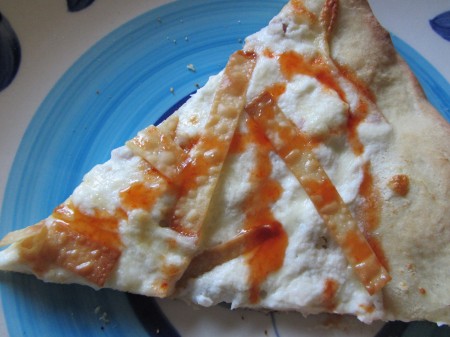
After the pizza came out of the oven it got topped with the wonton strips and sweet chili oil (sriracha, honey, and lime juice).

The chili oil wasn’t too hot, so the slices got more of it.
The underside.

It was no more work than a regular pizza, this one is going into the “making it again” file.