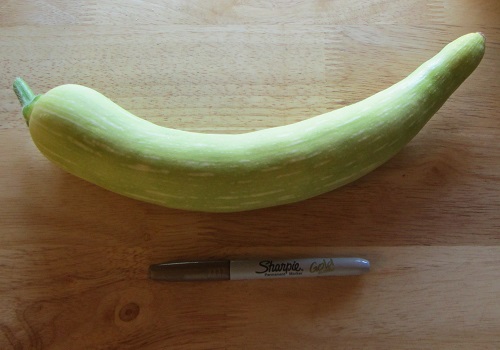
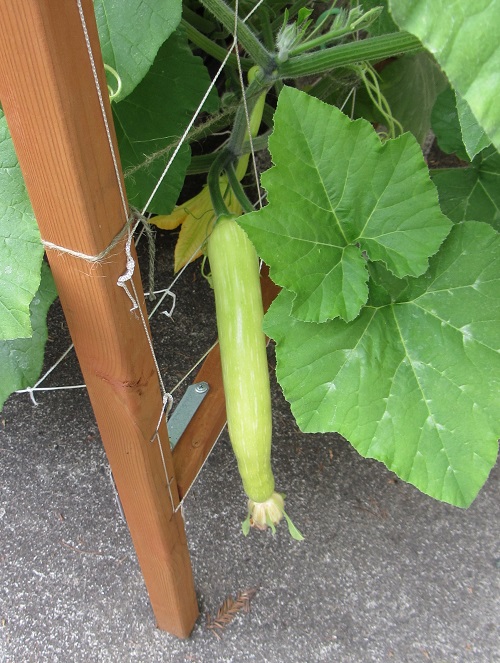
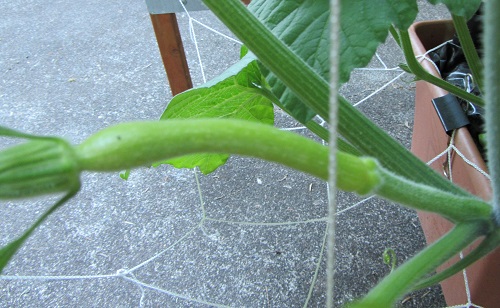
The Tromboncino zucchini is now at the top of the 8′ trellis. This one was intended to be grilled for dinner. Note that the end never got a “bulb”. That either “happens sometimes”, or “it didn’t get pollinated”, or it’s “something that I did” that made it misshapen. It weighed almost exactly 1 pound, and it was still tasty despite the less-than-ideal shape:
Unfortunately, we ran out of propane shortly after firing up the grill, so I used the Le Creuset grill pan.
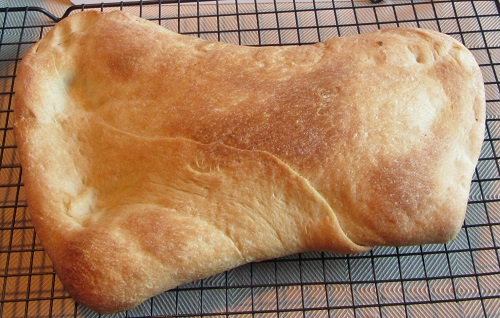
The “grilled” laminated flatbread was finished in a 450F oven on a baking stone:
Another angle:
A closeup of an end-piece:
Formula/recipe: 300g AP flour, 180g water (60% hydration), 6g olive oil (2%), 7g kosher salt (2.3%), 1/2 tsp yeast. Mix on low speed for 10 minutes. Let rise two hours. Lightly oil the workstation. Roll out thin. Brush with olive oil. Fold over. Rinse. Repeat.
Looking at it, I think I folded it about five times. The result was airy and crispy at the same time. Excellent!
(It’s sort of a sendup on Ming Tsai’s shallot pancakes, though I don’t think it was a conscious thing — I just wanted to see what would happen if I tried grilling a laminated dough.)
Previous post here. June 21, 2014 post here. June 16, 2013 post here.
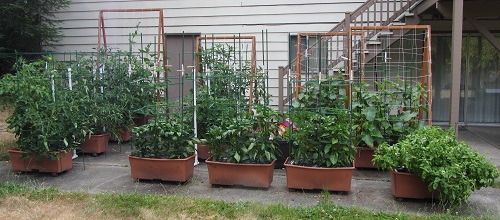
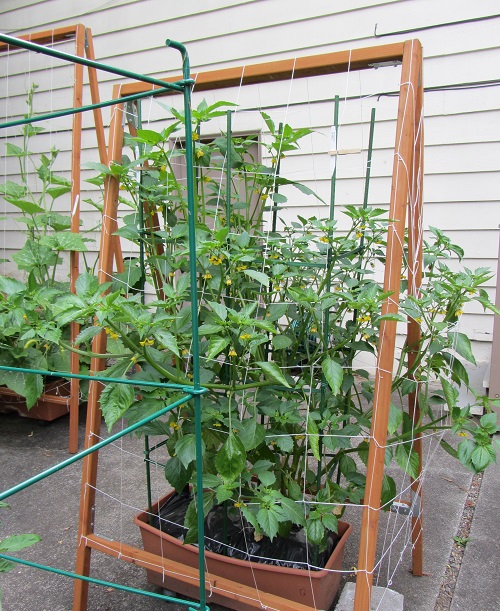
More beautiful, warm weather means more happy plants. The overview:
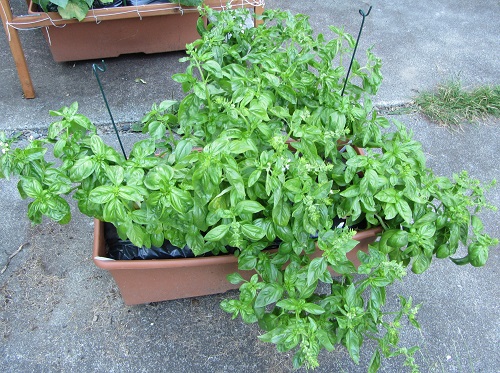
The basil is … sprawling:
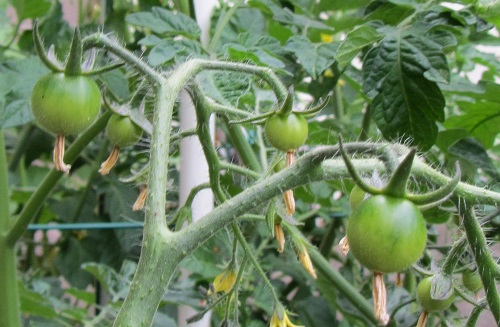
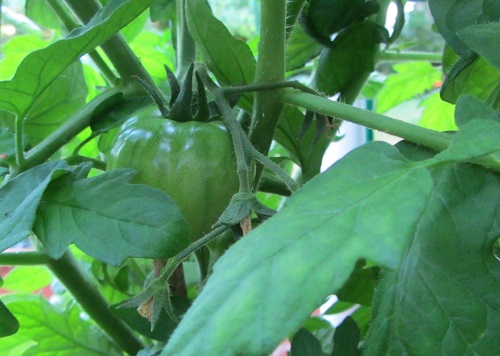
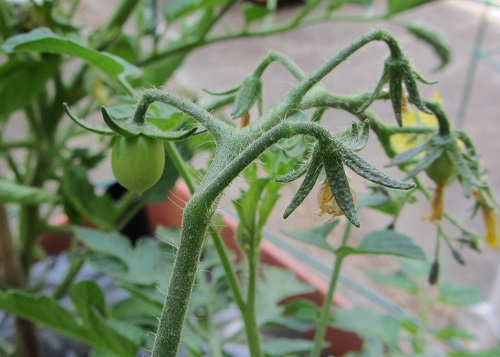
The Sun Gold tomatoes:
The Sweet Millions are at more or less the same stage:
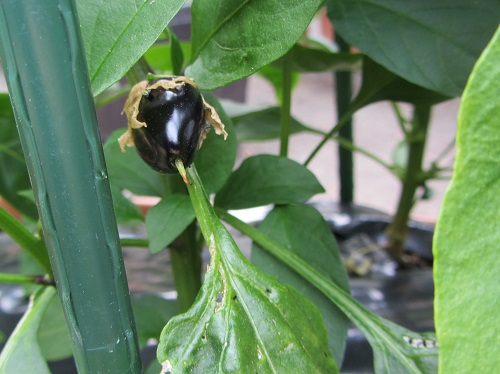
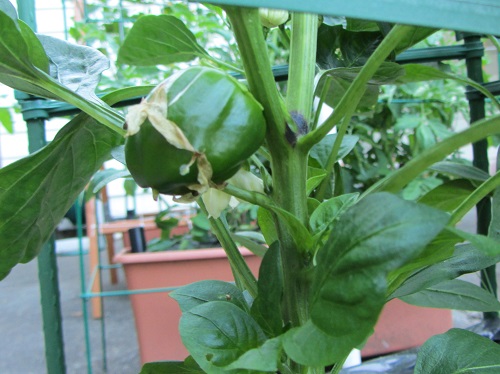
The first little Jalapeno:
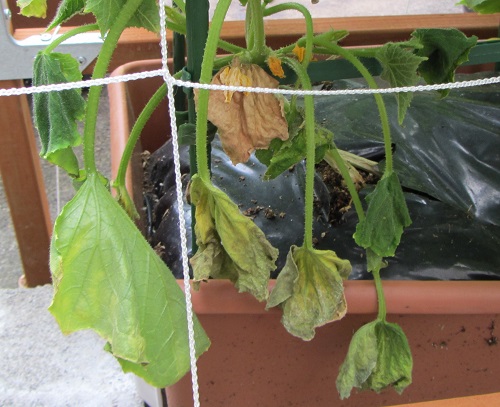
One of the two Lemon cucumbers in the southeast corner is shriveling, but only the bottom leaves. It’s been going on for more than a week. If the top starts to go we’ll cut out the plant. This is the perfect example of why I don’t like to prune to one plant per hole:
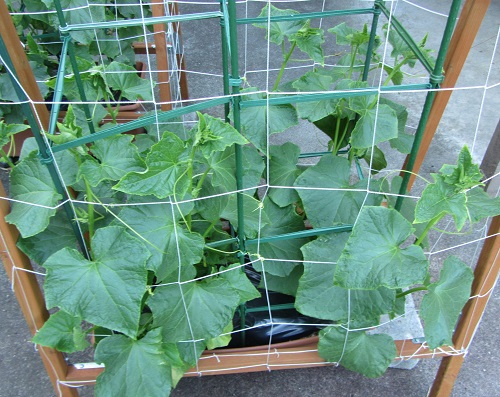
The earliest cucumbers — “Calypso”:
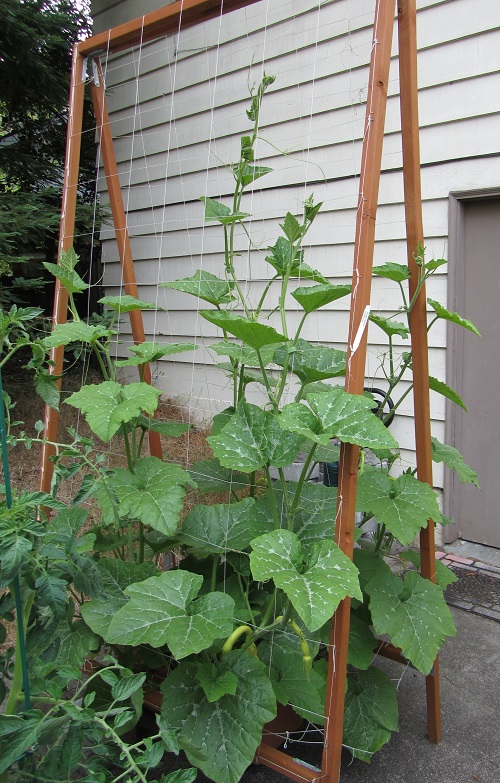
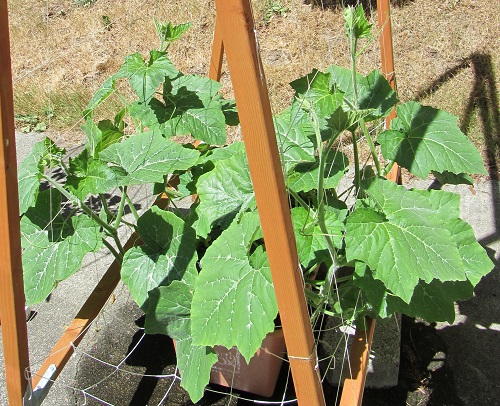
The Tromboncino zucchini is well taller than the door. Still no sign of powdery mildew. The milk treatment is “working”. Or it’s still just early:
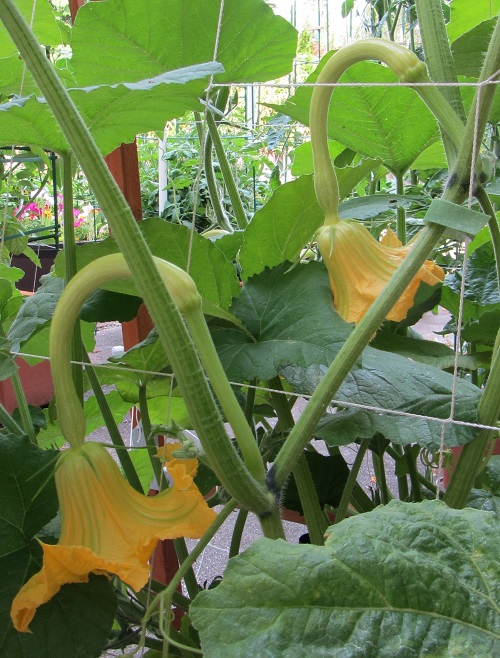
Zucchini flowers:
The biggest fruit. It’s going to be dinner sometime this week:
The tomatillos. They can’t be controlled. Or contained:
The peas by the front door are doing their thing, finally:
As an aside: We went to the local P-patch today to look around — Lots of peas, lettuces, carrots, and various types of alliums. Some tomatoes and tomatillos. One tiny little bit of corn, and one of beans. A little bit of squash. Not a cucumber in sight. The groupthink seemed almost monolithic in its decision making.
That doesn’t make any sense to me. Our cucumbers out-produce everything expect maybe the tomatoes. Maybe they’ll all plant cucumbers after the peas are done?
My guess is no. The food bank boxes are densely planted and well maintained. The other boxes, not so much. It might be because they’ve got so much space to play with, but to my mind they’re “wasting” a lot of it. There are “big” areas with nothing going on… Today is basically June 1st, shouldn’t there be something growing? (Or maybe it’s just me, and that having to deal with super finite space all the time has made me feel like wasted space = wasted opportunity. It’s really my problem, not theirs…. Nah.)
I went by again yesterday. There are still tons and tons of peas and lettuces. Much of the “wasted” space is now occupied by baby cucumbers and zucchini, as well as some smallish tomato plants. Beds like this are the exception:
There are some small squash or cucumber at the far end of the box. I think those are tiny broccoli(?) or some type of brassica in the front right. In the background you can see a tomato bed (#4) and a beet bed (#5). The beets look good..
I’m going to hazard a guess that in a couple of weeks all of the peas and lettuce will become short season tomato plants(?)
Previous post here. June 21, 2014 post here. June 16, 2013 post here.
Reviewing the pictures, this post is very similar to the June 21 post of last year. I even took pictures of most of the same things (Oregon Spring tomatoes, King of the North Peppers, the first Tromboncino zucchini.)
But I’m just now figuring that out, so here goes, starting with the overview:
Overall, I’d say we’re basically one week’s growth ahead of last year.
The basil — The mass is loosely the same as 2014, it’s just sprawled out:
The Tromboncino zucchini. They’re a little less than six feet tall:
The biggest zucchini. It’s around 4-5 inches long:
The tomatoes are trying to escape their cages. This one had to be coaxed back in:
The Oregon Spring:
It feels like we’re not seeing as many bees this year. Hopefully they’ll find the tomatillos attractive over the next few days:
The biggest King of the North. I may hit them with diatomaceous earth sooner than later. In theory it should keep the earwigs from eating holes in the peppers:
Because I haven’t done a picture of these in a while, the Marketmore 76 cucumbers:
I’d been looking for a new “old school” Nerf for a long time. I hadn’t been able to find one because they’re no longer manufactured. This past weekend I knew I’d have some arms willing to test out the new Nerfs, so I purchased the two most likely replacements in advance of some serious throwing around. My elbow is still a little sore four days later.
Pictured below are two new Nerf footballs, as well as what I think is an ancient Nerf knockoff — probably a Poof.
Weather Blitz: The green on the Weather Blitz is actually a semi-hard raised plastic. It’s easy to grip and easy to catch. I found I could get a good spiral on it, though I really had to “snap off” the throws. I found a couple of arm slots that worked, but that was it. It was fun to really get a good tight-spiral throw, though I think it was harder on my elbow than the other two footballs.
Sloppy throws resulted in really “ugly balls”. I didn’t think it was very forgiving — basically All Or Nothing — if my release point was too low the nose of the ball would burrow towards the ground. Additionally, I’d be a little hesitant to play catch using the Weather Blitz with someone young or someone with bad coordination. I’d be worried about hitting them in the nose or eye. It probably would’t hurt them, but I doubt it’d be fun.
All in all though, the ball does “sing” when thrown really well, and that’s really satisfying.
Pro Grip: Easy to throw. A variety of arm slots and deliveries worked. I could rarely get a perfect spiral, but even the imperfect throws were still pretty good. I found it a little hard to catch because, at least when new, it’s fairly slick. It’s also not very dense, so the ball would tend to try bounce off of my hands. Definitely less like a “real football” than the Weather Blitz, but it was still fun. I would have liked it more if it were a tiny bit heavier and/or denser.
Poof: Easy to throw, though it needs a good spiral to carry very far into the wind. This is the ball that Amazon reviewers thought was the hardest to put a good spiral on. I didn’t have that hard a time with it personally. I found that it allowed for some really crummy technique and it would still carry ok. Almost any arm slot and release point worked. Maybe they’re now making them with lighter foam than mine has. I like mine, it’s just so old that it will need replacing soon. I may buy a new Poof and try that out too.
Other Stuff: The Poof is close in size to a regular football. If I remember correctly, it’s also vaguely larger than an “old-school” Nerf. I’m pretty sure that the new Nerfs are somewhat smaller than the “old-school” Nerf, and they’re definitely smaller than I’d prefer.
The gang was fairly evenly divided about which ball they liked best, though all the votes were for one of the two new Nerfs. I think that the Pro Grip is a better ball for smallish kids, and that the Weather Blitz is more for older kids/adults, or for use in windy conditions.
My guess is that the Pro Grip is the one I’ll use more often, just because it’s more forgiving on my arm than the Weather Blitz. I can move my arm slot and release point around more with the Pro Grip, which means I get more play time before my arm bags out.
Ultimately, they’re different and loosely equal — I don’t think you can go wrong either way.
——-
Peyton Manning in one of my favorite SNL sketches:
Previous post here. June 7, 2014 post here. June 9, 2013 post here.
Things have changed a lot in two years. The cucumbers and peppers are much larger this year than in 2013. I think a big part of that is because we spread the cucumbers out more — the EarthBox instructions call for four in a row along one side of the box. This year we put two on each side with the fertilizer strip down the middle. There is only one “Calypso” — it’s not competing with anything else, and it’s growing faster than every other cucumber we have. It has blooms! Progress!
(In theory the right answer is to prune out the weakest zucchini and cucumbers and leave only one per hole. I’m hesitant to do that though, because if something happens to the solo plant we’re starting over from scratch. This year we pruned the cucumbers back to two per hole, mostly. However, if the “Calypso” continues to beat the bejeezus out of the other cucumbers then we maybe we’ll need to take a deep breath and go with one per hole in the future… Ultimately the final yield will tell use what to do — two plants at 60% production create more food than one plant at 100%… we’ll see how it shakes out.)
Clockwise from front right on a very bright day: “Calypso” cucumber, Lemon cucumber (2), National Pickling cucumber(2), Lemon cucumber (2) –
For comparison, here are the 2013 Marketmore cucumbers. (This year’s Marketmores are similar to the picture above):
For whatever reason, the two on the left are much bigger than the two on the right…
The photo below is facing north. It’s a direction I don’t usually use to take pictures-
Left side, front to back – basil, peppers, tomato
Center – Marketmore cucumbers, pretty container, tomatoes
3rd row – cucumbers, tomatillo, tomato
Far back right – Tromboncino zucchini
A more conventional view. Tomatoes and zucchini on the left. Peppers in the front. The basil (front right) is still floppy, but it’s now growing upwards:
A closeup of the Tromboncino zucchini. The four plants have been trained to their own “space”. One plant on one half of each side of the A-frame trellis. Note the complete absence of powdery mildew.. so far the 1/3 milk spray is working. Or it’s just early yet:
The tomatillos. “De Mipa” on the left. “Mexican Strain” on the right. The “De Mipa” is doing it’s usual flopping thing, and “Mexican Strain” is catching up:
Next week I’ll try to get pictures in the early morning before the direct sun kicks in. I think that makes for much better photos. Today that wasn’t a possibility. Hopefully by next week we’ll have a lot more little veggies to look at.
I had mostly written a post about how it was time for the Mariners to hit the panic button and then the Mariners went and did it in the worst possible way – they went out and traded for Mark Trumbo, which is exactly what the Mariners did not need to do. Granted, the Mariners traded a bunch of spare parts to get Trumbo (contrary what people may say, Gabby Guerrero, Vlad’s Nephew, is probably not going to be anything beyond a 4th OFer in the majors.
David Schoenfield wraps up the Mariners issues really well in this article. Basically, the team doesn’t get on base. The team has spent most of the Zdrienick era near or at the bottom of the AL in OBP which is why this team is consistently near or at the bottom of the AL in runs scored and near or at the bottom of the standings. This is a fundamental flaw in organizational philosophy. How many hitters have the Mariners developed into all-star caliber players under Z? One – Kyle Seager, despite having multiple top 10 picks. Ackley is looking like a 4th OFer, Zunino can’t hit a curve ball and looks like he will struggle to get to .200 every season, Brad Miller is really a league average SS as a hitter, Chris Taylor looks like he is going to be the same, Nick Franklin, who was traded to TB last season is looking like a 4A player and there isn’t much hope on the horizon.
Those who know me know that I wasn’t high on the Mariners coming into 2015 – they didn’t fix their on-base issues in the offseason and they were historically good last season at preventing runs, which meant that regression in that capacity is likely. Any offense that they added was going to be offset by a bigger increase in runs allowed, which is exactly what has happened so far this season.
Back to Trumbo. The guy has power, which puts him in 30 HR territory. That is great, except that the Mariners already hit a ton of home runs. Trumbo has a career .299 OBP which is horrible. He is a terrible defensive OF (although he isn’t bad at 1B, but it seems that the Mariners are convinced that Logan Morrison is the answer there). He probably ends up as a full time DH and occasional 1B, which is probably about right for him. The other thing that Trumbo has going for him is that he hits right handed. The M’s have an incredibly left handed heavy lineup and this will help balance it out. It doesn’t solve the issue of getting on base.
While we are at it, it is past the time where Fernando Rodney is the Mariners closer. Rodney has converted 14 of 17 save opportunities, which makes him look better than he has been. He has managed to compile an ERA of near 7 and in 7 out of his last 9 save opportunities, he has given up at least 1 run. The scary thing is that he has entered every one of those games at the start of the inning with no runners on. I can’t imagine that the Mariners even remotely trust him to come in with runners on at this point, yet McClendon still says Rodney is his closer.
I figured the Mariners were an 80-83 win team this season. I am willing to bet if they finish anywhere below 81 wins, that you will see a new manager and GM for the 2016 season.
You may remember that Culinary God Food Network Star Alton Brown appeared on Mythbusters. I had not realized there was actually a segment that did not make it into the show – I give you Dishwasher Lasagna.
If MLB is going to insist on keeping its current configuration of 162 games and 15 teams in each league, there are a few things that they should change, and don’t worry, what they should change won’t affect the “integrity” of the game.
Change 1 – eliminate the divisions. When you have divisions, all you are doing is potentially recognizing mediocrity. Even with 2 wild card teams, the potential still exists to have a division winner having a worse record than a team that does not make the playoffs, you also have the potential of a division winner having a worse record than both of the wild card teams. That makes a huge difference since the wild card winners have to play in the “coin-toss” game (AKA the wild card game) and then get to not have home field advantage against a team with an inferior record. Granted, home field doesn’t mean much in baseball (home teams win about 54% of the time) but I think most teams would rather have it. I am much more in favor of taking the 5 best teams in each league for the playoffs. Heck, I would even be in favor of adding another team and having the top 2 teams get a “bye” and the next 4 play a best of 3 series to advance. It would make the positioning for the playoffs much more important, forcing teams to play more meaningful games later in the year.
Change 2 – balance the schedule. If you eliminate the divisions, it becomes a no brainer to balance the schedules in the leagues. Even with the divisions, the balanced schedule makes more sense. You don’t think that it gives a team in the NL East a competitive advantage this season to get to beat up on Philadelphia and Miami 18 times each than say the NL Central which only has Milwaukee as a whipping boy? You can never balance the interleague stuff, but it wouldn’t hurt to have all of the AL teams play each other the same amount of times each season and eliminate the imbalance of the division strengths.
Change 3 – have both leagues use the DH. This one will upset people who complain that it will ruin the “sanctity of the game” or causes less strategy in the game. To that I say bullcrap. Here is how MLB pitcher have faired over the last 4 seasons (2015 stats through May 31).
Year
BA
OPB
SLG
OPS+
2015
.121
.144
.150
-16
2014
.122
.153
.152
-12
2013
.132
.164
.169
-6
2012
.129
.162
.166
-8
Honestly, let’s say you were faced with a situation in a playoff game where you are down 1-0, a runner on 3rd, two out in the 8th inning. You have Felix Hernandez pitching and he is dealing – he gave up 1 hit (a HR in the first on a bad pitch) and he has retired every batter since and hasn’t had a hard hit ball against him since the HR. Let’s say you are facing elimination. Your chances of winning in the 9th aren’t good because you are facing a Marino Rivera-like closer in the 9th. What would you do? Before you answer, here is what pinch hitters have done over the last 4 seasons:
YEAR
BA
OPB
SLG
OPS+
2015
.219
.292
.335
78
2014
.213
.291
.322
76
2013
.217
.292
.336
77
2012
.225
.304
.334
80
With a pitcher hitting, you have pretty much no chance that you will be tying up the game. Granted, a pinch hitter is no real guarantee, but wouldn’t you rather have someone who hits for a living up at the plate? So how does it not cause less strategy? Look at it from the other way – if you have the DH in play and don’t have to worry about the pitcher coming up at bat, you have an opportunity to deploy your pitchers more effectively in critical situations. What made Mariano Rivera so great in the post season was that the Yankees were able to utilize him in multiple innings without having to worry about his spot coming up in the batting order. Look at the 2014 WS – the games in KC allowed both teams to deploy the 2 best bullpens in the league over a longer stretch and hit more strategic matchups than you ever would with allowing the pitcher to bat.
In addition to this, if you don’t like the 2-1 games that dominate baseball these days, putting in a DH vs a pitcher is worth about half a run a game. Wouldn’t you rather see a guy with 250/20/75 slash lines up at the plate rather than a guy who has a 100/0/0 slash line? A pitcher in the lineup generally means that you end up with effectively an 8 man lineup with an automatic out thrown in. That isn’t all that much fun to watch.
Previous post here. June 1, 2014 mini post here. June 7, 2014 post here. (Note the basil, third picture down, front right. More on that below.)
The growth in the garden is accelerating rapidly — here are the first tomatoes (Sweet Million):
The potted raspberries have around 100 fruits or so. It’s year three and they’re really getting going. There’s bird netting strung up over the cage:
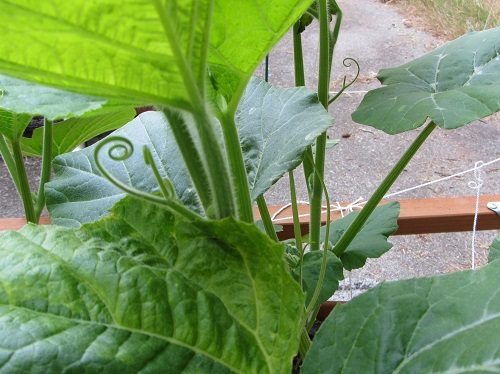
The cucumbers and zucchini simultaneously decided it was time to start getting grabby. The “Calypso” cucumbers:
The Tromboncino:
Today saw the first dose of calcium nitrate for the tomato plants (1 tsp down the feed tube). Tomorrow I’m going to try a milk/water solution on the leaves of the zucchini as a preventative against powdery mildew. Hope it works.
—–
As compared to last year, this year’s basil is twisted, floppy, and sickly looking. The plan is now to harvest it next week and try again with better starts. I don’t think we’ll be using Tilth for basil anymore. Bah.















 FlatbreadGarden