Star Realms Tips And Strategy Guide

by A.J. Coltrane

Star Realms tips, strategy, and collected thoughts.

Opening Game:

1.  In the first two shuffles I like buying either – economy, Red “deck thinner” cards, or cards that can be Trashed for Trade, such as the Ram (3 Trade when Trashed) or Blob Wheel (same). If it’s the Ram or Blob Wheel then I try to immediately flip them for something bigger. The object is to try to get a big economy engine going without committing to a lot of cards that would represent late-game clutter. Generally I only buy Explorers (2 Trade/2 Damage when Trashed) if literally nothing else is available, and Trash them no later than the 3rd shuffle. I think if I need Explorers after the 3rd shuffle I’ve already lost.

2.  Trash Vipers, then Scouts. The tiny amount of damage that a Viper might do isn’t as valuable as the potential 1 extra Trade from a Scout.

Mid Game:

3.  Buy a maximum of 2-3 Red “thinners”. Red cards are good for thinning the deck and that’s about it. Once the deck has been thinned they’re relatively weak cards.

4.  Try to buy a minimum of 3-4 Stations (Bases and Outposts). Bases and Outposts effectively thin the deck for as long as they’re in play, and Outposts function as bonus life every time they’re drawn. I love getting 5 or 6 Stations total, including at least 3 Outposts. That’s a lot of damage prevention.

Late (End) Game:

5.  I think the end game starts at around 30 life (for either me or the opponent). I try to focus on Outposts, card draw, and offense after that point — ideally expensive stuff only. No cheap clutter allowed. Which leads to…

Other Thoughts:

6.  Don’t feel compelled to spend just because you have it. I generally avoid all 1 cost cards after the first shuffle, and by the time the mid game rolls around I try to avoid purchasing anything that costs less than 5. The exception is Outposts. Outposts = extra life. I like extra life. It’s possible I’m too “purchase averse” — it may be as I play more games I’ll reconsider this point, though right now it appears to be working.

7.  Draw > Opponent Discard. In fact, I think Opponent Discard is basically useless, and the cards that have it are relatively too expensive. I say this because I’ve had it happen where I’ve been forced to discard down to two or three cards and redrawn a dozen cards anyway. I actively try to avoid buying Opponent Discard, except lately I’ve been buying a turn 1 Imperial Frigate (if there’s nothing else) and immediately Trashing it for card draw. (With the Frigate I will have paid 3 Trade for 4 damage, 1 Opponent Discard, and 1 Draw. That seems not unreasonable to me. But I’m not going to leave it to suck up space in my deck.)

8.  Pay attention to what cards the hard AI likes. Especially Recycling Station.

9.  Try to focus on buying only one or two factions + a few Red. Faction bonuses are really important. The exception is that sometimes I’ll snap up a 6+ cost stompy Ship or powerful Station, even if it doesn’t “fit”. I’ll also buy Outposts regardless of what it is, though I still try to match factions if possible.

10.  Yellow:  Focus on draw and Outposts.

11.  Green:  I tend to go for off-faction Outposts and Bases. Exception: Blob World is a game-ender.

12.  Blue:  Really needs a blue-heavy thin deck — without faction bonuses Blue isn’t very good. Blue bases help.
Encouraging A Better Rise For The Big Sandwich Bread

by A.J. Coltrane

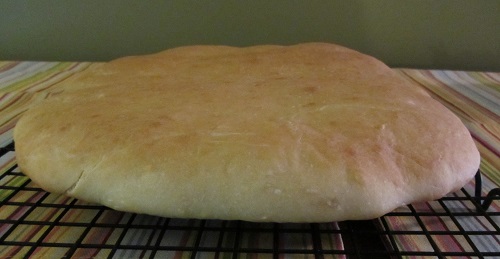
When we’re feeding a crowd I’ll make a big-*ssed sandwich — it’s basically the same size as a sheet tray (18″ x 13″). For the last GNOIF it was … either a ciabatta with a little bit of oil in the dough, or a focaccia with no oil on top and no dimples. It wasn’t the platonic ideal of either, but I’m calling it a ciabatta this time around.

Ingredient Measure Baker’s %
AP Flour 300g 50
Bread Flour 300g 50
Water 420g 70
Salt 15g 2.5
Instant Yeast 1 tsp
Olive Oil 24g 4

I wanted to encourage a lighter bread than the usual focaccia. The changes were:

1.  The incorporation of bread flour into the formula.

2.  I chose not to top the dough with oil before it went into the oven. Also, no dimpling the surface.

3.  Before kneading, the flour, water, and 1/8 tsp of yeast were combined and allowed to rest for an hour. This is called an “autolyse.” It allows for the gluten strands to start setting up, and yeast doesn’t have to compete with salt for the available water.

Very foreshortened. It's 13" wide and 18" long.
Very foreshortened. It’s 13″ wide and 18″ long.

4.  Normally when I proof the bread I’ll do it directly in a parchment-lined sheet tray. I’ll cover that with another inverted sheet tray. It dawned on me that the rise might be improved by using steam in the oven, which is how I’ve been baking baguettes… But then why not just leave the inverted sheet tray as a cover for the first 10 minutes of baking, similar to the No-Knead Bread dutch oven technique?

I mean really, why did that take so long to occur to me?

The finished bread was 2-3″ tall, which is about half again as tall as the focaccias have been. It was lighter and less oily too.

I think it’s a variation with potential.

GNOIF: New GNOIF On The Block

by A.J. Coltrane

GNOIF #16 Recap — New GNOIF On The Block (Games that have only been played a few times at GNOIF.)

Games That Got Played —  Castle Panic, Dead Fellas, Fluxx, Forbidden Desert, Get Dr. Lucky, Run For Your Life Candyman, Star Realms, Ultimate Werewolf, We Didn’t Playtest This At All.

Games That Didn’t Get Played — Batt’l Kha’os, Carcassonne, Medina, Pirates Cove, Power Grid, Seven Wonders, Small World.

GNOIF turned sweet sixteen, and we celebrated by offering games that hadn’t been seen much in past events. Not too surprisingly, everyone gravitated to stuff that at least a few people knew how to play… and almost all the games played could be categorized as “light”. It seems starting from scratch by reading a big rulebook and then teaching is too slow when there are games that need little introduction. (I started to type “introducation”. That word doesn’t exist, but I think it should. It’s perfect for what I’m trying to describe.)

Which sort of makes it funny that the big hit of the evening was new to everyone. Ultimate Werewolf. One person went into the other room, read the (tiny) rulebook, then taught it to the group of ten players. It has some similarities to Resistance or Mafia, which helped the learning curve.

The concept is that some of the players are Werewolves, some are Villagers, and some are “special” roles such as “Seer”, the “Hunter”, or “The Village Idiot”. Each player’s role is a secret. The Werewolves try to eat the Villagers, and the Villagers try not to get eaten… there’s more to it than that, but that’s the gist of it. Suitable for 5 to 30 players, and best at 10-15 players, it made a good substitute for some of the other “late in the evening” games we’ve been playing, such as Bang! or The Worst Card Game Ever. It was loud, boisterous, and not too heavy on the thinking.

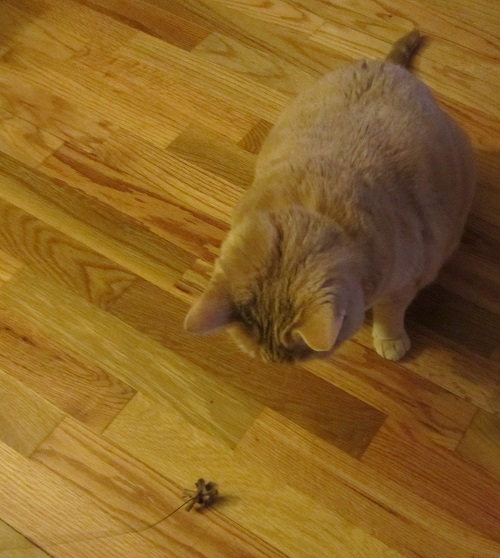
Bonus boy cat pic:

150124 boy cat

He’s long. That’s a dog bed.

The Best And Worst In Board Games

by A.J. Coltrane

Links to three articles about board games at FiveThirtyEight.com, all of them based around BoardGameGeek ratings:


“Designing The Best Board Game On The Planet”

and

“Stop Playing Monopoly With Your Kids (And Play These Games Instead)”

and

“The Worst Board Games Ever Invented”


To quote Sid Meier — I’m of the opinion that  “A [good] game is a series of interesting choices.” Overall the voters on BoardGameGeek tend to agree, and will rank games based around that type of idea. I like to check the BoardGameGeek rating when we’re considering purchasing a game. If the rating is below 7.00 we’ll be hesitant about buying it — a 7.00 rating represents the #275th ranked game on the site.

And we don’t have room in the house for 275 games anyway.

Recommended Game — Star Realms

by A.J. Coltrane

Star Realms — A space-themed deckbuilder available either as an android app or as actual physical cards. The full app version is $5. The base set of cards runs around $15.

Like Dominion, the object of Star Realms is to build an efficient deck from a selection of cards available on the table. You can buy Outposts, Bases, and different varieties of ships, each of which provide some combination of offense, defense, buying power, life restoration, or deck thinning.

In contrast to Dominion, you and your opponent start the game with 50 life (“Authority”). The winner is the last player with Authority greater than zero.

An example of a ship that might be available for purchase, the Ram:

150119 Ram

The Ram costs 3 “Trade” to buy. (The number in the upper right corner of the card.) It does 5 damage. The green circle on the card indicates that the Ram is also part of the Blob faction — if other friendly Blob faction are in play the Ram does an additional two damage. Finally, the Ram can be “trashed” (removed from the game) at a gain of 3 Trade.

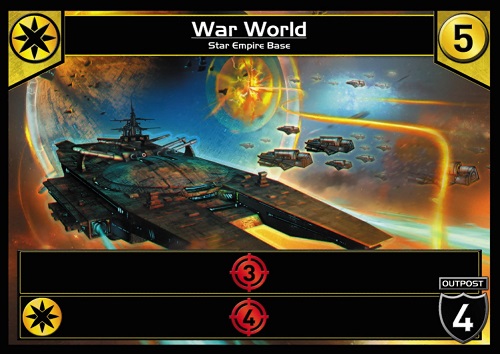
Pictured next is an Outpost — War World. A big advantage of outposts and bases is that they stay in play until destroyed, in effect thinning your deck. They also provide some measure of defense.

150119 War World

War World costs 5. It does 3 damage unless it has an ally in play, in which case it does 7. It also has 4 defense, and must be destroyed by the opponent before they’re allowed to damage you.

The app is free to play. Spending $5 upgrades the game to include harder opponent AI options and turned-based asynchronous matchmaking. (In other words, your opponent sends a move, then you log in and play your move, and so on.)

I’ve played both the over-the-table game as well as the online app. The games go fast, and while it’s not quite as “deep” as Dominion, there’s still plenty of strategy, lots to learn, and there’s always the possibility for making a big stompy combination to win the game.

Highly recommended!

Recommended Game – Qvadriga

by A.J. Coltrane

Qvadriga:  It’s turn-based chariot racing for your android phone!

Do you like old-school strategy games? Like, really old school?

Back in the dark ages of board games there existed Circus Maximus.

circus maximus

Published by Avalon Hill in 1979(!), Circus Maximus was cool because you could select and train your horses and riders, bribe the officials, and run your buddies off of the track, all for fame, glory, and riches in ancient Rome.

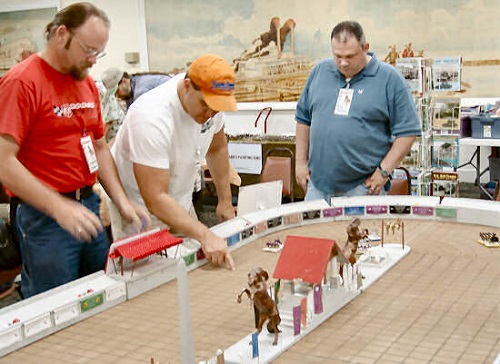
It’s been out of print forever, but it still has a passionate fan base. These guys are taking it waaay more seriously than I ever did:

circus maximus2

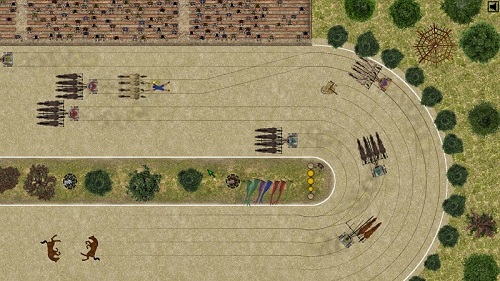
So I was really exited to see a sort-of-port for the phone – Qvadriga:

qvadriga

In Qvadriga you maintain a stable of four chariot teams. Your drivers can gain experience and become more skillful, assuming they survive. The game forces you to balance aggressiveness against keeping your drivers alive — go too fast around a tight corner and the chariot might break apart, leaving your driver dragging behind his horses. At that point you have to hope that he can get to safety before he gets run over. If the driver dies it takes a new hire a while to get competent… Plus you have to buy a new chariot to replace the one you broke, and the good ones aren’t cheap.

Anything goes, you can direct your driver to whip the other drivers, the other horses, or use his chariot to ram into anyone nearby. The game rewards weaving to cut off faster opponents.

There are two campaign modes, one of which allows you to resurrect a driver if he’s killed. The “Epic” mode doesn’t allow for resurrections. Ultimately the object is to become famous enough to be allowed admittance to the Circus Maximus, and then to have the driver with the most career wins of any driver still alive.

It’s $10 on the android store. I went ahead and forked out the $10 because I knew I’d get at least that much fun out of it.

Highly recommended.

Rick Bayless’ Corn Tortillas

by A.J. Coltrane

Periodically I decide I want to make tortillas from scratch. The results tend to be uneven, probably because I’m only trying it periodically.

150112 press

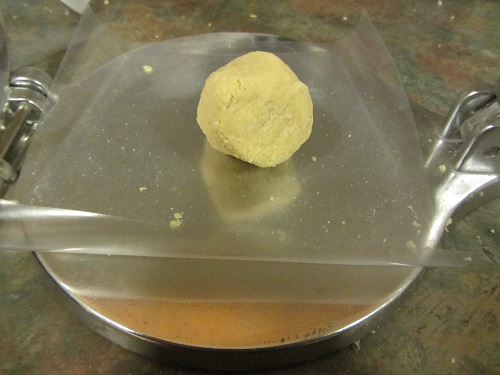
Tonight’s came out better than usual and were less hassle. I think there are two reasons for that — I didn’t make them as wet as usual, and I didn’t squeeze the tortilla press super hard. The drier, thicker tortillas separated from the plastic much more easily than in previous attempts.

I used a sandwich-size freezer bag. The thicker plastic seemed to help as well.

150112 tortilla

Cast iron skillets really hold the heat and lead to good color on the tortillas. (These are all 5-6″ in diameter.)

Combined with slow-cooker pork shoulder, cheese, and salsa:

150112 finished

Very tasty!

Bonus hunter pic:

141221 hunter

The toy is a Cat Dancer. The girl cat completely loses her mind. (Link for reference. Shop around.)

(Recipe link. Amazon link for the source recipe in Mexico One Plate At A Time.)

Stuff I’m Playing On The Phone — Brave Frontiers

by A.J. Coltrane

My intent is to write a few posts about what I’ve been playing on the android phone as time-killers. (a.k.a. “What I’ve been playing while I wait for the Marvel Puzzle Quest heroes to heal”.) Some of these games are more fun than others, but each has something that kept me interested, at least for a while.

First up:

Brave Frontiers

brave frontier fight

Cost:  Free, with optional in-game purchases that aren’t really needed if you log in daily and approach the game in a casual fashion. (See below.)

What is it?:  Sort of a high-fantasy Japan-anime Pokemon style turn-based fighting game. (whew)

You create a team of heroes and fight whatever the quest requires. Every creature/hero is inherently one of six colors, and there’s a rock/ paper/ scissors element to it — Blue > Red > Green > Yellow > Blue… Also — White > Black > White. The quests often involve fighting creatures of a certain color, so having the “rock to their scissors” can be very helpful.

When you win a fight you’re rewarded with gold, crafting materials, and sometimes you get an “essence” of one of the creatures that you defeated. These “essences” are “fused” with your existing creatures/heroes to level them up and improve their abilities.

brave frontier character

Why It Held My Interest:  I’m always a sucker for Diablo-style random drops, and Brave Frontiers has that with the essences. The actual crafting portion isn’t as interesting, but it still adds something.

Other Thoughts:

1.  Eventually, “optimal” fighting becomes more or less the same, which is why I eventually tired on it somewhat.

2.  If you decide that this game looks interesting I would *highly* recommended that you log in daily — the daily rewards can include “gems” once you’ve logged in a number of days in a row. The “gems” are used to increase your inventory slots for creatures, which you’ll need. (You can use “gems” for lots of things, as a casual player I’d recommend using them ONLY for creature slots.) The “gems” are where the developers try to monetize the game.

3.  Quests require “energy” to fight, starting at 3 energy and going up from there as you advance. Energy regenerates at the rate of 1 point per 10 minutes, which leads to the next point:  The fights can be unforgiving — there are times that you don’t know that you’re not “tall enough to ride this ride” until after you’ve gotten the snot kicked out of you, which basically represents a time sink… of course you can repair your energy faster with “gems”…

Overall though, if you like Pokemon-style games you can do a lot worse, I got quite a few hours out of Brave Frontiers, and I’m leaving the window open to maybe playing more.

Just make sure to check out the Brave Frontiers wiki if you’re at all serious about advancement.

Closer To The Truth Baguettes

by A.J. Coltrane

The middle of December saw the Not-Pretty Baguettes.

Tonight’s are much more photogenic:

150106 baguettes

The crumb was decent but not exceptional. This may be to be expected given the relatively small diameter of the breads:

150106 crumb

Notice how the open spaces are directly down the center — the area that was slashed.


It’s basically a classic baguette formula:  100 parts bread flour, 60 parts water, 2 parts salt:

1.  Before I left for work I combined 200g bread flour and 200g water with ~1/16 tsp of instant yeast.

2.  When I got home I combined the preferment in the KitchenAid with an additional 130g flour, 7 grams of kosher salt, and 2/3 tsp of instant yeast. The combined dough was mixed for 8 minutes on low speed.

3.  The dough was allowed to rise for 30 minutes, then divided, shaped, and placed into a towel-lined (and covered) baguette pan. The doughs were allowed to rise in the baguette pan for 30 minutes..

4.   A loaf pan with 1/4″ of water was preheated in a 450F oven for 15 minutes. (45 minutes of rise time in the baguette pan for the doughs, total.) The breads were then baked for 22 minutes. At the 11 minute mark the loaf pan (with remaining water) was removed, and the baguette pan was rotated 180 degrees.

Progress!

—-

I recently received a copy of Advanced Bread and Pastry. It confirmed something that I suspected. (Paraphrasing) “High protein flours brown more readily than low protein flours.”

I’ll need to look for the exact quote again.


Two Cold Season Gardening Links

by A.J. Coltrane

A couple of links I would have liked to have found a few months ago–


Tilth.org:  “Fall and Winter Gardening in the Pacific Northwest”  (2001, PNW 548)

Includes planting dates for winter/spring harvest, minimum plant temperatures, recommended varieties, and other useful tips and resources.


Fourseasonfarm.com – Eliot Coleman:  “A Garden For All Seasons”, or, “Gardening On The Back Side Of The Calendar”. (PDF, Issue 178, February/March 2000)

Contains a cross-section of the information from Coleman’s 1999 book “A Four Season Harvest“. Minus much of the fluff. (And minus a good bit of the information, to be fair.) Still, it’s a good start if you’re interested to see where Coleman is coming from.


As it is, the first Spring Seed catalogs arrived in the Wednesday mail. Time to start planning for summer.