A From-Scratch Gluten-Free Flatbread Recipe I’m Pretty Happy With

A friend of mine expressed interest in a recipe for a gluten-free flatbread, since they weren’t happy with any of the pre-made mixes they’d tried. That sparked my interest too — and I spent a bunch of hours digging around forums and websites looking for commonalities and differences among the recipes I could find.
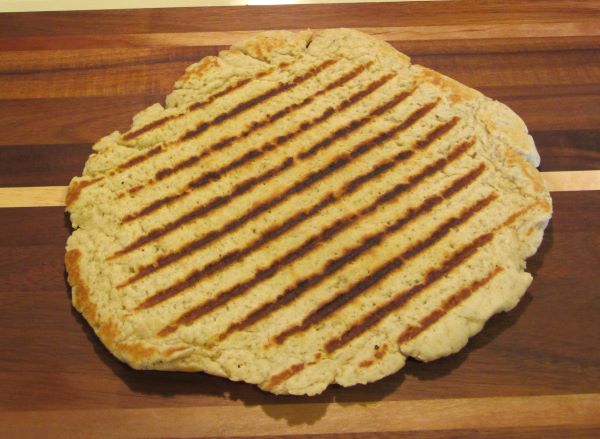
This recipe makes a flatbread that just fits into our grill pan. When the flatbread comes out of the grill pan it’s flexible — to make it crispy on the bottom put the finished bread onto a pizza stone at 450F for 2-3 minutes. The oven is also a good way to warm up any desired toppings.

I’ll post some other thoughts towards the bottom of the post.

The Recipe:

Wet Ingredients:

110g lukewarm warm (~100F)

40g milk powder

8g psyllium husk

10g extra virgin olive oil

Dry Ingredients:

65g Super Fine Brown Rice Flour

20g Tapioca Starch/Flour (same thing)

10g Corn Starch

5g Potato Starch

4g Baking Powder

3g Kosher Salt or Sea Salt

The steps:

  1. Add the lukewarm water to a mixing bowl. Add the powdered milk and whisk to combine.
  2. Add the psyllium husk and whisk to combine. Let rest a few minutes to let the psyllium husk hydrate.
  3. In a separate bowl combine all of the dry ingredients and stir to distribute.
  4. Add the olive oil to the wet, now viscous milk mixture. Whisk to combine.
  5. Add the dry ingredients to the wet ingredients. Starting with a spoon or spatula mix to combine.
  6. “Knead” and press the mixture until it becomes the texture of masa. I use my knuckles to fold and press the dough into the leftover dry bits until it’s completely combined.
  7. Preheat a pan to medium-high. I use the same temperature that I use for hashbrowns. I want brown but not charred.
  8. Cut a piece of parchment to the same size as the pan. Mine is 8″ x 8″.
  9. Oil the parchment and roll out the dough to 1/4″ thick. (picture below)
  10. Oil the top of the dough.
  11. When the pan is up to temperature, invert the dough/parchment onto the pan and peel away the parchment paper. Add more oil to the top if it looks dry.
  12. Bake 3 minutes on side one, then flip and bake on side two another 2-3 minutes. I use two spatulas to flip to try to make sure the bread doesn’t break.

At this point the dough can be topped and reheated in the oven.
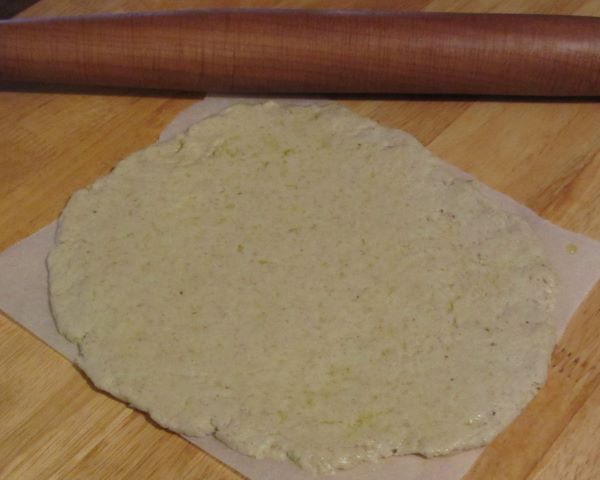
For pretty edges, trim the outside with a knife or pizza cutter. I’m always ok with rustic.

When creating the recipe I wanted to pin-down at least one variable. I decided that 100g of flour + starches would fit pretty well in the pan so that became the “base”. The end result is (65g brown rice + 35g total starches = 100g). More notes on that ratio below. Once I settled on the dry weight only the wet weight required adjusting.

The tapioca / corn starch / potato starch ratio was partly inspired by a forum post on pizzamaking.com, and partly because I was targeting a particular mouthfeel and taste in combination. Every starch has a “signature” taste and mouthfeel, I tried to avoid using too much of anything so that when people eat it they won’t say “that’s tapioca”, or “that’s corn starch”. I started with way too much potato starch, which has a pleasant taste, but too much and it becomes dense and “potatoey”.

Flexible when it comes out of the pan.

Some other commonalities among gluten-free baking recipes, broadly:

2% salt by weight is a very normal amount in all bread baking. This becomes 3g in the recipe above due to all the other stuff in addition to the 100g of flour and starch.

4% baking powder by weight is normal. This one took a little more digging since almost without exception people use volumetric measures.

For gluten-free flatbreads the ratio of flour to starch varies quite a bit but often lands around 2 flour to 1 starch by weight. Water tends to be around the same weight as the combined weight of the flour and starch. “Regular gluten-free breads” tend to be more around 1:1 flour:starch by weight.

One other thing I learned that I didn’t know going in, was that the potential ingredients/exchanges can vary a lot in weight, given the same volume. I always bake with metric weights, so changing one component for another was pretty simple, and I usually didn’t have to mess with the amount of liquid required to get a similar dough ball.

More so than in “regular” (gluten) bread baking, substituting anything will make for a different, or very very different end result. The ingredients themselves have different tastes, or they hydrate differently, or they give a different mouthfeel. I know that this recipe gives consistently pleasing results. Changing anything will basically make it a different recipe. It may still have a good taste and texture, it’ll just be different, and using a substitution may require more fiddling to make it work.

Finally: The most obvious way that this recipe differs from pre-made mixes is it uses psyllium husk rather than xanthan gum, or guar gum. I think the reason so many mixes contain xanthan gum, and by extension so many people include it in their recipes is this: It doesn’t require a separate hydration step and it can be bagged and shipped together with the rest of the pre-made mix. I feel like Xanthan gum has its places but psyllium husk was the better choice for this recipe.

Happy Baking
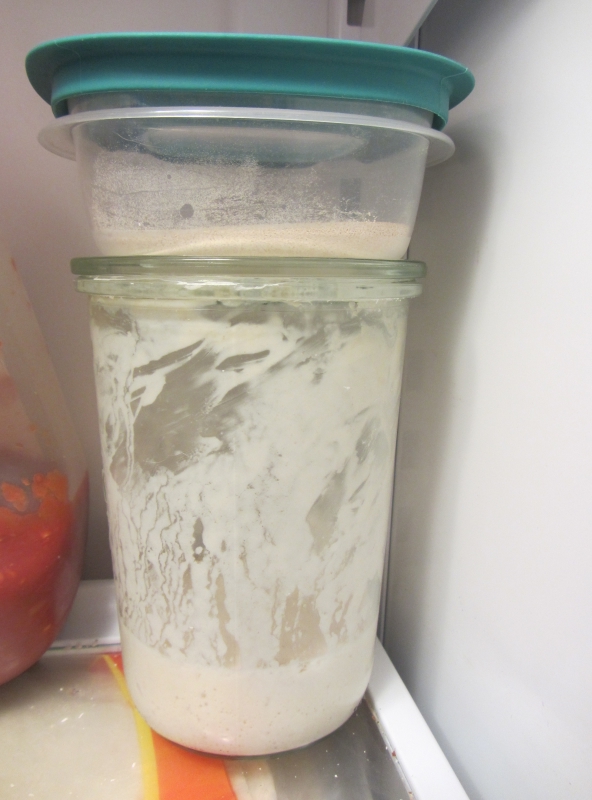
Levain Starter – Evolutions In Bread By Ken Forkish

A few months ago I decided to begin maintaining a starter. To that point I’d avoided it, partly because I didn’t want Another Living Thing to maintain, partly because the idea of throwing away starter seemed wasteful, and partly because it just felt like it was going to be a messy and unnecessary hassle.

Hanging with the salsa.

The flip side of maintaining a starter would be that it would allow for more interesting things to try with breadmaking. It would also add another “color” to my available “palette”. The end product could be better tasting, better for us, and keep longer before spoilage. Ultimately I read enough intriguing starter-based recipes that I decided to give maintaining a starter a try so I took the leap.

I wanted a starter recipe that wouldn’t consume or waste much flour. I also wanted a starter recipe I could mostly ignore after it was finished. I settled on Ken Forkish’s Levain recipe from Evolutions In Bread. The entire process requires one week and 550 grams of flour.

Creating the starter is pretty simple really. Weigh the container and write that number down. Every 24 hours some amount (by weight) of the contents of the jar will be discarded and then the container will be fed a small amount of fresh water and flour. I made the decision ahead of time to mill all of the whole wheat flour I was going to need, 250 grams total. That way I wasn’t getting the mill out for the first few days when it was time to discard and feed. The process felt very easy and pretty bulletproof — I think that fresh milled whole wheat contains enough nutrients and enough bacteria/enzymes/assorted microbes and whatnot that kicking off the new tiny ecosystem basically took care of itself.

The recipe it calls for 250 grams of starter as the end product. I “shorted” the final feeding and I didn’t see any adverse effect. I did that because I wanted to be able to pull a smaller amount out of the jar each week and still keep things fresh and lively with smaller feedings. If I want to build up a large quantity of starter it takes a little longer but I’m fine with that.

I maintain 150 grams of starter in a 393 gram jar (weighed with no lid). Each week I take a small spatula and scrape/pour out 100 grams for bread baking. I then add 50 grams of bottled water and 50 grams of bread flour to the container, scrape down the sides, and stir it up. I put the lid back on and let it sit on the counter for 1-2 hours, until it starts to show some signs of life. Then it goes into the back corner of the refrigerator for another week. I store yeast in a tupperware-type container on top of the starter. Everything is in one place and ideally staying fairly cold.

As for the container – it became clear pretty quickly that straight sides are a good thing and a threaded jar is a bad thing. Straight sides because it’s much easier to get into and scrape down the jar when there’s no “neck”. Threads just gather crud and rapidly clog. I purchased a 6-pack of the Weck 743 jars and split it with a friend who was also making a new starter. (At the time the total cost was ~$6.50 per jar for six.) I use them without the gasket. They’re nice somewhat heavy jars made of thick glass. The lid just sits on top and it’s plenty secure.

Final thought: Evolutions in Bread is a great book. Highly recommended.

50/50 Pullman Loaf, A Recipe I’m Happy With

I’ve now reached a point with the weekly sandwich bread bake that I’m basically happy with it. I’m sure I’ll continue to fiddle with it to see how it reacts, but here’s where I’ve settled as a base recipe:

Ingredients

100g starter discard or overnight poolish (either of these are optional but they seem to improve the mouthfeel of the finished bread). The starter discard is 50g bread flour and 50g water. If using a poolish it will be 50g bread flour, 50g water, and a tiny tiny pinch of yeast.

200g Bread flour and 250g fresh-milled whole wheat flour (Red Fife, Turkey Red, or Rogue de Bordeaux berries), (In total it is 500g flour weight total including the starter/poolish).

325g cool water (with the 50 grams from the starter/poolish the total water is 375 total grams. 75% dough hydration).

    15g honey (3% of flour weight)

    15g olive oil (3% of flour weight)

    10g kosher salt (2% of the flour weight)

    1.5 tsp instant (not rapid-rise) yeast.

    Process

    Start by adding the 325 grams of cool water to the bowl of the stand mixer.

    Scoop 100 grams of starter discard into the water.

    Grind the wheat directly into the water/starter mixture. I feel like this helps keep the milled wheat temperature lower than it would be if I just milled it into an empty container. At the very least, it can’t hurt.

    Add the remaining ingredients and mix for one minute to combine. Cover and let rest 20 minutes, up to an hour. Uncover and mix another 6 minutes.

    Spray a pullman pan lightly with Baker’s Joy. (I’ve tried more than a few ways of attempting to prevent the baked loaf from sticking to the pan. Baker’s Joy has been by far the easiest and most consistent solution. If overused Baker’s Joy with give the crust a vaguely weird and sticky quality, so don’t go overboard with it.)

    Transfer the dough to a pullman pan and spread out the dough with wet fingers. Cover, and let rise until 1/2″ to 1″ from the top of the pan. Preheat oven to 350F when the dough is getting close to ready.

    Bake, covered for 30 minutes then remove the cover and bake for another 25 minutes or until the loaf reaches 195-205F.


    I had been using powdered milk in the recipe, but it didn’t seem to be adding flavor. I thought it might also be contributing to the finished loaf being a little crumbly, since when used in moderation the powdered milk is supposed to help with loft. Simpler might be better here.

    This recipe still technically functions as a same-day loaf, given I always have a starter in the refrigerator. The weekly sandwich bake then doubles as an opportunity to remember to refresh the starter. Win-win.

    Happy baking

    King Arthur Epi de Ble and Dutch Oven Dinner Rolls. And A Couple Of No Kneads.

    I went a little over the top with the Thanksgiving breads this year: A 1.3x batch of King Arthur’s Epis de Ble, two batches of King Arthur’s Dutch Oven Dinner rolls, and two No-Knead breads. All of that for nine people. I started at 4:30am and finished around 11am.

    I made a couple of changes to the Epi de Ble recipe. I increased the total flour weight to 620 grams and used bread flour instead of all purpose. This made four epi. The poolish was changed to incorporate all of the water — 403 grams water and 403 grams flour. The total formula included 63% water, 2% salt. King Arthur original recipe here.

    I made a double batch the Dutch Oven Dinner Rolls and modified that recipe slightly as well. All of the water (227g x 2 = 454g) and 454g of the flour were included in poolish that spent three days in the refrigerator. And I used 2% salt by weight. King Arhur recipe is here.

    Finally, I made two No-Kneads using the recipe in the header at the top of the page.

    I think overall everything came out a little bit lighter colored than usual — I put a sheet tray in the bottom of the oven so that none of the bottoms would get too dark. It had the side effect of not allowing the breads to deeply brown either, but I thought it was a reasonable tradeoff and nobody seemed to mind.

    It was basically five individual bakes, so I made a chart of when everything needed to be handled, mixed, or if the oven needed a temperature change for the upcoming items. With that many things happening I was glad I did, and I didn’t wind up with any timing conflicts.

    Next year I’m going to make half as much stuff and get more sleep.

    Happy Baking

    A 50/50 Boule With Yecora Rojo

    Inspired by this “Yecora Rojo Sourdough Breads (No Knead Version too)” recipe on Breadtopia, I thought I’d try a non-sourdough version that I sort of crossed with my basic No Knead recipe.

    The recipe is 200 grams King Arthur Bread Flour, 200 grams fresh-milled Yecora Rojo wheat flour, 336 grams cool water (84% hydration), 8 grams kosher salt (2%), and 1/4 tsp instant (not rapid-rise) yeast. Combine all in a bowl and mix until it’s a homogenous mass. Cover and leave on the counter.

    I started the dough at 7pm the day before baking. At 11pm the dough was looking pretty feisty and had about doubled, so I did some Rubaud folds and put the container into the refrigerator, mostly because I preferred sleep over handling bread at that hour.

    I did two more Rubaud folds at 1am and 4am, each time returning the dough to the refrigerator. At 4am the dough was still fairly shaggy but it was coming together. I removed the dough from the refrigerator at 6am and did coil folds at 6am, 7am, and 8am.

    The dough was smooth and handled well after the 8am coil fold so I moved it to a covered banneton. At 9am I preheated the oven and our Le Creuset bread oven to 460F. At 10am the dough went onto a parchment and was slashed, then moved over to the bread oven. I reduced the temperature to 450F and baked the dough for 20 minutes covered, then 22 minutes uncovered. (The same time and process that I use for No Knead bread, though most times I’ll just go directly into the Le Creuset or a dutch oven rather than starting on parchment.) Cool on a baking rack.

    The 84% hydration matches the Breadtopia recipe. The 1/4 tsp instant yeast matches my normal No Knead recipe. The bread measured 205F when I removed it from the oven which (again) is in-line with Breadtopia.

    The bread was very moist. It had a decently open crumb, though it wasn’t quite as open as the pictures on Breadtopia. My feeling is that the dough could have possibly used another round or two of coil folds, but that was going to put the timing really close to when we needed to take it across town.

    I was happy with the crust too, it had a nice bite to it but not “too much”. The next time around I’m going to try a little less flour in the banneton — I was probably too concerned with the dough easily releasing from the banneton so I may have overdone it a bit.

    I don’t normally drop breads that I haven’t tested at all into a group setting, but I was reasonably confident everything had worked out and the bread was well received. So that was good.

    The next time I’ll probably move the dough to the refrigerator after a shorter initial room temperature rise, then incorporate coil folds as soon as the dough will allow it. It might be the right answer is to do some Rubaud folds in the first hour prior to refrigerating overnight, then moving the dough back to the counter in the morning and using coil folds until the dough is ready.

    Yecora Rojo is a Hard Red Spring wheat variety developed in the 1970’s. It’s my understanding that it’s used by some well-known bakeries and in flour blends for “artisan breads”. Last week I was buying wheat berries and Rogue de Bordeaux was not available, so I added Yecora Rojo to the Breadtopia shopping cart. I’m glad I did. It (predictably) functions well as an artisan bread flour. Based on one bake it’s not finicky to work with. The taste is not assertive and I think even people who Don’t Like Wheat Bread would eat it, especially if the percentage of Yecora Rojo was cut back to 20% or so.

    Happy baking.

    Naan For A Dinner Party

    We were recently invited to a dinner party that involved dishes from a variety of cultures and places, sort of focused on North Africa and the Fertile Crescent. We brought naan. Pictured is a triple recipe to generously serve ten people:

    The white girl kitty inspecting the naan.

    I’ve made naan or naan-like things a number of times and basically winged it with decent-to-good results. This bake was for a discerning crowd so I wanted to use an actual recipe as a starting point to help ensure things didn’t go too far off the rails.

    Ultimately I chose between Kenji’s Grilled Naan recipe on Serious Eats and a King Arthur website recipe. Kenji’s recipe calls for using an outdoor grill, so I mostly went with the King Arthur recipe because we were cooking on a grill pan instead of live fire. I used Kenji’s recommendation of bread flour instead of a mix of flours.

    First, the King Arthur formula as written:

    180g King Arthur AP Flour, 90g King Arthur Bread Flour, 142g warm water, 71g Full-Fat Greek Yogurt, 28g melted ghee or butter, 1-1/2 teaspoons Active Instant Dry Yeast, 1 teaspoon granulated sugar, 1 teaspoon salt. Full recipe here. …After baking brush with butter and top with nigella seeds and cilantro.

    My slight modification that includes honey and uses Baker’s Percentages:

    270g King Arthur Bread Flour, 142g warm water (52% of flour weight), 71g Full-Fat Greek Yogurt (26%), 28g melted ghee (10%), 1-1/2 teaspoons Active Instant Dry Yeast, 2/3 teaspoon honey, 5g (scant 2%) salt. Combine all in a mixer for 6 minutes on low speed.

    1. Cover and let rise until doubled, about 60 minutes.
    2. Divide into ~100g balls. (The original recipe calls for 65g, which I felt were too small for that event.) Let the dough balls rest 20-30 minutes.
    3. Preheat grill pan to medium/medium-high.
    4. Very lightly oil a work surface roll out a dough ball to 8-10″ long. Then roll the next ball as the one on the stove is cooking. Resist the urge to roll out very thinly — the center may burn instead of bubbling.
    5. Bake the first side about 45 seconds — until it the dough bubbles, then flip and bake another 45 seconds or until the naan is just cooked through. (Cooking them too long makes them tough.)
    6. After baking brush with ghee and top with minced chives.

    For transport we put a cooling rack on the bottom of a sheet tray, then piled on layers of naan with each level separated by parchment paper. We wrapped the entire thing in foil. Shortly before dinner the naan was reheated in a low oven while still wrapped in the foil.

    Thoughts:

    I’d never made ghee, but it’s super easy. There are tons of recipes online but basically you just heat butter until warm/very warm, skim the surface until the solids drop out, strain. Done. We heated a couple of smashed garlic cloves in the finished ghee for a little background sense of garlic.

    The naan was well received at dinner, so that part went well. I think the King Arthur recipe calls for too much liquid — I wound up adding a few tablespoons of flour and then a pinch of salt to keep the balance. If I had it to do over again I would have held back about 1/3 of the water initially to see how the dough shaped up.

    I sort of feel like that’s not-uncommon in bread baking and recipe writing — too much liquid in the formula that then combines with generous amounts of bench flour to compensate. As a rule I try to do the opposite and incorporate as little raw flour as possible, which then also helps maintain the balance of the recipe. That’s why in Step #4 it calls for a lightly oiled surface, rather than floured or heavily floured.

    Ten people ate twelve of the fifteen naan. Little or No Leftovers = Successful Recipe. I’ll use this one again.

    No-Fuss Roasted Potatoes

    By Iron Chef Leftovers

    Potatoes are not one of my favorite things to cook or eat since they act as more of a flavor vehicle for what they are cooked in rather than having a great deal of inherent flavor on their own. Mrs. Iron Chef however loves them so I do occasionally make them, but I am constantly looking for new ways to cook them.  I came across an easy, no-fuss, one pot recipe on America’s Test Kitchen that I figured was worth a shot. Basically it calls for braising the potatoes first and then searing them, but it didn’t involve even taking them out of the pot, and only a couple of ingredients, so it really doesn’t get too much easier than this.

    The Software

    1 lb. Red Potatoes, roughly 1 to 1 ½ inches in diameter, washed and halved

    1 cup water

    3 cloves of garlic, peeled

    2 teaspoons of salt

    3 tablespoons of unsalted butter, in 6 pieces

    1 tablespoon, fresh squeezed lemon juice


    The Recipe

    Arrange the potatoes in the bottom of a skillet (don’t worry about over-crowding, it won’t matter, I used a 10 inch, straight sided skillet) so that all of the cut surfaces are in contact with the surface of the pan. Add the water (it should come up about half way on the potatoes, add more water if necessary), butter, salt and garlic to the pan. Turn burner on high and heat the skillet until the water comes to a boil. Reduce heat to medium and cover for about 15 minutes. Check if the potatoes are cooked after 15 minutes (a knife inserted should pull out easily), if they are not, cover until they are. Once the potatoes are done, remove the lid and remove the garlic to a bowl. Increase heat to medium high and continue cooking until the bottoms of the potatoes are golden brown – all of the water will evaporate leaving just the butter (this should take 10-15 minutes depending on your stove). While this is happening, mince the garlic and combine with lemon juice. Once the potatoes are done, remove from heat and toss in garlic and lemon. Season with salt and pepper to taste and serve.


    Notes

    I would recommend using a non-stick skillet for this process to keep the potatoes from sticking to the bottom of the pan. The recipe scales easily, just put enough potatoes to fit in the pan and add enough water to come up half way on the potatoes. You probably won’t need to add more butter unless you use something larger than a 12 inch skillet. Fresh rosemary, sage, thyme or oregano would work well with this recipe. Just mince them and add them at the end with the garlic.

    Chewy Chocolate Brownies

    By Iron Chef Leftovers

    I don’t generally like to bake, partially because I hate following recipes and partially because I usually end up eating too much of the finished product. However, when it comes to parties, it is nice to have something sweet on hand that can feed a large number of people easily, and brownies fit that bill very well. The better the chocolate used in these, the better the brownies will be. There are so few other ingredients that you will actually be able to taste the more subtle flavors that the chocolate will carry, so use one that you like the taste of when eating it on its own. The recipe is adapted from Cook’s Illustrated.

    The Software

    The Recipe

    1. Adjust oven rack to lowest position and heat oven to 350 degrees.
    2. Make a Foil Sling using the following steps: Cut 18-inch length foil and fold lengthwise to 8-inch width. Fit foil into length of 13 by 9-inch baking pan, pushing it into corners and up sides of pan; allow excess to overhang pan edges. Cut 14-inch length foil and fit into width of pan in the same manner, perpendicular to the first sheet (if using extra-wide foil, fold second sheet lengthwise to 12-inch width). Spray with nonstick cooking spray.
    3. Whisk cocoa and boiling water together in large bowl until smooth. Add unsweetened chocolate and whisk until chocolate is melted. Whisk in melted butter and oil. (Mixture may look curdled.) Add eggs, yolks, and vanilla and continue to whisk until smooth and homogeneous. Whisk in sugar until fully incorporated. Add flour and salt and mix with rubber spatula until combined. Fold in bittersweet chocolate pieces. (this may seem like a bunch of steps, but it comes together very quickly)
    4.  Scrape batter into prepared pan and bake until toothpick inserted halfway between edge and center comes out with just a few moist crumbs attached, 30 to 35 minutes. Transfer pan to wire rack and cool 1½ hours.
    5. Using foil overhang, lift brownies from pan. Return brownies to wire rack and let cool completely, about 1 hour. Cut into 2-inch squares and serve.


    Notes

    This is a very easy recipe and makes a big pan of chewy, dense, intensely chocolaty brownies, just prep everything in advance. These are nice with a small sprinkle of sea salt on top, but really just work fine on their own. I like using chocolate in the 70-85% range for this (my preferred chocolate is Kallari), but the original recipe calls for 60%, so you can use that. I wouldn’t use chocolate under 60% (the brownies will be very sweet) or over 85% (never tried this, but I suspect that the chocolate chunks won’t end up melting enough). The notes from the Cook’s Illustrated recipe:

    For the chewiest texture, it is important to let the brownies cool thoroughly before cutting. If your baking dish is glass, cool the brownies 10 minutes, then remove them promptly from the pan (otherwise, the superior heat retention of glass can lead to overbaking). While any high-quality chocolate can be used in this recipe, our preferred brands of bittersweet chocolate are Callebaut Intense Dark Chocolate L-60-40NV and Ghirardelli Bittersweet Chocolate Baking Bar. Our preferred brand of unsweetened chocolate is Scharffen Berger. Leftovers can be stored in an airtight container at room temperature for up to 4 days.

    Classic Buttermilk Waffles

    By Iron Chef Leftovers

    I don’t normally do breakfast, but when I do, I tend to gravitate more toward pancakes and French toast. On occasion, I will get a waffle, but generally it is something I may eat once a year. On a recent trip back to the Iron Chef homeland, my mom purchased a waffle iron. Well, she needed a recipe; I knew a good one from Cooks Illustrated, so here you go:

    The secret to great waffles is a thick batter, so don’t expect to pour this one. Make toaster waffles out of leftover batter—undercook the waffles a bit, cool them on a wire rack, wrap them in plastic wrap and freeze. Pop them into the toaster for a quick breakfast.

    The Software

    • 1 cup unbleached all-purpose flour
    • 1 tablespoon cornmeal (optional)
    • ½ teaspoon table salt
    • 1 teaspoon baking soda
    • 1 egg, separated
    • 7/8 cup buttermilk
    • 2 tablespoons unsalted butter, melted

    The Recipe

    1. Heat waffle iron. Whisk dry ingredients together in a medium bowl. Whisk yolk with buttermilk and butter.

    2. Beat egg white until it just holds a 2-inch peak.

    3. Add liquid ingredients to dry ingredients in a thin steady stream while gently mixing with a rubber spatula; be careful not to add liquid faster than you can incorporate it. Toward end of mixing, use a folding motion to incorporate ingredients; gently fold egg white into batter.

    4. Spread appropriate amount of batter onto waffle iron. Following manufacturer’s instructions, cook waffle until golden brown, 2 to 5 minutes. Serve immediately. (You can keep waffles warm on a wire rack in a 200-degree oven for up to 5 minutes.)

    NOTES

    That is it. Serve with syrup, butter, whipped cream, fruit, fried chicken or whatever you like.


    Braised Pork Sugo

    By Iron Chef Leftovers

    One of the nice things about making pasta sauce is that it is a fairly simple process and can be used in a variety of ways. One of the things I tend to do with my tomatoes is to make a really simple sauce and freezing it so that I can use it as a base for a more robust pasta sauce later in the year. One of my favorite sauces is a sugo – a hearty sauce that I love in the cold of winter. It was part of one of my courses at a recent dinner party and it is a nice sauce to feed a crowd.


    The Software

    3 lb. pork shoulder, cut into 1 inch cubes

    2 medium onions, finely sliced (about 2 cups)

    3 carrots, peeled and cut into 1 inch lengths

    3 celery stalks cut into 1 inch lengths

    1 tablespoon tomato paste

    1 can diced tomatoes (16 oz)

    1 1/4 cup chicken stock

    1 ¼ cup red wine

    1 teaspoon minced garlic

    5 cups tomato sauce

    1 teaspoon dried oregano

    1 teaspoon minced sage

    1 teaspoon minced rosemary

    2 teaspoons olive oil


    The Recipe

    Preheat oven to 275 degrees. In a dutch oven, heat one teaspoon of olive oil over medium high heat until just smoking. Add 1/3 of the pork and brown on all sides (about 4 minutes per side). Remove from the pot to a plate and reduce heat to medium and add 1 teaspoon of olive oil. Add onions and cook for 8 minutes until they start to become translucent, stirring occasionally. Add the tomato paste and cook for 3 minutes, stirring occasionally. Add garlic and cook for 30 seconds. Add celery and carrots and cook for about 10 minutes stirring occasionally. Add stock, tomatoes and red wine and increase heat to medium high until liquid comes to a boil. Add the pork and cook until the liquid returns to a boil. Cover and put in the oven. Cook for about 2 hours or until the pork is fork tender. Remove from the oven. Pull the pork from the liquid and set aside to shred. Take the vegetables and add them to a blender. Strain the liquid to remove the fat and then add to the blender with the vegetables. Puree until smooth (you may need to do this in a couple of batches). Add the puree and the pork back to the pot and combine with the tomato sauce, oregano, rosemary and sage. Heat over medium heat for 15 minutes, add salt and pepper as needed and serve over pasta.


    Notes

    This recipe is better if you make it a day ahead of when you want to use it. I use an even split of marsala wine and dry red wine, but just about any red wine will work in this recipe. You can adjust the amount of tomato sauce depending on how much sauce you like. If it is too thick when you serve it, add a bit of pasta water to it to loosen it up. This would also be nice with a bit of red pepper flakes added to the initial braise.