Note the little window box on the left. It’s a Kit Kat with bits of gummy. We were pretty pleased with how that came out. I like the snowman too — neither of the snowman nor the window box were my contributions. I contributed the oddly shaped tree.
The Joy of Cooking 75th Anniversary Gingerbread House recipe. I chose this recipe because it seemed to be the simplest dough, or, at least the dough that was the most similar to something that I was familiar with. I treated the house-pieces as crackers and I think that “grounding” helped.
The dough recipe begins with 1 cup (2 sticks) butter melted over low heat. Add 1 cup sugar and 1 cup unsulfured molasses and stir until the sugar dissolves. Let cool to lukewarm.
In a large bowl whisk together 4-1/2 cups AP flour, 1 teaspoon baking soda, 1 teaspoon salt, 1 tablespoon ground ginger, and (I left these out) 1 teaspoon cinnamon and 1 teaspoon ground nutmeg. Make a well in the center and mix in the wet ingredients. Add another 1/2 cup AP flour until the dough pulls away from the bowl. Knead on the counter a few times, wrap in plastic, and move to the refrigerator to fully cool for up to 3 days. I removed the dough from the refrigerator 1 hour before rolling out — I’d suggest allowing 3-4 hours for the dough to come to room temperature instead.
Note: I found this dough too grainy and loose to knead, so I added a couple of tablespoons of water. Interestingly, the recipe thinks the dough may already be too wet and calls for adding more flour if needed…
I recently saw a list of the top 10 selling cookbooks for 2012 and it is a rather disappointing list, led by the Barefoot Contessa’s new tome. It got me thinking, if I were stranded on a dessert island (no that is not a typo, I really would love to be stranded on a dessert island; a desert island just doesn’t seem like it would be all that much fun) and could only have 10 cookbooks/food related books with me, what would they be? Let’s just assume that I, for some reason, have a fully stocked kitchen and pantry (just don’t ask me how).
Here is my list, in reverse order:
If you were to own just one book on cooking, this should be it.
10 – Silver Spoon – it is generally considered to be the most complete Italian cookbook ever created and didn’t exist in an English translation until about 10 years ago. If you are serious about Italian cooking, you should own this monster.
9 – Charcuterie by Michael Ruhlman. If you watch No Reservations, you know who Ruhlman is. This is a survival guide to curing meats which would come in handy in a stranded situation. It is also an in depth read about the how and why of charcuterie.
8 & 7 – I’m Just Here for the Food / I’m Just Here for More Food by Alton Brown. More useful for why and how things work with cooking than for recipes, I can pretty much assure you that if you ever had a recipe fail, you can find out exactly why here. Be careful, these books are a gateway drug into the world of molecular gastronomy.
6 – On Food and Cookingby Harold McGee. The book is incredibly long (800+ pages), very technical in parts and is not a quick read (it took me over a year to read it cover to cover), but it is probably the single most important book on food ever written. It covers pretty much every aspect of food and food science and you should have it on your bookshelf as reference even if you never read it cover to cover. I doubt there has been a food book written in the last 20 years that has not cited this one as a reference in its bibliography.
5 – Modernist Cuisine at Home. Another book that is more science than recipes, it is another one that you should own, even if you aren’t into the molecular gastronomy thing. Reading this book will make you a better cook even if you never try anything from the book.
However, if you were to own just two books on food, this should be the other one.
4 & 3 & 2 – Bones / Fat / Odd Bits – by Jennifer McLagan. These books are really essential for understanding and cooking the rest of the animal and should really be looked at as 3 parts of a single book; the ultimate in utility – you realize after reading them, everything is useable. They really fill in the gap for all of the stuff that most other cook books don’t address. It doesn’t hurt the descriptions are well written and the anecdotes are funny.
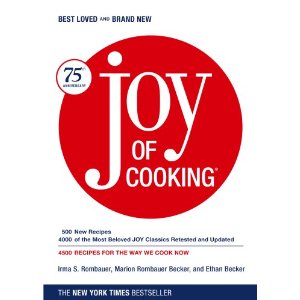
1 – Joy of Cooking – there should be a law that every home cook should have this book on their shelves since it pretty much has a recipe for everything in it. It has been updated about 14 times over its 75+ years in existence, but have some fun and get an edition that is printed before the 1960’s just to see how cooking has changed.


 FlatbreadGarden