Food as Nostalgia

By Iron Chef Leftovers

A while back, I wrote a post about my lack of understanding about the fascination with Dick’s and why do people consider it great. Regular reader, SeattleAuthor, wrote a response here. I am really not writing this to debate who is right or who is wrong; this is a post more about emotions that food evokes. When we talk about food or wine or beer that brings up strong emotions, we can usually pinpoint the time and the place and all of the details that surround that event. When we describe something to someone and call it “great” or the “best that I ever had,” we do need to ask ourselves, “Was it the food/wine/beer itself that was truly great, or was it the context of when I had it that made it great?”

I would place the mantel of calling something great or the best when I take a step back and look at the context. The first question that I would ask myself is “If I had the meal/wine/beer outside of the context that I had it in, would I still feel the same way?” Then I ask myself, “Would someone who did not know my feelings about the food/wine/beer but had a similar taste for those items feel the same way I do?” It is possible for something to be great without invoking the nostalgic memories of the event and it is also possible to be nostalgic without being great. It might also be both.

I think of examples in my own life – a dinner at Au Pied de Cochon in Montreal a few years ago, shared with the two people who stood with me at my wedding was both amazing and nostalgic. Seven years later, we still can recount the details of what we had at that meal and I still consider it one of the three best I ever had. Those details were enhanced by the company and my feelings for those two people. I also realize that had I had that meal by myself, I would have still considered it to be one of the three best meals I ever had. I didn’t need the context of who I was with to frame that. I have many similar experiences, all of which seem to be as fresh in my mind as the day they happened.

A Bud Light was one of the best beers I ever had, not because it was a good beer (yes, I still think it is complete swill), but because of the circumstances surrounding when I had it. It was the first time my dad came to visit me in Seattle, it was just him and me, sitting down the third base line in Safeco field, on a warm April day. It also happened to be the first baseball game I ever attended with my dad. Framing that beer in that moment made it probably the most enjoyable beer I ever had. I can still picture the scene in my head and I can tell you exactly what that beer tasted like and, in my mind, it was the greatest tasting beer I ever had. We tend to have these types of experiences growing up – a favorite pizza or Chinese place; the ice cream truck that used to stop in front of the house; the diner at the end of the block that my mom and I would go to get cheesecake or where my grandmother and I would go when I would come back home to visit; a bottle of wine shared with a special someone. Were these places great, no. Would I recommend them to anyone, probably not – they are not great, but they are special to me.

I have had many great meals, beers, wines in my life also that there was no emotional attachment to. I would recommend these without hesitation to anyone, it is just the context in which I enjoyed them was not particularly memorable. I probably could tell you why they were such great experiences, but I doubt that I would be able to recount every detail of them.

This article has sat for over a month unfinished because I couldn’t figure out how to bring it to its conclusion. I found that inspiration a few weeks ago with something a friend of mine wrote on her blog. She recently lost a close friend in a senseless act of violence and wrote a very moving tribute on her blog. It made me realize that I saw the evolution of how food/wine/beer can be both great and nostalgic at the same time. An excerpt from what she wrote:

…would come to me on a regular basis proclaiming “OMG, Jen, you’ve got to get this wine. This shit is amazing!”

One day he had come to me with the same old story and I replied with something to the effect of “Zip it! I’m not falling for this Yancy. I need to save money”. His retort was “you’re making the biggest mistake of your life. You WILL regret not buying this wine and I won’t share any if you don’t get at least one bottle.” We both laughed and laughed because I finally stepped into the big leagues this time and purchased three bottles. Weeks later, like ‘em or not, the Wine Spectator came out and named this one of the top three wines in the world.

Well as luck would have it, I still have a bottle in the cellar. In the coming weeks a friend has organized a few industry colleagues to gather for a little tribute and bring a special bottle to honor our dear friend. I know what I’ll be pouring. You can bet your bottom dollar that I will toast my spirited cohort and recall many fond stories as I relish in how precious our time really is.

So often we realize after the fact, the significance of an event, like the simple act of buying a bottle of wine. Later on, that event takes on a different context and memories, maybe even more powerful than the original experience. We are lucky when we can attach those two separate events together to create something lasting, both “great” and “nostalgic.”

I would like to thank my friend Jen for allowing me to use her words and feelings in this post. I definitely owe her a beer since this piece probably would have never gotten finished if it wasn’t for what she wrote.

A Burger with Heart

By Iron Chef Leftovers

I have been accused of being a food snob over the years because I tend to shun crappy, mass produced foods in favor of items that are freshly prepared on a small scale and because I will eat things that most Americans won’t, despite, in most of those cases, most of the rest of the world does eat it.

One case in point – beef heart. Before you go “yuck”, understand this – heart is a muscle that is no different from the steaks that you eat and it actually contains significantly less fat than most other cuts of beef. It also has an incredibly beefy flavor (not the metallic flavor that most people would assume it has since it is considered “organ meat”), much more so than just about any other cut off the cow. If you haven’t tried it, you should – it is cheaper than a steak and cooks incredibly quickly so it can be prepared for a weeknight meal.

All of this lead author Jennifer McLaglan to include a recipe for a heart burger in her Odd Bits cookbook. Before you say “yuck” again, be aware that if you are eating any commercially produced burger or using commercially produced ground beef, you probably have had heart already without knowing it. As she writes:

This is a great way to try heart for the first time…

I took this recipe and made it at home without telling Mrs. Iron Chef Leftovers what was in the burgers and she loved them. I suggest you try it for yourself before saying “yuck.”

The Software
¾ lbs. brisket, fat cap on, ground
¾ lbs. heart, fat on, cleaned and ground
1 ¼ teaspoons salt
Freshly ground black pepper
1 tablespoon olive oil, beef drippings or bacon fat

The Recipe
In a large bowl, combine all ingredients, except the oil, mixing gently until combined. Divide into 4 portions and form into patties about 1 inch thick. Place the patties on a large plate or sheet pan, cover with plastic wrap and refrigerate for at least 1 hour. Pre-heat a pan or grill over medium high heat and add oil. When the oil begins to smoke, add the burgers. Cook for 4-5 minutes until a nice brown crust forms and flip, reducing the heat to medium. Cook for another 4-5 minutes until the burgers reach your desired doneness, Server with your favorite burger toppings.

Notes
I would highly recommend sourcing your heart from a small grower and preferably from a grass fed animal. You will get a better quality product with better flavor. I usually get mine from Skagit River Ranch. You probably won’t be able to find either ground heart or ground brisket easily, so you can see if you purveyor will grind it for you, or better yet, grind it at home yourself. I also added about 2 strips of uncooked bacon to my meat mix before I formed the patties and it took these burgers over the top. This comes in especially handy if the brisket you use does not have much fat. I would not recommend cooking these burgers all the way to well-done; they will dry out as a result and won’t be particularly tasty. If you are grinding the meat yourself and you have a good source, you shouldn’t need to cook these beyond medium-rare to medium. If you don’t like beef, pork belly or lamb shoulder can be subsituted for the brisket and the heart of those respective animals can be used.

Leftover Calzone Ingredients? More Pizza!

by A.J. Coltrane

I just liked the way this one looked… It reminded me of the pizza that I loved when I was small.

Baked on a screen.

It’s the leftover calzone ingredients from the other night:  sausage, bacon, sauteed onion, sauteed red pepper, “pizza sauce” with additional oregano and roasted tomato flakes, and mozz.

Up close and personal.

And a bonus picture of the princess.

Two Links About Pizza

by A.J. Coltrane

Two links to Serious Eats —

The very cool Del Popolo food truck serves wood-fired pizza out of a 5,000 lb oven — the oven is inside the truck! Includes a slide show and an interview.

This is an older post that I just ran across today:  Donna Currie has a 12-part post discussing many different baking surfaces for home oven pizza. Includes a slideshow overview highlighting the pros and cons of each surface. There’s a lot of useful information both in the posts and in the comments. Well worth the reads.

…and a bonus animal pic!

Late Afternoon Sun On The Kitchen Table


Looking for a Restaurant Recommendation?

By Iron Chef Leftovers

Next time someone asks you for a restaurant recommendation, have them fill out the following mad lib:

I’d like to dine out with my (noun) this (day of the week), and am having trouble finding the perfect spot. I always prefer a restaurant that (everybody/nobody) knows about. I (don’t want to/don’t mind to) wait in line; what really matters is the (food/service/value/ambiance).

I’m envisioning a restaurant where we can drink a (craft cocktail/pitcher of beer/foreign soft drink) while (reading/listening to a server recite/trying to translate) the menu. I’m (adverb) devoted to local, seasonal cooking, and I (verb) if the chef kills his own (noun) or forages her own mushrooms.

I don’t eat (kind of food) or (kind of food), but I’m not picky. I love (type of cuisine). My favorite restaurant experience was in (city), where I ate at (name of restaurant). That place is so (adjective)!

I (enjoy/could do without) a leisurely, multi-course meal. I’m thinking my budget is about (price). Do you think that’s doable? I just don’t want (greatest restaurant fear).

That was written by Hanna Raskin of Seattle Weekly in response to constantly being asked about what restaurant should someone go to. I may start having to have Mrs. Iron Chef fill this out when she tells me she doesn’t care about where we go out, but actually does. You can read the full article here.

Unorthodox Egg Rolls

by A.J. Coltrane

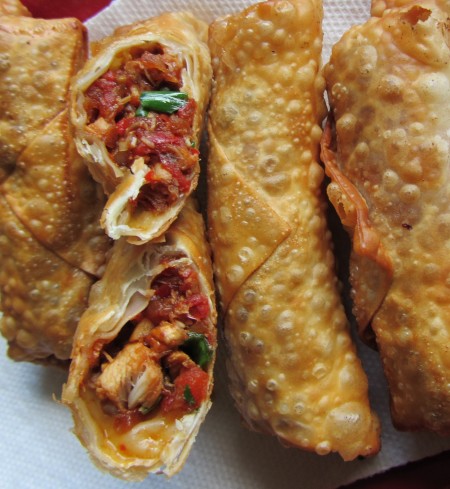
These were inspired by this Simply Ming recipe:  Spring rolls filled with turkey, carrots, and carmelized onions. The carmelized onions in an egg roll sounded really good to me.

I began by shredding one red pepper, 1/2 a red onion, and three large button mushrooms. These went into a skillet with two cloves of minced garlic, two tablespoons of hoisin sauce, and a splash of soy. Everything was sauteed over medium heat until it was all a big, sticky, red mess. When cool it was combined a bowl with minced cooked chicken (about one large breast), and the green parts of a bunch of scallions.

The egg rolls were sealed with an egg wash.

And deep fried in canola oil until golden brown.

I used this recipe for sweet and sour sauce, minus the cornstarch and the boiling. (1/3 cup rice vinegar, 4 TBP brown sugar, 1 TBP ketchup, 1 tsp soy.) It came out vaguely too sour, though that could have been because I ran out of ketchup. A little fiddling and it was fine… if anyone has an easy sweet and sour recipe they like I’d be happy to try it.

*Somebody* has a drinking problem.

Don’t worry, no beer was wasted on the cat.

Belgian Beef Carbonnade

By Iron Chef Leftovers

I really love things that are braised. Tender chunks of meat, rich unctuous sauces, loads of flavor, the ideal comfort food on a cold day. Braising’s dirty little secret is that you really should make it one day in advance and reheat it the next day. It gives the sauce a chance to infuse itself and increase the flavor.

One of my favorite braises is a classic Belgian dish, Beef Carbonnade. It uses an inexpensive cut of meat, a handful of ingredients and very little prep to produce what I think is the perfect example of what beef stew is. It also combines two of my favorite things – meat and beer. The below recipe was originally taken from Cook’s Illustrated and I have made a few modifications, most notably the amount of liquid used in the dish. My biggest problem with the recipe is that there was not enough sauce, so I took care of that. Also, the original recipe calls for equal parts of chicken stock and beef stock. I replaced that with only chicken stock and I think it actually turned out better. Then again, I was using my homemade stock, which is about 1000 times better than anything that you can get in a store.

Serve over rice, potatoes, pasta, frites or just in a bowl with some bread on the side. The leftovers will freeze nicely for 3-6 months.

The Software
3 1/2 pounds blade steaks, 1-inch-thick, trimmed of gristle and fat and cut into 1-inch pieces
Salt and ground black pepper
3 tablespoons olive oil
2 pounds yellow onions (about 3 medium), halved and sliced about 1/4-inch-thick (about 8 cups)
1 tablespoon tomato paste
2 medium cloves garlic, minced or pressed through garlic press (about 2 teaspoons)
3 tablespoons all-purpose flour
1 1/2 cups chicken stock
2 1/2 cups Belgian brown beer
4 sprigs fresh thyme leaves, tied with kitchen twine
2 bay leaves

The Recipe
Adjust oven rack to lower-middle position; heat oven to 300 degrees.
Dry beef thoroughly with paper towels, then season generously with salt and pepper.
Heat 2 teaspoons oil in large heavy-bottomed Dutch oven over medium-high heat until beginning to smoke; add about one-third of beef to pot.
Cook without moving pieces until well browned, 2 to 3 minutes; using tongs, turn each piece and continue cooking until second side is well browned, about 5 minutes longer.
Transfer browned beef to medium bowl.
Repeat with additional 2 teaspoons oil and half of remaining beef. (If drippings in bottom of pot are very dark, add about 1/2 cup of above-listed chicken or beef broth and scrape pan bottom with wooden spoon to loosen browned bits; pour liquid into bowl with browned beef, then proceed.)
Repeat once more with 2 teaspoons oil and remaining beef.
Add remaining 1 tablespoon oil to now-empty Dutch oven; reduce heat to medium-low.
Add onions, 1/2 teaspoon salt, and tomato paste; cook, scraping bottom of pot with wooden spoon to loosen browned bits, until onions have released some moisture, about 5 minutes.
Increase heat to medium and continue to cook, stirring occasionally, until onions are lightly browned, 12 to 14 minutes.
Stir in garlic and cook until fragrant, about 30 seconds.
Add flour and stir until onions are evenly coated and flour is lightly browned, about 2 minutes.
Stir in stock, scraping pan bottom to loosen browned bits;
Stir in beer, thyme, bay, browned beef with any accumulated juices.
Increase heat to medium-high and bring to full simmer, stirring occasionally; cover partially, then place pot in oven.
Cook until fork inserted into beef meets little resistance, about 2 – 3 hours.
Discard thyme and bay.
Remove about 2 1/2 cups of the sauce to a saucepan and reduce over medium heat by 1/2.
Add the reduced sauce back to the pot with the beef.
Adjust seasonings with salt and pepper to taste and serve to a grateful public. (Can be cooled and refrigerated in airtight container for up to 4 days; reheat over medium-low heat.)

Notes
You can probably use any low hop beer for this recipe, but I prefer to use either the Belgian beer Duval (about $8 for a 750 ML bottle) or the Trader Joe’s Vintage Brown Ale (about $4.50 for a 750 ML bottle). The Belgian beers are malty and sweet and will really enhance the sauce. You won’t use the entire thing, so drink with the meal. I have been contemplating trying this recipe with skipping the searing step for 2/3 of the beef. The meat that is above the liquid will brown during the braise, so it might actually save some time that would be used for searing. I would still want to sear 1/3 of it to build the fond in the bottom of the pan (the browned bits), because there is a ton of flavor in that. The recipe also originally called for 1 teaspoon of cider vinegar. I removed it since I didn’t think it really added anything to the braise.