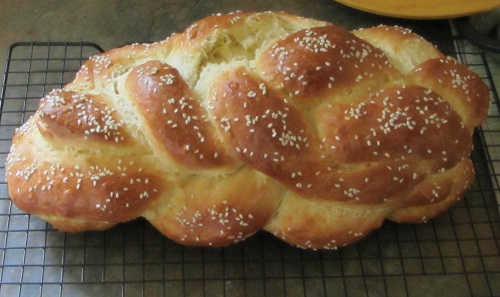
A Focaccia, A Braided Challah, And Sort Of King Arthur Big Batch Quick Dinner Rolls

Three breads over three days. I started the day before the first bakes by making two poolishes.  One was made with AP flour, the other was bread flour. Each contained 600g flour and 600g water — 2400 grams in total. Both poolishes received a 24-hour rise on the counter. At that point I made the (below) challah and dinner rolls, but that didn’t use up all of the poolish. The remaining poolishes went into the refrigerator and three days later were used up in this focaccia:
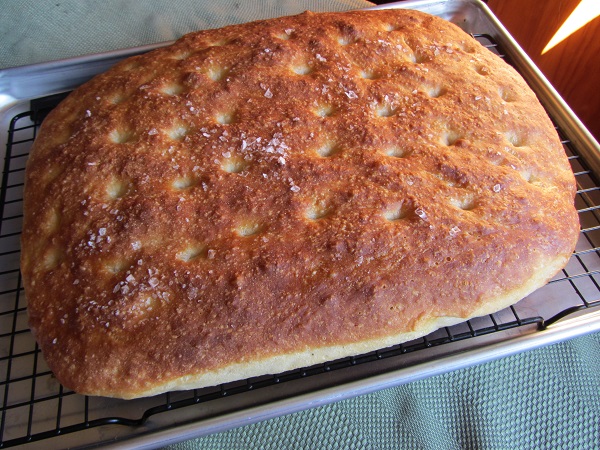
The leftover poolishes totaled 1000 grams; right around 500g of the AP poolish and 500g of the bread flour poolish. In theory that means what remained contained 500 grams of water and 500 grams of the mixture of flours. 

To that I added 500g bread flour, 250 grams water, 20 grams kosher salt, 30 grams olive oil, and 2 teaspoons of instant (not fast acting) yeast.  The bakers percentages come out to 75% hydration, 2% salt, 2% oil. Mix everything for 8 minutes, then cover and allow to rise for two hours. De-pan to an oiled and parchment-lined sheet tray. Oil the top of the dough, poke into the dough all over with your fingers, and cover and let rise another hour. Prior to baking sprinkle on flaky salt, rosemary, or whatever topping is preferred. Bake at 450F for 25-35 minutes. I used an additional sheet tray to the bottom to prevent the bottom from getting too dark.

Next up, but baked first in reality is the challah.
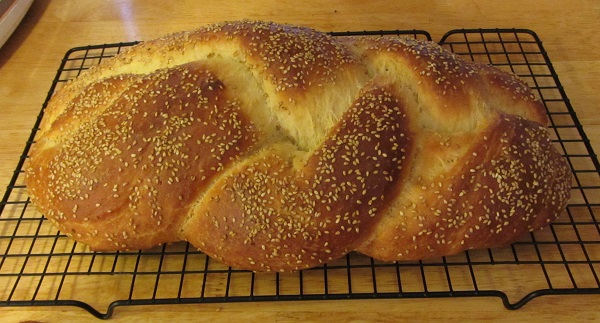
Historically I’ve used either a Michael Ruhlman recipe or a Peter Reinhart recipe. The link to the Ruhlman recipe that I’d refer to was broken so I went with: ~800g poolish (400g bread flour, 400g water), an additional 400g bread flour, 1 egg + 1 yolk (reserve white for egg wash), 50g water, 50g room temperature butter, 14g kosher salt, 2 teaspoon instant yeast. Mix for 8 minutes on low speed. Cover and let rise 1.5 hours. Divide into three braids about 18″ long. Braid. Cover and let rise 1 hour. Make an egg wash of the egg white + 1 TBP water. Brush over the challah, sprinkle on sesame seeds. Bake 30-40 minutes at 425F. I should have used a 2nd sheet tray under this one, the bottom was vaguely overdone though nobody complained.

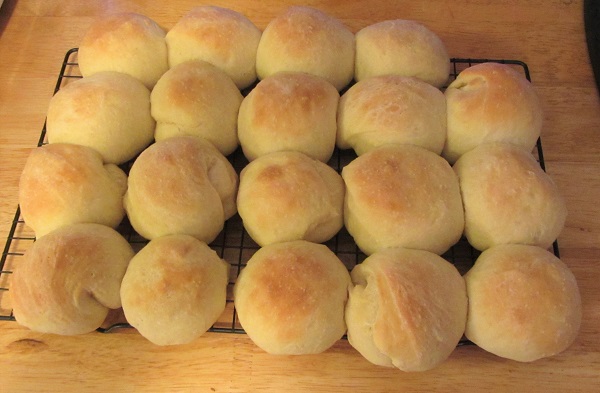
Last up are the dinner rolls, which were based on this King Arthur Big Batch Quick Dinner Rolls recipe. The differences were that I was using an AP flour poolish. And I didn’t want them quick.
  1. minutes until a soft, smooth ball of dough is formed. The dough should feel elastic and slightly tacky to the touch.
  2. Lighly oil the dough and the bowl and let rise for 1-2 hours at room temperature or until the dough is full and puffy.
  3. You can place the rolls into one Silpat lined (or parchment lined) sheet tray.
  4. After the rolls are in the tray, cover with an inverted sheet tray and let rise at room temperature for another 1-1.5 hours, or until well rounded and full looking. Preheat the oven to 350°F.
  5. Bake the rolls for 20 to 25 minutes or until golden brown and an internal thermometer reads 190°F. You can brush the baked rolls with melted butter if desired. (I chose not to, since I wasn’t serving immediately. We reheated the rolls for serving.)

Double Celebration Challah – An Adaptation From Reinhart’s

For Thanksgiving I thought I’d give Peter Reinhart’s recipe another try. (2015 post here. 2016 post here. Ruhlman original post here. The skeleton of the post below is copied and pasted from the 2015 post.)

From the Bread Baker’s Apprentice — Peter Reinhart’s Double Celebration Challah. The “Double Celebration” indicates a double-decker of braided dough — a smaller braid sits on a larger braid. I increased the recipe by 1.5x because we were feeding a crowd:

Ingredient Measure Baker’s %
Bread Flour 27 oz 100
Sugar 3 TBP 5.5
Salt 1.5 tsp 1.4
Instant Yeast 2 tsp 0.85
Softened Unsalted Butter 3 TBP 5.5
Eggs, beaten 3 large 18
Egg Yolks 3 7
Egg Whites, whisked until frothy 3 7
Water 12 oz 45

and Sesame Seeds for garnish.

1.  One day ahead of time, combine 10.5 oz of water and bread flour in the bowl of a stand mixer. Cover with plastic wrap and leave it at room temperature. (It’s a simple Poolish without yeast. This would also be fine up to three days in the refrigerator, if so, remove from the refrigerator at least 2 hours before continuing.)

2.  Stir together 15 oz flour, sugar, salt, and yeast. In a separate (mixing) bowl combine butter, eggs, and yolks. Turn the mixer on low speed. Add the wet ingredients to the mixer, then slowly add the dry mixture until the ingredients gather and form a ball.

2.  Mix on medium low speed for 6 minutes, adding more flour if needed to make a dough that is not sticky.

3.  Lightly oil a large bowl. Form the dough into a ball, coat with oil, and let rest one hour, covered.

4.  Remove the dough from the bowl and knead 2 minutes to degas. Return the dough to the bowl and let rest 1 hour.

5.  2/3rds of the dough becomes the big braid, and 1/3rd becomes the small braid. Each of those portions are divided into 3rds again, and rolled out into ropes which are smaller at the ends and larger in the center. The ropes are then braided, tucking the ends underneath. Watch this for help on how to braid. Transfer the big braided portion to a parchment lined baking sheet, top with the smaller braided portion.

6.  Brush the loaf with an egg whites wash, spray with oil, loosely cover with plastic wrap, and let rest 60-75 minutes until the the dough has grown to 1.5x its original size.

191201 unbaked challah

7.  Preheat the oven to 325F. Brush the loaf again with egg wash and sprinkle with sesame seeds. Bake on the center rack for 20 minutes, then turn and bake another 20-45 minutes. The bread is done when golden brown and an instant thermometer reads 190F. (The pictured loaf saw 25 minutes after turning, which I think was too long. More on that below.)

8.  Transfer to a cooling rack and wait at least an hour to eat.

191201 challah

Notes:

I think every time I’ve made this I’ve come away thinking it could be better.  20 minutes + 25 minutes brings the internal temperature closer to 205F than 190F. In the future I’ll likely check the temperature at about the 20 + 15 minute mark. I also think the challah would benefit from a little more salt than the recipe calls out, perhaps even just an extra 1/2 tsp to take the total to 2 tsp (not including the salt in the eggs.)

We had a little bit of extra dough at the end of one of the braids. We were going to visit a 6-year old on Thanksgiving, so:

191201 turkey

In reality the “body” is about 4 inches across. It has an “eye” of sesame seeds and a piece of black sea salt. The “turkey” went into the oven with the challah and was pulled at the 25 minute mark.

The kid seemed to dig it.


Peter Reinhart’s Double Celebration Challah

by A.J. Coltrane

150406 challah2

From the Bread Baker’s Apprentice — Peter Reinhart’s Double Celebration Challah. The “Double Celebration” indicates a double-decker of braided dough — a smaller braid sits on a larger braid. I increased the recipe by 1.5x because we were feeding a crowd:

Ingredient Measure Baker’s %
Bread Flour 27 oz 100
Sugar 3 TBP 5.5
Salt 1.5 tsp 1.4
Instant Yeast 2 tsp 0.85
Vegetable Oil 3 TBP 5.5
Eggs, beaten 3 large 18
Egg Yolks 3 7
Egg Whites, whisked until frothy 3 7
Water (approx) 10.5-12 oz 45

and Sesame Seeds for garnish.

1.  Stir together flour, sugar, salt, and yeast. In a separate (mixing) bowl combine oil, eggs, yolks, and 10.5 oz water. Slowly add the dry mixture to the wet and mix on low speed until the ingredients gather and form a ball. Add the remaining water, if needed.

2.  Mix on medium low speed for 6 minutes, adding more flour if needed to make a dough that is not sticky.

3.  Lightly oil a large bowl. Form the dough into a ball, coat with oil, and let rest one hour, covered.

4.  Remove the dough from the bowl and knead 2 minutes to degas. Return the dough to the bowl and let rest 1 hour.

5.  2/3rds of the dough becomes the big braid, and 1/3rd becomes the small braid. Each of those portions are divided into 3rds again, and rolled out into ropes which are smaller at the ends and larger in the center. The ropes are then braided, tucking the ends underneath. Watch this for help on how to braid. Transfer the big braided portion to a parchment lined baking sheet, top with the smaller braided portion.

6.  Brush the loaf with egg wash, spray with oil, loosely cover with plastic wrap, and let rest 60-75 minutes until the the dough has grown to 1.5x its original size.

150406 challah1

7.  Preheat the oven to 325F. Brush the loaf again with egg wash and sprinkle with sesame seeds. Bake on the center rack for 20 minutes, then turn and bake another 20-45 minutes. The bread is done when golden brown and an instant thermometer reads 190F. (The pictured loaf took 25 minutes after turning.)

8.  Transfer to a cooling rack and wait at least an hour to eat.

———————

The picture at the top of this post is the pretty side. Here’s the other side. The oven spring was so violent that it tore the braids:

150406 challah3

I’ve never seen anything spring like that. I was really surprised at the “time to turn” point — the bread had basically exploded.

The only complication that I ran into was self-induced:  I combined the flour with the minimum (7 oz) quantity of water and let it hang out in the refrigerator for three days before continuing with the recipe. In theory this would allow more flavor to develop. In reality it wasn’t enough water, and the flour became a brick. After a lot of work with a wooden spoon and the KitchenAid I was able to rehydrate the dough with the eggs and the rest of the water. For much of the process I thought the end product might have clumps of under-hydrated dough.

As far as taste — the recipe calls for oil out of respect for Passover. I think next time I’ll use butter. The finished product also needed a little more salt. I’m guessing the issues that I had with hydration resulted in the addition of too much flour, which threw the salt balance out of whack.

All in all though, it wasn’t a bad first attempt, and there’s plenty of room for it to get better.