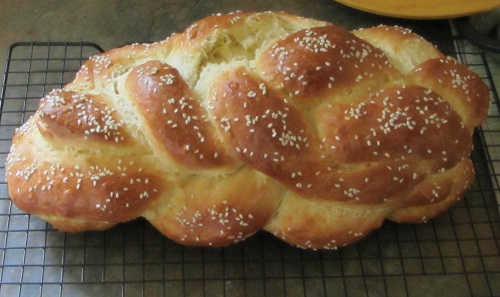
Peter Reinhart’s Double Celebration Challah

by A.J. Coltrane

150406 challah2

From the Bread Baker’s Apprentice — Peter Reinhart’s Double Celebration Challah. The “Double Celebration” indicates a double-decker of braided dough — a smaller braid sits on a larger braid. I increased the recipe by 1.5x because we were feeding a crowd:

Ingredient Measure Baker’s %
Bread Flour 27 oz 100
Sugar 3 TBP 5.5
Salt 1.5 tsp 1.4
Instant Yeast 2 tsp 0.85
Vegetable Oil 3 TBP 5.5
Eggs, beaten 3 large 18
Egg Yolks 3 7
Egg Whites, whisked until frothy 3 7
Water (approx) 10.5-12 oz 45

and Sesame Seeds for garnish.

1.  Stir together flour, sugar, salt, and yeast. In a separate (mixing) bowl combine oil, eggs, yolks, and 10.5 oz water. Slowly add the dry mixture to the wet and mix on low speed until the ingredients gather and form a ball. Add the remaining water, if needed.

2.  Mix on medium low speed for 6 minutes, adding more flour if needed to make a dough that is not sticky.

3.  Lightly oil a large bowl. Form the dough into a ball, coat with oil, and let rest one hour, covered.

4.  Remove the dough from the bowl and knead 2 minutes to degas. Return the dough to the bowl and let rest 1 hour.

5.  2/3rds of the dough becomes the big braid, and 1/3rd becomes the small braid. Each of those portions are divided into 3rds again, and rolled out into ropes which are smaller at the ends and larger in the center. The ropes are then braided, tucking the ends underneath. Watch this for help on how to braid. Transfer the big braided portion to a parchment lined baking sheet, top with the smaller braided portion.

6.  Brush the loaf with egg wash, spray with oil, loosely cover with plastic wrap, and let rest 60-75 minutes until the the dough has grown to 1.5x its original size.

150406 challah1

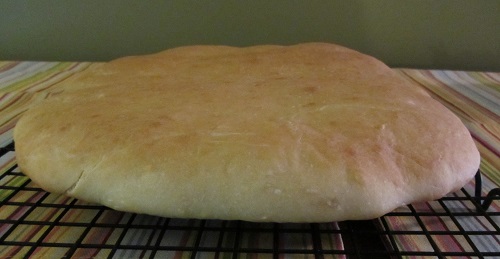
7.  Preheat the oven to 325F. Brush the loaf again with egg wash and sprinkle with sesame seeds. Bake on the center rack for 20 minutes, then turn and bake another 20-45 minutes. The bread is done when golden brown and an instant thermometer reads 190F. (The pictured loaf took 25 minutes after turning.)

8.  Transfer to a cooling rack and wait at least an hour to eat.

———————

The picture at the top of this post is the pretty side. Here’s the other side. The oven spring was so violent that it tore the braids:

150406 challah3

I’ve never seen anything spring like that. I was really surprised at the “time to turn” point — the bread had basically exploded.

The only complication that I ran into was self-induced:  I combined the flour with the minimum (7 oz) quantity of water and let it hang out in the refrigerator for three days before continuing with the recipe. In theory this would allow more flavor to develop. In reality it wasn’t enough water, and the flour became a brick. After a lot of work with a wooden spoon and the KitchenAid I was able to rehydrate the dough with the eggs and the rest of the water. For much of the process I thought the end product might have clumps of under-hydrated dough.

As far as taste — the recipe calls for oil out of respect for Passover. I think next time I’ll use butter. The finished product also needed a little more salt. I’m guessing the issues that I had with hydration resulted in the addition of too much flour, which threw the salt balance out of whack.

All in all though, it wasn’t a bad first attempt, and there’s plenty of room for it to get better.
A Quick Pizza

by A.J. Coltrane

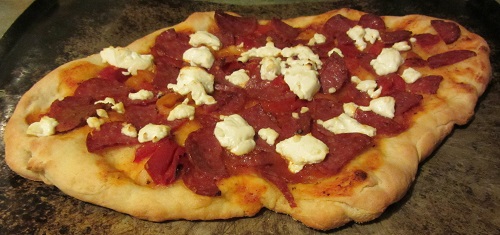
In between watching and recording 30-something college basketball games over the last few days — a two-hour pizza happened:

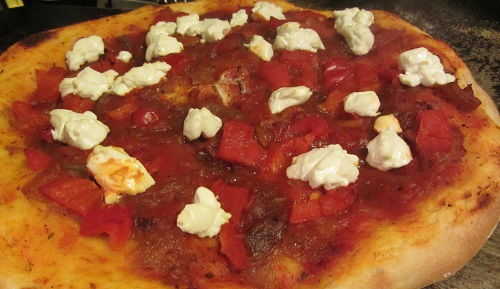
Goat cheese, roasted red pepper, and soppressata.
Goat cheese, red sauce, roasted red pepper, and soppressata.

50% bread flour, 50% “oo” flour, 60% hydration with a splash of white wine. 2% kosher salt. Baked on a stone preheated to 500F.

The “oo” flour continues to be super extensible. I thought maybe cutting in some bread flour would make it more controllable. It didn’t seem to have much impact.

As for other possible improvements — I think maybe I need to be slightly freezing the meat before slicing it. It would benefit the pizza if the soppressata was even thinner than I’ve been able to get it.

Overall though, I feel like I’m really starting to get the hang of the pizza peel and stone. It’s resulting in better pizza crusts. The pizza peel isn’t now as intimidating as I used to think it was.

More Baguettes

by A.J. Coltrane

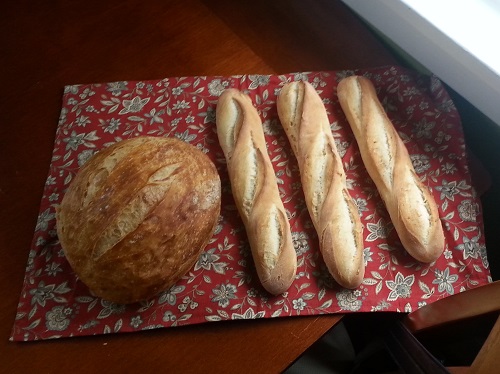
I’m finally getting comfortable enough with the baguettes to bring them places and introduce them to friends.

150305 breads

That’s a No Knead on the left that I lightly slashed a couple of times. It wound being a fairly attractive example of the type.

I made six baguettes altogether, in two batches of three. The pictured breads are the from the first batch. The 2nd batch was more irregular and was quietly sliced and served in baskets.

I used a “poolish” when making the baguettes — 200 grams of water and 200 grams of bread flour were combined a day ahead of time and allowed to sit at room temperature. That’s done to allow enzymes time to break starches down into sugars, and in theory it helps the structure of the finished product.

The next day I added the poolish to the mixer, along with an additional 200 grams of bread flour, 52 grams of water, 8 grams of kosher salt, and one teaspoon of instant yeast. (That’s 63% hydration, 2% salt, and a normal amount of yeast for a 2-hour rise. Pretty standard.)

The dough was allowed to rise for an hour,  then was divided and shaped into baguette shapes. After another 45 minutes of rising the doughs went into a preheated 450F oven for 22 minutes. I tried adding steam but I don’t think that I used enough water/surface area to have much impact — there wasn’t much steam going on. Overall the whole structure of the baguettes wasn’t very “open”.

Still, the breads were well received, and I got at the three relatively photogenic baguettes out of the deal, so I’ll call that a win.

I think the next real breakthrough will come when I get a better handle on the steam thing.

More “00” Flour Pizza

by A.J. Coltrane

I’m continuing to work through the 22 pounds (10 kg) of “00” flour that Iron Chef Leftovers gave me. That’s actually more than it sounds like — a typical pizza uses ~300 grams of flour.

150225 pizza

Caramelized onions, roasted red peppers, red sauce with a little sausage, and feta. The onions are hiding under the sauce, away from the heat.

The dough formula:  350g flour, 210g water (60% hydration), 7g kosher salt, 10g olive oil, 1 tsp instant yeast, and a splash of white wine. Baked in a 500F oven on a baking stone for 12 minutes total. The cheese was added with 4 minutes to go.

The post-mortem:  350 grams of flour makes for a fairly thick pizza. Most likely I’ll cut it back to 250-275 grams next time.

The “00” flour is crazy extensible. The dough was kneaded for 10 minutes, and did a “stretch and fold” on it probably 20 times after removing it from the mixer and it was still super duper stretchy. This time I patted it out on the counter, then carefully tossed it between my hands. There were some really thin places in the finished dough, so I clearly need more work on technique.

The pizza was very light and airy, which was probably partly due to all the “stretch and folds”, and partly the “00” flour. It was fully cooked, though next time I think I’ll let it go another 2-3 minutes for more color and snap. The caramelized onions really “made” the pizza. Tasty!

Bonus girl cat pic. She’s nestled in somebody’s lap, and on her favorite blanket to knead. Check out those claws:

150225 girl cat

Encouraging A Better Rise For The Big Sandwich Bread

by A.J. Coltrane

When we’re feeding a crowd I’ll make a big-*ssed sandwich — it’s basically the same size as a sheet tray (18″ x 13″). For the last GNOIF it was … either a ciabatta with a little bit of oil in the dough, or a focaccia with no oil on top and no dimples. It wasn’t the platonic ideal of either, but I’m calling it a ciabatta this time around.

Ingredient Measure Baker’s %
AP Flour 300g 50
Bread Flour 300g 50
Water 420g 70
Salt 15g 2.5
Instant Yeast 1 tsp
Olive Oil 24g 4

I wanted to encourage a lighter bread than the usual focaccia. The changes were:

1.  The incorporation of bread flour into the formula.

2.  I chose not to top the dough with oil before it went into the oven. Also, no dimpling the surface.

3.  Before kneading, the flour, water, and 1/8 tsp of yeast were combined and allowed to rest for an hour. This is called an “autolyse.” It allows for the gluten strands to start setting up, and yeast doesn’t have to compete with salt for the available water.

Very foreshortened. It's 13" wide and 18" long.
Very foreshortened. It’s 13″ wide and 18″ long.

4.  Normally when I proof the bread I’ll do it directly in a parchment-lined sheet tray. I’ll cover that with another inverted sheet tray. It dawned on me that the rise might be improved by using steam in the oven, which is how I’ve been baking baguettes… But then why not just leave the inverted sheet tray as a cover for the first 10 minutes of baking, similar to the No-Knead Bread dutch oven technique?

I mean really, why did that take so long to occur to me?

The finished bread was 2-3″ tall, which is about half again as tall as the focaccias have been. It was lighter and less oily too.

I think it’s a variation with potential.

Rick Bayless’ Corn Tortillas

by A.J. Coltrane

Periodically I decide I want to make tortillas from scratch. The results tend to be uneven, probably because I’m only trying it periodically.

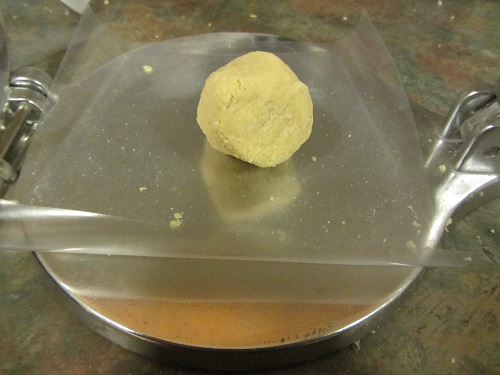
150112 press

Tonight’s came out better than usual and were less hassle. I think there are two reasons for that — I didn’t make them as wet as usual, and I didn’t squeeze the tortilla press super hard. The drier, thicker tortillas separated from the plastic much more easily than in previous attempts.

I used a sandwich-size freezer bag. The thicker plastic seemed to help as well.

150112 tortilla

Cast iron skillets really hold the heat and lead to good color on the tortillas. (These are all 5-6″ in diameter.)

Combined with slow-cooker pork shoulder, cheese, and salsa:

150112 finished

Very tasty!

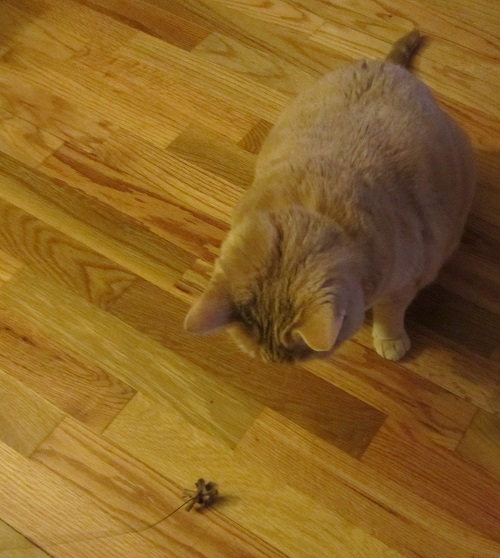
Bonus hunter pic:

141221 hunter

The toy is a Cat Dancer. The girl cat completely loses her mind. (Link for reference. Shop around.)

(Recipe link. Amazon link for the source recipe in Mexico One Plate At A Time.)

Closer To The Truth Baguettes

by A.J. Coltrane

The middle of December saw the Not-Pretty Baguettes.

Tonight’s are much more photogenic:

150106 baguettes

The crumb was decent but not exceptional. This may be to be expected given the relatively small diameter of the breads:

150106 crumb

Notice how the open spaces are directly down the center — the area that was slashed.


It’s basically a classic baguette formula:  100 parts bread flour, 60 parts water, 2 parts salt:

1.  Before I left for work I combined 200g bread flour and 200g water with ~1/16 tsp of instant yeast.

2.  When I got home I combined the preferment in the KitchenAid with an additional 130g flour, 7 grams of kosher salt, and 2/3 tsp of instant yeast. The combined dough was mixed for 8 minutes on low speed.

3.  The dough was allowed to rise for 30 minutes, then divided, shaped, and placed into a towel-lined (and covered) baguette pan. The doughs were allowed to rise in the baguette pan for 30 minutes..

4.   A loaf pan with 1/4″ of water was preheated in a 450F oven for 15 minutes. (45 minutes of rise time in the baguette pan for the doughs, total.) The breads were then baked for 22 minutes. At the 11 minute mark the loaf pan (with remaining water) was removed, and the baguette pan was rotated 180 degrees.

Progress!

—-

I recently received a copy of Advanced Bread and Pastry. It confirmed something that I suspected. (Paraphrasing) “High protein flours brown more readily than low protein flours.”

I’ll need to look for the exact quote again.


Ming Tsai’s Shallot Pancakes Revisited

by A.J. Coltrane

It’s been a while since we’ve had Ming Tsai’s Shallot Pancakes. (a.k.a. Hot Water Dough. Original Ming Tsai recipe here.)

It must be a “cold weather dish” — the last CSE Shallot Pancake post was dated January 12.

Photos from tonight’s attempt:

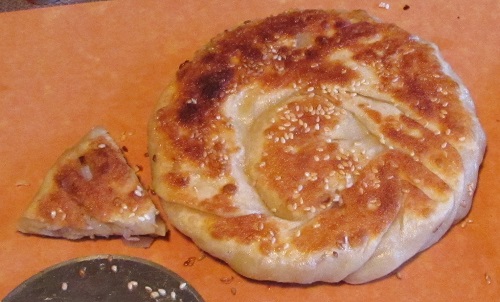
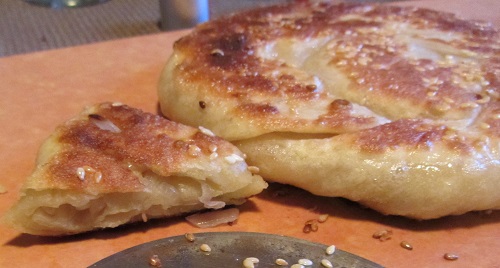
141228 hot water dough

Note the dough lamination. Layers of sesame oil, canola oil, and shallots create the air pockets:

141228 hot water dough 2

One key is to make sure that the final product is somewhat thin, so that it cooks through reasonably quickly over medium heat.

We’ll have to make this again sooner than later. I think I’ve had focaccia and other rustic breads on the brain.

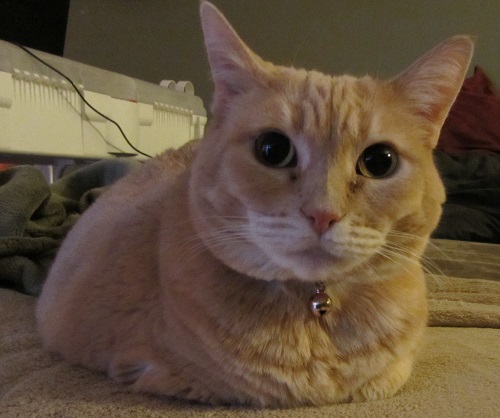
Finally, the first test photo on the new memory card:

141228 girl cat

Pizza alla DiGiorno

by A.J. Coltrane

We had guests last night and I figured I’d make what might be most strongly identified as “normal pizza”.

Actually, two pizzas. The recipe:

Ingredient Measure Baker’s %
Bread Flour 600g
Water 318g 53
White Wine 60g 10
Salt 15g 2.5
Sugar 1 TBP
Instant Yeast ½ TBP
Olive Oil 15g 2.5

Directions:

1.  Mix all ingredients on low speed for 10 minutes. Cover and let rise two hours.

2.  Divide the dough and shape into two balls. Cover and let rise one hour.

3.  30 minutes into the 2nd rise, place a baking stone in oven and preheat for 30 minutes at 500F.

4.  Lightly coat a baking peel with semolina. Shape the dough, and place onto the peel. Top the dough (sauce, then cheese, then pepperoni).

5.  Bake the pizza for 12 minutes.

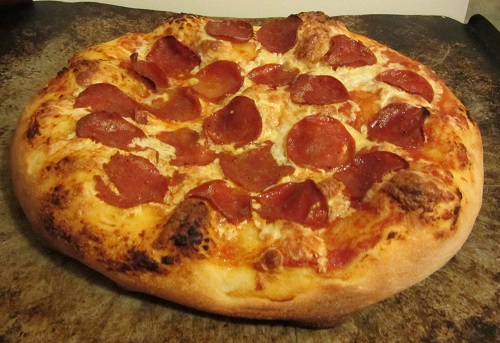
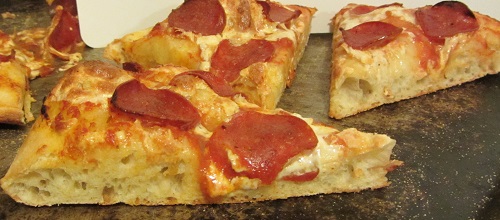
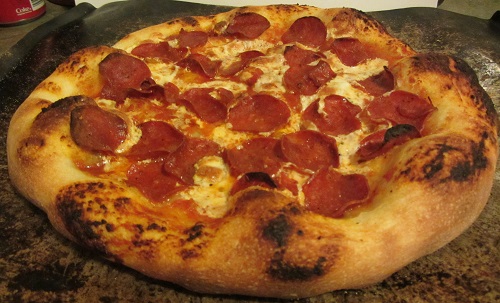
Pizza one:

141221 pizza 1

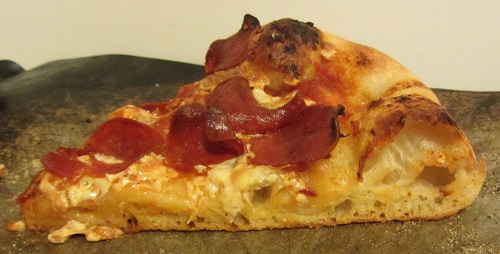
Pizza one crumb:

141221 pizza 1 crumb

Pizza two:

141221 pizza 2

Pizza two crumb:

141221 pizza 2 crumb

Pepperoni, shredded mozzarella, home made red sauce made from home grown tomatoes (with garlic, oregano, minced onion, salt. And butter! Ssshh! Thanks, Marcella Hazen!)

Overall they were nice, light pizzas. The cornicione (crusts) were especially airy, with large pockets running through the perimeter of each. (The blackened areas show the location of the air pockets.) The first pizza came out somewhat wet. The liquid had been exuded by the cheese. We corrected that, and the (drier) 2nd pizza had much more concentrated flavors, in addition to not being wet, so… double bonus. In the future we’ll do a more thorough job of drying the mozzarella on paper towels.

From a technique standpoint, the biggest change is the use of the baking stone. I think that a long time ago I had trouble transferring the dough from the peel to the baking stone and then avoided using the peel for years.

I think that’ll be a new “thing” for a while.


A Couple Of Not-Pretty Baguettes

by A.J. Coltrane

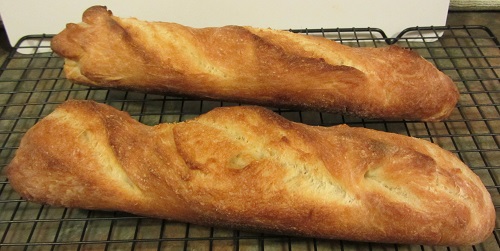
A twist on a classic dough — 60% hydration, 2% salt. (300g bread flour, a scant 1/4 tsp instant yeast, overnight rise.)

141213 baguette

It’s really visible on the top loaf — I didn’t try to shape the dough much, I just divided it, rolled out the pieces on the counter, and laid them baguette pan. They got a 20 minute rise in the pan, then were slashed before they went into the oven. The bread blew out at every seam.

141213 baguette2

The bottoms expanded more than the tops. Still, they were nicely caramelized and tasty.

(450F oven, a few minutes of steam created by a small amount of water in a loaf pan in the bottom of the oven. 12 minutes, rotate 180 degrees and bake another 12 minutes.)

[Two previous attempts here. Including a cute cat pic.]