A Tale Of Three Pizzas

by A.J. Coltrane

I recently received a Baking Steel as an early holiday gift. The Steel is 16″ x 14″. It *just* fits in our undersized oven:

151119 baking steel

It’s pretty tight against the top of the oven too — the directions call for placing the Steel on the 2nd rack from the top.

I wanted to start with some small, simple, and very manageable pizzas to get a feel for how everything was going to behave, and to ideally introduce as few variables as possible. I was targeting pizzas 8-10″ in diameter to keep things from getting too interesting.

The Recipe:  450 grams AP Flour, 270g water (60%), 11g kosher salt (2.4%), 9g olive oil (2%), 1 TBP of “Italian Seasoning”, and 1 tsp instant yeast. Combine all ingredients and mix on low speed for 10 minutes. Lightly oil the bowl and dough ball, cover and let rise 1.5 hours. Divide the dough into 3 roughly equal pieces, shape into balls, cover with a towel, and let rise 30-45 minutes or until “poofy”.

I stretched each dough out by hand, trying to take care to preserve the gas bubbles around the edges. (The remaining doughs hid under the towel until it was their turn for shaping and baking.) The pizzas were topped with pepperoni and a Roma tomato sauce from the garden that was doctored up with garlic, onions, “Italian Seasoning”, diced bell peppers (from the garden again), and kosher salt. I used a floured peel to slide the pizza onto the Baking Steel, in an oven heated to 500F. The Baking Steel instructions call for a 9-minute bake. I went 9 minutes on the first pizza, 10 minutes on the 2nd, and I-don’t-know-because-I-failed-to-set-the-timer on the 3rd.

Some cheap pre-shredded parmesan was tossed on top of the pizzas shortly after they came out of the oven.

The Results:

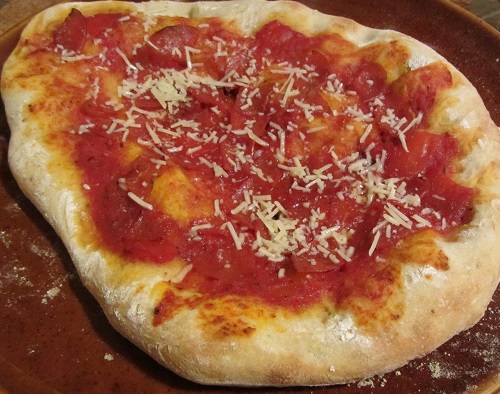
Pizza One:
151119 pizza1

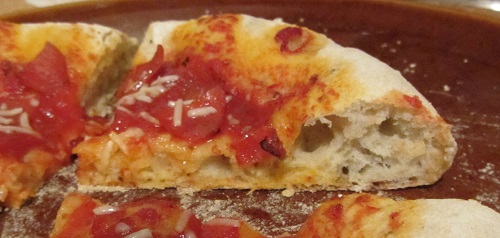
Pizza One Crumb:

151119 pizza1 crumb

Pizza Two:

151119 pizza2

Pizza Two Crumb:

151119 pizza2 crumb

Pizza Three:

151119 pizza3

Pizza Three’s crumb wasn’t “all that”, so I didn’t bother with a picture.

———-

I selected AP Flour because I wanted to use some up. I think the color and structure would have been better had I used Bread Flour instead. Alternately a little bit of sugar might have been a good addition.

Even so, the pizzas were all fairly airy, especially so considering the AP Flour. They were really easy to eat without realizing how much had been eaten — the small, savory slices went away fast.

Conclusion: The Baking Steel seems to perform as advertised. It’s definitely an improvement over the pizza stone, and as an added bonus it’s basically indestructible. At $80, it’s not a cheap toy, but I’ll think we’ll get years of value out of it. It might be the right answer would have been to spend $100 and get the unit that’s 3/8″ thick, rather than the 1/4″ of the regular version, but $100 seemed like too much to throw at something that I wasn’t totally sure about.

Still, I’m happy with it.

(I think Pizza Two was the most attractive.)
Two “00” Pancetta Pizzas

by A.J. Coltrane

Pizza #1

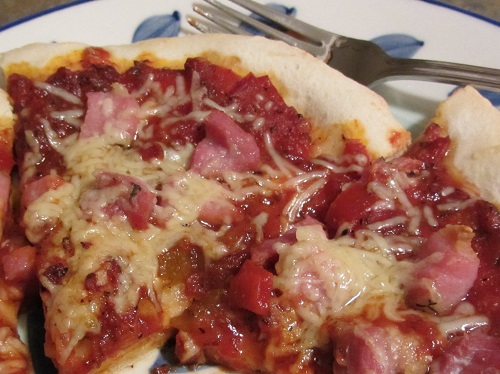
A “00” pizza using SeattleAuthor‘s pancetta and a little goat cheese:

151101 pizza

This started out as a 60% hydration pizza. (250g “00” flour, 150g water, 6g salt (2.4%), 1/2 tsp instant yeast.) I kneaded it on low speed for 10 minutes. At that point it was obvious that the dough was going to be unmanageable (again), so I kneaded it by hand while adding a small amount of flour until it became more cooperative.

The dough (with the pancetta) was baked on a pizza stone at 500F for 10 minutes. The goat cheese and herbs were combined, then added to the pizza and allowed to bake for another 4 minutes. (Herbs:  Chives, rosemary, garlic, sage, and lemon thyme, all finely minced together with a little olive oil — flavors I thought would complement the pancetta. I was sort of shooting for a “pistou” type of idea, though there’s likely a better term for whatever it was.)

A significant amount of the pancetta fat rendered out and soaked into the dough. I’m guessing the pools of fat didn’t do much for the appearance, though after the fat permeated the dough it looked fine again.

Overall it came out about like I’d visualized. The shape and thickness were good, and the crust puffed up around the edges well. I was hoping for something closer to little matchsticks for the pancetta, but the larger size was fine anyway. I liked the finished pizza, though others in the crowd weren’t so sure about the concept.

Pizza #2

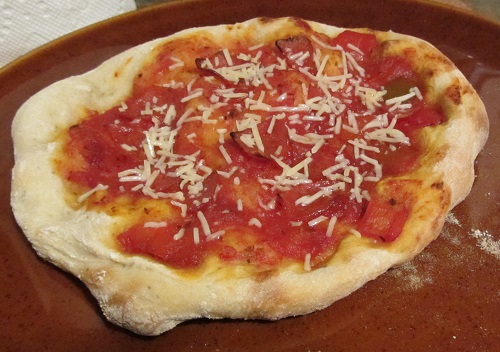
SeattleAuthor’s pancetta with red sauce and parmesan:

151102 pizza

This time I used 250g “00” flour, 142g water (57% hydration), 7g kosher salt (2.8%), and 1/2 tsp instant yeast, all mixed for 10 minutes on low speed in the KitchenAid. The dough was immediately cooperative (the extra salt may have helped), and it shaped more easily too. It’s hard to tell by the photo, but there’s a nice lip around the outside. The pizza was baked on a pizza stone at 500F for 10 minutes with everything except the cheese, then the cheese was added and it went back into the oven for another 3-4 minutes.

The red sauce was made with roma tomatoes and sweet bell peppers from the garden, flavored with salt, pepper, garlic, dried oregano, and some “Italian herb mix”. (How we came into the possession of a bottle of “Italian herb mix” I have no idea.)

There was less fat in finished product #2 — I’d trimmed away some of the really fatty bits before baking. I think the 2nd (red) pizza was the better of the two, though I learned a little something about handling “00” flour from each.

I think I still have enough “00” flour for ~20 more of these pizzas… thank you Iron Chef Leftovers.

————–

Late edit: It was pancetta, not prosciutto. I knew that..

“00” Chili Pizza

by A.J. Coltrane

I think it’s fair to say that the results I’ve had when using “00” flour have been… uneven. Each time the dough has been stretchy to the point of barely manageable, at best.

I did a little looking around online — it sounds like “00” flour is supposed to be really stretchy, and it doesn’t absorb much water… I’ve been using too much water in the dough. Evidently “Official” VPN pizzas use either 58% or 58.7% hydration. (The actual quantity quoted varies by source. I didn’t look that hard.) (That, and in Reinhart’s “American Pie” he says that in Italy, Bread Flour may be included at 25% of the total amount of flour. Sneaky.)

Also, oil isn’t used in a VPN pizza. However, while searching for the “proper” hydration I found sources that recommend 1-2% oil for home bakers using “00” flour, due to the temperature differences between a home oven and a professional or wood-fire oven. So…

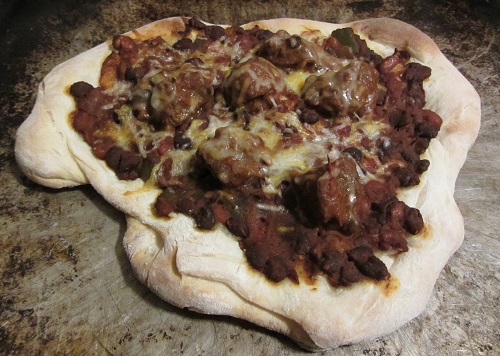
This time I kept it as simple as possible:  240 grams “00” flour, 57% hydration, 1/2 tsp salt, 1/2 tsp instant yeast. Knead on low speed for 10 minutes. I gave it a stretch and fold after an hour, then let it rise for another 45 minutes before shaping. A baking stone was preheated to 500F in the oven, the dough was formed on a pizza peel, and:

151022 Chili Pizza

The chili carmelized and sweetened somewhat in the oven, but it was still tasty and not too dry. The crust had a nice snap that in places was almost reminiscent of tortilla chips. I thought it worked. I know my mouth was watering before I dug in.

(The rest of the recipe:  10 minutes in the oven with the non-meat component of the leftover chili, then the reserved meat pieces and a “Mexican” cheese blend were added and allowed to heat through for three minutes.)

Other notes:

1.  57% hydration seems to be a good starting point for getting the hang of “00” flour. It behaved in a fairly similar fashion to a higher hydration bread flour.

2.  My shaping needs work. The dough was too thick in the center, and the seams from the stretch and fold are clearly visible in the finished product.

3.  I may try adding 1% oil next time, or brushing the rim of the pizza with oil, or both. A little more color would have been nice.

4.  240 grams is plenty for a small diameter pizza. 200 grams might be more appropriate next time.

—–

Overall all it was a good learning experience, and I used up leftover chili in the process. I enjoyed eating it, so win-win-win.

It might be just me, but I think maybe chili is a less “weird” topping on pizza than some other things are.. Like pineapple.

Bring Your Baguette Dough To Work Day

by A.J. Coltrane

Earlier this week we came into possession of a goodly amount of Chanterelles. As in previous years, that meant we’d pass them along to Iron Chef Leftovers, and he’d cook dinner for us. (More on that later.)

We needed something to sop up sauce, and a regular No-Knead Bread wasn’t going to fit into the schedule, time-wise. I chose instead to go with overnight-rise baguettes. The recipe was a fairly standard french bread dough:  450 grams bread flour, 270 grams water (60% hydration), 10 grams salt (2.2%), and 1/4 teaspoon instant yeast (the same amount of yeast as is in the “regular” No Knead Bread.)

The thing was, I also chose not to do an initial knead.

In the morning the dough wasn’t looking promising. There was very little sign of fermentation, and the dough was nowhere near evenly hydrated — there were clumps of almost dry flour.

151006 dough

So I brought the dough to work with me. About every 90 minutes I did a few stretch and folds on the dough and tried to pinch out the really dry parts, then I snuck off to the washroom to rinse the bits of sticky dough off of my hand. (I needed to keep a non-doughy hand for the restroom door, right?)

By the time I got home, the dough was ready to be shaped. To do that:

1.  On a lightly floured counter, cut the dough mass into three mostly equal pieces, then spread the pieces out into rectangles about 8″ x 6″ x 1/2″

2.  Roll up the rectangles, leaving an 8″ long tube.

3.  Use your hands to roll/stretch the doughs on the counter until they are just shorter than a baguette pan. (Start from the centers and work outward.)

4.  Line the baguette pan with floured linen, place the doughs into the linen, then cover with more linen and let rise for 30 minutes.

5.  While the doughs are doing their final rise, put 3 cups of water into a large dutch oven. (No lid) Place the dutch oven on the bottom shelf of the oven. Preheat the oven to 450F.

6.  When the oven is really steamy, remove the linen from the baguette pan, score the doughs, and bake them for 10 minutes.

7.  After 10 minutes, remove the dutch oven, turn the baguette pan around, and bake for another 7-10 minutes.

151006 loaves

——–

For years, I’ve been messing with different ways of producing steam in the oven. I think I’ve finally found a method that I’m happy and comfortable with — I don’t want to spray the sides of my oven, and the other techniques that I’ve tried haven’t made adequate steam.

But three cups of water in a 7 quart dutch oven seems to work pretty slick. Learning!

151006 slices2

Also, 450F is warmer than I’ve historically baked baguettes. I think the crust came out better than usual, so my current plan is stick with that temperature going forward, or perhaps try an even hotter oven.

————-

The bread was an accompaniment to best Best. Dinner. Evar. Iron Chef Leftovers totally topped himself, and I can say with all honesty that I’ve never had a better meal.

151006 dinner

[Smoked Pork Loin with Chanterelle Cognac Cream Sauce. Chanterelle and Saffron Rissoto.]

———————

I feel like I’m finally starting to get a “system” of steps for baguettes. There’s still a lot of room for improvement, but I feel like I’ve now worked out enough variables that progress should be easier to quantify — I won’t be stabbing in the dark quite as much as I have been.

And as always, failure is an option, but the end results taste good regardless.


Roasted Tomatillo-Pork Tacos

by A.J. Coltrane

I used this recipe (“Pork Stew in Green Salsa”) as a jumping off point for Roasted Tomatillo-Pork Tacos. The picture is of my variation, situated on a corn tortilla, topped with sour cream and frilly cilantro:

150929 tomatillo pork

Ingredients

  • 1/4 cup all-purpose flour
  • 1 teaspoon salt
  • 1/2 tablespoon ground black pepper
  • 1 teaspoon ground cumin
  • 1.5 lb boneless pork shoulder roast, trimmed of excess fat and cut into 1-inch cubes
  • 2 tablespoons olive oil, or more if needed
  • 1/2 large onion, chopped
  • 2-3 cloves garlic, minced
  • 2 cups pureed roasted tomatillos
  • 4 seeded minced green tomatoes (I used Romas)
  • 1 jalapeno pepper, seeded and minced
  • 1/2 cup chopped fresh cilantro
  • 1/2 cup water
  • 1 tablespoon Apple Cider Vinegar (pork loves apple)
  • Additional salt to taste

Directions

  1. Stir together the flour, salt, pepper, and cumin in a large bowl. Place the cubed pork into the mixture, and stir well to coat the meat with the seasonings.
  2. Heat the olive oil in a large, heavy pan or Dutch oven over medium-high heat until the oil shimmers. Working in batches if necessary, place the meat into the hot pan in a single layer. Pan-fry the pork until brown on all sides. Remove the pork to a bowl.
  3. Cook and stir the onion in the hot pan over medium heat, adding more olive oil if necessary, until the onion is translucent. Return the meat to the pan and stir in the garlic, tomatillos, tomatoes, apple cider vinegar, and water. Cover and simmer over low heat, stirring occasionally, until the meat is tender, about 1 hour.
  4. Stir in cilantro shortly before serving. Check for salt.

———–

The big changes from the original are:

Roasted tomatillos instead of fresh. I may try it with fresh at some point, but we currently have a freezer stocked with a lot of roasted tomatillos.

The addition of green tomatoes instead of green chiles. We have more than a few green tomatoes on the counter at the moment. (Gotta use everything up.)

More garlic (surprise!). More cumin. No majoram.

The addition of apple cider vinegar, which I think really helps. It brightens the dish and somewhat compensates for using roasted tomatillos rather than fresh.

Less liquid. The target was a taco filling rather than a stew.

Adding the cilantro very late in the cooking process. No point killing it by adding it early.

Half as much meat. It’s still plenty of food for four.

——————

[As an aside, the allrecipes picture uses mint as a garnish, which isn’t anywhere in the recipe. I guess they didn’t want a completely brown picture either. The inclusion of mint in the photo is “cheating” I think. They should have garnished with cilantro, which is actually in the recipe. /rant]

I really enjoyed this take on Roasted Tomatillo-Pork Tacos. It’s an easy one-pot preparation that doesn’t take all night. We’ll be making this one again for sure.

Roasted Tomato Pizza

by A.J. Coltrane

We had a hodge-podge of tomatoes left over from our tomato tasting on Wednesday, so Thursday night was pizza night featuring the stragglers. (Mostly Roma, Oregon Spring, and Sweet Million.)

I cut the tomatoes into pieces, then roasted them with a little salt and olive oil as part of warming up the oven:  425F for about 15 minutes. Roasting removed the worst of the liquid. The tomatoes were then lightly pureed, and:

150813 pizza

Very simple – Roasted tomatoes, sopressata, and parmesan. The pizza really didn’t need anything else.

———————-

In the “it’s a small world” category, NW Edibles did a roasted tomato post today too, though she roasts hers at 250F for 3 to 7 hours(!)

Grilled Flatbread With Pesto And Goat Cheese

by A.J. Coltrane

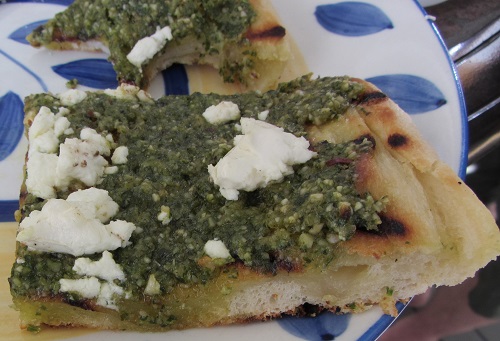
Or Pesto and Goat Cheese Grilled Flatbread? It definitely featured pesto:

150720 pesto flatbread

The dough formula:  400g Bread Flour, 240g vaguely warm water, 9g kosher salt, 8g extra virgin olive oil, 1.5 tsp instant yeast. (60% water, 2.25% salt, 2% oil)

Those are very “normal” ratios. It was basically a grilled pizza dough. Or focaccia. Take out the oil and it’s a baguette dough. Normally I’d use 1 tsp of yeast, but this was the same “company-coming-over-soon” night where things needed to be ready quickly. The “extra” yeast ensured that the dough would be ready for dinner, and it allowed for additional reshaping, leading to a lighter end result.

For the grilling process:  I stretched out the dough and tossed it onto the grill over medium heat. After a few minutes I brushed the top with olive oil and flipped it over. I  brushed the new top lightly with oil, then spread on the pesto. When the flatbread looked like it was about done we scattered goat cheese over the whole thing.

What follows is the first picture on this blog of an actual human that we know personally. This one happens to be a very short female:

15720 kid1

Not my child. She belongs to the dinner guests. Though she’s small, she almost single-handedly ate a 1.5 pound flatbread. Anytime short people will eat food without complaint I’ll call it a victory.

I also think I learned a little something about pesto in the process. Something like this FN recipe is a “standard” pesto. It calls for 2 cups packed basil, 1/2 cup grated Pecorino, and 1/4 cup pine nuts. I used ~2 cups packed basil, ~3/4 cup grated parmesan, and ~3/4 cup buzzed toasted pine nuts.

I like it way more with the additional cheese and (especially) pine nuts. I feel like it’s more earthy and complex with the balance tilted away from the basil. Hopefully the “lesson” sticks.

Ina Garten’s Creamy Cucumber Salad. Mostly.

by A.J. Coltrane

We had company over for grilling last night, and we have lots of cucumbers, so I made a creamy cucumber salad, using Ina Garten’s recipe as a starting point. Pictured is a family-style presentation:

150720 cucumber salad

Her salad calls for four hot-house cucumbers and two small red onions. The dressing is a 4-1 ratio of whole-milk yogurt to sour cream, flavored with dill, white wine vinegar, and pepper.

On the Barefoot Contessa tv show she uses greek yogurt and sour cream for dressing. Inspired by that, I used a small (6 oz) Greek yogurt and about 1.5 ounces of sour cream, flavored with fresh mint, dried oregano, cumin, and rice wine vinegar. It’s what we had available, and the flavorings pushed the recipe in a welcome Mediterranean direction.

The other difference between hers and the one pictured is that I didn’t have time to drain the cucumbers, onions, and yogurt for the 4+ hours (or overnight) called for in the recipe. For me, it needed to be done draining in about an hour. Longer might have been preferable, but the result was good with the shorter time allowed.

She suggests that this salad is a good substitute for cole slaw, and I think that’s accurate. It’s best served chilled, and it gets better when allowed to “marinate” for a while. It was definitely a nice change of pace from the other grilled foods we offered. We’ll be making it again for sure.

Tomato Bread

by A.J. Coltrane

We had company the other night, and I wanted to make a short-notice bread.  Lacking the time for the flavor to develop on its own, I decided to use tomato puree from the freezer in place of some of the water.

I went for a slightly higher “hydration” bread, with the expectation that the puree wasn’t 100% water. So:

400g bread flour, 166g puree, 94g water. (65% hydration). 8g salt. 1 tsp instant yeast. The dough was mixed for 10 minutes on low speed, followed by a 90 minute rise.

A dutch oven was preheated to 425F. The dough got 22 minutes covered and 15 minutes uncovered. (A longer time uncovered might have created a super dark bread, due to the sugars in the tomato puree.)

150416 tomato bread

The picture makes it look smaller than it really was, though it didn’t rise or spring as much as I would have anticipated, and the crumb was relatively tight.

I’m of the suspicion that the actual water content was around 50% or so. Next time I’ll look at the dough rather than just doing the math and walking away — even 25 grams of water might have made a big difference.

Still, it was attractive and it tasted good. Another lesson learned.

“00” Flour Pizza

by A.J. Coltrane

Another “00” flour pizza.

300 grams flour. ~62% hydration. 2% salt. A glug of olive oil. A splash of hard cider. Eight minutes in the mixer. Two days in the refrigerator.

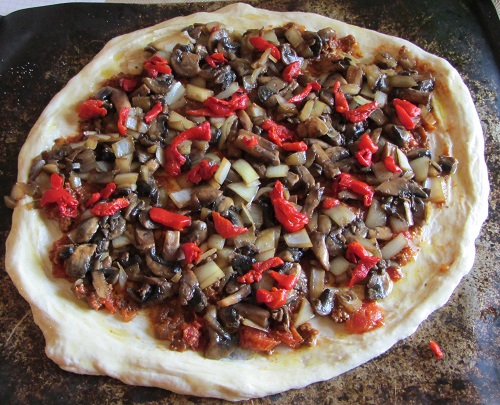
Prior to baking:

150423 pizza

Toppings: A whole bunch of lightly sauteed mushrooms, some lightly sauteed sweet onion, and roasted red pepper on a thickened bolognese.

The “00” flour was super stretchy again. There was no way it was going from the baking peel to the baking stone. I decided to make it less interesting and form the pizza on a baking sheet. The baking sheet went onto a pizza stone in a preheated 500F oven.

The pizza baked for 9 minutes, then parmesan was added and the pizza was allowed to bake another 5-6 minutes.

150423 cooked pizza

The small amount of less-melted parmesan was added after the pizza came out of the oven.

The crust was actually darker than it looks in the picture. I’d brushed the crust with olive oil before baking, and it improved the color and taste.

Despite the large amount of toppings the pizza came out crisp, and with a good snap the crust. I think it helped that the toppings were precooked — they didn’t dump a bunch of water onto the pizza.

Overall it was very tasty, and very filling without making me feel bloated. Two thumbs up.