A Crackly “Bar Pie”, Sorta

-A.J.

I recently came across The Pizza Show (Vice Network, part of their MUNCHIES series). It’s a fun and informative show, and it’s less.. guarded than the programming on some of the other networks — it’s more relaxed and it seems less scripted and far less premeditated. Recommended.

The show featured a “bar pie” at one point. A “bar pie” has a thin, crackly crust and is traditionally square cut. (As opposed to the triangular slices seen on most pizzas.)

Which inspired this:

170111 bar pie

There’s no red sauce, so I’m hesitant to call it a pizza — it’s really more of a flatbread thing. It came out nice and crispy/crackly. The toppings are spicy salami, pesto, and feta.

As I’ve “discovered” over the years, it’s important not to work the dough too much when the target is a crispy or crackly end result. Working the dough encourages gluten development, which is the arch-enemy of crispy. (Digression:  Perhaps not surprisingly there’s a Queensryche-meets-death-metal band called Arch Enemy. Meh. Nothing new to see here, other than the female lead singer doing death shouts. I’m guessing that’s the “hook”. (YouTube link))

The recipe:

  1.  Combine 300g AP flour, 180g water (60% of the flour weight), 6g kosher salt (2%), 12g olive oil (4%), and 1 tsp yeast in the mixer.
  2.  Mix for 6 minutes.
  3.  Stretch and fold the dough (once from each direction).
  4.  Lightly oil the mixing bowl. Rub the dough ball around in the oil in the bowl. Cover and let rise 90 minutes.
  5.  Preheat the oven to 500F for at least 30 minutes prior to baking.
  6.  Roll the dough out to about 1/4″ thick. The diameter will be around 12″. Transfer to a baking sheet and let rest 10 minutes.
  7.  Dock everywhere except the edges of the flatbread pizza with a fork. Brush the edges with olive oil. Top with the salami.
  8.  Bake for 8 minutes. Top with the feta.
  9.  Bake for 5 minutes. Remove the pizza from the oven and let rest a minute or two.
  10.  Dollop pesto over the top of the pizza.
  11.  Eat.

—————

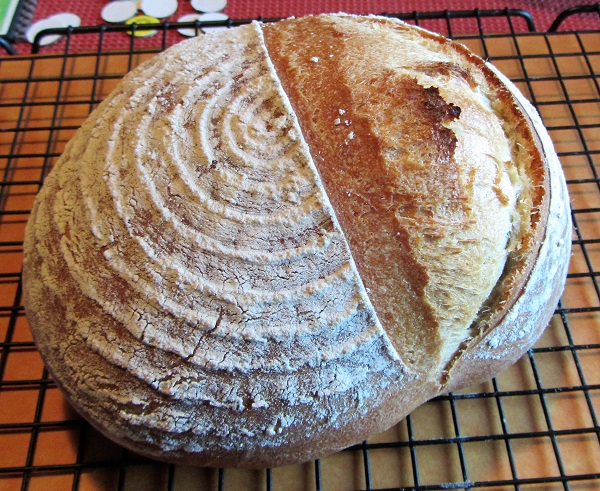
For posterity —  The first pass at Hamelman’s Pain Rustique. It could have gone better in a number of ways. The fatal issue was that it was vaguely underbaked.

And all of the other problems were caused by some variety of user error:
170111 Pain Rustique


Epi de Blé at the Annual Lasagna Party

-A.J.

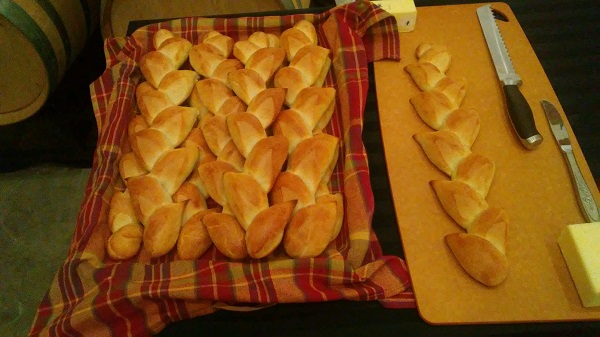
Epi Bread makes an appearance at the Iron Chef Leftover Annual Lasagna Party (cell phone pic):

161224-epi-bread

I feel like everything came together pretty well this time around. The color was better than usual due to the addition of egg wash — two eggs were beaten then strained and brushed onto the doughs before the doughs were cut into the Epi shape. The egg wash created more contrast between the light and dark parts.

Each individual Epi was around 15″ long. The finished weight of all of the breads put together was around five pounds.

As far as the actual “mechanics”:

Each “batch” was three breads at 150 grams of flour each.

This time around I used a refrigerated “Poolish” (preferment) that I started on the 22nd — two days before the event. I went with a refrigerated Poolish because on the 22nd we weren’t sure we were going to be able to make it to the event, and I could bake the dough on the 25th if we missed out on lasagna.

To make one batch of Poolish combine 150 grams of bread flour, 150 grams of refrigerated water, and a pinch of instant yeast. Mix on low speed for 8 minutes. Cover. It can be refrigerated for up to three days with no real loss in quality.

(I did all three batches together (900 grams total), then divided it out into three – 300 gram units on baking day.)

On baking day combine in the mixer one batch of Poolish with 300 grams of bread flour, 120 grams water, 9 grams of salt, 1/3 stick unsalted butter (36 grams), and 1 teaspoon of instant yeast. Mix for eight minutes. Hand knead a little if the dough looks rough. Let rest, covered for 20 minutes.

Divide into three pieces and roll each piece into a baguette shape that will fit lengthwise into a Silpat-lined sheet tray. Cover and let rise two hours.

Brush each baguette with (beaten and strained) egg wash. Using scissors, cut the breads and lay the cut segments off to the sides for the finished Epi shape.

Bake at 460F for 22 minutes. Carefully remove to a cooling rack. (I used tongs to slide the Silpat out of the sheet tray, then slipped the Epis off of the Silpat.)

The addition of butter to the recipe made the finished product a little richer and dinner-roll like. The Epi shape made it easy to cut or break off pieces, and increased the total amount of “browned goodness” surface area. I’d like to think those decisions helped the breads fit in with the rest of the meal. Nobody complained.

[Total recipe in Baker’s Percentage is 60% hydration, 8% butter, 2% salt, yeast.   Or:  450g bread flour, 270g water, 36g butter, 9g salt, yeast.]


Flat Bread “Pizza”

-A.J.

I’ve been experimenting more with the pizza stone lately, trying to get more comfortable with it. (Most recently, these hearth breads.) It’s definitely a better cold weather activity, when the kitchen and house can use the heat from the oven.

For reference, the pictured flatbread is about 12″ across.

161216-flat-bread-pizza

One “trick” that I noticed making this Flat Bread “Pizza” is that if I lightly dust the counter with flour before rolling out the dough then that little bit of flour seems to help keep the dough from sticking to the pizza peel when it comes time to slide the dough into the oven — the dusting of flour removes some of the tackiness from the bottom of the dough. As an added benefit, the pizza peel then requires less corn meal for slipperiness, so I’m less likely to set off the smoke detector with burning corn meal. Win-win!

Not exactly a “Eureka” moment, but I’ll gladly take any new nuances like that one.

During the initial bake this flatbread had only a bit of oil and a couple of thinly sliced shallots as toppings. By the five minute mark it had poofed to between 3″ and 5″ high in places, so I stabbed it with a knife a few times and beat back the bubbles. The herbed goat cheese was added at the ten minute mark and the flatbread was allowed to cook for another five minutes. (15 minutes all total.)

The crust came out nice and crunchy — in places the crust was separated from the top by big bubbles. I was very happy with the texture overall.

—————————-

300g bread flour, 190g room-temperature water (63% hydration), 7g salt, 1 TBP “Italian Seasoning”, 1 tsp instant yeast, 1/4 tsp diastatic malt.

Mix on low speed for 8 minutes. Let rise one hour. Stretch and fold the dough. Let rise one hour.

Preheat oven and stone to 500F, 30 minutes prior to baking. Roll out the dough to ~12″ across. Bake for 10 minutes, top with cheese and bake for another five minutes.


I think the stretch and fold definitely encourages the “poofiness”.


Hearth Breads

-A.J.

161130-done-closeup

I’ve been meaning to try out the combination of banneton + baking stone when making a “hearth” bread. Hamelman recommends a 73% hydration dough for his Ciabatta, but I knew if I went that high the odds of “disaster” would be pretty high too. I settled on a more moderate 65% hydration for this first pass, something along the lines of a French Bread, though it’s really a “65% hydration boule” (ball).

The recipe involves light mixing followed by three folds at one hour intervals, then a two hour rise in a banneton.

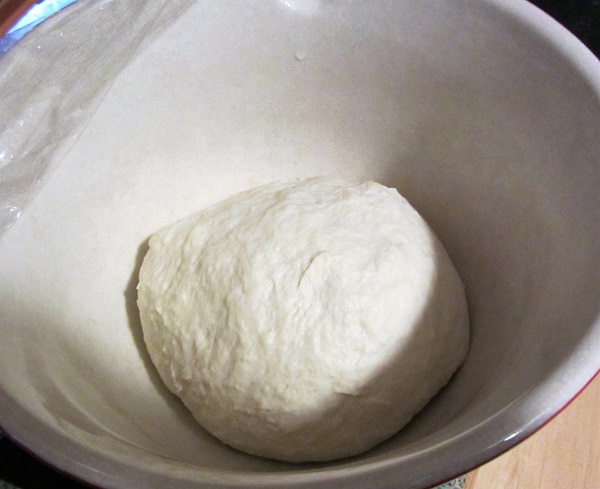
The first picture was taken right after the light mixing:

161130-fold0

Notice how the dough is somewhat shaggy. It’s fairly sticky too. Over the next few hours it’s going to shape up.

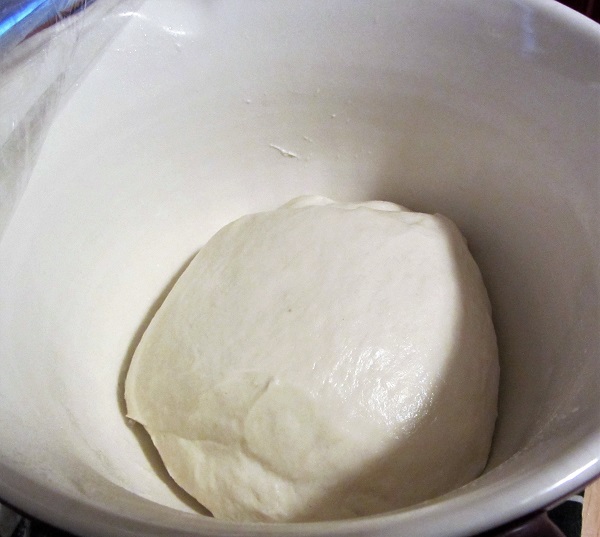
Here it is after fold number one:

161130-fold1

The “folding process” involves taking one edge of the dough, stretching it out, then folding it back on the mass. Then the stretch is done to the opposite side — repeat until all four sides have been stretched and folded back onto the mass. If you look closely you can see the last fold sitting on top with a slight seam running left to right.

Here it is after fold number two:

161130-fold2

Not much evidence of the seams this time. The dough has gained a lot of structure, and it’s not nearly as sticky as it was — now it’s just sort of tacky.

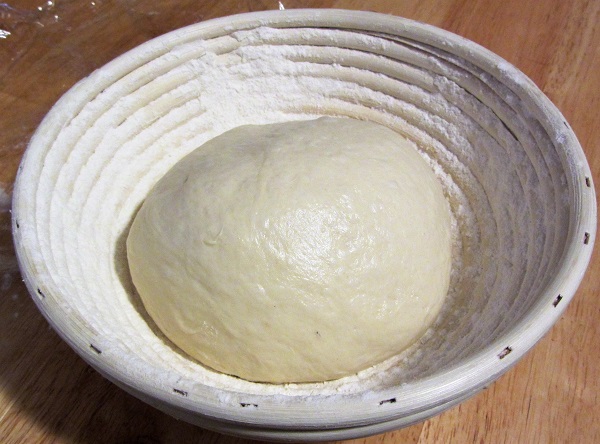
An hour later was the third fold, and the dough placed placed into a well-floured banneton:

161130-banneton

I should mention because it isn’t pictured:  During every rise the bowl/banneton was covered with plastic wrap.

The dough was allowed to rise for two hours. An hour prior to baking the stone was placed in the oven and the oven was preheated to 460F.

The dough ready to be flipped onto the pizza peel:

161130-risen

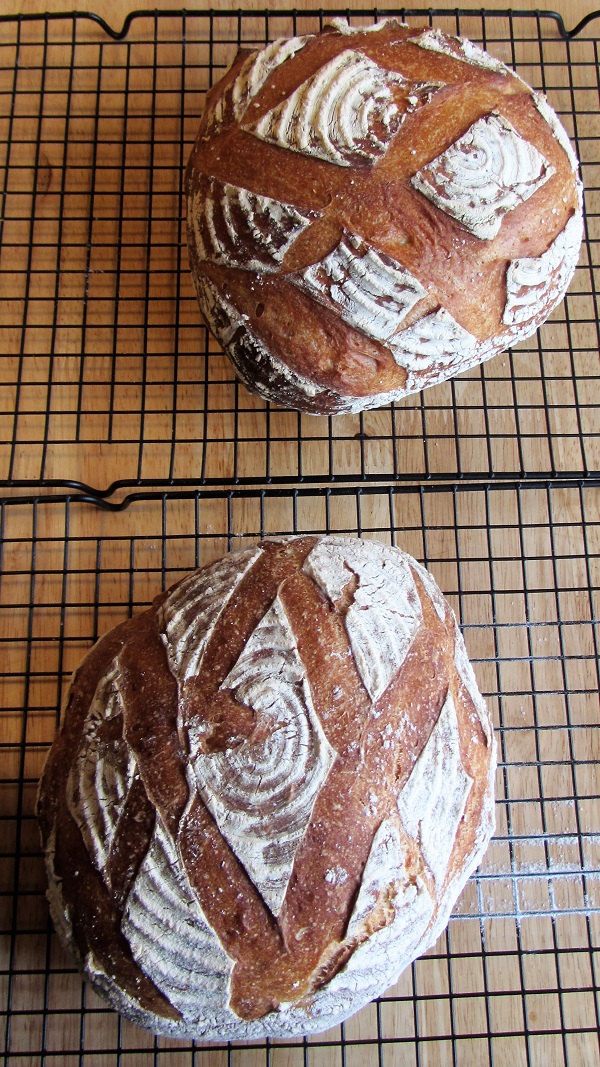
And out of the oven (I baked one at a time):

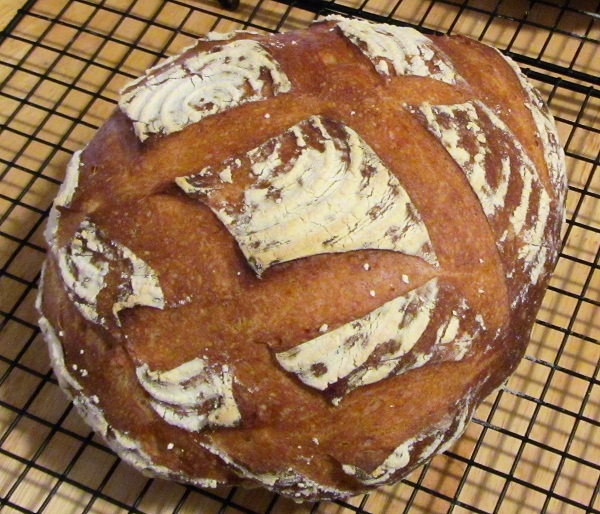
161130-done

The appearance is due to the floured rings of the banneton, combined with slashing the dough prior to baking. It looks involved, but it’s really pretty simple.

Overall the structure was a little tighter than I would have preferred — the “right” answer to that is probably more steam and higher hydration. The first dough stuck to the pizza peel, which was the “disaster” I was trying to avoid, and it’s why I used a moderate hydration in the first place. (And it degassed the dough somewhat, which is not what I wanted.) I used ample flour for the second dough and that one released fine.

There’s definitely a “wow” factor with this approach. I’m sure I’ll do it at least once again during the holidays.

—–

The recipe is based around Hamelman’s “Ciabatta with Poolish” (Bread:  A Baker’s Book of Techniques and Recipes)

The day before — make the Poolish  (120g bread flour, 120g water, a few grains of yeast. I added 2% salt to the Poolish, which is not classically correct — I wanted the Poolish to not go totally crazy and overproof.)

Baking day:

  1.  Combine the Poolish with 280g bread flour, 140g water, 1/2 tsp yeast (up to 1 tsp might work better next time), 6g kosher salt. Total recipe is 400g bread flour, 260g water (65%), yeast, 8g salt (2%)
  2.  Mix for 3 minutes on low speed, then 3 minutes on 2nd speed.
  3.  Fold the dough, move to a lightly oiled bowl cover with plastic wrap and let rise 1 hour.
  4.  Fold the dough. Cover and let rise another hour.
  5.  Fold the dough. Cover and let rise a third hour.
  6.  Fold the dough, place into a well-floured banneton or bowl. Cover and let rise two hours until doubled. With one hour to go preheat the oven and stone to 460F.
  7.  Gently dump the dough onto a pizza peel. Slash the dough.
  8.  [Late Edit:  SeattleAuthor brought it to my attention that I left out a step in the directions — Steam The Oven.]  Bake for 40 minutes. Remove to a cooling rack and let cool.

Again, it looks like a lot of steps, but it’s really pretty easy. Just set the timer and forget it for a while.

Some Assorted Baking Output

-A.J.

The weather has cooled and that means the kitchen is cooler too. I’m way more inclined to bake stuff when it’s not a million degrees in the kitchen.

Recent Stuff:

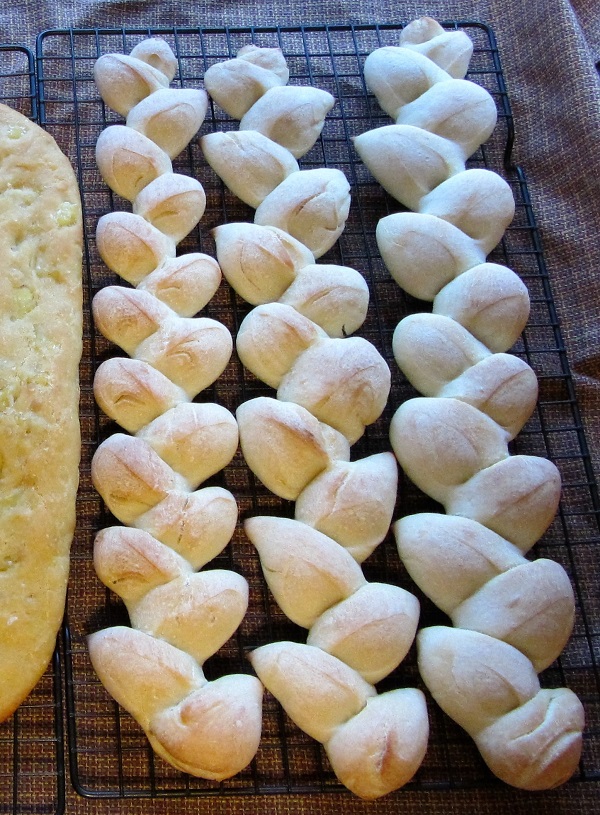
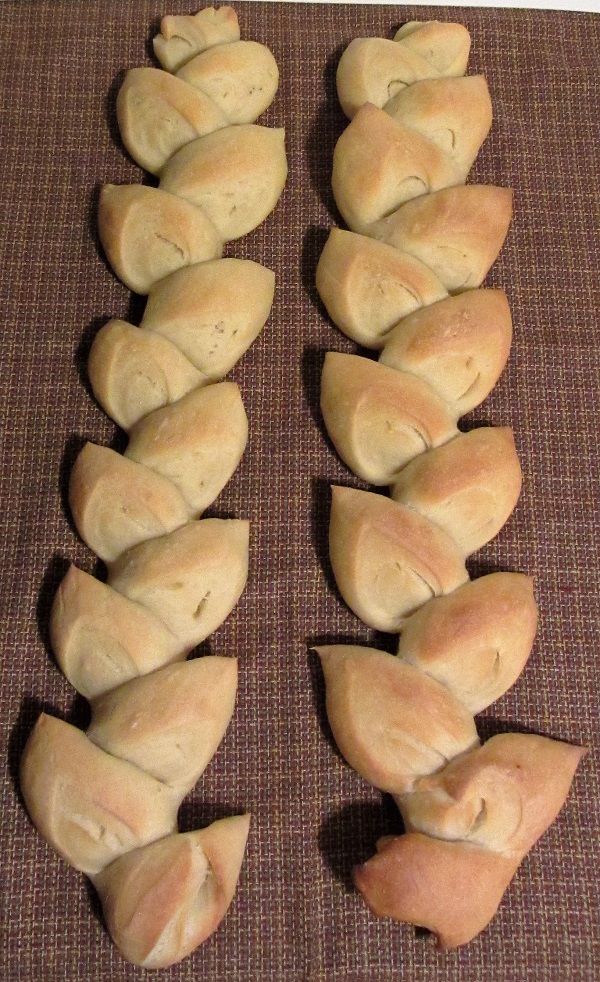
Epi breads on October 28:

161028-epi

To the left is a potato foccacia, similar to this 2011 recipe. What’s interesting to me is that recipe uses volume, not weight. I don’t bake using volume anymore. At some point I need to go back and figure out when the approach changed, and whether it was an overnight thing or if using weights was gradually phased in.  [Late edit:  The answer is further down this post.]

The epi breads used 150 grams of flour each. (This recipe, raising the oven temperature to 450F.) They really had a lot of oven spring this time. I’m guessing that the epi were allowed to rest a little longer after shaping, increasing the existing holes for steam to push up and out. I’d still like more contrast in color, other than that I’m pretty happy with them.

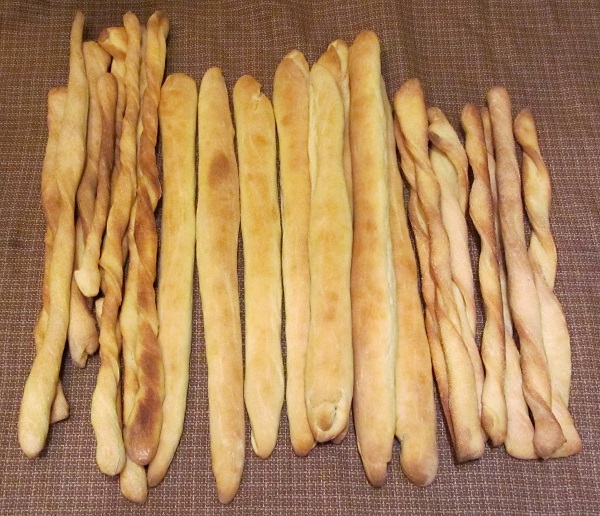
Next up, bread sticks on November 2:

161102-bread-sticks

There are two or three recipes here-

The sticks on the left use bread flour and 57% hydration. I rolled the 200 gram dough mass out to about 1/4″ thick, sliced it into ~1/3″ wide strips, twisted the strips, placed them on a Silpat, and baked at 450F for 22 minutes. They came out nice and crispy.

The sticks on the right were treated identically, except that I lightly dusted the dough mass with semolina flour for extra crunch. They didn’t need the extra crunch, but the semolina did offer a little bit different taste and texture.

I added about four tablespoons of butter to the sticks in the center. The 400 gram bulk dough was divided into about eight pieces and rolled out. These were intended for sopping up the sauce Iron Chef Leftovers had included with dinner. (Many Iron Chef Leftover dinners involve something awesome that needs sopping at the end of the meal.)

This batch comes at about the 5 year mark of messing with breadsticks. I was fairly happy with how they all came out, so that’s progress.

[Late edit:  On the linked post it says:  “This is the first time I’ve done a recipe using weights instead of volumes.”  Mystery Solved!]

I think I’ve gone through some broad baking trends since 2011:   increasing temperatures, decreasing hydration, decreasing oil, slightly increasing salt, more preference for a room temperature rise vs a refrigerator rise. Total abandonment of using volume and English measurements. (Thankfully, look at the tortured math in the link.) In other words, the baking is moving from a Reinhardt influence to a Hamelman influence, but that’s a long blog post in itself.

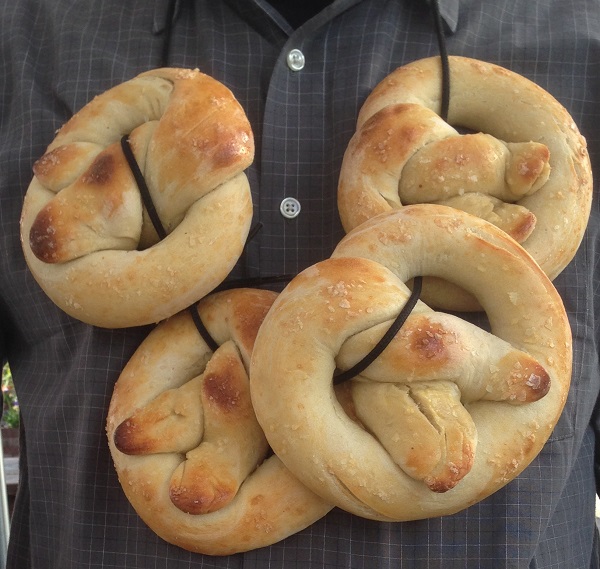
Finally, a big, goofy, pretzel necklace on November 8:

161110-pretzel-necklace

The pretzels would have looked better if I would have rolled them out thinner. The flipside is that they had enough durability to tolerate being worn on a string. It’s basically this recipe, except that the egg wash was only yolks thinned with a little water. That, and they were baked at 460F, which is the temperature that Hamelman uses for many of the doughs in his book. Each change was intended to produce a darker end result. A little more color would have been nice, but they tasted good, which is the main point of the thing anyway.

As Iron Chef Leftovers said:  “It’s a Flavor Flav pretzel necklace!”


Epi de Blé, Take Two. Closer To The Truth.

by A.J. Coltrane

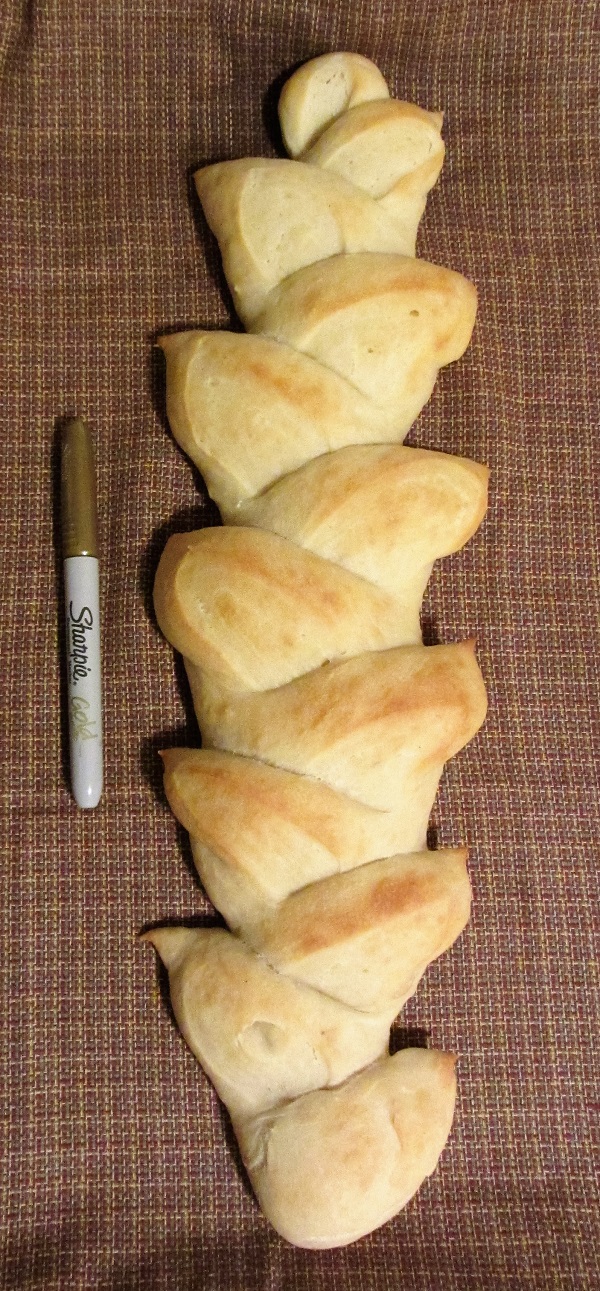
Attempt #2 at Epi bread:

161021-epi

It’s basically just a baguette recipe:  400g Bread Flour, 240g water (60%), 9g kosher salt (2.25%) 3/4 tsp instant yeast. 425F oven for 22 minutes.

The shape is better this time around. Each Epi contains less flour — 200 grams (1/2 lb) of flour per epi. (Instead of 300 grams of flour as in Take One.)

I think maybe the “right” answer is 150 grams of flour per 18″ Epi. Baking at 450F and adding malt might help the appearance as well.

Still. Better this time. “Better” is good.


Epi de Blé, Take One

by A.J. Coltrane

1st attempt at Epi de Blé (sheaf of wheat):

161014-epi

The finished result is a long way from the “flower of wheat” idealized form. (Search “epi bread” for examples.)

The recipe is basically a standard baguette dough that is cut with scissors. I used 300 grams of flour for the dough. That was too much. As a guess, 200 grams would have made a thinner, more “graceful” epi.

Recommended temperatures run between 400F and 450F. I went with 425F for 20 minutes, which seemed to work out ok.

The Verdict:  It’s a nice pull-apart bread for dinner or a crowd. The shape creates a high ratio of crust, so there are more crunchy bits to go around. It’s easy, attractive, and festive. I’ll be making this again soon, and probably a bunch of times through the holidays.

Preztels For The Beer Event

by A.J. Coltrane

A big batch of pretzels:

161009-pretzels

Using this recipe:

400g bread flour, 220g water (55% baker’s percentage), 10g (2.5% bp) salt (does not including the finishing salt), 4g diastatic malt (1% bp), 20g unsalted butter (5% bp), 1 tsp yeast.

It’s the same ratios as the 2nd Pass — everything was doubled this time. (All the more reason to use Baker’s Percentage when baking.)

Each pretzel used 1/2 of the recipe, so each one contained basically 1/2 lb of flour. Everything on the counter represents a little over 6 pounds of flour, almost 10 pounds of ingredients in total. The oven has enough room to bake two at a time, so I was starting a new batch every 20 minutes. Two in the oven, two proofing on the counter covered in egg wash, two resting before shaping, two being shaped, and two in the mixer. It was an assembly line.

I finally got the “classic pretzel shape” right. I’m not sure what I was thinking before. I doubt I’ve ever really looked at a pretzel I guess.

All that, and we discovered that we couldn’t bring them into the beer event, so they got to hang out in the car.

😛


The Second Pass At Pretzels

by A.J. Coltrane

The malt powder arrived today. Time for a 2nd attempt.

The recipe from the 1st attempt:  200g bread flour, 102g water (51% baker’s percentage), 6g (3% bp) salt (does not including the finishing salt), 1/2 tsp yeast.

Tonight’s recipe:  200g bread flour, 110g water (55% baker’s percentage), 5g (2.5% bp) salt (does not including the finishing salt), 2g diastatic malt (1% bp), 10g unsalted butter (5% bp), 1/2 tsp yeast.

TLDR;  Less salt, more water, and I added malt and butter. The recipe is now sort of an aggregate of Beranbaum and Hamelman.

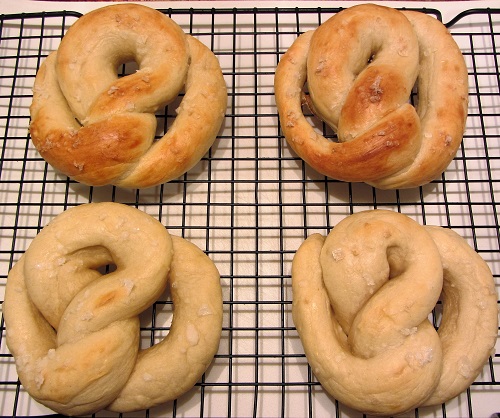
The Beranbaum recipe calls for 400F. Hamelman calls for 450F. I decided to make two batches, one at 425F and one at 450F:

161007-preztels

The two on the top were baked at 450F for 16 minutes. The two on the bottom were baked at 425F for 14 minutes. The lower temperature and shorter time was enough to cook the pretzels, but the color still wasn’t as deep as I’d like. Even the 450F batch darkened quite a bit in the extra two minutes it was given.

The other mini-experiment was an egg white wash vs a “whole” egg wash. The two on the left got the egg white wash, the two on the right used “whole” eggs. I couldn’t really tell a difference either in appearance or texture (bite).

All in all, every change seemed to be an improvement. Now it’s time to try making some really large pretzels and see how that goes.


The First Pass At Pretzels

by A.J. Coltrane

The first pass at pretzels:

100416-preztels

It’s a variation on the Preztel Bread recipe from Rose Levy Beranbaum’s Bread Bible. I didn’t use malt or the optional butter, and I used egg white instead of lye. (I didn’t and don’t feel like messing with lye.) The I may go out tomorrow and find malt — I doubt the finished color will be as dark as I’m looking for without it.

The “recipe”:  200g bread flour, 102g water (51% baker’s percentage), 6g (3% bp) salt (does not including the finishing salt), 1/2 tsp yeast. Knead for eight minutes. Let rest for 20 minutes then cut the ball into two pieces.

Roll each piece out into a 22″ log. Shape into preztels. Cover and let rise 30 minutes.

Combine one egg white with 1/2 tsp water and brush on the pretzels. Brush again with the egg wash and sprinkle with coarse salt.

Preheat the oven and a sheet tray to 400F, add three ice cubes to the preheated tray for steam, and bake for 20 minutes. Let cool on a wire rack.

I need to try this again using malt and butter. I may also raise the temperature to 450F on the next attempt in the quest for better browning.