Here is the even easier version of the Mushroom Soup recipe posted yesterday. It is relative since this saves you about 5 minutes total on the cooking of the soup and exchanges the roux and the volute with an extra potato for thickening. These recipes make about 1 quart of soup and freeze really well.
The Software
1 1/2 lbs mushrooms – you can use any kind you want
3 small or 2 medium Yukon Gold potato
1/2 oz dried Porcini (or any other kind of dried) mushrooms
4 cups chicken or vegetable stock
2 cups water
1/4 cup marsala or port wine
1/8 cup cognac
1 teaspoon dried thyme
Salt and Pepper
The Prep
Rinse the mushrooms well to remove dirt – you don’t need to worry about soaking them with water – they aren’t going to be seared. Half any that are larger than a 1 inch diameter. Scrub the potatoes and cut into quarters for a small potato or eights for a medium one.
The Soup
Add the mushrooms, potatoes, stock, thyme, marsala and cognac to the pot (don’t add the water just yet).If there is not enough liquid in the pot to cover all the dry ingredients, add a bit more stock or water to cover. Just a reminder, mushrooms do float, so it may look like they are not covered. If you are not sure, submerge them and see if there is any liquid on top of them. Bring to a boil and then reduce heat to a simmer. Cook for 1 hour.
The Finish
Puree the soup in three parts in a blender (BE CAREFUL, it is HOT). Taste and add salt and pepper. If you want a thinner soup, add additional stock or water. The soup is great on its own or add in some rice or pasta, maybe a few leaves of fresh thyme or a dab of sour cream or a dash of sherry vinegar and consume.
A note to readers: It is really easy to make soup and unless you plan poorly, you should never have to buy pre-made soup.
Mrs. Iron Chef has a traditional hash brown recipe that calls for a can of Cream of Mushroom Soup. The store bought ones are not very mushroom-y and are loaded with sodium and generally they taste like crap, so I decided to make my own. It involves maybe 5 minutes of prep time, an hour of cooking and 5 minutes to blend it smooth, not to mention a few dollars worth of ingredients and a much better taste. The best part – you can make this a completely vegan recipe with very little modification.
I am including 2 recipes for the price of one – the first one is the one that I made which is a little more complicated but a richer soup which I will post today and the second one is slightly less tasty, but even easier and I will post that tomorrow.
The Software
2 tablespoons of butter
2 tablespoons all-purpose flour
1 1/2 lbs mushrooms – you can use any kind you want
2 small or 1 medium Yukon Gold potato
1/2 oz dried Porcini (or any other kind of dried) mushrooms
4 cups chicken or vegetable stock
2 cups water
1/4 cup marsala or port wine
1/8 cup cognac
1 teaspoon dried thyme
Salt and Pepper
The Prep
Rinse the mushrooms well to remove dirt – you don’t need to worry about soaking them with water – they aren’t going to be seared. Half any that are larger than a 1 inch diameter. Scrub the potatoes and cut into quarters for a small potato or eights for a medium one.
The Roux
In a pot large enough to hold all the ingredients, melt the butter over medium heat. Once melted, add the flour and whisk until combined. Cook over medium heat for 5 minutes, stirring about every minute to a blonde color (you can keep cooking this as long as you want – the darker the roux, the more flavor, but that is for another show).
The Volute
Add 1 cup of stock in 1/2 cup increments to the roux, whisking as you add it. Once the 1 cup of stock is incorporated, add the remaining stock and whisk until the roux has been absorbed in the stock (i.e. you don’t see any pieces floating around).
The Soup
Add the mushrooms, potatoes, remaining stock, water, thyme, marsala and cognac to the volute. Bring to a boil and then reduce heat to a simmer. Cook for 1 hour. If there is not enough liquid in the pot to cover all the dry ingredients, add a bit more stock or water to cover. Just a reminder, mushrooms do float, so it may look like they are not covered. If you are not sure, submerge them and see if there is any liquid on top of them.
The Finish
Puree the soup in three parts in a blender (BE CAREFUL, it is HOT). Taste and add salt and pepper. If you want a thinner soup, add additional stock or water. The soup is great on its own or add in some rice or pasta, maybe a few leaves of fresh thyme or a dab of sour cream or a dash of sherry vinegar and consume.
I’m always looking around at how everyone is making Jim Lahey’s No Knead Bread. One day I ran across a blog post where the writer recommended *not* preheating the cooking pot. Her method was to place the the dough on parchment and let it rise in the pot prior to baking. I had to try it out — if it worked then it wouldn’t be necessary to transfer the dough from a towel into a smoking hot pot. The approach would be neater, cleaner, and easier.
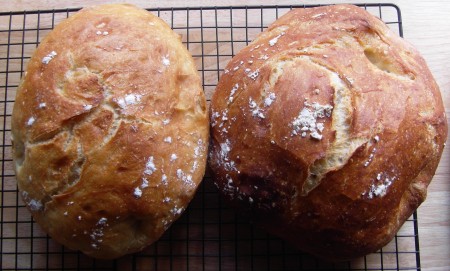
The two breads below use the same formula, one of the two didn’t use a preheated pot:
One bread is significantly lighter, isn’t it? The darker crust was preheated, and it had a better crust that was more highly regarded by the crowd.
The Lahey recipe calls for a 4.5-5 quart heavy pot. I don’t own that size – yet.
The larger of the two is 7.25 quarts (#28). The smaller is 2.75 quarts (#23).
The lighter bread used the smaller container. The darker bread used the larger one. I mention this because it might be possible that the difference in pots changed the color of the crust, though I doubt it. I do think the difference changed the finished shape. (Related note: From what I’ve read, smaller pots create a higher rise.)
So… In my opinion, the “no preheating” thing doesn’t work as well.
One change from the recipe that I think works is this: I let the final rise happen in a bowl instead of on a towel. I put about 1 teaspoon of olive oil into the bowl and spread it around the entire interior with a paper towel. I then dust the interior of the bowl lightly with flour. The flour prevents most of the interaction between the oil and dough, which keeps the oil from tendering the crust.
I use a bowl that is slighter smaller in diameter than the final pot. I’ve tried it with just flour in the bowl, or just oil towards the bottom of the bowl, and in my experience the dough will stick somewhat to the sides and/or bottom when I attempt it one of those ways. Using both flour and oil, the dough plops right out:
No dough is stuck to the bowl! That’s my $.02 “improvement”.
People have been grilling Jim Lahey’s No Knead Bread, that’s not new. From what I’ve found they all put a Le Creuset on a gas grill and cook the bread normally. That doesn’t seem to me to be very far up the “fun” scale. (But who knows, maybe placing an enclosed pot on a grill is a party-and-a-half — I’ll probably try it when it gets hot outside.)
Back to the point: My version of fun involved using the dough for grilled pizza and eating the results.
The recipe is based on Lahey’s No Knead Bread, with a couple of (related) differences. I halved the recipe, but kept the yeast amount the same, and I slowed the fermentation by refrigerating the dough overnight. In total, the dough got about 16 hours in the fridge and 6 hours at room temperature. I also did extra stretch and folds to the dough within the last two hours.
After the rising I oiled a pizza pan and rolled out the dough to about 1/4 – 1/3″. The dough went onto the pizza pan and I oiled the top. The dough was then covered with plastic wrap and allowed to rest for about 90 minutes. While the dough was resting I sauteed super thin slices of red pepper and red onion over medium high heat.
There was no chance this dough was coming off of the pizza pan easily. I put the pizza pan directly onto the medium grill for 2-3 minutes until the dough loosened and I could slide it off onto the grill grates.
After the bottom had nice grill marks I slid the pizza pan back under the dough and flipped it over. The pizza was then topped with a marina heavy on garlic, as well as the red pepper, red onion, and shaved parmesan.
Fin.
The pizza came out with a medium thickness crust that was nice and airy, almost weightless.
I’m going to have to try more high hydration pizzas!
This Grissini recipe uses two formulas from The Bread Baker’s Apprentice — Pate Fermentee and French Bread. Really, it’s the same recipe twice. The Pate Fermentee is made 24 hours in advance then refrigerated. The exact same ingredients are used again and combined with the (warmed) refrigerated dough to make French Bread. Reinhart suggests a number of different potential bases for Grissini, I used the French Bread version because it’s only flour, water, salt, and yeast — all stuff I had on hand.
Grissini ready for the oven. They're about 1/2" wide
This is the first time I’ve done a recipe using weights instead of volumes. I did this for three reasons:
1. The Reinhart formulas inevitably call for volumes that are too much for one loaf. The French Bread winds up using 4-1/2 cups of flour, intended to make three baguettes. For reference, I use 1-1/2 cups for a large pizza. I definitely didn’t want to make three large pizzas worth of Grissini.
2. Scaling the recipes down tends to make lots of weird measurements and oddball math. Halving the following formula below would mean halving 1-1/8 cups of each flour, which comes to 1/2 cup + 1 TBP. Halving the salt would be 3/8 teaspoon. That’s all assuming the scaling isn’t 1/6 of a recipe or something. “Makes 6 baguettes, 6 to 8 pizzas, or one 17 by 12-inch focaccia”.
3. Baker’s Percentages allow working in grams, and the metric system is waaayyy easier to scale than messing around with cups, tablespoons, and teaspoons.
The nice thing about Baker’s Percentages is that everything is weighed relative to the total weight of the flour. The “65” in the water column means that for every 100 grams of flour the formula uses 65 grams of water. It couldn’t be simpler. Especially with a calculator.
The table:
Reinhart (vol)
Reinhart (weight)
Reinhart (grams)
This One
Baker’s Percentage
AP Flour
1-1/8 cup
5 oz
140 g
75 g
50
Bread Flour
1-1/8 cup
5 oz
140 g
75 g
50
Water
3/4 cup
6-7 oz (6.5 oz)
182 g
98 g
65
Yeast
1/2 tsp
.055 oz
1.5 g
1 g (0.67%)
0.55
Salt
3/4 tsp
.19 oz
5.5 g
3 g (2%)
1.9
The 75 grams of each flour was pretty arbitrary — it was loosely half a recipe. Had I realized how close it was to a half recipe I might have gone with exactly half a recipe, though at the time I was more interested in the nice, round 150 grams of flour to use as a base for the rest of the math.
The recipe in short form:
1. Knead all of the ingredients, place the dough in a lightly oiled bowl, cover, and let it rest in the refrigerator overnight.
2. Remove the dough from the refrigerator and let it warm up for an hour. Cut the dough into about 10 pieces and mix together with the “new” ingredients. Knead and let rise about 2 hours.
3. Roll out the dough and divide into strips. Let the strips rise, covered, on parchment lined baking sheets, about 60-90 minutes. (I used a pizza cutter to make the strips.)
[One difference between what Reinhart calls for and what I actually did: I rolled the dough out on semolina flour. I wanted some crunch on the outside of the breadstick.]
4. Reinhart simply says “To drive off the moisture for crisp breadsticks, bake them for a long time at low temperatures, 325F to 350F, until dry and crisp. For soft breadsticks, bake hotter, at 400F to 450F, until the sticks turn golden brown.”
I wanted not-super skinny grissini with a little bite and soft insides. Looking around the internet, I settled for 400F for 20 minutes. At the 20 minute mark there was no browning, so I gave them another 5 minutes, then gave up on brown.
Way hotter than they look.
In retrospect, a small amount of fat on the outside of the sticks, or a higher temperature, might have made for an appearance closer to what I’d visualized as a target.
Of course, I don’t own anything to use to serve or display the breadsticks, therefore it’s
I thought it might be fun and good eating to bring rosemary flatbread to the last beer event we attended. It’s basically the Smitten Kitchen pizza recipe, with modifications:
Smitten Pizza Recipe
This One
Flour
3 cup
3 cup
Water
1 cup
1 cup
Yeast
1.5 tsp
1 tsp
Salt
2 tsp
3 tsp
Olive Oil
2 TBP
2 TBP
Rosemary
none
2 TBP
I increased the salt, figuring we’d eat it with pretzels and use it to cut the beer. As it turned out there were a lot of stouts at the beer event, so the strong salt/rosemary combo worked out pretty well.
The dough was mixed, then got a four hour rise. At the end of four hours the dough was cut into six pieces.
The dough was then shaped into balls and allowed to rest for another hour. At this point the dough was very “pillowy”.
The dough was then rolled out, brushed liberally on both sides with extra virgin olive oil, and grilled. Olive oil was lightly applied after I took it off of the grill. Then it got a little sea salt.
Overall I think it came out pretty well — one thing I learned is that in the middle of winter, when the grill is cranky and damp, is that the grill needs to preheat for a while to heat up and to burn off whatever moisture is kicking around in there. I didn’t do that, and the bottoms came out with poor grill marks and darker than I would have liked. The light application of olive oil at the end is probably what salvaged it.
In any case, it didn’t last long around our table of seven people at the event — everyone was tearing off hunks of bread — it was a massacre!
Saturday morning frittata very loosely based on Alton Brown’s recipe.
4 eggs
1 red pepper, diced
1/4 lb breakfast sausage, broken up
About 1/4 cup each grated cheddar and parmesan.
—-
Cover and heat sausage & red pepper over medium-low heat until cooked. Beat eggs with cheese, salt & black pepper. (It won’t take much salt, both the parmesan and sausage are salty.) Add the egg mixture to the sausage/red pepper and cook covered until the top is almost set, then broil until the top browns a little. (To broil, I slid the frittata out of the non-stick skillet and onto a baking sheet.)
Jamie Oliver’s English Onion Soup, mostly. Using chicken stock and the bread from the “7 Hour Rustic Bread” post to finish. The bread went under the broiler, which seemed to work well enough:
I didn’t really follow his recipe though: 1/2 red onion, thinly sliced. 1/2 large leek, thinly sliced, salt, pepper, and 6 mashed garlic cloves (remove garlic cloves at the end of the “saute”). Cook partially covered over low heat with 2 TBP extra virgin olive oil and 1 TBP butter for about 30 minutes. Remove lid and cook another 20 minutes until everything is brown. Add a 14.5 oz can of chicken stock. Heat through and add 2 TBP of butter to finish. Check for seasoning and fix if needed. Serves 2.
This is another attempt at a “same day rustic bread”. The last batch didn’t get mixed adequately. The recipe is the same as the last time, with some modifications — this recipe uses 1-1/4 tsp salt to 3c flour. (The salt was increased to .42 tsp per cup from .375 per cup.) This was also a 3 cup recipe rather than a one cup recipe, so the crust had time to get much darker — the color it’s supposed to be. There were also some time and handling differences.
Scaled to 1 cup flour
Lahey/Bittman
Reinhart
This Loaf
Flour
ap or bread
bread
bread
Water
.44 cups
.4-.5 cups, cold
.5 cups, cold
Yeast
.08 tsp
.3 tsp
.125 tsp
Salt
.42 tsp
.375 tsp
.42 tsp
Because the dough was underworked on the last try I also decided to incorporate more folding, (only one during fold the last attempt) and the dough got an extra hour of time. I had originally intended for 8 hours with folds every two hours, but other stuff came up:
9 am – Mix dough
11 am – fold (stretch and fold over each direction one time)
1 pm – fold (x2)
2 pm – fold, wait 15 minutes, form into a ball as in the Lahey/Bittman recipe and place seam side down in a floured bowl. (I’m still sticking with trying the bowl, at some point I’ll have to try the towel as in the Lahey/Bittman recipe.)
4 pm -bake as the Lahey/Bittman recipe calls for.
The result:
I think I may have to start slashing these loaves — the bread has cooperated exactly one time getting nice ears and rising like I think it’s supposed to (out of four attempts). Either that, or I need to make sure the seams wind up on top, which is tricky with a dough this wet (of course, I *could* use a towel like the recipe calls for…).
The overall result was better than last time — it may be as a that as a dough with only flour, water, yeast, and salt, that there is a limit to how good a bread can be without an overnight rise or a preferment. I’m going to assume there’s still plenty of room between this dough and whatever that limit is.. The Lahey/Bittman recipe blows it away. It still made a nice turkey melt though:
Vaguely out of focus, but I've already eaten it, so it's too late.



 FlatbreadGarden