No Knead Bread, The Next Day

by A.J. Coltrane

The next-night-using-up-the-No-Knead-Bread dinner. Grilled steak sandwiches with blue cheese-horseradish mayo, caramelized onions and green peppers.

142114 no knead sandwich3

Messy and good.

[Product recommendation that sort of reads like a plug:]  The steak was hit with McCormick’s Steakhouse Seasoning Grinder. It’s a quick and easy way to “add something” that’s tasty but still somewhat hard to define. Hands down my favorite offering of theirs. (From the website:)  “A robust blend of green, black, and pink peppercorns with salt, garlic and onion.  This grinder jazzes up steaks, burgers, ribs and potatoes.”

I guess I could have put actual effort into the picture, but we were hungry, and I’m not one of those bloggers to spend a bunch of time on the photo and get cold food as a reward. Those people have a sickness. (Initially the colors in the photo were really funky. I think maybe the camera was trying to normalize the yellow cutting board as “white”. Maybe. Placing a white cutting board behind the sandwich helped the camera figure out what “white” really looks like.)

Three attempts at a decent photo is plenty.

Tonight the bread “ends” are becoming garlic croutons.
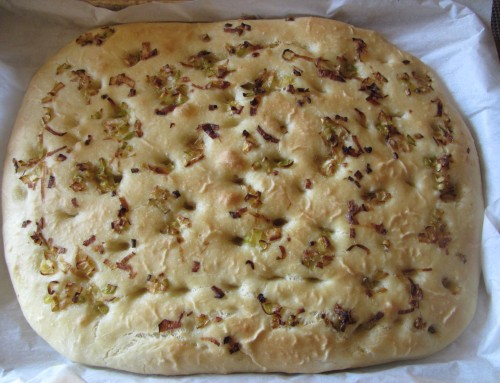
A Simple Onion Focaccia

by A.J. Coltrane

The current go-to focaccia. This is the one I make when I have three hours to prepare something — short notice by bread standards.

The Recipe:

1.  Finely slice 100g of onion. (Red onion, sweet onion, scallions, bunch onions — they all work.) Lightly saute the onion in 100g (7  TBP) of extra virgin olive oil. The idea is to remove the rawness from the onion and to impart that flavor into the oil. Let the oil cool for a few minutes, until the pan is no longer hot to the touch. 64g of the oil is used in the dough, below:

Ingredient Quantity Bakers %
Bread Flour 800g 100
Water 600g 75
Ex Virgin Olive Oil 64g 8
Kosher Salt 20g 2.50
Instant Yeast 2 tsp
Thinly Sliced Onion ~100g

2.  Combine all ingredients in a KitchenAid and mix with the dough hook, low speed for 15 minutes.

3.  Place parchment paper in a 13″ x 18″ sheet pan, leaving enough to go up the sides and hang over a little. Very lightly oil the parchment paper, then scrape the dough out onto the parchment.

4.  Oil your fingers and gently stretch the dough towards the edges of the sheet tray. It doesn’t have to go all the way to the edges. It will settle somewhat towards the edges on its own.

5.  Cover the dough for 1:45. At the 1:45 mark turn the oven to 425F. Oil your fingers again and dimple the dough. Spread the onion and remaining olive oil over the top of the dough.

6. When the oven is hot, bake the focaccia for 15 minutes, then rotate the pan and bake for another 15 minutes.

140128 focaccia

—-

Notes:

Halving the recipe will work. Reduce the pan size and the baking time to a total of about 24 minutes.

The crumb has a relatively fine texture, inspired by this Rose Levy Beranbaum recipe. The Beranbaum recipe calls for a very long mixing time (basically 20-30 minutes on medium speed) and an even larger amount of water.

One nice thing about making a focaccia for company rather than a leaner bread, is that the extra oil helps prevent staling while it’s sitting around.

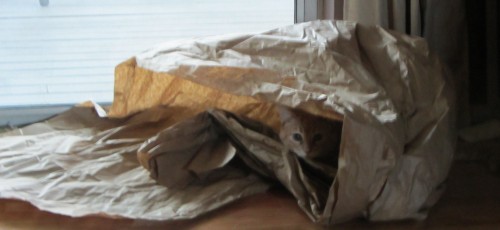
..aaaand… Bonus Girl Cat Pic!

Everybody loves playing in packing paper

Focaccia. Simple.

by A.J. Coltrane

Making rustic breads is easy. Focaccia is even easier. The recent-high-school-graduate niece made the loaf below, with very little coaching.

focaccia 061513

This became one of two caprese sandwiches for GNOIF. (She made both breads.) Both of the breads were devoured in no time.

The ingredients are essentially the same as for the No Knead Bread, with extra-virgin olive oil added to the mix — 400 grams AP Flour, 300 grams water, 8 grams kosher salt, 1/4 tsp instant yeast, and 1-1/2 TBP olive oil. (75% hydration and 2% salt by weight. Most of the time I use the scale if it’s baking related. It’s just as fast as measuring cups and the results are way more consistent.)

Everything gets combined in the Kitchenaid and mixed on low speed with the paddle attachment for 8 minutes. Cover the dough with plastic wrap for 18-24 hours. The next day, line a sheet tray with parchment paper and add a light coat of extra virgin olive oil, about 1-2 tablespoons. Scrape the dough out onto the parchment and spread it out to near the corners of the tray. (It doesn’t have to be perfect, the dough will fix itself.) Let rise 1-1/2 to 2 hours until poofy. When the dough is almost ready to go, preheat the oven to 425 F. Spread about 2 tablespoons of oil over the top of the dough and dimple the top with your fingers. (Oiled fingers help keep the dough from sticking as much.) Place the tray in the oven and bake 22-25 minutes. Let cool in the tray.

focaccia sliced 061513

We sliced this loaf width-wise. Both sides were lightly coated with basil pesto. (Yay Earthbox basil!) We splurged on heirloom tomatoes, which were “drained” and thinly sliced and chopped. The sandwich was finished with fresh mozzarella that had been thinly sliced and squished between paper towels until most of the moisture was pressed out.

Easy! I’m sure that one out of one nieces would agree.

Assorted Pics That Don’t Really Rate A Full Post On Their Own

by A.J. Coltrane

1.  I made this pizza a few days before I went to Zeek’s  pizza. It’s puffy in places, which is why it burned a little bit:

120312pizza

The Zeek’s people had a longish lightweight crowbar looking thing that they were using to punch down the “puffs” as they cropped up. It seemed like they had the doors to the ovens open quite a bit while doing they were busy punching the dough down. I wonder what temperature the pizzas were actually cooking at.


2.  Far and away the most symmetrical No Knead Bread I’ve ever made:

1212bread

Purely by accident of course.


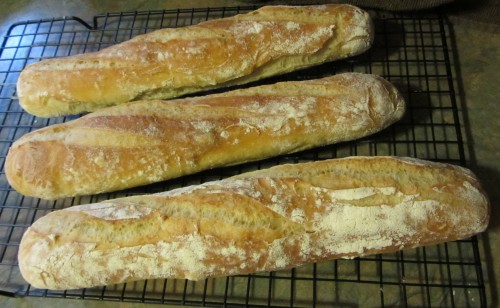
3.  More baguette experiments. I’m still not getting loaves that are as attractive as I’d like, though I feel I’m on the right track:

1212baguettes

The “right” answer seems to be to visualize the dough with two imaginary lines running lengthwise along it, dividing it into 3rds. The slashing needs to all happen within the middle 3rd.


4.  A basket that was purchased for transporting bread. It was a little small for the purpose, and somebody had other ideas as to its intended use:

cat-boy

5.  Who knew a Sham-Wow let to dry on the edge of the tub could be so comfortable?

cat-girl


Long Cold Fermentation Baguettes

by A.J. Coltrane

Baguettes inspired by Rose Levy Beranbaum’s The Bread Bible. One of her recommendations for rustic loaves calls for combining all of the water with an equal weight of flour, then letting that marinate in the refrigerator for up to three days. (A poolish.) I targeted 63% hydration for the baguettes, and I wanted two loaves as an end product. 600 grams of flour is about right for two shortish baguettes, so:

Poolish:  378 grams refrigerator water, 378 grams AP flour, 1/16 teaspoon Instant Dry Yeast. Mix with a spatula, cover the bowl, and let rest in the refrigerator for 3 days.

The poolish after three days.

One hour before you are ready to combine the rest of the ingredients with the Poolish, remove it from the refrigerator.  Note the fabulous shower cap. Another idea that I picked up from interweb forums. It should help cut down on the plastic wrap use.

Fashionably coiffed. Note the Space Invaders cutting board lurking in the background.


Add 222 grams of AP flour to the Poolish, as well as 12 grams of salt (2% of the total flour weight) and 1 teaspoon of Instant Dry Yeast. Knead in the mixer for 6-8 minutes at low speed until the dough is smooth. Cover and let rise one hour. Divide the dough into two pieces and let rest 15 minutes.

Post-shape and pre-rise.

Shape into baguettes, cover, and let rise 1.5 hours. Slash the loaves.

Slashed. I really need to get better at that technique.


Place a baking stone on the middle rack and a sheet tray on a lower rack. Put three ice cubes in the sheet tray and set the oven to 425F.

They came out a little paler than I would have liked. I think the flavor suffered a little bit as a result.

Load the loaves into the oven and add a couple of ice cubes to the sheet tray. (I’m still working on figuring out how many ice cubes to use and the timing, though this combination got high remarks on the finished bread crusts the first time I tried it, and it’s about what the guy at the Restaurant Supply Store recommended. It seems like a good place to start.)

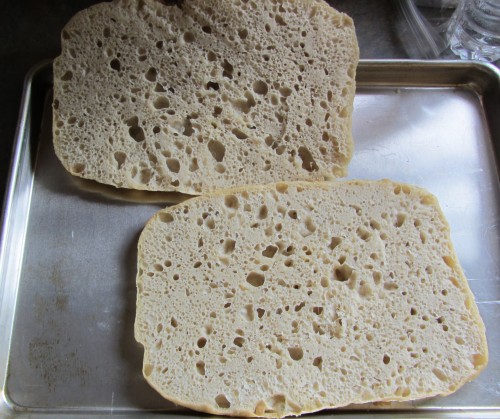
The crumb. I was visualizing a more open hole structure. To get there I may need to increase the hydration, or use bread flour, or just work the dough a little more. Probably all three.

I think the end result was fine but not exceptional. I need more practice. Fortunately this is one of those things where nobody minds eating the experiments, and even the less than ideal loaves still taste pretty good.


Yeast, Bacteria, Temperature, And Taste

by A.J. Coltrane

While browsing pizzamaking.com I’d been noticing a bunch of references concerning the effect that temperature has on flavor during fermentation, though I hadn’t been able to find real, concrete specifics.

While looking for that information and re-reading Rose Levy Beranbaum’s The Bread Bible, I came across this [pg 30]:

…When chilled, the yeast goes into dormancy, slowing its activity and producing more alcohol. The decreased activity gives the bacteria a chance to feed on the sugar, develop more, and produce more acetic acid. Temperatures of 40F to 50F are ideal for the formation of acetic acid; 55F to 90F results in the formation of blander lactic acid. Acetic acid imparts a far more sour quality to bread than lactic acid. As an added benefit, acetic acid also strengthens the dough’s structure, although too much of this acidity would ultimately weaken it. Some bakers prefer the milder flavor provided by lactic acid.

Emphasis mine. The angels weren’t singing or anything, though right now I’m thinking it’s a key component of flavor development that I’d initially overlooked/undersold.

On a not-unrelated point, within the last year Iron Chef Leftovers and I attended a bread-baking class taught by a local professional baker. The guy kind of wrinkled his nose when one of the students expressed a high opinion of Peter Reinhart’s level of knowledge and contribution to the craft. (I don’t think it was one of us, though we had previously attended a class taught by Reinhart and learned quite a bit.)

Anyway:  a quote from Reinhart’s Artisan Breads Everyday [pg 52].

Pain a l’Ancienne Rustic Bread

I first introduced the concept of cold-fermented wet dough in The Bread Baker’s Apprentice. While the idea isn’t new or original, it has blossomed during the past few years into various no-knead, overnight rise permutations…

Maybe it’s just me, but it feels to me like Reinhart is taking credit in a backhanded kind of way for the no-knead idea and the general increase in popularity in the use of the refrigerator to retard fermentation. “it has blossomed the last few years into… (these other guy’s come-lately stuff)”. It’s a fairly common thread that runs through his writing — I can see now why the guy might have wrinkled his nose.

It’s just me, right?

—–

Note: The Bread Baker’s Apprentice is still highly recommended.

Baked Potato Bread

by A.J. Coltrane

I thought it would be fun to try combining instant mashed potato into a bread, inspired by this Onion-Potato Focaccia.  The catch was, I had two hours from the initial mixing until the bread needed to be out of the oven. Two hours isn’t remotely enough time to naturally develop flavors in the bread, so I loaded the dough with a couple of flavors that go great with a baked potato — sour cream and onion soup mix. The time limit wasn’t going to allow for a focaccia either, so I went with a baguette shape to reduce the process time.

The ingredients:

Ingredient Weight in Grams
Bread Flour 320
Instant Garlic Mashed Potato 80
Water 220
Sour Cream 80
Lipton Onion Soup Mix 1 package
Active Dry Yeast 2 tsp

The sour cream is about 75% water; the total hydration works out to about 70%.  After some staring at the box of onion mix and trying to figure out what a “serving” was and multiplying that by the sodium information I decided the total sodium looked close enough to skip actual “salt” and I’d just see what happened. I did a little “research”, some popular recipes online were using similar ratios of flour to onion soup mix, so I figured it wouldn’t be a total disaster.

I kneaded the dough at low speed for 6 minutes, then covered it and allowed it to rest for 40 minutes. I then shaped it into a baguette and allowed a final proof of 45 minutes. Looking at the surface, I may have vaguely undermixed it.

The baguette then went into a 450F oven for 30 minutes. (In a related note, the silpat is supposed to be rated to 482F, so it was cutting it close.) I removed it from the oven when an instant read thermometer read 200 degrees.

Below is a picture of what happens when you don’t seal the seam very well. It was a fairly wet dough, and once it got on the silpat I didn’t want to degas it too much, so I decided the bit of seam that I saw running down the side of the dough was “good enough”. I shoulda coulda done a better job of tucking the seam on the underside. Oh well.

Three people besides myself ate the bread. I didn’t tell them what was in it. Two correctly guessed the onion, the other correctly guessed the garlic and potato. Nobody got the sour cream, which was hiding behind and the onion and the other stuff. Eating the bread with butter brought out some of the dairy elements of the sour cream; the bread tasted much better with butter — the butter was kind of like the rug that ties the room together.

Note the poor expansion on the top. That’s because the side blew out instead.

That makes sense though, doesn’t it? Butter goes great on baked potatoes too. We were just missing the bacon bits.

Beer And Honey Bread

by A.J. Coltrane

I thought this bread compared not unfavorably to the No Knead bread we’ve all been enjoying.

To back up a bit, I was looking to make a bread with the following characteristics:

1.  It needed to be out of the oven within two hours of when I got home from work.

2.  I wanted to use the No Knead Covered Dutch Oven method. I wanted a 75% hydration dough, since that’s the same hydration as the No Knead. I went online to find out how much of butter and honey is represented by water weight — it’s about 15% for each. (That’s right, it was another mathy baking thing.)

3.  I wanted to use honey, inspired by a Cheese Board Collective recipe that I’m still meaning to try out.

4.  I wanted a flavorful end product, so I thought I’d add beer to the mix. And butter.

Ingredient Quantity
350 g Bread Flour
50 g Wheat Flour
8 g Kosher Salt
2 tsp Instant Dry Yeast
1/4 cup (57 g) Melted Butter
1/8 cup (43 g) Honey
256 g Beer (Pyramid Hef)
30 g Water

The Process:

1.  Combine all of the ingredients and mix at low speed for 6 minutes. Cover and let rest for 20 minutes.

2.  Coat a bowl lightly with oil, then dust with flour.

3.  Shape the dough into a ball and place seam side down in the bowl. Use damp hands so that the dough won’t stick as much.

4.  Let rise 60 minutes. With about 10 minutes to go preheat a dutch oven at 450F.

5. Carefully invert the bowl so that the dough gently falls into the dutch oven. Slash the dough if desired. Place the lid on the dutch oven.

6.  Bake for 20 minutes. Uncover and bake 20 minutes more.

The bread had a lightly crispy, buttery crust. The wheat flour, beer, and butter all combined for a flavorful interior. And it went from the mixing bowl to the table in under two hours. Next time I’m going to try a few stretch and folds before placing the bowl in the final rise bowl. Slashing didn’t do anything for it, but if I can get a little more gluten development maybe I’ll get a better shape next time — I’ll definitely be making this one again when I don’t have much time for baking before dinner.

Joy Of Cooking’s Fast White Bread

by A.J. Coltrane

I wanted to make a white sandwich bread, so I thought to myself: “Where would I find a totally universal white bread recipe?”

In the Joy Of Cooking of course!

Ingredient Volume
Bread Flour 3 cups
Water 1 cup, warm (115-125F)
Salt 1.5 tsp
Yeast 2.25 tsp
Sugar 1 TBP
Butter 2 TBP, softened

The recipe calls for mixing most of the flour with the other ingredients, then the remaining flour. I skipped that. Otherwise, this is the basic recipe:

1. Knead all ingredients on low speed for 10 minutes.

2. Transfer to a lightly oiled bowl and let rise 20-45 minutes until doubled in size.

3. Shape, grease a 9 x 5 loaf pan, place the dough into it and let rise another 20-45 minutes, until doubled again.

4. Bake at 450F for 10 minutes, then turn down the oven to 350F and bake about 30 minutes more.

5. Remove the loaf to a cooling rack and let cool completely.

Notes:

1. I think 10 minutes is a loooong time to knead anything. I’d cut it back to about 6 minutes next time and see how that works out.

2. It came out maybe a little too salty. I think I’ll weigh the salt in the future and shoot for 2% of the flour weight (about 8 grams).

3. Substituting olive oil for the butter would make a pretty generic pizza dough recipe. (It’s a ~60% hydration dough.)

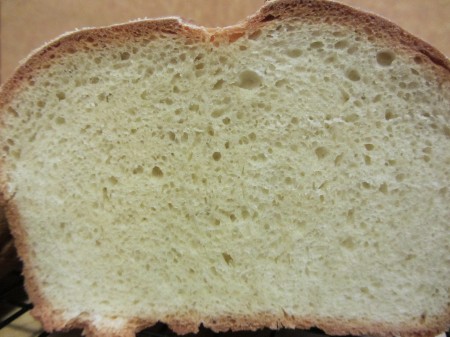
4. All in all, a very easy loaf that’s better than store bought. Cheaper too.