Mark Bittman’s Bruschetta and Crostini

by Coltrane

The recipe is basically Mark Bittman’s, from How To Cook Everything, 10th Anniversary Edition.  I used french bread that I’d made the day before.  The bread hadn’t risen like I would have liked — it wound up relatively too dense to use as “bread”, so I repurposed it into these crostini.  

The plate is in focus. The food, not so much.

This crostini recipe didn’t quite use up all of the bread I’d made — the remaining bread became Bittman’s French Toast.  The French toast was also quite good.  That book has yet to let me down.

The crostini ingredients:

8” of Baugette, cut into 1/2” rounds
15 oz can or Whole Tomatoes, seeded and diced
6 large Roma Tomatoes, seeded and diced
10 large Basil Leaves, chiffonade
4 TBP Blue Cheese, in small pieces
2 TBP Pecorino Romano, in small pieces
1 clove Garlic, minced
  Sea Salt or Kosher Salt
  Extra Virgin Olive Oil for brushing
  Garlic clove cut in half

I  used canned tomatoes in this recipe and it went over well.  Roma tomatoes would be good too.  My advice would be to go with whatever you have on hand.

Directions:

Place the tomatoes in a colander and drain for a few minutes.   Heat broiler and adjust the rack to 4″ from the heat.  Place the bread onto a cookie sheet or equivalent.  Lightly brush the bread slices on both sides with olive oil.  Place the cookie sheet under the broiler to lightly brown the first side of the bread.  (This will take 2-4 minutes.)  Turn and brown the other side.  Don’t walk away from the bread while it’s under the broiler, as the bread will go from “toasty” to “setting off the fire alarm” in about 30 seconds.  Rub the crostini with the halved garlic clove.

Combine the tomato, basil, cheeses, minced garlic, and the two tablespoons of olive oil.  Mix to combine and salt to taste (about 1/2 tsp).  Distribute the tomato mixture on the crostini rounds.  Finish with a drizzle of olive oil.

As for what happens when you get wrapped up in taking pictures and forget about the bread under the broiler…

Chard with Cannellini

by Coltrane

Chard arrived in the CSA box this week.  The chard, along with some leftover cheese, canned beans, and basil from the planter box become a very nice topping for crostini or crackers:

2 TBP Extra Virgin Olive Oil
1/3 cup Shallots, minced
1 clove Garlic, minced
1 lb Chard, stems removed, cut into 1” pieces
1/2 15 oz can Cannellini Beans rinsed and drained
1/4 cup Chicken Broth
Pinch Red Pepper Flakes
3 TBP Pecorino Romano, chopped fine
6 large Basil Leaves, chopped or chiffonade
1 TBP Lemon Juice

Heat skillet over medium high heat.  Add Olive Oil, Shallots, and Garlic.  Saute until soft.   Add Chard, Beans, Chicken Broth, and Red Pepper.  Cook until the Chard is wilted and reduced.  Add cheese, basil, and lemon juice, heat through.    Salt to taste (the chicken broth and cheese both contain some salt.)

Serve over crostini, bruschetta, or crackers.

This recipe would work well with spinach instead of chard.   A lesser amount of onion may be substituted for the shallot.

Things to do with your CSA box

By Iron Chef Leftovers

I don’t actually get a CSA basket (although I probably should), but I know plenty of people who do and I frequently get asked if I want the stuff they aren’t going to use or what can they do with the leftovers. I say, make a stir-fry. I am pretty sure that stir-fry is ancient Chinese for “take a whole bunch of shit and throw it in a pot to make something tasty.”

I love summer in the Northwest since we have access to some great quality and amazingly fresh ingredients. Here is my CSA inspired stir-fry from a farmer’s market shopping spree. There is really no recipe. I just cut up a bunch of stuff, cooked it and ate it. It really is that simple.

The Software
Zucchini
Bok Choy
Green Bell Peppers
Walla Walla Onions
Broccoli
Garlic – minced or sliced
Oil (any kind will do, I use olive)
Lime
Soy Sauce
Rice Wine Vinegar
Chicken Stock
Sesame Seeds

The Stir-Fry
Chop the zucchini, bok choy, peppers and onions to whatever size you want them to be. I personally like large pieces of veggies, so I chopped them very roughly. You are going to cook all of the veggies separately, so you will need a large sauté pan and a large bowl. Heat the pan over medium-high heat with about 1.5 tablespoons of oil. When the oil is hot, add the onions. Cook for about 1 minute until they begin to soften. Add a little soy sauce and toss the onions around in it. Continue cooking until less cooked than you would want to eat (they will continue cooking in the bowl). Add in garlic and cook for 15 -30 seconds more. Empty contents of pot into bowl. Return pot to heat, add oil until it is hot and add whichever veggie you would like to cook next (it really does not matter), just remember not to overcook them and add a dash or 2 of soy sauce for the last minute or so of cooking. Repeat the process until all of the veggies are done. Once all of the veggies are done, take a small amount of chicken stock and deglaze the pan (or you can use veggie stock, water, wine, beer – pretty much any liquid will work). Add it to the bowl of cooked veggies. Takes some rice wine vinegar, the juice of the lime and a handful of sesame seeds and add them to the bowl. Give everything a good stir and taste. Adjust the seasonings as needed. Eat. That is it; the whole thing takes less than 10 minutes.

Notes
You can add any veggies you want to this, the recipe is based on what I picked up and looked good. I like to serve this over some pan-fried yakisoba noodles, but you can serve it over rice, cous cous, pasta or just on its own. If you want some protein in it, this does work well with tofu or poultry. If you like heat, a nice chile sauce or some diced chile peppers are wonderful. Ginger is also nice with this too – just mince it and add it at the same time as the onions. Just remember – don’t overcook the veggies or you will end up with mush.

Sambal Oelek

by Coltrane

Sambal OelekSambal Oelek is a spicy asian chili paste.  I like to use it instead of cayenne or tabasco — anywhere heat is needed.  Here are three quick recipes; one “Asian”, one “Mexican”, and one “Mediterranian”.  Sambal Oelek works great in all three.

“Asian” Sauteed Spinach

2 TBP Peanut or Canola Oil
1 lb Baby Spinach
2 cloves Garlic, minced
2 TBP Soy Sauce
½ tsp Sambal Oelek

Heat a skillet and oil over medium-high heat.  Add garlic and saute until it colors a bit.  Add soy, spinach, and Sambal Oelek, cover for 1 minute.  Remove cover and stir until the spinach is cooked to your liking, about 2-5 minutes more.

Psuedo Pico de Gallo

About 6 Roma tomatoes
½ – 1 Red or Sweet Onion
½ cup Chopped Cilantro
Juice of 1-2 Lime
pinch Salt
½ – 1 tsp Sambal Oelek

Seed and dice tomatoes.  (They’re easiest to seed if you cut them through the equator and clean out with your finger.)  Mince the onion.  Add all ingredients to a bowl and stir to combine.  Serve immediately.

White Bean Hummus Send-Up

I use peanut butter instead of tahini in this recipe.  Don’t tell them and they won’t notice.  (Of course, if they did call me on it I’d say “Well yeah, I didn’t tell you it was Hummus”.)

1 can White (Cannellini) Beans
Juice of 1 Lemon
2 cloves Garlic
pinch Salt
1 TBP Peanut Butter
1 TBP Extra Virgin Olive Oil
½ tsp Sambal Oelek

Drain beans.  Roughly chop the garlic.  Add garlic to food processor and process briefly.  Add all other ingredients and process until smooth.  It may require a bit more oil to get the texture you want.

Alton Brown’s Diet, Granola Bar Recipe

by Coltrane

The diet that Alton Brown used to lose 50 pounds in 9 months:

Daily:

Fruits, Whole Grains, Leafy Greens, Nuts, Carrots, and Green Tea.  Eat breakfast every day.

3 times per Week:

Oily Fish, Yogurt, Broccoli, Sweet Potato, Avocado.

1 time per Week:

Red Meat, Pasta, Dessert, Alchohol (one drink).

Never:

Fast Food, Soda, Processed Meats, Canned Soups, “Diet Anything”.

Alton Brown expressed a low opinion of store-bought granola bars during the episode “Live and Let Diet”.  Below is nutrition information for his granola bars, compared to Nature Valley’s Peanut Butter granola bars.

Item AB’s Nature Valley
Cal 189 190
Total Fat 6.2g 7g
Sodium 9.4mg 180mg
Total Carbs 29.8g 28g
Fiber 3.84g 2g
Sugar 13.8g 11g
Protein 4.35g 5g

You decide if it’s worth making your own.

Nutrition Information and Recipe Source.  Note that the serving size in the left column was 1/3 the number of calories of the right column.  (63 calories vs 190 calories.)  The math has been adjusted so that it is a direct comparison.

Upcoming Events for Foodies

By Iron Chef Leftovers

Some upcoming events for foodies and non-foodies alike that may be of interest:

June 26th – Paella Cook Off at Treehouse Bar in Ballard. Never knew this event existed. For $25, you get to eat lots of paella and get 2 glasses of wine or beer. Sounds like fun.

July 10th – Mobile Chowdown 4 at the Seattle Center. Food Trucks, lots of them, enough said.

July 11th –Burning Beast 2010 at Smoke Farms in Arlington. It is sold out but how could you not love a full day of roasted meats prepared by 11 Seattle Area Chefs.

July 14th – Fare Start’s Guest Chef on the Waterfront – Bell Harbor Convention Center. Heck $75 for an all you can eat, all you can drink event featuring some of Seattle’s best chefs? I wish I didn’t already have plans. Did I mention that all proceeds are going to support Fare Start’s programs?

August 25-28 – Cheese-a-topia at various locations in Seattle. I will be honest, I had no idea that there was even a National Cheese Society, but I love the idea and I love cheese, so I may have to take Mrs. Iron Chef to some of the events.

Thursdays, Fridays and Saturdays throughout the summer – 25th Anniversary Celebration at Le Gourmand in Ballard. They are offering a $45 pirx fixe menu to celebrate. A great way to get out to one of the best (and most expensive) restaurants in Seattle.

When Life Hands You Chicken Breast…

By Iron Chef Leftovers

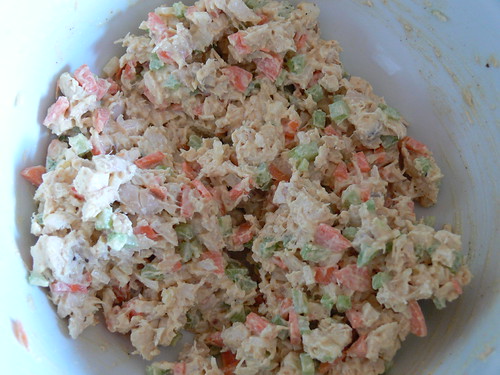
I promised a recipe for the leftover chicken breast from the Chicken Soup recipe, so here it is – my take on my grandmother’s chicken salad, which, as much as I try, will always be better in my heart. The original recipe involved grating all of the veggies, using the chicken breast from making soup and never included bacon salt (wasn’t invented yet), balsamic vinegar or garlic powder (she used minced garlic, which, is too overpowering for this dish). She would have thought it weird that I would be writing a recipe for this, so I am sorry grandma. When I learned to make this from her, she never measured anything and neither have I until this point. It is all about tasting everything until it tastes right (or good, there is no right or wrong on this meal). Nothing that she made came with a recipe, if you wanted to learn to make something she made, it was by being in the kitchen with her and tasting and feeling as you went. Sadly, she passed a few years ago, but fortunately, just about all of her cooking wisdom was passed down to her children and grandchildren. This is also one of Mrs. Iron Chef’s favorites.

Chicken Salad

The Software
1 chicken breast cut into bite sized pieces
1 large carrot finely minced
1 large stalk celery, finely minced
2 tablespoon finely minced yellow onion
1 tablespoon bacon salt
1 tablespoons mustard powder
1 tablespoon garlic powder
1/4 teaspoon balsamic vinegar
Salt
Pepper
3 tablespoons mayo (see note)
1 teaspoon Dijon mustard (see note)

• Note – when I say tablespoon for the mayo and teaspoon for the mustard, I am not talking about the measurements, I am talking about the spoons you would find in your silverware drawer. I just take 3 big scoops of mayo and 1 big teaspoon of mustard. If I had to guess measurements, 1/2 cup of mayo, 1 1/2 tablespoons (the measurement) of mustard.

The Salad
In a large bowl, combine the chicken, carrot, celery and onion.

The Dressing
This is a salad, so you are making a salad dressing essentially. In a bowl, combine the mayo, mustard, mustard powder, bacon salt, garlic powder and balsamic vinegar. Mix until well incorporated. Taste it. Add any additional seasoning as needed.

The Final Product
Add the dressing and fold using a spatula. Taste it. There should be a subtle hint of heat from the onions and mustard. I usually will add a few grinds of black pepper and, if needed, some salt and fold that in. That is it, you are done. If for some reason you like more dressing, just make some more and add it in. This is pretty potent stuff and you are really looking more to coat everything rather than drown it.

To Serve
Serve it however you want – on a sandwich, salad, or my favorite, just out of the bowl with a spoon.

Final Notes
It took me longer to type this up than it did to make. This dish really shouldn’t take more than 5 minutes to put together. You can not add the bacon salt (if you don’t put it in there, you might need to add salt later) if you choose. Of course if you don’t add the bacon salt, you could always add some real crumbled bacon to it, because, frankly, everything is better with bacon. The mustard powder is really essential for the right flavor, but if you don’t have any, and aren’t able to stop what you are doing and run out to get some, double the amount of Dijon. It won’t be the same, but it will still be edible. If you find yellow onions too strong, try substituting sweet or Walla Walla onions or even scallions. At various times, I have added in hot sauce, horse radish, worcestershire sauce, paprika and a bunch of other stuff I am probably forgetting. Feel free to play with your seasonings. Make it taste the way you want – grandma would just be happy that you are eating it.

Onion-Potato Focaccia

by Coltrane

Or Potato-Onion Focaccia, or Potato Focaccia with Onion.  It’s a focaccia bread with yukon gold potato inside and onions on top.  An oniony olive oil is both inside of and on top of the bread.

The recipe below probably started life in a slightly different form at The Wednesday Chef.  Her recipe features tomatoes.

The Ingredients

1 Medium Yukon Gold Potato

2 Cups All-Purpose Flour

1 Teaspoon Instant Yeast (or 1.25 tsp “active” yeast)

Pinch of Sugar (or a few drops of honey)

1/2 Tablespoon Kosher Salt

2/3 Cup Warm Water (not “hot”)

1/4 Cup Extra Virgin Olive Oil

1/2 Medium Onion (The quantity is very flexible.  Do what you like.  If you cook up more than the focaccia needs there’s always the refrigerator for the extra.)  I usually use a sweet onion, but red onion and spring onions work too.

Directions:

1.  Bring a pot of salted water to a boil.  Boil the potato until tender, about 20 minutes.  Slightly undercooked is ok.  When the potato is cool enough to handle, peel and break it up into marble-sized pieces.

2.  While the potato is boiling:  Slice the onion into pieces about 1/2″ long.  Heat a pan over medium-low heat, add the olive oil, and saute the onion until it softens.  Remove pan from the heat and let cool.  (More olive oil than necessary is used here.  This step infuses the olive oil with the onion flavor.)

3.  In a mixing bowl combine the yeast, sugar or honey, and water.  Let stand 5 minutes.

4.  Add to the bowl the flour, salt, potato, and about half of the oil from the pan of onions.  Knead until the dough comes together, about 5-7 minutes.  The dough should be tacky but not sticky.  (I knead the dough right in the bowl, it’s one fewer thing to clean.)  Add a light coating of oil to the dough and the bowl.  Cover the bowl with plastic wrap and let rest one hour.

5.  Line a baking pan with parchment paper (mine’s about 12 x 8 x 2).   Place the dough into the middle of the parchment and pull the dough to fit the pan.  If the dough resists the stretching, wait 5 minutes and stretch again.  It’s not critical that the dough goes all the way to the edges, it will expand during the 2nd rise.   Cover the dough with plastic wrap and let rest one hour.

6.  Preheat oven to 425 degrees.  Remove the plastic wrap from the focaccia.  Dimple the focaccia with your fingers.  Spread the remaining olive oil over the top of the dough.

7.  Bake for 20 minutes.  At the 20 minute mark add as many onions as you like.  Rotate the pan and bake another 20 minutes.  (This will be 40 minutes of baking total.)

8.  Let cool 20 minutes in the pan.

Enjoy.