Beer of the Week: NW Peaks Granite Oat Ale

By Iron Chef Leftovers

When we think of beer brewed with adjuncts, we think of the mass-produced American Lager like Bud – flavorless and lacking any real character. By definition, a beer brewed with anything besides water, yeast, grain and hops is an adjunct beer and most can be delicious if not outstanding. NW Peaks Brewing did an adjunct beer (two actually) as part of their Mountain Beer series in March. The first of the two to be reviewed is the Granite Oat Ale. The beer contains about 20% oats and is not a dark beer (which is where you will usually find the addition of oats).

From the NW Peaks website:

Granite is the second ‘adjunct’ (oats) beer for March. Granite ended dry and crisp with oat notes. The oats added some silkiness to the mouthfeel as well. However, the featured character is the NZ Saaz hop that we used, which creates a nice floral character in the finished beer.

The beer is orange-amber in color with lots of oats and malt on the nose and slight hints of hops interspersed. The beer is very oat forward on the palate with a slight umami feel in the mouth from them. The long oat backbone slowly fades into a slight malty sweetness with a slightly bitter hop profile before transitioning into a long malt finish. As the beer warms, the oat presence becomes more pronounced and the complexity is increased with a touch more sweetness, a slightly floral character and a bit less bitterness from the hops.
Definitely an interesting and well-executed oat based beer which you should run out and try next time it makes an appearance.

NW Peaks Granite Oat Ale follows the trail and leads with a solid 3 horses to water out of 5.

EarthBox Update — July 28, 2013

by A.J. Coltrane

Previous post here.

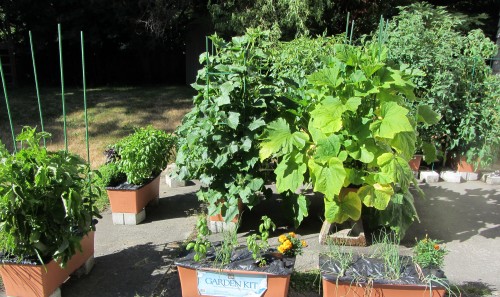
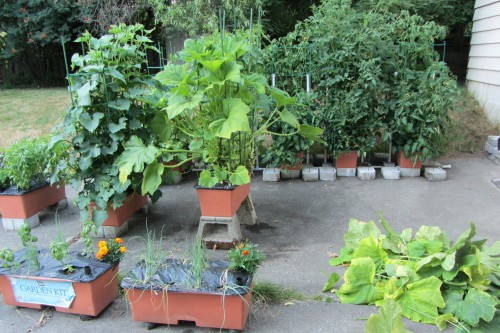
More nice weather = happy plants! All of the peppers are now fruiting. I think there’s going to be a deluge of tomatoes soon.

Today’s harvest:

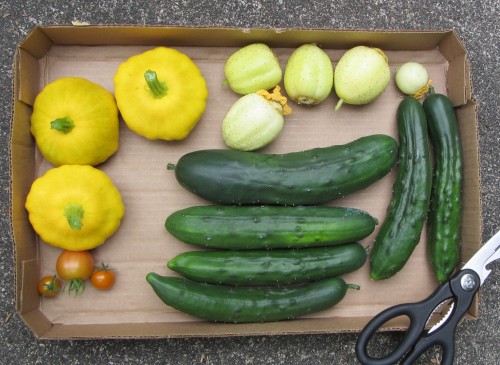
A couple of pounds of regular cucumbers and a pound of patty-pans. Also lemon cucumbers and a few tomatoes.

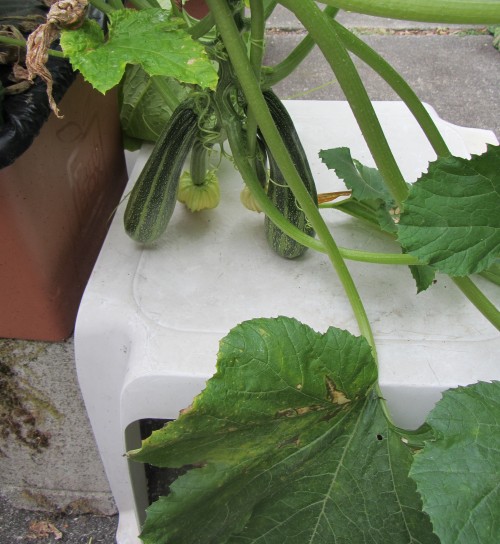
The zucchini got some support to try to avoid a repeat of the breakage a few weeks ago:

072813 zucchini

If this flower is any indication, the mother of all zucchini is on the way:

Continue reading “EarthBox Update — July 28, 2013”

Beer of the Week: Black Raven Brewing Schwartzeit Black Lager

By Iron Chef Leftovers

There are times that I think Black Raven is one of the best breweries in the state and others that I think “WTH are they doing over in Redmond?” Schwartzeit Black Lager lends itself more to the former than the latter sentiment. In case you are not familiar with Black Lagers, Wikipedia comes to the rescue:

Schwarzbier, or “black beer”, is a German dark lager beer. It has an opaque, black colour and a full, chocolatey or coffee flavour similar to stout or porter.
Schwarzbiers are bottom-fermented beers, though originally top-fermenting yeast was used in brewing them. The alcohol content usually ranges from 4.8%–5%. They get their dark colour from the use of particularly dark malts in brewing. The malt in turn gets its colour during the roasting procedure.

The roots of the Schwarzbier lie in Thuringia and Saxony; the oldest known Schwarzbier is Braunschweiger Mumme (“Brunswick Mum”) brewed since the Middle Ages (the first documented mention is from 1390[1]) in Braunschweig. The earliest documented mention in Thuringia is of Köstritzer from 1543, a popular Schwarzbier still produced today. The East of present-day Germany has many unique varieties of this style from regional breweries. It is often served with dark, chunky breads with cream cheese. It also pairs well with marinated meats like brisket and is an excellent companion to German Sauerbraten.

I had the Schwartzeit in a 22oz bottle which ran about $7 and clocked in at 5.9% ABV.

The beer pours dark and slightly opaque with a generously fizzy tan head. A great deal of roasted malt appears on the nose with hints of chocolate and coffee – this beer could easily be confused with a stout on smell alone. The similarities end with the nose though – a slight sweetness starts you out, followed by a pleasant light grain flavor. That fades very quickly into light roast and chocolate (the chocolate is more pronounced as the beer warms) with a very mild bitterness from the hops at the end. The beer won’t win over light beer, drinkers despite being a lager, but it is balanced and delicious and should appeal to those who like a dark beer, but don’t want to go for full bore into the realm of stouts and porters.

Schwartzeit is a seasonal beer for Black Raven and one of the few that they actually bottle, so pick up a couple next time you see it in your local bottle shop.

Black Raven Schwartzeit Black Lager goose-steps in with a stellar 4 Achtungs! out of 5.

EarthBox Mini Update — July 26, 2013, or, I Ain’t Missing You At All

by A.J. Coltrane

Previous post here.

We did a thorough search of the plants last night, looking for anything that might ready. A.S. found these eight perfectly ripe tomotoes all grouped together towards the bottom of the Stupice. I had no idea that they were there.

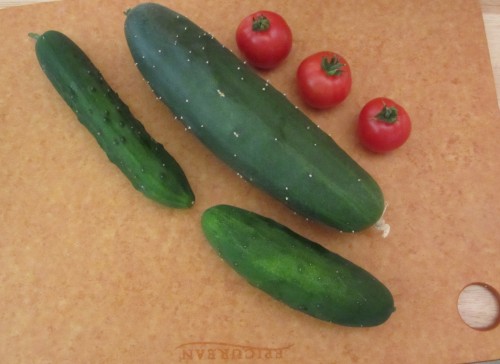
The cucumbers are about 6" long. The tomatoes are about 2" in diameter.
The cucumbers are about 6″ long. The tomatoes are about 2″ in diameter.

But when outside to water this morning I thought maybe I’d lift some of the wayward cucumber vines into the trellis. I discovered this big guy. (Photographed with some of last night’s produce for reference.)

072613 cuc tomato

Holy cow. I don’t *think* we missed it last night, although I guess it’s possible. The other explanation would be that it went from the smaller size to THAT between 5:00 pm last night and 9:00 am this morning.

EarthBox Mini Update — July 26, 2013, or, I Ain't Missing You At All

by A.J. Coltrane

Previous post here.

We did a thorough search of the plants last night, looking for anything that might ready. A.S. found these eight perfectly ripe tomotoes all grouped together towards the bottom of the Stupice. I had no idea that they were there.

The cucumbers are about 6" long. The tomatoes are about 2" in diameter.
The cucumbers are about 6″ long. The tomatoes are about 2″ in diameter.

But when outside to water this morning I thought maybe I’d lift some of the wayward cucumber vines into the trellis. I discovered this big guy. (Photographed with some of last night’s produce for reference.)

072613 cuc tomato

Holy cow. I don’t *think* we missed it last night, although I guess it’s possible. The other explanation would be that it went from the smaller size to THAT between 5:00 pm last night and 9:00 am this morning.

EarthBox Update — July 21, 2013

by A.J. Coltrane

Previous post here.

The zucchini are bouncing back nicely. The cucumbers, peppers, and patty-pans are finally getting into gear. The tomatoes are going nuts. Yesterday provided this:

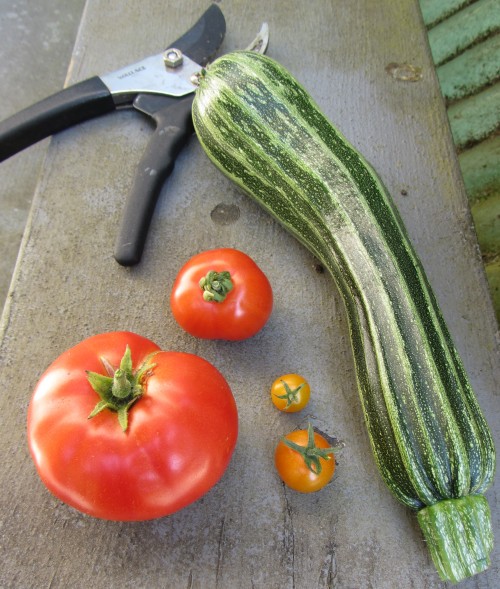
Left to right:  Stupice tomato, Glacier tomato, two Sun Golds, and a Cocozelle zucchini.
Left to right: Stupice tomato, Glacier tomato, two Sun Golds, and a Cocozelle zucchini.

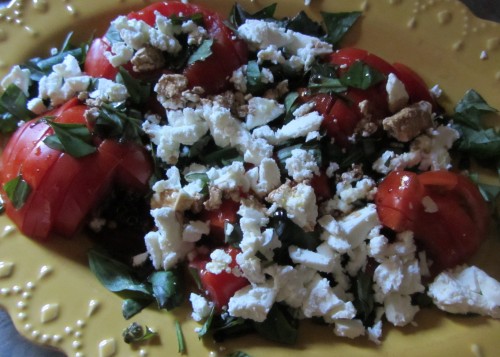
Which made for the first taste comparison among the tomatoes. A “caprese” with goat cheese and balsamic:

Tomatoes from left to right:  Store bought, Stupice, Glacier.
Tomatoes from left to right: Store bought, Stupice, Glacier.

The store bought tomatoes lost. They lacked the acid and character of the home grown.

Continue reading “EarthBox Update — July 21, 2013”

EarthBox Update — July 14, 2013

by A.J. Coltrane

Previous post here.

There are issues with the zucchini, and I think there is more than just one thing wrong with them. The symptoms:

1.  The patty-pan leaves are more yellow overall than it had been. (It was never as dark as the cucumbers or the cocozelle.)

2.  The cocozelle has fruits that are rotting from the blossom end. I cut off four bad fruit yesterday.

3.  Sometime in the last week white mold appeared on the cocozelle.

Which is kind of strange, because the cocozelle has produced seven pounds of fruit in the last few days. I thought it was ramping up for the summer.

Before.
Before.

My totally stab-in-the-dark diagnosis is that the fruits are experiencing blossom end rot caused by a calcium deficiency. (Which I’m pretty sure is correct after looking around the interwebs.) I’m also of the suspicion that the plants need fertilizer. I dosed the feed tube with a 14-14-14 granular fertilizer and calcium nitrate last night. In retrospect, that’s a double dose of nitrogen, which will be either good, bad, or indifferent, but, why not? I also pruned the heck out of the two plants, removing all of the really yellow leaves, as well as the most beat-up older leaves and the leaves with a lot of mold. The intent is to let more air and sunlight in, and to try to make it so that all leaves are getting more optimal use. Finally, I sprayed the plants with an organic mold inhibitor. The aftermath:

071313 postcut overview

Zucchini from the back:

I didn't mess around with the pruning. I'd like to think the plants will be healthier. We'll see.
I didn’t mess around with the pruning. I’d like to think the plants will be healthier. We’ll see.

Onto “sunnier things”.

Continue reading “EarthBox Update — July 14, 2013”

Beer of the Week – Reuben's Brews Cask Conditioned Auld Heritage

By Iron Chef Leftovers

It is a gutsy move in the Northwest to put out a beer style that you don’t normally see and it is even gutsier to put that style out in a cask, but that is exactly what the guys from Reuben’s did with their Auld Heritage Ale. Auld or Old ale is defined as follows (from Wikipedia):

Old ale is a term commonly applied to dark, malty beers in England, generally above 5% abv, also to dark ales of any strength in Australia. Sometimes associated with stock ale or, archaically, keeping ale, in which the beer is held at the brewery.

Reuben’s version clocked in at 8.7% alcohol and 58 IBU; not exactly a small beer.

Auld Heritage is mahogany brown in color. There is lots of malt and caramel on the nose with hints of toffee. The beer builds slowly as you drink it, starting off with little fanfare before showing lots of toffee then transitioning into burnt sugar and caramel before finishing off with a slightly alcoholic and sweet with notes of toffee, caramel and dried fruit. The finish is long – several minutes after taking a sip, you still get light notes of toffee, caramel and dried fruit, and it is not a bad thing. The beer is like enjoying a nice toffee or hard candy and the caramel notes made me thing of eating a confection and wanted a sprinkle of sea salt (salted caramel is one of my favorite flavor). For a moderately IBU beer, any of the hop character is lots in the deep flavors, but I don’t think this is necessarily a bad thing.

If you are an advanced drinker or just someone who wants to try a new style of beer, you should head down to Reuben’s to have an Auld Heritage when it is on their tap list, and doubly so if they have it on cask. Because of its alcohol and deep flavors, it is a heavy beer and not one that everyone is going to enjoy, but it is different than most Northwest beers and you should at least give it a taste.

Reuben’s Brews Auld Heritage crosses the pond and collects 4 family heirlooms out of 5.

Beer of the Week – Reuben’s Brews Cask Conditioned Auld Heritage

By Iron Chef Leftovers

It is a gutsy move in the Northwest to put out a beer style that you don’t normally see and it is even gutsier to put that style out in a cask, but that is exactly what the guys from Reuben’s did with their Auld Heritage Ale. Auld or Old ale is defined as follows (from Wikipedia):

Old ale is a term commonly applied to dark, malty beers in England, generally above 5% abv, also to dark ales of any strength in Australia. Sometimes associated with stock ale or, archaically, keeping ale, in which the beer is held at the brewery.

Reuben’s version clocked in at 8.7% alcohol and 58 IBU; not exactly a small beer.

Auld Heritage is mahogany brown in color. There is lots of malt and caramel on the nose with hints of toffee. The beer builds slowly as you drink it, starting off with little fanfare before showing lots of toffee then transitioning into burnt sugar and caramel before finishing off with a slightly alcoholic and sweet with notes of toffee, caramel and dried fruit. The finish is long – several minutes after taking a sip, you still get light notes of toffee, caramel and dried fruit, and it is not a bad thing. The beer is like enjoying a nice toffee or hard candy and the caramel notes made me thing of eating a confection and wanted a sprinkle of sea salt (salted caramel is one of my favorite flavor). For a moderately IBU beer, any of the hop character is lots in the deep flavors, but I don’t think this is necessarily a bad thing.

If you are an advanced drinker or just someone who wants to try a new style of beer, you should head down to Reuben’s to have an Auld Heritage when it is on their tap list, and doubly so if they have it on cask. Because of its alcohol and deep flavors, it is a heavy beer and not one that everyone is going to enjoy, but it is different than most Northwest beers and you should at least give it a taste.

Reuben’s Brews Auld Heritage crosses the pond and collects 4 family heirlooms out of 5.