Beer of the Week: Populuxe Experimental Sour Brown Porter

By Iron Chef Leftovers

imagesCAAR87MMA few months back, Populuxe brewed a small batch of their Brown Porter as a sour beer. I tried it and thought that it was one of the better sours available and, for a while, thought it was the best beer that Populuxe brewed. It somehow got buried in my notebook and did not make it onto the blog as a result. It is time to correct that and oh, did I mention that the beer might be available on tap soon?

The beer pours medium brown in color with notes of chocolate and roasted malt dominating the nose with hints of light sour in the background. The first sip produces medium notes of chocolate and coffee at the front of the palate, yielding to malt and light English yeast in the middle before finishing off with a mildly sour/sweet malt finish. The sour lingers, not in a lip puckering way, but in a light and pleasant experience, almost like a sourball candy. The sour and chocolate flavors become slightly more pronounced as the beer warms, but neither ever become too heavy and dominate the beer. This isn’t a Flanders Ale – it has a great richness and complexity that you would expect in a porter and just enough sour to let you know that there is something beyond the porter going on here. The sourness integrates well with the malt character of the porter, leaving you with a complex and interesting drinking experience. The Experimental Brown Porter would be a good way to get someone who doesn’t like sours to try one – a number of friends who fall into this category tried this beer and liked it.

Populuxe Experimental Sour Brown Porter bellies up to the counter with a stellar 5 penny candies out of 5.

Beer of the Week: Rogue Voodoo Donuts Bacon Maple Ale

By Iron Chef Leftovers

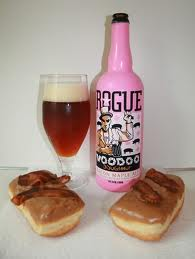
Every once in a while I can make a trip into a place like Chuck’s Hop Shop and not see anything in the under $10 range that I am in the mood for/haven’t had/want to try, and that is a dangerous thing. That means that I start looking at beers that are getting up there in prices, which means that I end up taking a risk on something that may or not be good. The Rogue Voodoo Donut Bacon Maple Ale was one of those risks (ed note: this was the beer released in 2012, the 2013 beer has bananas added to it).  The beer ran $13.59 for a 22 oz. bottle.

Here are the stats from the Rogue website:

13 Ingredients:

Malts: Briess Cherrywood Smoked Malt, Weyermann Beechwood Smoked Malt, House-smoked Hickory Malt, Great Western 2 Row, Munich, C15, C75 Malts

Speciality: Applewood-Smoked Bacon, Pure Maple Flavoring

Hops: Perle, Sterling

Yeast & Water: Pacman Yeast, Free Range Coastal Water


Specs:

14º PLATO

30 IBU

76 AA

30º Lovibond


At least the bottle is nice and I really could go for a bacon maple bar.

The beer pours golden brown in color, almost exactly maple syrup like. The nose presents itself with a very strong maple smell (You can smell it from 6 feet away), hints of smoke and malt – it smells like breakfast at a campfire. The beer starts off pleasantly with notes of maple but it is quickly overpowered by smoke in the middle (more of a campfire than smoked bacon) with hints of bacon (yes, you can actually taste the bacon in this), but the smoke overpowers just about every other flavor in the beer and just lingers well after you have taken a sip, like you have been chewing on a log that has been left in a fire. I really had high hopes for this beer since bacon and maple are two of my favorite flavors, but the smoke kills it and everything that you might want to drink afterwards. I kept going on the bottle, hoping that the smoke dissipated, but it did not and it made for a somewhat unpleasant experience.

I am willing to admit that I am not a huge fan of rauchbeer, but I can appreciate the subtle flavors that smoke can add to a beer, lifting it up to a different plain. Stay tuned to next Tuesday where I actually review a beer that does this. This beer did none of that, killing your palate almost immediately with the smoke. That, coupled with the high price tag made this one of the worst beers I have had in a long time.

That being said, Rogue’s Voodoo Donuts Bacon Maple Ale gets smoked with a ruined 1 burning ember out of 5.

EarthBox Update — September 22, 2013

by A.J. Coltrane

Previous post here.

21 pounds of produce today, a new single-day record. That brings us up over 180 pounds for the season, including 65 pounds of cucumbers and 70 pounds of tomatoes.

The wind was picking up as I was taking this picture and preparing to bring everything inside. It’s now raining really hard. It looks like I got outside (and back in the house)  just in time today.

092213 harvest

The Roma tomatoes seem to have hit their “timer”. Here’s a picture “before” the big pile above:

Continue reading “EarthBox Update — September 22, 2013”

Beer of the Week: Reuben’s Brews Roggenbier

By Iron Chef Leftovers

Until about a year ago, I had no idea what a Roggenbier even was, let alone what it really tasted like. Reuben’s changed all of that by putting Roggenbier on the menu and even making it one of the beers they initially bottled. The review is for the beer on tap, which clocks in at 5.3% ABV and 19 IBU. What is a Roggenbier you ask, well, the short version is a rye based hefeweizen. A much longer answer comes courtesy of the German Beer Institute:

Roggenbier is a medieval ale usually made from a grain bill of about half barley malt and equal portions of wheat and rye malts. Today, a Roggenbier may be either an ale or a lager. Modern renditions of the brew have about 5 to 5.5% alcohol by volume. Rye ales are mildly hopped, which allows the grain flavors to be dominant. Filtration appears to be optional in a rye ale and many, such as the Paulaner (depicted right) are “naturtrüb,” meaning naturally turbid. A yeast-turbid Roggenbier is more authentic, considering that the style had been around long before beer filtration was invented in 1878.

Being ancient brews, Roggenbiers can have a faint whiff of earthiness in the nose that is reminiscent of rye bread. The up-front sensation is one of mild fruitiness. There is a slight to extreme yeastiness and breadiness in the middle, and an almost smoky, spicy, faintly sour and very dry finish—clearly the effects of the rye malt. Effervescence ranges from medium to spritzy like a Hefeweizen. The body is substantial, almost reminiscent of a Bockbier. The brew has a pleasant, rich, off-white head when poured.

For the most part, Roggenbiers are tart, refeshing summer quaffing beers, a nice alternative to a Hefeweizen. They go extremely well with a succulent slice of barbequed roast pork.

untitled2Roggenbier pours dark amber in color with notes of rye, bananas, cloves and coriander on the nose. Slightly sweet when you first take a sip with notes of banana and wheat. The sweetness quickly drops off into light citrus and cloves before dropping the hammer with a rye finish = intense rye notes with hints of cinnamon with a dry mouth feel which lingers for a fairly short period of time before mellowing out and hanging around the palate with a background malt/rye/banana finish, noticeable well after you have taken a sip. For some strange reason, this beer seems like a liquid pretzel and that is a good thing. Incredibly well balanced and complex, you should try this beer if you have not done so already.

Roggenbier is a great alternative to a hefe or any other light beer if you are looking for something that isn’t terribly hoppy, is fairly low in alcohol and is refreshing, but still has a complex character.

Reuben’s Brews Roggenbier twists in with 4 Rolled Golds out of 5.

Beer of the Week: NW Peaks Tinkham Berliner Weisse

By Iron Chef Leftovers

I have a love/hate relationship with sour beers. When I am in the mood for one, I love them; otherwise, I really want nothing to do with them. They also tend to be very polarizing, people either love them or hate them, there is no middle ground. NW Peaks recently released a Berliner Weisse as part of their Mountainbeers series. What is a Berliner Weisse you ask, well, here is what NW Peaks had to say:


The name. The mountain. As close as its mountainBeer counterpart is to Steven’s pass, Tinkham Mtn is just as close to Snoqualmie pass. Again, just off the PCT, it’s a great place for a good, light summer excursion. The climb is ~ 1,000 feet of easy scrambling (NE route), or a more straight forward, albeit longer, boot pack (SE route). The summit offers great views of the ever popular summits peppering the Snoqualmie area and serves as part of the boundary that surrounds one of Seattle’s 2 major watersheds (the Cedar River watershed).

The Beer. The Berliner Weisse style is even lesser known than the dunkelweiss. Berliner Weisse is a very low ABV, cloudy, sour wheat beer traditionally brewed in Berlin. In many cases, it is served with fruit syrups, cutting some of the sourness with fruity sweetness. Our first sour beer at NW Peaks, we kept the Tinkham Berliner Weisse recipe simple using only Pilsner and Wheat Malts and Hallertau hops. With a slight fruitiness and a charmingly sour aroma, the beer has a light and refreshing body and a tart finish. A great introduction to sours, Tinkham is perfect for sipping on a spring evening or on top of a raspberry syrup/puree.

Malts: Pilsner and Wheat. Hops: Hallertau. ABV: ~2.75%


untitle8dThe beer pours pale yellow in color with notes of lemon and grain dominant on the nose and light sour notes interspersed (kind of reminded me of sour patch kids). Crisp and clean on the initial taste followed by notes of lemon and grain before transitioning into a slightly funky sour finish, not overpowering and pickle-like, but more subtle like a light citric acid. This beer was much easier to drink than most sours and the sour flavor are mild and balanced with the grain, with the mild sour finish being the best part – just enough to let you know this is a sour beer but not so much that you feel like you need to scrape your tongue afterwards. Definitely not a beer that everyone is going to love, but it is a good introduction to sour beers and it also pairs very well with a bit of fruit puree (I personally preferred the beer on its own).

A wonderful first attempt at a sour, NW Peaks Tinkham Berliner Weisse cuts through the blockade and drops in 4 airlifts out of 5.

Beer of the Week: Populuxe Founders Imperial IPA

By Iron Chef Leftovers

imagesCAAR87MMSince I decided to post 3 beer reviews a week, I came up with a rotation: the Friday and Sunday posts rotate between NW Peaks, Reuben’s and Populuxe since I have a major backlog from those 3 and the Wednesday post is always some other brewery. I plan on keeping that rotation for the near future until I can get caught up or at least somewhat caught up. Today is an exception though and it is because I wanted to get this information out there to all of our readers in time for you to actually try a beer.

So why break from the plan now? Well, I sampled a beer that was so extraordinary that everyone should run out and try it.

Populuxe recently hosted a party for their Founders Club and were kind enough to put out 3 new beers for us to sample. One of those beers was their Founders Imperial IPA. As you can guess, this was a big beer, coming in at 9%. The beer is supposed to be on tap at the brewery starting this Thursday for anyone to enjoy.

The beer pours deep orange in color with a major amount of hops on the nose and copious amounts of citrus and citrus peel. An incredible hop bomb that is front loaded with juicy citrus and just a touch of barely noticeable bitterness. The beer then moves into the realm of citrus peel and hops where great balance keeps the beer from becoming overly sweet or bitter but with an abundant hop character (citra were used) that would please any hop head. The finish is long, with more citrus and decent amount of bitter peel but not so much to be unpleasant. The alcohol was very well integrated and not noticeable on the beer and the beer has enough bitterness to let you know what you are drinking but enough balance that you get to enjoy its many layers of complexity.

I haven’t been this enamored with a beer since the Imperial Rye IPA from Reuben’s and I will go as far to say that this may well be one the 20 best beers I have ever had. I would put the Populuxe Imperial IPA up against just about any other Imperial IPA and I think it would come out on top.

Check the Populuxe FB Page on Thursday and if it is on tap, get down to the brewery and drink it. Just save some for me.

The Populuxe Founder’s Imperial IPA builds its case with a perfect 5 monuments out of 5.

We now return you to our regularly scheduled programming already in progress.

Your Sushi Impact

By Iron Chef Leftovers

When you are going to your local sushi joint, chances are you are doing something that is both bad for your health and bad for the environment. What and why? You might ask? Well, you may not realize this, but most of the fish used in sushi restaurants (even at the high end places – although this is starting to change) are the equivalent of factory farmed livestock. Here are some examples that I pulled off the menu from I Love Sushi in Seattle:

Atlantic salmon – raised in densely packed pens where they have to be fed antibiotics to prevent disease.

Shrimp – raised in stagnant pools of water in Asia and Latin America loaded with filth and diseases. Here is an example of how bad it is.

The same thing goes for most of your white fishes – sea bass, escolar, yellowtail, snapper, etc. There are very few farmed fish that are done in an environmentally responsible manner.

What about wild caught fish? Well, some are better choices than others. From the same menu:

Sea Eel – they are horribly overfished and the fisheries are on the verge of collapse.

Tuna – depending on the kind, it ranges from a good choice (locally pole caught albacore) to a lousy choice (critically endangered Bluefin tuna).

Sea Urchin – Depending on how and where it is harvested, it might be sustainable.

Clams/Scallops/Oysters/Geoduck – these are generally raised in heavily regulated beds and are an excellent choice for sushi. It doesn’t hurt that Washington has some of the best producers of these tasty critters in the world. If you are buying sushi here, there is a good chance that your bivalves are local.

Wild Salmon – a much better choice than the farmed stuff, especially if the fish is pole caught.

All of this came up from an article I read about Bluefin tuna recently in the Smithsonian magazine. (I highly recommend reading it). I am not saying don’t eat sushi; what I am saying is make informed choices.

The issue is a complex one and I am over-simplifying it here. If you want more information on good choices for eating fish, check out the Monterey Bay Aquarium’s Seafood Watch program or the Vancouver Aquarium’s Ocean Wise program. We have many sustainable sushi places in Seattle, most notably Mashiko – the chefs there are passionate about what they are serving and are happy to guide you through unfamiliar but tasty choices on their menu. Whole Foods no longer stocks fish on the Seafood Watch red list. The best thing that you can do is to ask where the fish you are eating is coming from – whether it is from a sushi place, a seafood restaurant, a fish monger or a supermarket. If the person selling the fish can’t tell you where it was from, if it is farmed or wild and how it was caught, you really should not buy it. Don’t be afraid to ask a place to carry more sustainable choices. In most cases, they are willing to do it because they don’t want to lose the business. If they aren’t willing to do it, go somewhere else that is.

There is much more information on this topic out there, so I will let you decided what your feelings are on the subject. I would recommend the following though to get you started (and I have all of these books if you want to borrow them from the Iron Chef Lending Library):

Four Fish by Paul Greenberg

The Story of Sushi by Trevor Corson

Tuna, A Love Story by Richard Ellis

The Most Important Fish in the Sea: Menhaden and America by H. Bruce Franklin

The Secret Life of Lobsters by Trevor Corson

And finally a video from a chef who gets it:

http://c.brightcove.com/services/viewer/federated_f8/1399191810
Oh, and in case you are skeptical and  you think that all of these books are written by academics who have never been on a boat, Trevor Corson worked as a professional lobsterman for several years and spent a number of years living in Japan. Greenberg, Ellis and Franklin are all avid sport fishermen and really know their subjects (I have had the pleasure of having long conversations will all 4 of these authors). I am trying to get the dialogue started and at least make people aware of their choices, and getting the information out there is the first step in the process.

EarthBox Update — September 15, 2013

by A.J. Coltrane

Previous post here.

It feels to me like fall is coming, and the plants agree. The lemon cucumbers will need to be pulled soon. The regular cucumbers aren’t far behind. More and more fruits are dropping off of the plants, especially when the hard rains come, so today we  pulled all of the tomatoes that looked like they were at least 95% of the way there — I’m not sure that some of the varieties are intended to be uniformly red all the way to the stem, anyway.

(All pictures taken during a heavy rain.)

Today’s harvest. The Brandywines in the back right average about 5″ in diameter and 1-1/4 pounds each. It’s basically six tomatoes weighing 8 pounds total:

harvest 091513

At the start of the year the cucumbers were straight, dark green, and relatively round on each end. Then we started seeing more twisty ones with bulbous ends, and straight ones with tapered stem ends. Now they’re coming in much lighter in color and misshapen. The first little one to rot on the vine happened this week. Note the two different colors here, and the moldy leaves — I’m guessing this is how the cucumbers tell you they’re about done:

Continue reading “EarthBox Update — September 15, 2013”

Beer of the Week: Populuxe Wheat IPA

By Iron Chef Leftovers

imagesCAAR87MMOne of the most amazing things about Populuxe is, that despite their tiny brew capacity, they manage to put out a wide variety of beers. The generally have around 8 taps on at any given point and still occasionally manage to sneak in new beers once in a while.

They recently released their Wheat IPA and, of course, I had to give it a shot.

The beer pours hazy orange in color and the nose permeates with citrus and lemon with notes of green hops and hints of wheat. The beer has a very interesting flavor profile; lemons dominate the beer at the beginning win a slightly tart way before moving into a completely different set of flavors. Grains appear next and dominate the middle of the beer in a complete change from the citrus heavy beginning, providing a nice change of pace. The beer finishes with just a hint of tannic hops that lingers with a light bitterness mixed in and what tastes like lit could be a small amount of rye at the very end of the beer, probably from the combination of wheat and hops.

Overall this beer is well integrated and refreshing; perfect for a warm summer day, plenty of hops and character to keep it interesting, but light enough that you could easily find yourself going back for more.

Populuxe Wheat IPA sings in at 4 amber waves of grain out of 5.

Beer of the Week: Reuben’s Brews Nitro Roasted Rye PA

By Iron Chef Leftovers

untitled2Sometime last year, I reviewed the Reuben’s’ Roasted Rye PA (short version, I liked it a lot, long version is here). Like everything else in my notebook, I never bothered to getting around to posting a review of the nitro version of the Roasted Rye, so here it goes:

The beer pours brown with hints of orange hue, almost looking like iced tea, and a short tan head. Light notes of rye and toast appear on the nose with a faint hint of hops hiding in the background. When you take a sip, a quick hit of hop bitterness gives way to a long, heady rye drag that seems to last forever before finally yielding to a burst of citrus and citrus peel on the very end. This beer has a creamy mouth feel from being on nitro. Some of the more interesting flavors from the regular version are subdued, but the rye is really the star of this beer; not quite the heavy rye bread flavor of the Imperial Rye PA, but a really pleasant rye/grain beer that feels the need to be its own beer.

Reuben’s Nitro Roasted Rye PA smokes it with a solid 4 kilns out of 5.