Tulle

by A.J. Coltrane

Last year we had no idea that those white moths lay eggs on the bok choi and brussels sprouts (both members of the cabbage family). The eggs turn into voracious caterpillars.

Which is very uncool.

So for this year I purchased tulle. (Link here. I paid $46 at the time. It now says $54.96. There may be a better deal out there.)

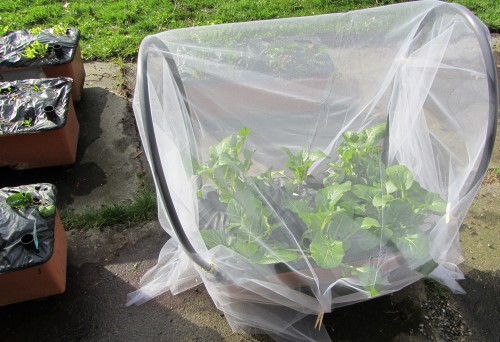
I used the hoop house idea again, but this time I made the hoops larger. I cut the dowels to two at 10″ and two at 14″, rather than all four at 12″. The dowels sit a little more even in the EarthBox that way. Below, there are clamps on the corners and clothespins on all four sides – the clothespins keep it tidier and add weight to the bottom of the cover.

140331 tulle

Pictured is the Pak Choi that was started from transplants on October 22. It’s come a long way.

Along about May I’m going to try basically the same setup, but with shade cloth for the lettuces/parsley/cilantro/dill/ anything else that bolts.

If you’re one of my neighbors and want some tulle, let me know. 50 yards is a lot of fabric.

The Next Big Thing in Chocolate

By Iron Chef Leftovers

If you like chocolate, you should really pay attention to where your chocolate is being sourced. Most of it is poor quality, purchased in bulk and is produced with unethical labor practices. Fortunately, there has been an alternative that is catching on (finally) in the chocolate world called bean-to-bar. It isn’t a new concept, but one that is finally becoming more mainstream. Here is how it works in an overly simplistic way:

A chocolate company decides it wants to make a bar with beans sourced from say Ecuador. The chocolate maker goes to Ecuador and talks to farmers and selects some that they would like to work with. The chocolate maker and the farmers collaborate on producing the best quality crop (over quantity) they can produce. The chocolate maker purchases the higher quality product at a significantly higher price than the going bulk rate (as much as 8 times the going bulk rate for the best quality beans) and makes their bars from that cacao.

Basically bean-to-bar is a direct trade between the farmer and the chocolate maker. It has become hugely popular in the U.S. thanks to Theo Chocolates, but there are now dozens of chocolate makers doing the same thing, many of them very small producers. One of my favorites is Mindo out of Dexter, Michigan. The owners spend part of their year working directly with the farmers in Ecuador (all of their chocolate is sourced from there), so they have a truly personal relationship with the process.

The trend seems to be catching on elsewhere, as evidenced by a recent article in the UK paper The Telegraph:

No longer is it sufficient for a smart bar to proclaim – as Green & Black’s do – that its contents are merely organic. Nor will it raise much interest among the chocolati to declare that your bar is artisanal or hand-wrapped, or that the cocoa within comes from a single estate. Worthy though all these considerations are, they are being swept aside by the latest trend in chocolate: bean to bar.

Let there be no mistake. Organic is good, and compared to the sugary slop mass-produced by Cadbury and Hershey, Green & Black’s (owned by the multinational Mondelez) is decent stuff.

Single origin bars, whose beans come from a particular location, are now becoming hugely popular, and supermarkets are making their own. So long as the farmers producing the beans are fairly rewarded and decent labour standards are maintained in production, there is nothing sinister about this either. But as it becomes easier to buy “good” chocolate, so the search for the best becomes more refined. True connoisseurs now like to pursue products that are not concocted from bought-in-bulk chocolate, but in which the whole process, from the grinding of the bean to the moulding of the bar, has occurred in one spot, under the care of one group of people: “bean-to-bar” chocolate.

I have had many conversations with small chocolate producers over the years and they all believe their biggest challenge is trying to convince consumers that paying $6 for a 2 oz. bar of chocolate is something they should be doing. Their product is infinitely better than the mass produced crap, but the price point is a tough sell. How tough? Well take a look at what I found last year when looking at dark chocolate prices:

Type Producer Cost Per Bar Bar Size Cost Per Pound
Mass Produced Hershey’s $1.19 1.55 oz $12.28
Fair Trade/Organic Endangered Species $3.25 3.00 oz $17.33
Bean to Bar Mindo $2.75 1.05 oz $41.90
Bean to Bar Theo $4.00 3.00 oz $21.33
Farmer Owned Kallari $5.99 2.46 oz $38.96


Theo is large for an artisanal producer and gains a great deal in economy of scale when shipping cacao from its source back to the US. The transportation cost is actually the biggest cost to a chocolate maker and even with the scale, Theo costs twice what Hershey’s does.  There are other advantages that offset price – bean-to-bar producers are making chocolate that is infinitely better tasting (better taste means you eat less in one sitting) and they are improving the quality of life for the farmers that they work with. If you doubt me, come with me to the NW Chocolate Festival in September. I will introduce you to the people who are on the ground working directly with the farmers. They tell their story much better than I ever could.

If you really want to be on the cutting edge of chocolate, purchase it from a Farmer Owned Co-op, like Kallari or Grenada Chocolate Company. The farmers control the entire process from the bean to bar and all of the profits are invested directly back into the local communities where cacao is grown.
Beer of the Week: Reuben’s Randall Red

By Iron Chef Leftovers

untitled2Randalls are a fun way to infuse flavors into beer without having to brew an entire batch of beer with those ingredients. It means you can use fun stuff like fruit or obscure hops to get some additional flavor in the beer without being intimidating and making it a cask beer. Reuben’s has started its randall project thanks to their new employee, Thor (yep, that is his name), who comes to them from Fremont Brewing where he was responsible for their randalls. One of the first randalls that Reuben’s had was a simple one – their Red with centennial hops.

The beer pours deep ruby in color with a creamy, light tan head with light amounts of hops and grain on the nose. The beer has a light sweetness at the front, joined by a mild fruitiness to start before moving into pleasant grain middle and finishing with a nice light bitterness/hop character that lingers with the grain in a fairly long finish. Nicely layered and a nice progression of flavors, this beer is balanced and the subtleties are not overpowered by hops.

Reuben’s Randall Red storms into Valhalla swinging 4 Mjolnirs out of 5.

Beer of the Week: Machine House Brewery Imperial Oatmeal Stout

By Iron Chef Leftovers

unti50tledI really do love oatmeal stouts, especially in the winter. The beer is hearty and warming and really just fits the bill with what I am looking for in those situations. One thing that I can say that I have never tried is a cask version of an oatmeal stout, but Machine House Brewing took care of that for me.

The beer pour jet black in color with deep chocolate and espresso notes dominating the nose, coupled with secondary notes of vanilla and malt. The beer has an interesting first sip – not as heavy as I was expecting with mild coffee notes appearing first before switching to a distinctive oat profile. I wasn’t sure of what to make of this at first – this was a very pronounced flavor, similar to uncooked rolled oats. The beer finishes long with hints of chocolate and dried cherries and just a hint of vanilla, coupled with the oat profile. That is when I got it, the oats blended with the deeper flavors to produce a rich profile with a slightly gritty mouth feel making the beer deep and complex but at the same time balanced and easy drinking. I would have liked more coffee/chocolate notes from the beer, but it was a cask and the amount of depth that this one contained made me want to go back for more.

Machine House Imperial Oatmeal Stout races in with 4 thoroughbreds out of 5.

Beer of the Week: NW Peaks Stuart Stout

By Iron Chef Leftovers

I believe in the 150+ beer reviews that I have written, I think that I have only once reviewed a beer multiple times, Elysian’s Dark O’the Moon. Well, I am doing it again, this time with NW Peaks Stuart Stout. The beer only gets brewed once a year, so I felt it was a good time to review it again, especially since there were probably minor tweaks to the recipe.

From the NW Peaks website:

Since Mt Stuart is one of the most noticeable, bold, non-volcanic peaks in WA we tried to make the beer bearing its name similar. Stuart is medium-full bodied stout that is roast forward. The end result is a rich, deeply roasty interpretation of the style that starts smooth and ends with a slight lingering bitterness from the roasted barley . A fine beer to drink anytime, but best enjoyed in front of a fire on a cold rainy winter evening.


untitle8dThe beer pours jet black in color with a tannish-brown head and shows significant amounts of chocolate and coffee on the nose with backing hints of caramel, vanilla and malt supporting. The beer states out with notes of caramelized sugar before quickly moving into deep roasted flavors of dark chocolate and dark roasted coffee before beginning its finish with a very pleasant bitterness (think black coffee) with notes of vanilla and caramel coupled with a very long and mildly boozy dark chocolate finale that keeps lingering in a pleasant way. Layered and complex and creamy and unctuous, this beer is very drinkable and works well either with food or on its own.

NW Peaks Stuart Stout does it again with a solid 4 self-affirmations out of 5.

Beer of the Week: Machine House Brewery Gold

By Iron Chef Leftovers

Machine House brewing in the Georgetown neighborhood of Seattle is fairly new to the scene and very unique among Washington breweries – they produce all English style beers and all of them are served either on a beer engine or on cask. This means that you are going to get beer that is warmer, less hoppy, less fizzy and low alcohol – a nice change of pace from the high ABV, high IBU beers that you typically find around Seattle. As an added benefit, their tasting room is interesting, located in an old warehouse space, just across the street from Full Throttle Bottles.

From the Machine House website:

Gold – 4.5% ABV

A pale-straw coloured ale, again with English hops in the ascendancy. Reasonably assertive bitterness balances a slightly sweet malty finish.

unti50tledThe beer pours golden in color with an off-white head and shows strong notes of English yeast, grain and dried fruit on the nose. The beer drinks slightly bitter on the first sip with a tea-like quality (from the hops) followed by a nice yeast and grain middle and finishing clean with touches of dried apricot and peach and just a minimal amount of hops. The beer is slightly sweet, but not cloyingly so and well-balanced and easy drinking. It is a nice change of pace from the heavier beers that I had been drinking and a great experience to have a beer you don’t readily find in Seattle.

Machine House Gold strikes it rich with 3 prospectors out of 5.

No-Fuss Roasted Potatoes

By Iron Chef Leftovers

Potatoes are not one of my favorite things to cook or eat since they act as more of a flavor vehicle for what they are cooked in rather than having a great deal of inherent flavor on their own. Mrs. Iron Chef however loves them so I do occasionally make them, but I am constantly looking for new ways to cook them.  I came across an easy, no-fuss, one pot recipe on America’s Test Kitchen that I figured was worth a shot. Basically it calls for braising the potatoes first and then searing them, but it didn’t involve even taking them out of the pot, and only a couple of ingredients, so it really doesn’t get too much easier than this.

The Software

1 lb. Red Potatoes, roughly 1 to 1 ½ inches in diameter, washed and halved

1 cup water

3 cloves of garlic, peeled

2 teaspoons of salt

3 tablespoons of unsalted butter, in 6 pieces

1 tablespoon, fresh squeezed lemon juice


The Recipe

Arrange the potatoes in the bottom of a skillet (don’t worry about over-crowding, it won’t matter, I used a 10 inch, straight sided skillet) so that all of the cut surfaces are in contact with the surface of the pan. Add the water (it should come up about half way on the potatoes, add more water if necessary), butter, salt and garlic to the pan. Turn burner on high and heat the skillet until the water comes to a boil. Reduce heat to medium and cover for about 15 minutes. Check if the potatoes are cooked after 15 minutes (a knife inserted should pull out easily), if they are not, cover until they are. Once the potatoes are done, remove the lid and remove the garlic to a bowl. Increase heat to medium high and continue cooking until the bottoms of the potatoes are golden brown – all of the water will evaporate leaving just the butter (this should take 10-15 minutes depending on your stove). While this is happening, mince the garlic and combine with lemon juice. Once the potatoes are done, remove from heat and toss in garlic and lemon. Season with salt and pepper to taste and serve.


Notes

I would recommend using a non-stick skillet for this process to keep the potatoes from sticking to the bottom of the pan. The recipe scales easily, just put enough potatoes to fit in the pan and add enough water to come up half way on the potatoes. You probably won’t need to add more butter unless you use something larger than a 12 inch skillet. Fresh rosemary, sage, thyme or oregano would work well with this recipe. Just mince them and add them at the end with the garlic.

Beer of the Week: Populuxe Burke-Gillman Smoked Tea Bitter Cask

By Iron Chef Leftovers

imagesCAAR87MMYes, I figured that since I posted the Sorachi Ace Bitter, it was time to post the Smoked Tea Bitter review. This cask version used a scant one ounce of Chinese smoked black tea in the cask, something that is probably not a traditional cask ingredient, but definitely something that piqued my interest.

The beer pours the color of iced tea with significant notes of smoke on the nose with backing notes of dried fruit and malt. The beer starts out lightly tannic with hints of malt and hops before crossing into deeper tea notes before the smoke component shows up. The smoke starts strong with forest fire qualities (in a good way) before mellowing out into a pleasant campfire background without ever really disappearing. The beer finishes with a distinct black tea character showing light tannins and mild notes of dried fruit with notes of smoke and hints of caramel. The beer drinks like a light rauch beer without the heavy malt and smoke qualities, making it easier to drink. It is surprisingly balanced and deep without being ashtray like or losing the qualities of the beer in the process, and I found myself wanting to go back for another pint. It is definitely not a beer that you would enjoy if you don’t like smoked beers, but if you are looking for something very different, this would beer to try.

Populuxe Burke-Gillman Smoked Tea Bitter Cask races in with 4 mountain bikes out of 5.

Beer of the Week: Populuxe Burke-Gillman Bitter with Sorachi Ace Cask

By Iron Chef Leftovers

imagesCAAR87MMI have had some great cask beers, some good cask beers and some mediocre cask beers. The style of the beer almost doesn’t matter, some of the best casks I have had over the last couple of years have been non-traditional cask styles or casks with really non-traditional ingredients.  Populuxe has been on a roll with putting out their Burke-Gillman Bitter in cask form – a traditional beer done in a few non-traditional ways. (I have to get around to posting the Smoked Tea Bitter review). I usually try to post my reviews in chronological order, especially for one-off beers since there is no hurry to go out and drink them. This is an exception – the latest version of the Burke-Gillman Bitter, dry hopped with Sorachi Ace and Horizon hops will be available at the Cask Festival on Saturday, March 22nd and this is one that is worth seeking out there.

The beer pours cloudy brown in color with nice notes of caramel and orange with just a hint of grassy note and very light roasted notes. For a cask beer, this one has big, complex flavors. The beer starts out with a medium caramel profile with hints of roast before the hops start to kick in. The Sorachi brings a very light herbaciousness to the party and the Horizon brings a nice orange kick and just a touch of bitterness. These notes intertwine with the caramel and remain throughout the beer all the way to the finish making for an almost hard candy like profile as they are joined with just a touch of sweetness from the malt. The finish is very long for a cask beer and is incredibly pleasant and smooth. The beer drinks extremely easily and at less than 5% ABV, it goes down way too easily, leading you to want pint after pint.

Populuxe usually does a great job with their casks, but this one may be the best one they have ever done.

Populuxe Burke-Gillman Bitter with Sorachi Ace Cask lays down its cards with a perfect 5 Royal Flushes out of 5.

Get this beer early at the Cask Festival – it is worth the experience.

Beer of the Week: Elliot Bay Brewing Paint It Black Lager

By Iron Chef Leftovers

imagesCADDG23NIn looking through my beer notes, I realized that I had quite a run of dark beers in December. I guess I was either just drinking to the season or drinking what was new and interesting. Either way, a December trip to Elliot Bay Brewing yielded a beer which I had not seen before – the Paint It Black Lager. Black Lagers are a beer style that you don’t see too much these days so that appealed to me and it figured that I had to give a shot to a beer that was named after my favorite Rolling Stones song. Unfortunately, I couldn’t find any details about the beer on the interwebs.

The beer pours jet black with a creamy brown head. Roasted malt dominates the beer with hints of grain and mild hops supporting on the nose. The beer starts out on the palate strong with a slightly boozy vanilla, followed quickly by a pleasant milk chocolate and grain component, before moving into light coffee and sweet roasted malt. The finish is long and pleasant with lingering notes of coffee and chocolate supported by sweet malt and just the faintest hint of hops. The beer is deep and layered, and a nice change of pace if you are looking for something dark without venturing into the world of stouts or porters.

Elliot Bay Brewing’s Paint It Black Lager strums in with 4 Red Doors out of 5.