Beer of the Week: Laughing Dog Sneaky Pete Imperial IPA

By Iron Chef Leftovers

If you live in the Northwest, you have probably seen Laughing Dog’s beers in most places, including your local megamart, and just not bothered with them. If you are doing that, then you are definitely missing out on one of the better breweries in the Northwest and one that, despite wide distribution, really seems to fly under the radar. They make some killer IPA’s and a few years back, they started putting out an Imperial IPA, available in 12 oz. bottles for around $4. Knowing that I love their other beers, it was time to give the imperial a shot, especially since I found out that this beer was finished with honey.

From the Laughing Dog website:

 Sneaky Pete is a blend of five hop types: Simcoe, Glacier, Centennial, Vanguard and Hallertauer, with Simcoe playing the dominate role at 30%. In addition, three separate malts were used: Honey Malt, Rye Malt, and Munich Malt. The brew has a copious aroma of white grapefruit, citrus overtones, a complex rich middle and long flavors in the finish; a real beauty. Finished with wild clover honey. 89 IBU’s, 10% ABV

sneaky-pete-ipaThe beer pours deep amber red in color with a tan head. Notes of honey, caramel and hops dominate the nose with floral notes and light hints of toffee in the background. The beer starts off fairly mild on the palate with light malt sweetness before quickly moving into what you would expect from an Imperial IPA – strong notes of citrus and grapefruit with hints of resin first make an appearance before yielding to a significant pleasant bitterness that fades into a spectacular finally where the hop character is joined by a touch of sweetness and a touch of caramel that lingers and intermingles with the citrus bitterness, creating a sweet and bitter dynamic.  The balance on this beer is superb and the layering complex with the added bonus of the 10% alcohol being completely unnoticeable, making this beer surprisingly easy to drink. My biggest surprise with this beer is that they honey adds a noticeable depth and very light earthiness and manages to not be overpowered by the bold hop flavor in this beer.

Laughing Dog Sneaky Pete grabs its leash and takes you out for a walk with 5 big dogs out of 5.

Beer of the Week: NW Peaks Esmeralda Ale

By Iron Chef Leftovers

untitle8dSorry for the delay in posting some beer reviews. Seattle Beer Week and a few personal issues kept me from keeping up with the posting. I am back now, so you get to “enjoy” my reviews again.

Having been a member of the MountainBeer club at NW Peaks for over a year now, we are starting to see some of the beers make a return appearance. Since they are only brewed once a year, they warrant inclusion in my beer notes as well as posting here, just so I can compare how the beers and my tastes changed year over year. I posted a review of the Esmeralda Ale a mere 9 months ago and that was actually 5 months after I drank the beer. This time I am posting a review of it just 2 weeks after I drank the 2014 version. I am getting better at timely reviews.

From the NW Peaks Website:

 The name. The mountain. Esmeralda is located in the Teanaway River drainage just S of Ingalls peak and SW of Mt Stuart – one of our favorite areas. It’s on the other side of the Teanaway River from its beastly neighbors and is a much easier approach/climb than that of it’s neighbors. The “class 2″ trek to the summit offers some great views of the massive Mt Stuart and the Stuart range and is part of a great loop for a day hike.

The story of two experiences. Because of its popularity from past renditions, we bring Esmeralda Ale back for another late winter mountainBeer. Of course it is always fun (or not) to remember the comedy of errors that was our first batch brewed on our current system (Esmeralda Ale), while now we have everything dialed in.

The Beer. Esmeralda is one of our ‘adjunct’ beers for March. The adjuncts in Esmeralda are corn and molasses that create a unique character. The corn provides a nice sweetness and smoothness and complements the molasses notes. Esmeralda was fermented with an English ale yeast adding a smooth fruity flavor on top. With very little few hop notes, the slight grain sweetness and dark sugar properties are uniquely featured.

Malts: ESB, munich, corn, special B, biscuit, carafa 2. Hops: Apollo and Goldings. Fermented with British Ale yeast. OG/TG 1.058/1.016 ~5.5% ABV

The beer pours light mahogany brown in color with a thin tan head. The beer has a significant up front nose of corn and grain with hints of spice and grass and just a touch of bread. It starts out on the palate with a slight grain and corn sweetness before bringing in a very light hop bitterness that stays until the end of the beer, when it couples with a pleasant note of corn cakes, molasses spice and an almost pilsner maltiness that linger in a crisp, long fade. This is a full-bodied beer and different from almost anything out there, this beer brings hints of fresh corn to the party in a well-balanced and easy drinking way.

NW Peaks Esmeralda Ale travels down the yellow brick road with 4 flying monkeys out of 5.

Container Garden Update — May 16, 2014

by A.J. Coltrane

Previous post here.

The peppers and basil were planted in the EarthBoxes last night. If it threatens to get much under 50 degrees the basil will get rolled into the garage. (Note that the boxes now have casters — we bought them when EarthBox had a Valentine’s Day promotion. Money well spent.)

An overview picture:

140516 overview

Far left:  Four boxes of tomatoes (2 plants in each box). Tomatillos in the back box (2 plants)

2nd row from left:  Front box – Basil (6 plants). Back box – Peppers (6 King of the North)

3rd row:  Front box – 6 pepper plants (hot peppers nearest the camera). Back box – 6 Brussels Sprouts in a tulle hoop house.

Right row:  Front box – 6 pepper plants (hot peppers nearest the camera). Back box – 4 cucumber plants. Trellis – 2 zucchini.

Far right container:  Shallots, Arugula, Dill, Radicchio.

Compared to last year it came together in a fairly fast and organized way. With a little deduction the containers mostly arranged themselves. Many of last years’ issues had to do with attempting to mix plants varieties within the boxes — this year it’s all “mono-boxes”. We also tried to make sure that all of the fill tubes will be easy to access. (The tubes are arranged in what amounts to two rows, which should help minimize any wasted watering motion.)

In the front yard, the peas are now doing this:

140516 pea pods

There are maybe two or three dozen pea pods on the vines now. Unfortunately, they’re doing this too:

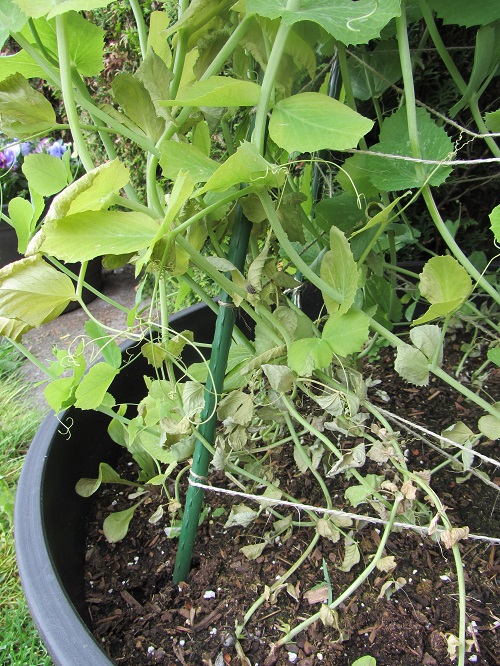
140516 peas bottom

The leaves on the bottom have withered, and the leaves to to left higher up have turned yellow. I *think* it’s root rot, which is supposed to be caused by poor drainage/too much water. I think it’s interesting that the peas made it through a rainy February/March/April and chose now to crap out. If I’ve correctly identified the root rot then it’s now a race to see how many peas we get before the plants collapse.

Which is… fine, I guess. Pea enation virus would have killed them before too long anyway. Now we’ll be able to use the planter for something else.

Final note:  So far this year we’ve gotten 11.3 pounds of mostly leafy greens out of the containers. At this time last year we’d gotten 1.3 pounds. Starting earlier seems to have helped.

Squirrel!

By Iron Chef Leftovers

Those who love me know of my man-crush on Alton Brown. Not only is he responsible igniting my interest in the science of food, he made the single best cooking show ever with Good Eats. I had the pleasure of meeting him several times over the years and he is a genuinely sincere and funny guy.

AB recently launched a web series that is a short bunch of how-to videos, like how to hard cook an egg in an oven (really useful if you need to cook a couple dozen eggs at once). His latest is how to make cat-poo flavored dog treats. I will admit, I am intrigued and am considering making them to try them out on friends’ dogs. The video is below and the link to the recipe is here. The bonus is that he shoots the short with his own dog, Sparky, guest-starring and calls the cat box the “stinky cheese shop.”

The First “Warm” Vegetables Get Planted — May 11, 2014

by A.J. Coltrane

Previous post (complete plant list) here.

We decided it’s now warm enough to put out the tomatoes and tomatillos. They joined the Brussels sprouts, cucumbers, and zucchini, already in progress:

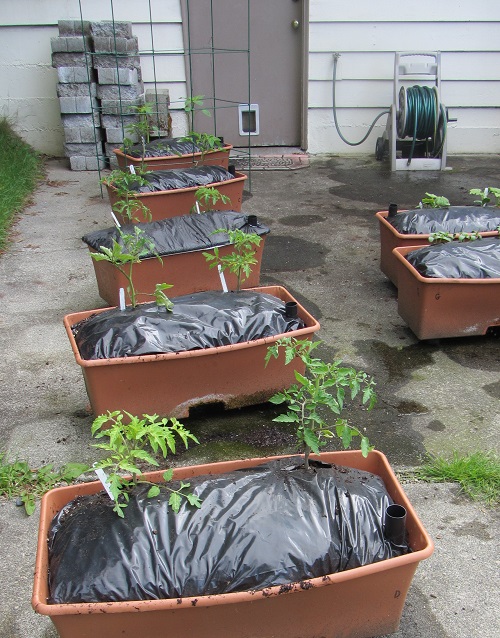
140511 tomato and tomatillo

The picture is taken from slightly south (left) of the vantage point of the late-afternoon sun. The two boxes off to the right are the cucumbers and zucchini. Everything will get a trellis or cage soon. We left more room this year (for hopefully less wading through the tomato jungle), and we tried to put more emphasis on eventual size when laying out the tomatoes. Last year it was just “is it determinate or indeterminate and how long is the maturity”, followed by a big tomato wresting match.

Foreground to background, and left to right:

Mountain Princess (D, 68 days, 4′), Taxi (D, 65 days, 2′)

Roma (D, 75 days, 4-6′), Oregon Spring (D, 60 days, 4-5′)

Black Krim (I, 75 days, 4-7′), Tigerella (I, 65 days, 4′)

Sungold (I, 65 days, 10′), Glacier (D, 56 days, 4′) (The Glacier will hopefully be completely done before the Sungold gets too crazy big. Last year the Sungold got to around 8-9′, then flopped over the 6′ cage.)

Tomatillo “De Mipa” (60 days), Tomatillo “Mexican Strain” (65 days)

The shorter plants are all on the south sides of the boxes. As a bonus, all of the short-season determinates are in the two foreground boxes. In theory those boxes should be available late-season for planting something else.

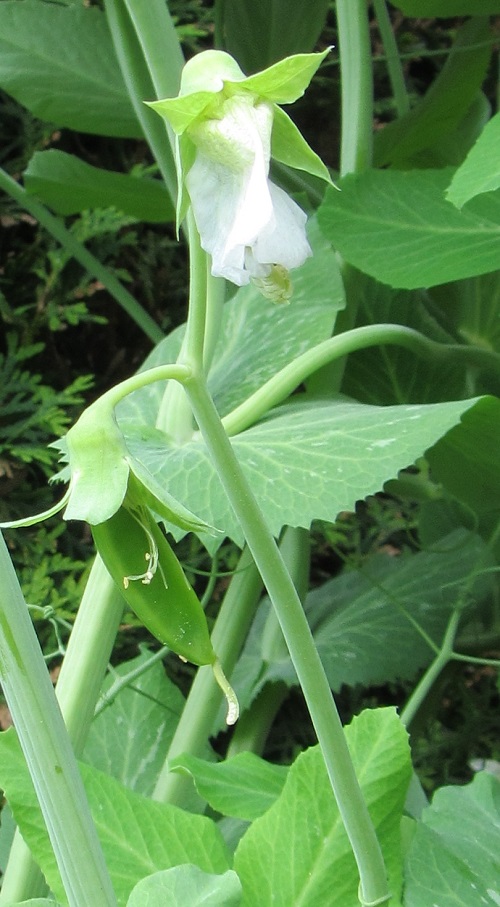
The peas are blooming. It seems like forever since we planted them. [Checks notes]  They were started indoors on February 5 and transplanted outside on February 16. They’re well beyond their listed 58 day maturity. I think in the future they’ll do better on the back patio. February and March front-yard sun isn’t all that awesome.

140511 peas

The basil and peppers are still coming in at night. It’ll be maybe another week for the peppers and towards the end of the month for the basil.

Random question/observation:  Why do most people spell “tomatoes” with an “e”, but the plural of tomatillo lacks an “e”(?)

(And yeah, I know “tomatoes” can be spelled without the “e”, but I basically never see it.) Odd.

Beer of the Week: Reuben’s Cream Ale Randall with Belma Hops

By Iron Chef Leftovers

untitled2A few weeks back I posted about the Reuben’s Roggenbier cask with Belma and its strawberries and banana qualities. Well, about a month later, Reuben’s came up with another Belma based cask, this time with using their Cream Ale as the base, going for a strawberries and cream profile.

The beer pours pale golden in color with light notes of cream, yeast, grain and strawberries on the nose. The beer starts off crisp with a pleasant hit of grain before moving into light fruit and jam, with notes of mild strawberry and sweet hints reminding me of a nice strawberry jam, before fading out into a very crisp and creamy finish. There is just the slightest note of grapefruit on the finish as you get near the end of the beer, making for an even more interesting end of the pint. The beer is not going to present big flavors, it is a cream ale after all, but it has plenty of balance and depth and is very easy drinking and it hits the mark for exactly what they were trying to do.

Reuben’s Cream Ale Randall with Belma Hops hits the mark with 3 William Tell’s out of 5.

Beer of the Week: Stoup T2R Haymaker III IPA

By Iron Chef Leftovers

Back a few months ago, a bunch of breweries got together and decided to each brew an Imperial IPA and then take them on the road. Most were good, a few were great and a couple, well, let’s just say that I won’t be drinking them again. Stoup was one of the breweries that participated in the Road Show with their T2R Haymaker III IPA (say that three times fast).

From the Stoup Website:

ABV: 10.5 IBU: 90 SRM: 6

Hops: Lots of “C” hops (Chinook, Centennial, Cascade, Columbus and some Simcoe for good measure).

Malt bill: Pale, Pils, cara Pils, C15 caramel and a little kettle sugar.

Given our love of science, it should be no surprise that we named our first-ever triple IPA after T2R, a class of bitter receptors on your tongue. We had a little fun with the hopping procedures, Mill hops, mash hops, kettle hops, hop bursting, hop imploding, hop exploding, hop back, dry hops, hop missiles and rockets. We slept on hop pillows the night before the brew. We prayed to the hop gods and even the hop devil, just to cover our bases! Ultimately, we decided to go for balance in the beer. You can put some T2R on your T2Rs at the Stoup tap room and a few select events and locales around town.

untitlasedThe beer pours golden orange in color with a fizzy white head. Strong notes of citrus and candied fruit peel dominate the nose with hints of grain and minimal floral notes showing. The beer starts off slightly sweet before quickly moving into a light bitterness coupled with plenty of citrus and burnt citrus peel. The finish is a touch hot with strong bitter hop and bitter citrus components which linger pleasantly. The alcohol burn, while present, dissipates quickly and enhances the hop bitterness, and completely disappears as you get further into the beer. This is a big and flavorful beer with many complex flavors but it also drinks easily and well balanced, assuming that you love hops.

Stoup  T2R Haymaker III IPA delivers the knockout punch with 4 body blows out of 5.

Beer of the Week: Goose Island IPA

By Iron Chef Leftovers

Back in the day before AB-Inbev bought Goose Island, they made some pretty great beers. They still do with their barrel aged and vintage beer line, but there has definitely been a decline in the quality of their regular line of beers – so much so that they are in the ‘just another brewery’ vein. I rarely find myself buying anything from their regular line these days. It is readily available though if you want to drink it. Recently, Annie S. gave me a few bottles of Goose Island stuff, so I figured it was time to give the IPA a shot and see how they are drinking these days.

From the Goose Island website:

Brewer’s Notes: Our India Pale Ale recalls a time when ales shipped from England to India were highly hopped to preserve their distinct taste during the long journey. The result is a hop lover’s dream with a fruity aroma, set off by a dry malt middle, and long hop finish.

Recipe Information:

Style: English Style India Pale Ale Alcohol by Volume: 5.9%

International Bitterness Units: 55

Color: Bourbon

Hops: Pilgrim, Styrian Golding, Cascade, Centennial

Malts: Pale

Serving Suggestions:

Preferred Glass: Thistle

Food Pairings: Curries, Chicken, Pork Cheese Pairings: Blue, Aged Gouda

Cellaring Notes: Enjoy within 180 days

ipa_full_beerpageThe beer pours orange in color with a light tan/off-white head. Strong amounts of citrus and hops appear on the nose with light notes of citrus peel and grain supporting. The beer starts off on the palate with hints of flora citrus before moving into lightly bitter citrus peel with gradually building hop bitterness before finally finishing pleasantly mildly bitter with notes of orange peel and citrus fruit. The finish is short and to the point making this a fairly easy beer to drink. As with the British style IPAs, the beer is not overly hoppy (but maybe a touch too citrus forward) and is a good beer to introduce someone to an IPA without completely overwhelming them with a hop bomb.

Goose Island IPA flies in formation with a solid 3 Snow Geese out of 5.

The 2014 Plant List

by A.J. Coltrane

We’ll start the “2014 season” with this post.

The 2014 Seattle Tilth Plant Sale Haul:

[Complete list of vegetables at the sale, PDF. The descriptions are from the PDF, with my comments in brackets. There may be some funky formatting below, but then, the PDF features a *lot* of funky formatting.]

Brussels Sprouts – We purchased the Brussels Sprouts at a nursery last year and I didn’t note the variety. This year we got them at the Tilth sale. The EarthBox directions call for six total plants in one box. We have about double that. We’ll see how it goes, though last year it went fine (if cramped) with four Brussels Sprouts in what would normally be the space for one plant. In any event, I grabbed too many by accident and we have a few extras if you’re a neighbor. Note that the white cabbage moths are already out and about, so the ones that we planted yesterday are covered with tulle to help prevent damage:

Catskill (Qty, about 5 or 6)
90 days. Open pollinated. Selection from a private stock of Long Island Improved, a treasured American heirloom.
Produces very high yields of 2″ diameter round green Brussels sprouts. This variety has strong, stout stalks and closelyspaced small sprouts. Easy to pick. Excellent freezing variety. Bred by Arthur White and Joseph Harris Company in New York and released in 1941.

Roodnerf (Qty 6)
100 days. Open pollinated. There are few open pollinated Brussels sprouts left to grow that yield great sprouts, but this is one of them! Cold hardy and good for letting winter over. [We’ll see if one variety does better than the other. This one is recommended in the book “Food Grown Right, In Your Backyard”.]

Cucumbers – The same variety as last year. No reason to mess with what worked. The cucumbers were planted outside on May 5th last year. (Gotta love those notes!) They don’t much like being transplanted, so maybe we’ll do that today/tonight/tomorrow depending upon the weather:

Marketmore 76 (Qty 4)
63 days. Open pollinated. In the Marketmore series, ‘Marketmore 76’ is very popular with organic growers due to its high level of disease resistance. This dark green slicing variety produces abundant, high quality, uniform fruits about 8 inches long with a wonderful cucumber flavor. This is your classic, all-around cucumber!

Peppers – We preselected about 10 varieties from the Tilth list that we wanted to grow. We had to accept three “2nd choices”, which wasn’t bad. We got all the ones we really wanted. Last year the peppers were transplanted outside on about the 25th of May. The first four listed are “hot”, the rest are “sweet”:

Anaheim College 64
74 days. Open pollinated. Medium hot flavor make these short season peppers a hit for dips, sauces, stuffing with cheese or roasting. They are just like the anaheims you find in the store but without having traveled all those miles to get to you! [A repeat from 2013.]

Early Jalapeno
66 days. Open pollinated. Hottest and fully ripe when they turn red but most is familiar in the green stage. 2 ft. tall plants produce 3 in. peppers. Will set fruit in cooler conditions better than other hot peppers. [Repeat from 2013.]

Hungarian Hot Wax
70 days. Open pollinated heirloom. Semi-hot, smooth waxy yellow 5 1/2 x 1 1/2″ fruits taper to a point. Popular with
Northwest gardeners due to their cold tolerance and early fruit production. [New. First choice was “Hot Portugal, but Tilth didn’t get them in.]

Thai Hot
82 days. Open pollinated heirloom. Only habanero is hotter, as Thai Hot has 80,000 Scoville units. Thai Hot’s small
conical peppers ripen to bright red and stand erect above the foliage so fetchingly that it’s sometimes grown as a
Christmas potted plant. Early pinching will produce a bushy 8″ plant that can be pulled, roots and all, and hung to dry for winter use or grown inside for both ornamental and edible enjoyment. [First choice was “Hot Portugal”. No stock on those.]

[All sweet peppers below this point.]

Alma Paprika
80 days. Open pollinated. These peppers can be harvested when red, dried and ground for homemade paprika. They
are also tasty fresh from the garden! You’ll get 2-inch round peppers with thick walls and sweet flavor. [New.]

Cute Stuff
62 days. Apple-shaped mini-bells are perfect for stuffing. High-yielding plants produce up to 3 times more than other
peppers. Pick the 3 inch fruits when they are green or red. Flavor is sweet and tasty at both stages. [A repeat, though not a 1st choice. Last chance to shine, guys.]

Early Hungarian Sweet
55 days. Open pollinated. An extra-early, large wax. The conical fruit is produced more reliably than the bells and tastes even sweeter! This one matures from a creamy-white to red–beautiful. [New.]

Gourmet
85 days. Open pollinated. This orange bell pepper has heavy, thick walls, and the sweetest flavor you’ll find in an orange pepper. Resistant to tobacco mosiac virus. [Repeat. Last chance due to low yields last year. Note the long season.]

Gypsy (Qty 2)
58 days. This speedy variety is much easier to mature than bell types. The 6-7 in. long, tapered, yellow fruit are very thick-walled and sweet. Gypsy’s flavor is hard to beat. [Repeat. The quantity is hedging upwards.]

King of the North (Qty 6)
76 days. Open Pollinated. Here is a sweet bell pepper that will mature in short season climates. Its crisp, blocky fruit will turn from medium green to red if left on plant longer. Excellent raw in salads or dips. Great to use as stuffed pepper or in tempura recipes. [Repeat. These did the best of everything last year, so this year they get a full box to themselves.]

Pasilla Bajio – Chili
80 days. Mild. Slightly sweet. Crinkly 8-10″ fruit ripen from dark green to red to dark brown. Use fresh in red chile
enchilada sauce and salsas. Also called Chile Negro or Chilaca, this pepper is a signature ingredient in mole sauces. [New. A 2nd choice, though it was on the “alternate” list.]

Tequila Sunrise
77 days. Open pollinated. Five-inch long, thick-fleshed fruits are borne upright on the stems and ripen from green to
orange. Very pretty and tasty too!

Zucchini – This year we’re going to try a vining zucchini that’s supposed to be especially hardy:

Tromboncino (Qty 2)
60-80 days. Open pollinated heirloom. A Tilth favorite, the flesh of this variety has a smooth buttery texture and a mild  flavor—the taste of summer! The 12 to 18” long fruits are “trombone”- shaped and can grow in curly cues or hang like bells on a trellised vine. Harvest when they are a pale, grass green or leave a few fruits at the end of the season to mature to a buff color and enjoy them as you would a winter squash.

Tomatillos – One repeat variety and one new variety. I’m hoping the new variety doesn’t drop fruit all over the ground:

De Milpa
60 days. Open pollinated. Mexican heirloom. “Di milpa” means “from the fields”, as this type commonly grows wild in the cornfields of Latin America. Small fruit but great storage quality, remains green and firm weeks after picking. [New. In addition to (possibly) being less of a mess, I’m hoping that they’ll last longer in storage too.]

Mexican Strain
65 days. Open pollinated. At 2 inches, these fruit are larger than most tomatillos. They are savory and fresh tasting, great for making salsa verde or adding a Mexican flavor to your dishes. Tomatillos produce tons of fruit on sprawling vines, but don’t usually need to be trellised. Fruits will burst out of husks and fall to the ground when they are ripe. [Repeat. Last year one of the two plants didn’t do much, so subbing out one for a new variety should still give us ample output.]

In 2013 the tomatoes and tomatillos were transplanted out on May 17.

Tomatoes – There’s a theme here — the maximum time to maturity is 75 days. We’ll check with SeattleAuthor to find out how his long-season plants do this year. Given our finite space we decided not to push the envelope again. (Our 85-day Brandywines were the least impressive of anything we grew in 2013.) Like last year, we tried to target a mix of Determinate and Indeterminate tomatoes with the hopes of spreading the harvest out at least somewhat — there are 5 Determinate and 3 Indeterminate. The Determinates are 56, 60, 65, 68, and 75 days. The Indeterminates are 65, 65, and 75 days.:

Sungold (Cherry)
65 days. Indeterminate. Wow! Sungold’s fruity or tropical flavor is a big hit with everyone who tastes it. Apricot-orange round 1 1/4 in. fruit. 10-20 fruits on grape-like trusses. Generally we try to offer open pollinated and heirloom varieties, but we just can’t give up Sungold! Winner of Best Cherry Tomato at the 2005 and 2006 Tilth Tomato Tasting. [Repeat. Easily our “best” and “most popular” in 2013. At some point I wouldn’t mind trying other cherry tomatoes, but these will be tough to beat.]

Black Krim
75 days. Open pollinated heirloom. Indeterminate. From the Black Sea region of Russia, these 10-12oz beefsteak type tomatoes have a strong, rich flavor that is common with black tomatoes. One seed catalog noted that the fruit is best when half green and still firm. Very productive. Reportedly is a consistent favorite at tastings, so why not give it a shot? [New. I wanted to try these last year, but Tilth didn’t get them.]

Taxi
65 days. Open pollinated. Determinate, early, prolific production. The best yellow tomato for short season gardeners. Expect heavy yields of mild, non-acid tomatoes for 3-4 weeks. Grows well in a container. [New. A little something different. These seem to be popular, so they seem like a good thing to try.]

Tigerella
65 days. Open pollinated. English Heirloom. Indeterminate. Interesting green turning to red and orange tiger-striped fruit . Very early and prolific – produces throughout the season. Excellent for salads. Low acidity variety. [New. Another “little something different”. An Indeterminate to balance out the harvests.]

Glacier
56 days. Open pollinated. Very early determinate. Orangey-red 2 1/2 in. fruit. Plants are 2 1/2 ft. tall and 3 1/2 ft. across. Surprisingly sweet for an ultra-early type. The nice thing about Glacier is that it’s the first tomato to ripen, and it keeps on producing late into the season, which is rare for most early determinates. Excellent grown in a container. [Repeat.]

Mountain Princess
68 days. Open pollinated heirloom. Determinate. A cool, short-season variety that hails from the mountains of West
Virginia, ‘Mountain Princess’ is very early and very productive. The round, 4 to 6 inch fruits make great slices for
sandwiches or drizzled with olive oil and a little salt and pepper–delicious! [New. We liked the name, and we liked the idea that they’d be good for caprese. I also liked the “cool, short-season..West Virginia” in the description.]

Oregon Spring
60 days. Determinate. An extra-early variety that sets loads of meaty fruits weighing 3 to 5 oz., with excellent flavor.
Compact plants set fruits even in cool weather and continue to yield all season long. Nearly seedless. A perfect choice for ketchup and sauces. [New. An early sauce tomato. Good in cool weather. Long yield. This one could work for us on a number of levels.]

Roma
75 days. Determinant. Premium canning tomato, ideal for sauce and paste. Pear-shaped scarlet fruits are thick and meaty with few seeds. [Repeat. Our biggest producer last year, though not everything ripened.]

Stupice, Siletz, and Brandywine didn’t make the cut this year. The Stupice and Siletz were considered replaceable. The Brandywine was “fine”, but the flavor wasn’t as awesome as it probably has the potential to be in warmer climates.

And six Basil! Basil is why we went to 12 boxes in the first place!