King Arthur Epi de Ble and Dutch Oven Dinner Rolls. And A Couple Of No Kneads.

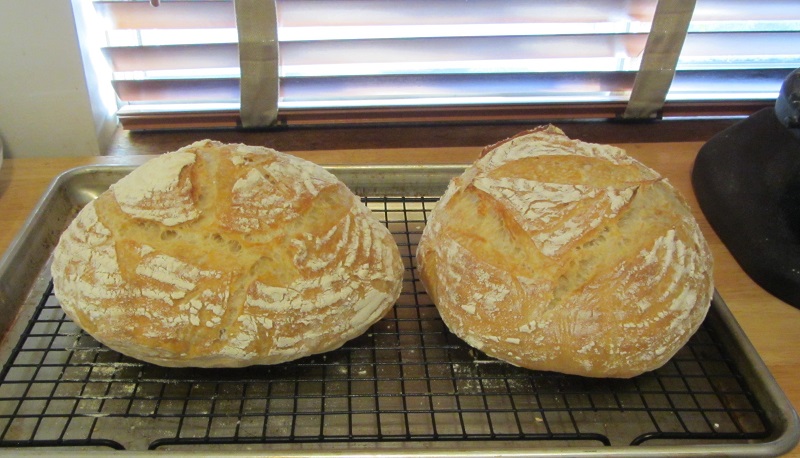
I went a little over the top with the Thanksgiving breads this year: A 1.3x batch of King Arthur’s Epis de Ble, two batches of King Arthur’s Dutch Oven Dinner rolls, and two No-Knead breads. All of that for nine people. I started at 4:30am and finished around 11am.

I made a couple of changes to the Epi de Ble recipe. I increased the total flour weight to 620 grams and used bread flour instead of all purpose. This made four epi. The poolish was changed to incorporate all of the water — 403 grams water and 403 grams flour. The total formula included 63% water, 2% salt. King Arthur original recipe here.

I made a double batch the Dutch Oven Dinner Rolls and modified that recipe slightly as well. All of the water (227g x 2 = 454g) and 454g of the flour were included in poolish that spent three days in the refrigerator. And I used 2% salt by weight. King Arhur recipe is here.

Finally, I made two No-Kneads using the recipe in the header at the top of the page.

I think overall everything came out a little bit lighter colored than usual — I put a sheet tray in the bottom of the oven so that none of the bottoms would get too dark. It had the side effect of not allowing the breads to deeply brown either, but I thought it was a reasonable tradeoff and nobody seemed to mind.

It was basically five individual bakes, so I made a chart of when everything needed to be handled, mixed, or if the oven needed a temperature change for the upcoming items. With that many things happening I was glad I did, and I didn’t wind up with any timing conflicts.

Next year I’m going to make half as much stuff and get more sleep.

Happy Baking

2024 Container Garden Recap

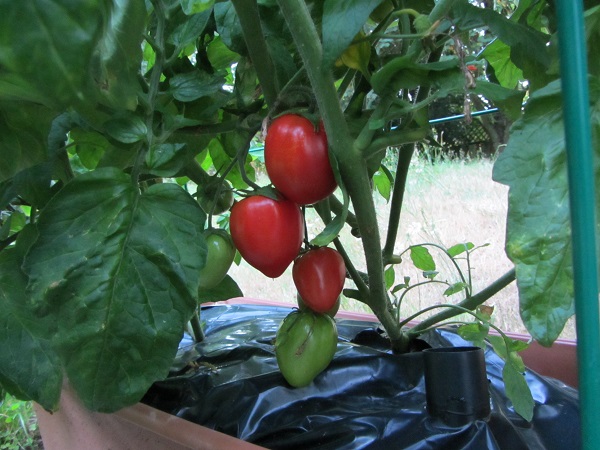
2024 was our worst year ever by total yield or by EarthBox by quite a bit. This year we grew four boxes of tomatoes (8 plants), one box of cucumbers (4 plants), one split box of zucchini and tomatillos (one of each), and one box of basil (4 plants).

Typically we get around 20 pounds per tomato plant — around 40 pounds per EarthBox. Not this year:

One box (four plants) Cucumbers: 27.9 pounds. Not a terrible year for cucumbers. They maintained good shape and taste deep into the harvest season.

One box (two plants) Black Krim Tomatoes: 14.6 pounds

One box (two plants) Oregon Spring Tomatoes: 12.6 pounds

Two boxes (four plants) Roma Tomatoes: 22.2 pounds

1/2 box (1 plant) Zucchini: 6.7 pounds

1/2 box (1 plant) Tomatillo: 3.3 pounds

87.3 pounds total.

We also grew one box of basil, and as usual the box produced way more than we could consume. At the end of every season it gets distributed around the neighborhood before the cold damages it too much.

We’re in the Seattle area. Almost everyone I talked to said they were having a bad year for tomatoes, so I don’t think it was just us. We did have one Roma die outright, which is the first tomato plant we’ve had die in over ten years of gardening. On average the yield this year was about 1/3rd of what we’ve seen historically.

The other “problem” was that we bought the last zucchini plant labeled as Tromboncino from the nursery. It turned out it was a “regular” zucchini plant, so it flopped all over the Tomatillo, rather than vining and staying out of the way like it was supposed to. There were no winners in that competition for space and light.

The flip side is 80 pounds of produce is a lot of stuff. We processed the tomatoes into sauce and froze dinner-sized portions. Both the downstairs chest freezer and the upstairs freezer are packed solid with vegetables.

Going forward, it may be we need to cycle out potting soil and replace it with fresh. It may also be that 2024 is closer to the new normal as the large trees around our lot continue to encroach on good sun for the garden.

I think overall it was a combination of relative lack of attention, bad weather, and bad luck (mislabeled pant and the dead tomato plant).

We’ll try again next year.

A 50/50 Boule With Yecora Rojo

Inspired by this “Yecora Rojo Sourdough Breads (No Knead Version too)” recipe on Breadtopia, I thought I’d try a non-sourdough version that I sort of crossed with my basic No Knead recipe.

The recipe is 200 grams King Arthur Bread Flour, 200 grams fresh-milled Yecora Rojo wheat flour, 336 grams cool water (84% hydration), 8 grams kosher salt (2%), and 1/4 tsp instant (not rapid-rise) yeast. Combine all in a bowl and mix until it’s a homogenous mass. Cover and leave on the counter.

I started the dough at 7pm the day before baking. At 11pm the dough was looking pretty feisty and had about doubled, so I did some Rubaud folds and put the container into the refrigerator, mostly because I preferred sleep over handling bread at that hour.

I did two more Rubaud folds at 1am and 4am, each time returning the dough to the refrigerator. At 4am the dough was still fairly shaggy but it was coming together. I removed the dough from the refrigerator at 6am and did coil folds at 6am, 7am, and 8am.

The dough was smooth and handled well after the 8am coil fold so I moved it to a covered banneton. At 9am I preheated the oven and our Le Creuset bread oven to 460F. At 10am the dough went onto a parchment and was slashed, then moved over to the bread oven. I reduced the temperature to 450F and baked the dough for 20 minutes covered, then 22 minutes uncovered. (The same time and process that I use for No Knead bread, though most times I’ll just go directly into the Le Creuset or a dutch oven rather than starting on parchment.) Cool on a baking rack.

The 84% hydration matches the Breadtopia recipe. The 1/4 tsp instant yeast matches my normal No Knead recipe. The bread measured 205F when I removed it from the oven which (again) is in-line with Breadtopia.

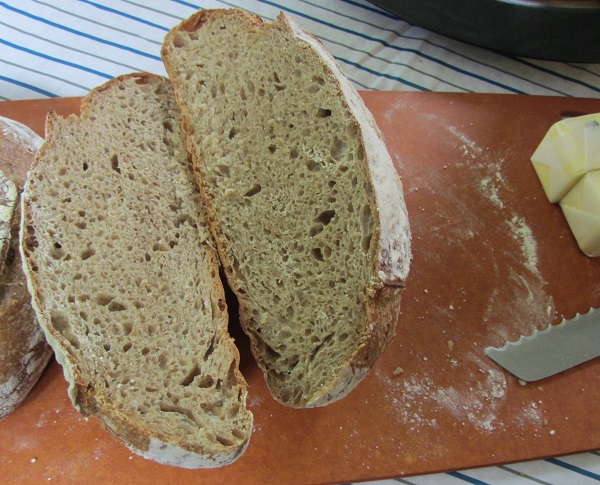
The bread was very moist. It had a decently open crumb, though it wasn’t quite as open as the pictures on Breadtopia. My feeling is that the dough could have possibly used another round or two of coil folds, but that was going to put the timing really close to when we needed to take it across town.

I was happy with the crust too, it had a nice bite to it but not “too much”. The next time around I’m going to try a little less flour in the banneton — I was probably too concerned with the dough easily releasing from the banneton so I may have overdone it a bit.

I don’t normally drop breads that I haven’t tested at all into a group setting, but I was reasonably confident everything had worked out and the bread was well received. So that was good.

The next time I’ll probably move the dough to the refrigerator after a shorter initial room temperature rise, then incorporate coil folds as soon as the dough will allow it. It might be the right answer is to do some Rubaud folds in the first hour prior to refrigerating overnight, then moving the dough back to the counter in the morning and using coil folds until the dough is ready.

Yecora Rojo is a Hard Red Spring wheat variety developed in the 1970’s. It’s my understanding that it’s used by some well-known bakeries and in flour blends for “artisan breads”. Last week I was buying wheat berries and Rogue de Bordeaux was not available, so I added Yecora Rojo to the Breadtopia shopping cart. I’m glad I did. It (predictably) functions well as an artisan bread flour. Based on one bake it’s not finicky to work with. The taste is not assertive and I think even people who Don’t Like Wheat Bread would eat it, especially if the percentage of Yecora Rojo was cut back to 20% or so.

Happy baking.

Pullman Pan 50/50 Sandwich Loaf, Sticking To The Side Of The Pan With Conviction

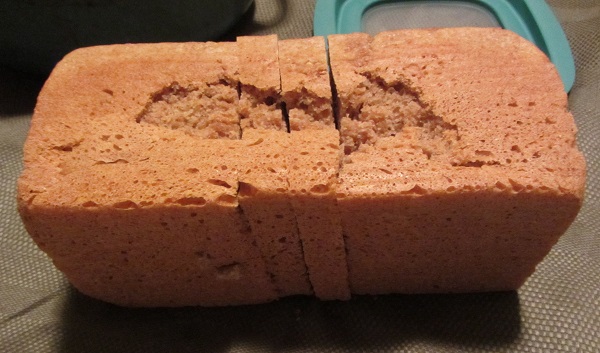
The last few loaves have wanted to stick to the sides of the loaf pan a little bit. This one took the sticking thing a little more seriously:

The pans themselves are no longer super duper new, and I haven’t been crazy fastidious about soaking the pans and cleaning out the old residue, so I probably deserved one that failed to release from the side. I did lightly oil the interior of the pan, but it may also need more oil than I’ve been using.

Another thing that might have contributed is the Red Fife flour combined with a longer bulk proof than usual — I let the bulk proof go a full two hours, followed by 45 minutes to an hour in the pan and the Red Fife might have started breaking down somewhat after that much time — I’ve read that Red Fife is prone to weakened gluten structure when given long proofing times. The crumb was more open than usual as well, which may be a sign of something, even if it’s just a looser crumb.

I’ve been experimenting with sometimes using Bread flour rather than AP flour and I’m leaning towards always using Bread flour going forward:

250g Bread flour and 250g fresh-milled whole wheat flour (Red Fife or Rogue de Bordeaux berries), (500g flour weight total). 375g water (75% hydration). 15g honey (3%), 15g olive oil (3%), and 15g (3%) powdered milk. 12g kosher salt (2.4% of the flour weight), 1.5 tsp instant (not rapid-rise) yeast.

Combine all ingredients. Knead on low speed for 8 minutes. (A prior hydration step is a potential and obvious improvement here.)

Cover and let rest one hour (two hours this time) for the dough to hydrate and proof.

Lightly oil the Pullman pan, pan lid, and a rubber spatula. Move the dough to the Pullman pan and spread it out with wet fingers or the spatula. Cover and let rise until 1/2″ from the top of the pan.

Bake at 350F, covered for 30 minutes then remove the cover and bake for another 25 minutes or until the loaf reaches 195-200F.


More edible mistakes. Happy Baking

Pullman Pan 50/50 Sandwich Loaf, the right grains make a big difference

I own Flour Lab by Adam Leonti. On page 71 he presents his Yeasted Loaf recipe, where he suggests a wheat variety: “I like Red Fife”.

At the start of this process I didn’t consult the book, I just picked a Hard Red Winter Wheat from the pantry (Turkey Red) and then adjusted the ratios of the ingredients bake by bake looking for the most suitable bread for sandwiches. No matter what adjustments I made the bread was still vaguely crumbly and lacked the gluten structure and springiness to be a good sandwich bread.

So I got what I deserved. It’s always the better idea to Stand On The Shoulders Of Giants, then riff from there. And I know that, usually.

The bread above is made with Red Fife. It works great as a sandwich bread, and it has a more interesting taste profile than Turkey Red. Rouge de Bordeaux works great too, and to my taste it’s even more intensely flavored, aromatic, and interesting than the Red Fife. Both the Red Fife and the Rouge de Bordeaux taste even better after a couple of days after baking, which may be true for all whole wheat breads. Leonti specifically states in a few places to let the finished bread rest until the next day prior to cutting into it.

The recipe this time is intended to be as quick and easy as possible. I’m sure it can be improved but I was initially curious to see what Red Fife would do with no other steps than would be used with a quick same-day loaf:

250g AP flour and 250g fresh-milled whole wheat flour (Red Fife or Rogue de Bordeaux berries), (500g flour weight total). 375g water (75% hydration). 15g honey (3%), 15g olive oil (3%), and 15g (3%) powdered milk. 12g kosher salt (2.4% of the flour weight), 1.5 tsp instant (not rapid-rise) yeast.

Combine all ingredients. Knead on low speed for 8 minutes. (A prior hydration step is a potential and obvious improvement here.)

Cover and let rest one hour for the dough to hydrate and proof.

Lightly oil the Pullman pan, pan lid, and a rubber spatula. Move the dough to the Pullman pan and spread it out with wet fingers or the spatula. Cover and let rise until 1/2″ from the top of the pan.

Bake at 350F, covered for 30 minutes then remove the cover and bake for another 25 minutes or until the loaf reaches 195-200F.


Having poked around some bread forums, it seems I’m not alone in my experience that “Turkey Red Is Sort Of Crumbly And Maybe Not The Best Variety For Bread”. I’m not sure if I’m going to re-purchase it when I run out. For a Hard Red Winter Wheat it’s relatively neutral tasting, and I didn’t love the gluten structure. It may still be useful in situations where strong gluten or an assertive flavor is not desirable, so I’ll focus on using it other places before I make a final decision.

Happy baking

Pullman Pan 50/50 Sandwich Loaf, the ingredients are sort of set?

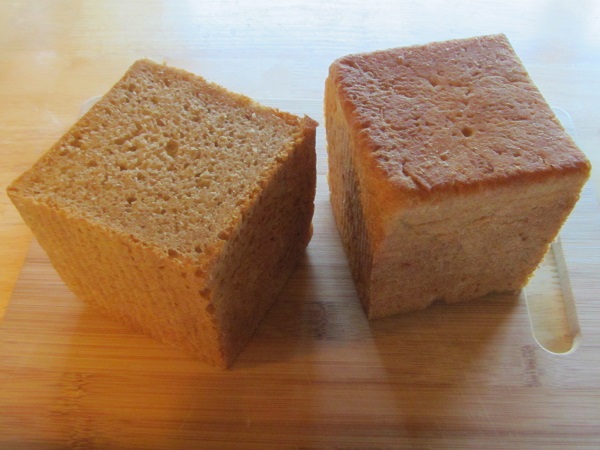
I’m pretty happy with the loaf at this point. It’s still vaguely more crumbly than I’d prefer, but the rest of it is good. The left-half has the crumb facing up:

It’s 250g AP flour and 250g fresh-milled whole wheat flour (heritage Turkey Red berries), (500g flour weight total). 375g water (75% hydration). 15g honey (3%), 15g olive oil (3%), and 50g (10%) powdered milk. 10g kosher salt (2% of the flour weight), 1.5 tsp instant (not rapid-rise) yeast.

As far as changes from where it started, it’s just been a continuous reduction in oil and honey from the original. The kneading has been cut way back. And the dough now goes directly from the mixing bowl to the Pullman pan. The current recipe:

Combine all ingredients. Knead on low speed for 1-2 minutes or until the dough comes together.

      Cover and let rest one hour for the dough to hydrate.

      Mix for 1-2 minutes. Cover and bulk rise until doubled.

      Lightly oil the Pullman pan, pan lid, and a rubber spatula. Move the dough to the Pullman pan and spread it out with wet fingers or the spatula. Cover and let rise until 1/2″ from the top of the pan.

      Bake at 350F, covered for 30 minutes then remove the cover and bake for another 25 minutes or until the loaf reaches 195-200F.

      I think to a degree I’m at a bit of a inflection point for further improvements. I’ve tried a moderate amount of mixing and very little mixing, and the “little mixing” seems to work better. It may be that combining at least the flour with the water overnight in the refrigerator (or possibly all of the ingredients) may allow for a better finished product. Another obvious change would be to sift the biggest chunks of bran out of the whole wheat flour, though that’s something I don’t want to do, both for the loss of nutrients and the bit of hassle and things to clean up afterwards.

      It may also be that Turkey Red isn’t the best grain from this application. I still have Rouge de Bordeaux and Red Fife to try out.

      So it feels like more upcoming process changes, to what, I’m not sure. Which is a fine problem to have, relatively.

      Happy baking

      The Reduced Footprint 2024 Container Garden

      In a typical year we have twelve active EarthBoxes. The yield is usually around 250 pounds of produce. We have plenty of frozen vegetables in the freezer, so this year we have seven boxes:

      The picture is facing east — the sun is just clearing the house and striking the cages and the tops of the tomato plants.

      Front row (L-R): box of two Romas, box of two Romas, box of two Oregon Spring. There’s going to be one more box to the right containing basil — I didn’t like what I saw when I went shopping for basil this morning.

      2nd row (L-R): Box of Black Krim tomatoes. Under the right-hand trellis are Marketmore cucumbers.

      Back left: A box with one tomatillo (Verde) and one zucchini. We purchased the zucchini as a Tromboncino (we got the last one!) but it now has all the appearances of a “regular” zucchini plant.

      North of Seattle it’s been very mild bordering on “too cold for basil”. Hopefully over the next few weeks we see some real growth.

      Pullman Pan 50/50 Sandwich Loaf: Getting Closer

      The newest formula is getting closer. The mouthfeel and taste are good. The crumb is still just a bit more crumbly than I’d prefer. An early morning picture of the top of today’s turkey sandwich:

      It’s 250g AP flour and 250g fresh-milled whole wheat flour (heritage Turkey Red berries), (500g flour weight total). 375g water (75% hydration). 25g honey (5%), 15g olive oil (3%), and 50g (10%) powdered milk. 10g kosher salt (2% of the flour weight), 2 tsp instant (not rapid-rise) yeast.

      Knead on low speed for 10 minutes. Cover and bulk rise until doubled. Flour the bench, the dough will be sticky. Pre-shape the loaf then move it to the Pullman pan. Cover and let rise until 1/2″ from the top of the pan. Bake at 350F, covered for 30 minutes then remove the cover and bake for another 25 minutes or until the loaf reaches 195-200F.

      As for changes relative to the first attempts — I upped the milk powder and yeast and decreased the olive oil and honey. The increased milk powder is giving a better mouthfeel. The yeast is making the process a lot faster. The decreased honey is softening the crust, which is an improvement. I’ve decreased the oil and I haven’t missed it, so I left the quantity lower than the original 8% of flour weight.

      I think the final piece of the puzzle may be either:

      1. Combining the ingredients briefly, then letting the dough rest before mixing again — letting the fresh milled wheat hydrate before the actual kneading.
      2. Kneading for a shorter time, about 4 minutes, then doing a series of folds in the bowl to promote gluten formation more gently than the mixer will do it.

      I think the recipe part of the equation is very close. Now it’s the handling technique that needs to be better. That’s part of the fun of bread baking though — figuring out solutions. Which of course never ends.

      Happy baking

      A No Knead Bread And Seasoning A Banneton

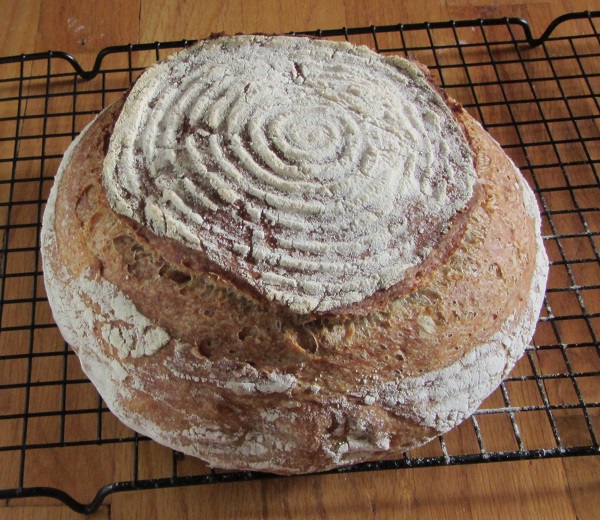
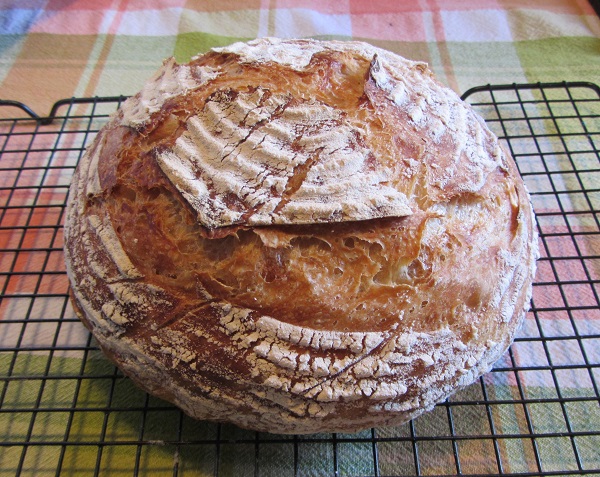
      First a picture of Sunday’s No Knead bread then a little background.

      I’ve owned a banneton for at least eight years. I know that because I have a blog post from 2016 that talks about me baking with two of them. Somehow I never got the message that they’re supposed to be seasoned to prevent sticking. The ones I purchased didn’t come with instructions. I just happened to be reading about a banneton related topic and a very small light bulb went off in my head. So I thought I’d see what banneton care and feeding was supposed to be.

      Bannetons are supposed to be seasoned. The method is:

      1. Spritz the banneton with oil or water. (I lightly rinsed mine in water then shook it out well — I didn’t want oil going rancid at some point.)
      2. Sprinkle some AP flour or rice flour or a combo of the two into the banneton and angle it around until the flour coats the inside. Shake out the excess flour.
      3. Use a little more flour with every bake.
      4. Air dry the banneton after every use, preferably in the sun to prevent any unwanted molds from populating the flour.
      5. Store the banneton in an airtight bag or container to keep bugs from taking up residence.
      6. If too much flour builds up then sweep it out with a stiff brush.

      That’s it. Any crevices or tiny cracks in the banneton are now basically non-stick.

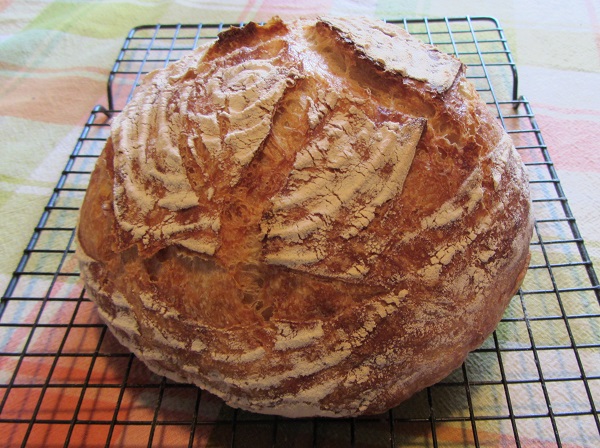
      Below is another picture of that same bread because I couldn’t decide which I liked better. The light is from the back rather than the side.

      The bread is 75% hydration with no additional “handling flour” added to the dough itself and it didn’t stick at all. (Recipe here. Or use the Menu above to go to the No Knead page.)

      Other notes — I’ve stopped using bench flour or a Silpat when preparing a No Knead — I use a tablespoon or two of oil on the counter and spread it around with a paper towel. If the dough tries to stick to the counter I just lift the dough with a bench scraper, though generally it doesn’t stick.

      The other advantage of using oil on the counter is that I can then used the oiled paper towel to rub a bit of sheen on any other tools that are coming into contact with the dough. I rub a little on a spatula to help remove the dough from the mixing bowl to the counter. I rub a little on a serrated bread knife for any slashes that I want to make on the dough prior to baking. In the picture above I used five slashes around the “waist” of the dough, the splits on top were caused the dough naturally expanding where the seams were gathered up as the dough was placed into the banneton. I also used a Le Creuset bread oven rather than a traditional dutch oven for this bake — that made it so I could easily get to the sides of the dough after it was removed from the banneton.

      I’ve gone years of using bannetons with some trepidation and drama for no real reason. Here’s celebrating finally learning something, even if it was mostly by chance.

      A Pullman Pan 50/50 Sandwich Loaf: Searching For Goldilocks.

      600 grams of flour was too much. 400 grams of flour was not enough. This bake uses 500 grams of flour and adjusts the other secondary ratios somewhat.

      The recipe uses 250g AP flour and 250g fresh-milled whole wheat flour, (500g flour weight total). 375g water (75% hydration). This time around I cut back on the “other stuff”: it uses 30g each of honey, olive oil, and powdered milk (all are 6% of the total flour weight, the old amounts had been 8%). 10g kosher salt (2% of the flour weight), 1 tsp instant (not rapid-rise) yeast. Bulk rise until doubled then move to the Pullman pan, cover and let rise until 1/2″ from the top of the pan. Bake at 350F, covered for 30 minutes then remove the cover and bake for another 25 minutes or until the loaf reaches 195-200F.

      It’s sort of based on King Arthur’s A Smaller Pain De Mie. Or at least it was at the beginning of tinkering.

      The newest version uses relatively less honey, olive oil, milk powder, and yeast. This is intended to make the end of the rise a little more predictable and controllable — with the earlier versions there wasn’t a ton of activity for the first 60 to 90 minutes, then things started to happen fast after that.

      It should be more manageable but we’ll see how it tastes and ages after a few days. It may be the correct answer will be to restore “other stuff” to the original 8% and just cut back on the yeast and expect the whole pre-bake process to go slower and longer. I feel like it’s getting close to where it should be.

      Happy baking