Beer of the Week: Oakshire O’Dark:30

By Iron Chef Leftovers

Oakshire is a relative newcomer to the Northwest Beer scene, opening in 2006 in Eugene, Oregon. They have been around the Seattle market the last few years, available both on tap and in bottles at better bottle shops and supermarkets. They produce a relatively small, but solid, lineup of beers, with O’Dark:30, a CDA or black IPA, being their spring seasonal.  The beers are reasonably priced, coming in at around $6 for a 22 oz. bottle.

From the Oakshire Website:

Dawn has not arrived, but we are awake, brewing this beguiling combination of dark malt and NW hops. Dry hopped with Cascade and Centennial Hops, this beer has a powerful hop aroma and flavor tempered with a sturdy malt backbone.

Style: Cascadian Dark Ale
OG: 15.0 Plato
IBU: 70
ABV: 6.3%
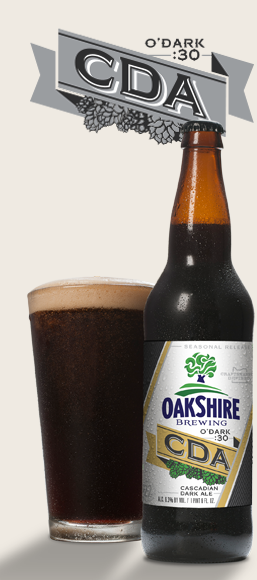
bottle_template_CDAThe beer pours jet black with a creamy tan head, it really poured like a Guinness, but that is about the only similarity O’Dark has with the beer from James Gate. Light notes of roasted malt and chocolate appear on the nose with hints of citrus and fruit peel that permeates the nose but doesn’t overpower it. With the first sip, I was surprised by the amount of roast that appears up front coupled with lighter notes of chocolate that fade quickly before moving into the hop profile – slightly fruity with notes of citrus peel and very light bitterness, surprising for a beer with a high IBU and roasted malt profile. The hops linger and fade after close to a minute and the beer leaves you with a very pleasant chocolate and orange peel finish. Incredibly well balanced and layered, this beer has deep complex flavors and a big hop profile without being palate killing or overly bitter.

Oakshire O’Dark:30 clocks in with a solid 4 half-past-the-hours out of 5.

GNOIF: Danger! GNOIF! Danger! — The Recap

by A.J. Coltrane

GNOIF #11 recap — Danger! GNOIF! Danger!  (Danger theme.)

Games That Got Played:  Bang!, Forbidden Island, Guillotine, Poo!

Games That Didn’t Get Played:  DeadFellas, Last Night On Earth, Mystery of the Abbey, Nuclear War, Small World, Stop Thief

We got a bit of a late start due to the Seahawks game, and we’d started “celebrating” well before GNOIF commenced. The games played were mostly the simpler, faster, social-oriented games that most everyone had played at least once or twice. Coincidence? I doubt it.

One table alternated games of Poo and Forbidden Island. Table two had a couple of big games of Bang followed by a few games of Guillotine. We had vaguely more players than seats at the tables, so people swapped in and out — it left plenty of time to circulate and hit the buffet. (Like I said, it was that kind of evening.)

We wrapped it up by putting the 9v battery into the controller of Stop Thief. We didn’t play, but it gave everyone a chance to see how the game worked and attempt some arrests. Definitely some 80’s flashbacks, and by 80’s I mean 1980. There are some pictures of the controller and box now floating around on Facebook.

Photo from Handheldmuseum.com. Ours is actually better shape -- we took care of our stuff as kids... Check out the size of the controller relative to that guys hand!
Photo from Handheldmuseum.com. Ours is actually better shape — we took care of our stuff as kids… Check out the size of the controller relative to that guys hand!

Good times. Thanks to everyone who played.

Classic Buttermilk Waffles

By Iron Chef Leftovers

I don’t normally do breakfast, but when I do, I tend to gravitate more toward pancakes and French toast. On occasion, I will get a waffle, but generally it is something I may eat once a year. On a recent trip back to the Iron Chef homeland, my mom purchased a waffle iron. Well, she needed a recipe; I knew a good one from Cooks Illustrated, so here you go:

The secret to great waffles is a thick batter, so don’t expect to pour this one. Make toaster waffles out of leftover batter—undercook the waffles a bit, cool them on a wire rack, wrap them in plastic wrap and freeze. Pop them into the toaster for a quick breakfast.

The Software

  • 1 cup unbleached all-purpose flour
  • 1 tablespoon cornmeal (optional)
  • ½ teaspoon table salt
  • 1 teaspoon baking soda
  • 1 egg, separated
  • 7/8 cup buttermilk
  • 2 tablespoons unsalted butter, melted

The Recipe

1. Heat waffle iron. Whisk dry ingredients together in a medium bowl. Whisk yolk with buttermilk and butter.

2. Beat egg white until it just holds a 2-inch peak.

3. Add liquid ingredients to dry ingredients in a thin steady stream while gently mixing with a rubber spatula; be careful not to add liquid faster than you can incorporate it. Toward end of mixing, use a folding motion to incorporate ingredients; gently fold egg white into batter.

4. Spread appropriate amount of batter onto waffle iron. Following manufacturer’s instructions, cook waffle until golden brown, 2 to 5 minutes. Serve immediately. (You can keep waffles warm on a wire rack in a 200-degree oven for up to 5 minutes.)

NOTES

That is it. Serve with syrup, butter, whipped cream, fruit, fried chicken or whatever you like.


Beer of the Week: NW Peaks Cascadia Shale Ale

By Iron Chef Leftovers

untitle8dIn 2012, NW Peaks made a dark version of their Eldorado Pale Ale which was outstanding.  In 2013, they made a hoppy dark beer called Cascadia Shale Ale. The beer was a bit big at 6.5% ABV and was available on tap at the tasting room.

The beer pours very dark brown in color with a light tan head, showing lots on malt on the nose with hints of chocolate and hops supporting the malt. On the palate, the beer is hop forward; mild bitterness with hints of pleasant and not overpowering citrus followed by malt with hints of chocolate before finally yielding back to hops with more light bitterness and a hint of alcohol and resin on the very end of the beer. I would have liked a slightly smoother finish (the beer did come off as slightly hot) but it was still outstanding and complex with multiple layers of flavor. This was a somewhat malty version of a CDA, perfect for an overcast Northwest evening in the fall.

NW Peaks Cascadia Shale Ale rumbles in with 4 subduction quakes out of 5.

Beer of the Week: Epic Ales Desert Rye Farmhouse Ale

By Iron Chef Leftovers

untsaditledThere are two breweries that drive me nuts because their names are almost identical. There is Epic Brewing out of Utah which makes some fantastic Belgian style beers and there is Epic Ales out of Seattle who tend to do some off the wall farmhouse style beers. I have seen more than one occasion where a tap last has listed the wrong brewery. In the case of the Desert Rye Farmhouse Ale, I originally just wrote Epic on my noted. In going back over them, I realized that I had no idea which Epic it was. After doing a bit of digging, I realized that it was the Seattle Epic that put out this beer. Given that it was a farmhouse beer with rye, I needed to give it a shot.

The beer pours cloudy with the color of peach/apricot jam and has an interesting nose – notes of grain and yeast dominate, supported by light notes of rye and hints of sugar. The beer is really complex on the palate, starting off with heavy rye notes before moving into a grassy farmhouse funk with lots of Belgian yeast and grain helped by very light citrus, finishing with light hops and more funk. The rye lingers thought the entire progression and is a bit harsh at the beginning, but it smooths out by the end of the sip and enhances the other flavors. The farmhouse component becomes more pronounced as the beer warms making for a very different beer by the end of the pint.

This is a beer that is really not for everyone, but is well balanced and complex to the point of being very different than most everything else out there.

Epic Ales Desert Rye Farmhouse Ale comes in out of the field with a heavy load of 4 hay bales out of 5.

The Road to the Super Bowl Runs Through…

By Blaidd Drwg

You hear all about home field advantage in the NFL, and there is definitely an advantage to playing at home, in the regular season. Come playoff time, momentum seems to be more important than playing in your front. I think it becomes exaggerated because the #1 and #2 seeds end up sitting around, doing nothing for a week and lose some of their competitive edge. I decided to take a look at just what kind of impact the bye week had on the top 2 seeds since the NFL went to the 8 team playoff in 2002.

#1 Seed

Game Wins Losses
Divisional Playoff 13 9
Conference Championship 9 4
Super Bowl 2 7


#2 Seed

Game Wins Losses
Divisional Playoff 15 7
Conference Championship 5 10
Super Bowl 3 2


The results are definitely surprising. The #1 seed has won just 59% of the time in the Divisional Playoff game. Considering that is a team that generally has won better than 75% of its games at home during the season, I would have expected better. The #2 seed wins about 68% of it Divisional Playoff games, which seems about right considering that they get the highest remaining seed for that game (usually the 3 or 4 seed). I suspect that the #1 seed ends up getting the tougher team for their matchup since it seems, especially over the last few seasons, that there is at least one Wild Card team who ends up with a better record than a couple of the division winners.

When you get to the Conference Championship game, it gets a bit interesting. There have been 8 times in the 22 instances that #1 and #2 have squared off in that game, with the #1 seed holding a 5-3 advantage in those games. That makes the results look a bit weird against the other seeds:

  #1 Seed #2 Seed
Vs. 1 or 2 seed 5-3 3-5 (On The Road)
Vs. any other seed 4-1 2-5 (At Home)


Basically, if you are the #1 seed and you survive the Divisional Playoff game, you really would rather face anyone other than the #2 seed.

Either way, I would almost be willing to bet that you won’t be seeing a Seattle – Denver (this year’s #1 seeds from their respective conferences) Super Bowl matchup. A battle of #1’s has only happened once in the last 10 seasons – in 2009 when Indy and New Orleans squared off.

Beer of the Week: Populuxe Gingersnap Amber

By Iron Chef Leftovers

imagesCAAR87MMI know I have said this before, but I don’t really like ginger in my beer. Don’t get me wrong, I love ginger, I use it frequently in my cooking, but I feel like it tends to overpower the subtle flavors of beer to the point where it is all you end up tasting. Populuxe put on tap their Gingersnap Amber recently, and I decided that I needed to try it with some reluctance. The beer clocks in at just 5.5% ABV.

The beer pours amber in color with notes of toffee, malt and gingerbread on the nose. Gingersnap drinks heavier than it smells, starting off with a mild yeastiness before moving into light toffee and caramel notes which pleasantly linger for a long time before moving into a delicious cookie like flavor with hints of sugar and very light ginger coupled with light molasses and toffee. The finish is extremely long and pleasant, reminding me of a really nice gingerbread cookie without the crumbs. Well balanced and easy drinking, this beer manages to draw some big flavors into the picture without having to empty the spice rack or overpowering the palate.

Populuxe Gingersnap Amber preps for the holidays with 4 warm cookies out of 5.

An Inexpensive EarthBox Hoop House

by A.J. Coltrane

SeattleAuthor brought over Mâche seeds the other day, so it seemed like a good time to make a hoop house to keep the rain off of the seedlings. The hoop house was intended for the front yard, so it had to look decent. I was also targeting the minimum cost that would still allow for a “sound” end result. The finished cost was about $4.

140714 hoop house

Bill of Materials

~8 feet of 1/2″ pvc (black, flexible). Cut into two 4′ pieces. (Of a 100′ roll @ $16. An 8′ length should be comparable in price.)

5′ x 5′  of 4 mil clear plastic sheeting (Of a larger roll. It won’t last forever anyway.)

4 pvc clamps (sold as a bag of 5 for ~$1.60, similar to these)

7/16″ dowel x 4′, cut into 2 @ 10″ and 2 @ 14″. (The EarthBox is shallower on the watering tube side.)

2 clothespins

Assembly

1.  Cut the dowel into four pieces. Cut two ~4′ sections of pvc pipe.

2.  Insert the dowels into each corner of the EarthBox. Slide the pvc lengths over the dowels.

3.  Cover with the plastic sheet and clamp. Pin the extra plastic on the ends with a clothespin. The clothespins can also be used to hold the plastic doors on the ends open.

Done!

—–

The postmortem and assorted thoughts:

I think that there must be a better answer for the clamps, though I didn’t want to spend ~$1 each for good spring clamps. I want something that can easily be moved around, so something like spring clamps would be desirable. Still working on the right answer.

The cost could have been lower — My first thought was to build a wooden frame and attach the pvc to it using clamps. That’s the “normal” way to do it. But then I thought, hey, I can just push the pvc into the soil in each corner of the EarthBox. *Then* I did some looking around online — it appears that toxins from the pvc could potentially (likely?) release into the soil. How to deal with that?

I chose to do something similar to the buried rebar — I purchased some 3/8″ dowels, cut them to 1′ length, and buried the dowels in the corners of the box. I then slid the pvc over the dowels, leaving the pvc above the soil. In retrospect that was a no-brainer, but I was so fixated on the wooden frame/external support idea that it never occurred to me use the area within the EarthBox to anchor the pvc tubing.

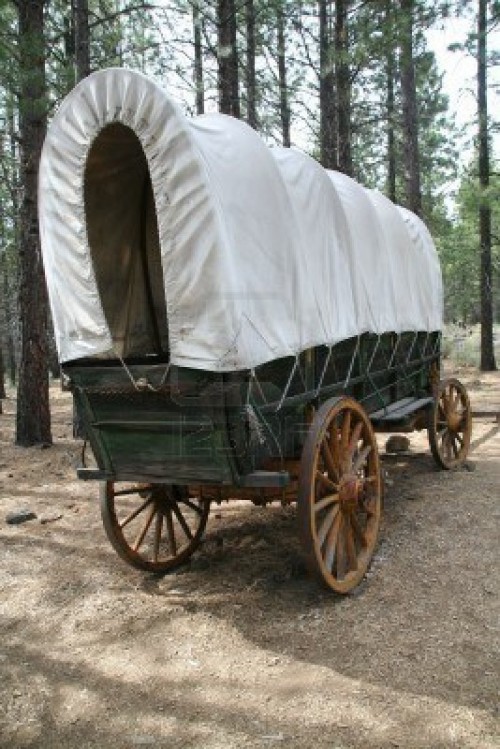
I think it’s interesting that if you were to stick wagon wheels on the sides of the hoop house would look a lot like a covered wagon.

covered wagon

That may mean that it was the right way to do it — form follows function, and both the EarthBox and covered wagon have a similar functions.

Or it’s just a coincidence.

———–

I learned something new. The french “a” thingy is alt and numpad 0226.

The Idiot Auburn Fan

by A.J. Coltrane

There was an Auburn fan who stood to make $50,000 last night had they won the national championship.

Rather than hedge his bet he chose to ride it out, even though Auburn was about a 10 point (or 3-1) underdog.

He got zero dollars.

What he could have done would have been to place a $16,500 on Florida State at -330.

Had Florida State won he would end up with $21,500.

Had Auburn won he still would have had $33,500.

Hedging his bet still would have left him with his home-team rooting interest. He didn’t want to “jinx it”. What an idiot.

Mark Your Calendars, Hop Heads of Seattle

By Iron Chef Leftovers

Twelve Breweries, all doing triple IPA’s, all being served at once.

The breweries:

The venues:

I will most likely make at least one of them, you know, just because I don’t do enough to support my local breweries.

More info here.