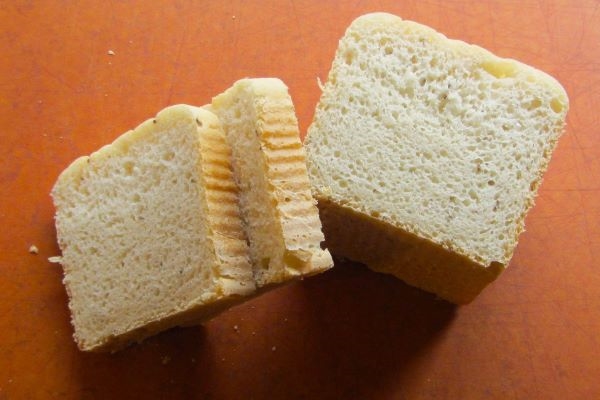
Bread Flour and Rogue de Bordeaux Sandwich Bread With Sourdough Discard

My current favorite sandwich bread using Bread Flour, Rogue de Bordeaux flour, and sourdough discard. The recipe is easy:

600 grams flour total:

350 grams King Arthur bread flour (58% of the flour weight)

200 grams Rogue de Bordeaux flour (33%)

100 grams sourdough discard (50 grams flour (8% of the flour weight)/ 50 grams water)

370 grams room temperature water (with the water from the sourdough the total hydration is 70%)

12 grams extra-virgin olive oil (2% of flour weight)

12 grams kosher salt (2% of flour weight)

1 tsp instant (not rapid rise) yeast

Combine all ingredients in a mixer and mix on low speed for 8 minutes. Lightly spray a Pullman Pan and move the dough to the Pullman Pan, patting it down and spreading to the ends. Cover and let rise until the dough is 1″ from the top of the pan. Preheat oven to 350F.

Bake covered 30 minutes, then remove the cover and bake an additional 25 minutes. De-pan to a cooling rack.

1/3 of the flour by weight is the Rogue de Bordeaux. This seems to be a good ratio of whole wheat to regular bread flour. The bread has good structure. The Rogue de Bordeaux adds a lot of the flavor and cinnamon and baking spices. One neat thing is that it highlights different flavors in the sandwich depending upon the ingredients.

The Pullman Pan works well for the relatively extensible Rogue de Bordeaux. Using wet hands for all handling helps a lot.

Happy Baking
Levain Starter – Evolutions In Bread By Ken Forkish

A few months ago I decided to begin maintaining a starter. To that point I’d avoided it, partly because I didn’t want Another Living Thing to maintain, partly because the idea of throwing away starter seemed wasteful, and partly because it just felt like it was going to be a messy and unnecessary hassle.

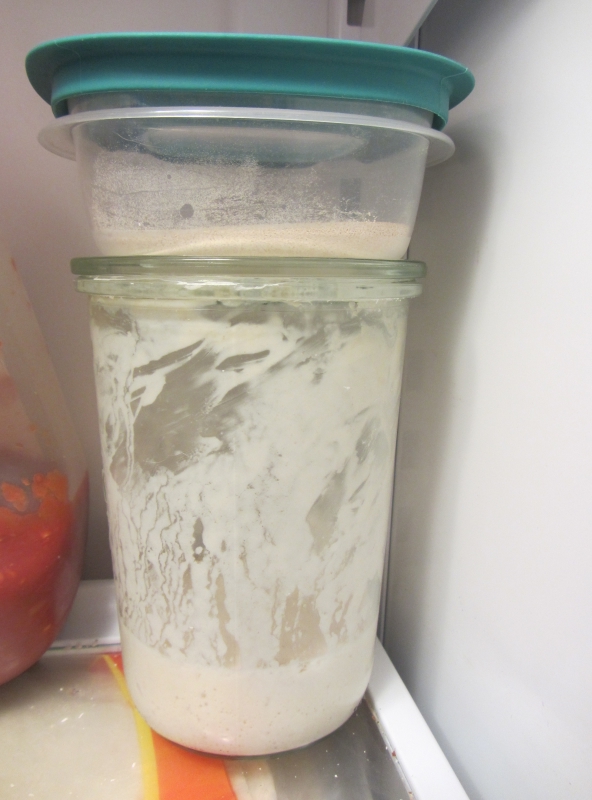
Hanging with the salsa.

The flip side of maintaining a starter would be that it would allow for more interesting things to try with breadmaking. It would also add another “color” to my available “palette”. The end product could be better tasting, better for us, and keep longer before spoilage. Ultimately I read enough intriguing starter-based recipes that I decided to give maintaining a starter a try so I took the leap.

I wanted a starter recipe that wouldn’t consume or waste much flour. I also wanted a starter recipe I could mostly ignore after it was finished. I settled on Ken Forkish’s Levain recipe from Evolutions In Bread. The entire process requires one week and 550 grams of flour.

Creating the starter is pretty simple really. Weigh the container and write that number down. Every 24 hours some amount (by weight) of the contents of the jar will be discarded and then the container will be fed a small amount of fresh water and flour. I made the decision ahead of time to mill all of the whole wheat flour I was going to need, 250 grams total. That way I wasn’t getting the mill out for the first few days when it was time to discard and feed. The process felt very easy and pretty bulletproof — I think that fresh milled whole wheat contains enough nutrients and enough bacteria/enzymes/assorted microbes and whatnot that kicking off the new tiny ecosystem basically took care of itself.

The recipe it calls for 250 grams of starter as the end product. I “shorted” the final feeding and I didn’t see any adverse effect. I did that because I wanted to be able to pull a smaller amount out of the jar each week and still keep things fresh and lively with smaller feedings. If I want to build up a large quantity of starter it takes a little longer but I’m fine with that.

I maintain 150 grams of starter in a 393 gram jar (weighed with no lid). Each week I take a small spatula and scrape/pour out 100 grams for bread baking. I then add 50 grams of bottled water and 50 grams of bread flour to the container, scrape down the sides, and stir it up. I put the lid back on and let it sit on the counter for 1-2 hours, until it starts to show some signs of life. Then it goes into the back corner of the refrigerator for another week. I store yeast in a tupperware-type container on top of the starter. Everything is in one place and ideally staying fairly cold.

As for the container – it became clear pretty quickly that straight sides are a good thing and a threaded jar is a bad thing. Straight sides because it’s much easier to get into and scrape down the jar when there’s no “neck”. Threads just gather crud and rapidly clog. I purchased a 6-pack of the Weck 743 jars and split it with a friend who was also making a new starter. (At the time the total cost was ~$6.50 per jar for six.) I use them without the gasket. They’re nice somewhat heavy jars made of thick glass. The lid just sits on top and it’s plenty secure.

Final thought: Evolutions in Bread is a great book. Highly recommended.

A Pullman Pan Loaf With Caraway And Milk Powder

This week’s sandwich loaf steers back towards “normal”. It includes a bit of sourdough starter, caraway, and milk powder. The caraway is the most obvious flavor.

The recipe:

100 grams starter (50 grams water/ 50 grams bread flour).

450 grams bread flour (500 grams bread flour total including the starter.)

300 grams room temperature water. (70% hydration, the water amount is 350 grams total including the starter)

50 grams milk powder (10% bakers percentage)

15 grams olive oil (3%)

10 grams kosher salt (2%)

1-2 teaspoons crushed/ground caraway seed. I didn’t go too fine because I still wanted to see flecks of caraway.

1.5 tsp instant (not rapid rise) yeast.

Combine all ingredients. Mix until combined, about 1 minute at low speed. Cover and let rest 30 minutes. Mix for 8 minutes on low speed.

Oil / butter / Baker’s Joy the pullman pan. Move the dough to the pullman pan and spread the dough out to the sides of the pan. Cover and let rise until 1″ from the top of the pan. Bake at 350F covered for 30 minutes, then uncover and bake an additional 25 minutes.

The finished loaf had a lighter crust color this time, partly because I left out the usual honey. The crumb was spongy and moist with dark flecks of caraway — it worked really well as a sandwich loaf and I think it’ll make good toast if it lasts that long.

Overall the finished bread was simple, quick, and fairly interesting on a baking night where I wanted simple, quick, and easy. Perfect.

50/50 Pullman Loaf, A Recipe I’m Happy With

I’ve now reached a point with the weekly sandwich bread bake that I’m basically happy with it. I’m sure I’ll continue to fiddle with it to see how it reacts, but here’s where I’ve settled as a base recipe:

Ingredients

100g starter discard or overnight poolish (either of these are optional but they seem to improve the mouthfeel of the finished bread). The starter discard is 50g bread flour and 50g water. If using a poolish it will be 50g bread flour, 50g water, and a tiny tiny pinch of yeast.

200g Bread flour and 250g fresh-milled whole wheat flour (Red Fife, Turkey Red, or Rogue de Bordeaux berries), (In total it is 500g flour weight total including the starter/poolish).

325g cool water (with the 50 grams from the starter/poolish the total water is 375 total grams. 75% dough hydration).

    15g honey (3% of flour weight)

    15g olive oil (3% of flour weight)

    10g kosher salt (2% of the flour weight)

    1.5 tsp instant (not rapid-rise) yeast.

    Process

    Start by adding the 325 grams of cool water to the bowl of the stand mixer.

    Scoop 100 grams of starter discard into the water.

    Grind the wheat directly into the water/starter mixture. I feel like this helps keep the milled wheat temperature lower than it would be if I just milled it into an empty container. At the very least, it can’t hurt.

    Add the remaining ingredients and mix for one minute to combine. Cover and let rest 20 minutes, up to an hour. Uncover and mix another 6 minutes.

    Spray a pullman pan lightly with Baker’s Joy. (I’ve tried more than a few ways of attempting to prevent the baked loaf from sticking to the pan. Baker’s Joy has been by far the easiest and most consistent solution. If overused Baker’s Joy with give the crust a vaguely weird and sticky quality, so don’t go overboard with it.)

    Transfer the dough to a pullman pan and spread out the dough with wet fingers. Cover, and let rise until 1/2″ to 1″ from the top of the pan. Preheat oven to 350F when the dough is getting close to ready.

    Bake, covered for 30 minutes then remove the cover and bake for another 25 minutes or until the loaf reaches 195-205F.


    I had been using powdered milk in the recipe, but it didn’t seem to be adding flavor. I thought it might also be contributing to the finished loaf being a little crumbly, since when used in moderation the powdered milk is supposed to help with loft. Simpler might be better here.

    This recipe still technically functions as a same-day loaf, given I always have a starter in the refrigerator. The weekly sandwich bake then doubles as an opportunity to remember to refresh the starter. Win-win.

    Happy baking