Pullman Pan 50/50 Sandwich Loaf, Sticking To The Side Of The Pan With Conviction

The last few loaves have wanted to stick to the sides of the loaf pan a little bit. This one took the sticking thing a little more seriously:
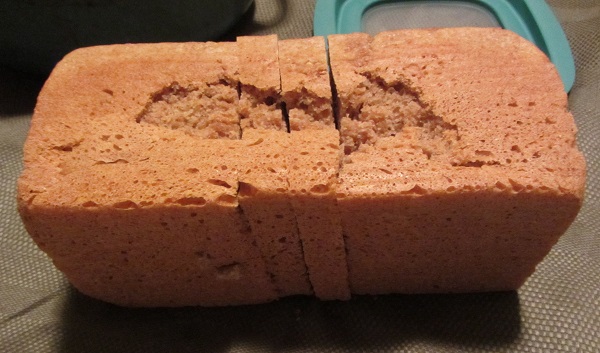
The pans themselves are no longer super duper new, and I haven’t been crazy fastidious about soaking the pans and cleaning out the old residue, so I probably deserved one that failed to release from the side. I did lightly oil the interior of the pan, but it may also need more oil than I’ve been using.

Another thing that might have contributed is the Red Fife flour combined with a longer bulk proof than usual — I let the bulk proof go a full two hours, followed by 45 minutes to an hour in the pan and the Red Fife might have started breaking down somewhat after that much time — I’ve read that Red Fife is prone to weakened gluten structure when given long proofing times. The crumb was more open than usual as well, which may be a sign of something, even if it’s just a looser crumb.

I’ve been experimenting with sometimes using Bread flour rather than AP flour and I’m leaning towards always using Bread flour going forward:

250g Bread flour and 250g fresh-milled whole wheat flour (Red Fife or Rogue de Bordeaux berries), (500g flour weight total). 375g water (75% hydration). 15g honey (3%), 15g olive oil (3%), and 15g (3%) powdered milk. 12g kosher salt (2.4% of the flour weight), 1.5 tsp instant (not rapid-rise) yeast.

Combine all ingredients. Knead on low speed for 8 minutes. (A prior hydration step is a potential and obvious improvement here.)

Cover and let rest one hour (two hours this time) for the dough to hydrate and proof.

Lightly oil the Pullman pan, pan lid, and a rubber spatula. Move the dough to the Pullman pan and spread it out with wet fingers or the spatula. Cover and let rise until 1/2″ from the top of the pan.

Bake at 350F, covered for 30 minutes then remove the cover and bake for another 25 minutes or until the loaf reaches 195-200F.


More edible mistakes. Happy Baking

Pullman Pan 50/50 Sandwich Loaf, the right grains make a big difference

I own Flour Lab by Adam Leonti. On page 71 he presents his Yeasted Loaf recipe, where he suggests a wheat variety: “I like Red Fife”.

At the start of this process I didn’t consult the book, I just picked a Hard Red Winter Wheat from the pantry (Turkey Red) and then adjusted the ratios of the ingredients bake by bake looking for the most suitable bread for sandwiches. No matter what adjustments I made the bread was still vaguely crumbly and lacked the gluten structure and springiness to be a good sandwich bread.

So I got what I deserved. It’s always the better idea to Stand On The Shoulders Of Giants, then riff from there. And I know that, usually.

The bread above is made with Red Fife. It works great as a sandwich bread, and it has a more interesting taste profile than Turkey Red. Rouge de Bordeaux works great too, and to my taste it’s even more intensely flavored, aromatic, and interesting than the Red Fife. Both the Red Fife and the Rouge de Bordeaux taste even better after a couple of days after baking, which may be true for all whole wheat breads. Leonti specifically states in a few places to let the finished bread rest until the next day prior to cutting into it.

The recipe this time is intended to be as quick and easy as possible. I’m sure it can be improved but I was initially curious to see what Red Fife would do with no other steps than would be used with a quick same-day loaf:

250g AP flour and 250g fresh-milled whole wheat flour (Red Fife or Rogue de Bordeaux berries), (500g flour weight total). 375g water (75% hydration). 15g honey (3%), 15g olive oil (3%), and 15g (3%) powdered milk. 12g kosher salt (2.4% of the flour weight), 1.5 tsp instant (not rapid-rise) yeast.

Combine all ingredients. Knead on low speed for 8 minutes. (A prior hydration step is a potential and obvious improvement here.)

Cover and let rest one hour for the dough to hydrate and proof.

Lightly oil the Pullman pan, pan lid, and a rubber spatula. Move the dough to the Pullman pan and spread it out with wet fingers or the spatula. Cover and let rise until 1/2″ from the top of the pan.

Bake at 350F, covered for 30 minutes then remove the cover and bake for another 25 minutes or until the loaf reaches 195-200F.


Having poked around some bread forums, it seems I’m not alone in my experience that “Turkey Red Is Sort Of Crumbly And Maybe Not The Best Variety For Bread”. I’m not sure if I’m going to re-purchase it when I run out. For a Hard Red Winter Wheat it’s relatively neutral tasting, and I didn’t love the gluten structure. It may still be useful in situations where strong gluten or an assertive flavor is not desirable, so I’ll focus on using it other places before I make a final decision.

Happy baking

A “Sampler” Heirloom Wheat Loaf

We had company over last night for board games. I baked a loaf of heirloom wheats so that everyone could try and compare the varieties side by side:

(L-R) Red Fife, Rogue de Bordeaux, Turkey Red, Sonora White

I decided on a combination loaf because I thought that would be easy to bake into a reasonably good and consistent result and it would eliminate variables that could happen if I baked all four little breads individually. The sections tasted distinctive, which was my one concern going in.

I started by milling 150 grams of each wheat berry. (Each process repeats four times, once for each variety.) I then combined in a tupperware 100 grams of a flour variety with 100 grams of cold water and a faint pinch of yeast as a poolish. I put the “extra” 50 grams of flour into another tupperware. I refrigerated both overnight then pulled them out in the morning to warm up.

In the morning I added the reserved 50 grams of flour to the poolish along with 3 grams of kosher salt (2% salt as a percentage of flour weight) and 1/2 teaspoon of Instant (not Rapid-Rise) yeast. Mix all to combine thoroughly, cover, and let sit one hour. Form the doughs into oblong disks so that all four will fit side-by-side in a 9″ x 5″ baking pan. Cover. Let rise another 90 minutes, then bake at 450F for 30-35 minutes.

They were definitely distinctive. The Rougue de Bordeaux tastes of cinnamon and spices. The Red Fife is less spicy but also sweeter. The Turkey Red was described as “meaty” or “bold”. The Sonora White is mild by comparison and it’s really intended more for tortillas, but it was a good contrast to the other red wheats.

It was fun introducing people to bread like they’d never experienced. I think next time it’ll be four (or just two) full-sized loaves — two loaves would be way less fiddly and people could literally stick their nose in to smell the aromas.