Could you imagine having to cook a meal for a man who many consider the best chef on the planet? How about one involving 50 courses? That is what the folks over at Modernist Cuisine did earlier this month when Ferran Adria came for a visit. The video montage looks amazing, I just wish I knew exactly what everything in it was. There is just some of the most beautiful food you will ever see here.
I recently saw a list of the top 10 selling cookbooks for 2012 and it is a rather disappointing list, led by the Barefoot Contessa’s new tome. It got me thinking, if I were stranded on a dessert island (no that is not a typo, I really would love to be stranded on a dessert island; a desert island just doesn’t seem like it would be all that much fun) and could only have 10 cookbooks/food related books with me, what would they be? Let’s just assume that I, for some reason, have a fully stocked kitchen and pantry (just don’t ask me how).
Here is my list, in reverse order:
If you were to own just one book on cooking, this should be it.
10 – Silver Spoon – it is generally considered to be the most complete Italian cookbook ever created and didn’t exist in an English translation until about 10 years ago. If you are serious about Italian cooking, you should own this monster.
9 – Charcuterie by Michael Ruhlman. If you watch No Reservations, you know who Ruhlman is. This is a survival guide to curing meats which would come in handy in a stranded situation. It is also an in depth read about the how and why of charcuterie.
8 & 7 – I’m Just Here for the Food / I’m Just Here for More Food by Alton Brown. More useful for why and how things work with cooking than for recipes, I can pretty much assure you that if you ever had a recipe fail, you can find out exactly why here. Be careful, these books are a gateway drug into the world of molecular gastronomy.
6 – On Food and Cookingby Harold McGee. The book is incredibly long (800+ pages), very technical in parts and is not a quick read (it took me over a year to read it cover to cover), but it is probably the single most important book on food ever written. It covers pretty much every aspect of food and food science and you should have it on your bookshelf as reference even if you never read it cover to cover. I doubt there has been a food book written in the last 20 years that has not cited this one as a reference in its bibliography.
5 – Modernist Cuisine at Home. Another book that is more science than recipes, it is another one that you should own, even if you aren’t into the molecular gastronomy thing. Reading this book will make you a better cook even if you never try anything from the book.
However, if you were to own just two books on food, this should be the other one.
4 & 3 & 2 – Bones / Fat / Odd Bits – by Jennifer McLagan. These books are really essential for understanding and cooking the rest of the animal and should really be looked at as 3 parts of a single book; the ultimate in utility – you realize after reading them, everything is useable. They really fill in the gap for all of the stuff that most other cook books don’t address. It doesn’t hurt the descriptions are well written and the anecdotes are funny.
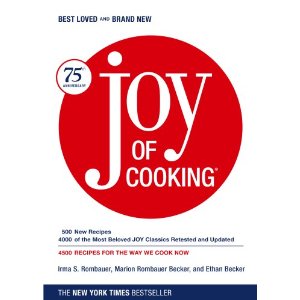
1 – Joy of Cooking – there should be a law that every home cook should have this book on their shelves since it pretty much has a recipe for everything in it. It has been updated about 14 times over its 75+ years in existence, but have some fun and get an edition that is printed before the 1960’s just to see how cooking has changed.
This type of steamer basket works best. You can get them at Amazon.com for about $8.
I do entirely too much reading of cookbooks. These days, I am not really looking for recipe ideas, more just to learn techniques. One thing that I hate to cook, but Mrs. Iron Chef loves to eat are potatoes. For me, they really are just a vehicle for adding stuff to it, much like chicken breast, so you go from healthy to unhealthy in a hurry since potatoes don’t inherently have much taste. For my End of the World meal, I was making beef stew served in a can, which I thought about it, and what goes better with beef stew than potatoes (well, celery root puree, sun choke puree…just humor me here). I took a hybrid technique from Modernist Cuisine and Cook’s Illustrated to come up with this recipe. This really isn’t much more difficult to do than making regular potatoes, but you will get better texture on them and you can actually do stage one in advance and finish them when you are ready to serve. When you are done, you should end up with potatoes that are creamy on the inside and crispy on the outside. The only special equipment you really need is a steamer basket.
The Software
1 large Yukon Gold potato, cut into ¼ inch slices
2 tablespoons fat (bacon fat, duck fat, butter or olive oil all work well. See note below)
Salt and pepper
The Recipe
Stage 1 – Fill a large pot with water to just below the surface of the steamer basket. Heat water over high heat until steam is visible. Add the potatoes to the basket in a single layer. Cover the pot and steam for 13 minutes. Check the potatoes for doneness – you are aiming for them to be slightly al dente and they should have leached their starch to the surface, so they will feel tacky. Remove them to a plate lined with a couple of paper towels and dry. It is important that the potatoes are dry before starting stage 2.
Stage 2 – Heat a large (12 inch) skillet over medium-high heat for 5 minutes (don’t use non-stick here). Add the fat and heat over medium-high heat until it just begins to smoke. Test the heat of the fat by dipping the edge of one potato slice in the fat. If it sizzles immediately, the fat is hot enough and you can add the potatoes in a single layer. If they all won’t fit in the skillet, you can do stage 2 in multiple batches. If the fat is not hot enough, continue heating it until you can get your test to sizzle. You are really just browning/reheating the potatoes and looking to get a golden crust on each side, so you probably won’t need more than about 2 minutes of cooking time on each side, checking after 1 minute to see the progress. After both sides are browned, remove to a cooking rack or a plate with a paper towel, season with salt and pepper to taste and serve right away. It pairs nicely with this Beef Carbonnade recipe.
Your end result should look something like this. You can also get really classy and serve it in a can, like I did.
Notes
You really want the potatoes dry before putting them in the fat since hot fat + water = bad news. Your cooking time will really depend on what type of fat you use. Animal fats (butter, bacon fat, duck fat) have a lower smoke point than vegetable fats (olive oil, vegetable oil), so they will reach that stage quicker and take longer to brown the potatoes, which is why you really want to check them after about the first minute. You can actually skip stage 2 if you want and just serve the potatoes steamed. Just increase the cooking time to about 16 minutes in the steamer. This dish would also benefit from the addition of some fresh rosemary, sage or thyme.


 FlatbreadGarden