My current favorite sandwich bread using Bread Flour, Rogue de Bordeaux flour, and sourdough discard. The recipe is easy:
600 grams flour total:
350 grams King Arthur bread flour (58% of the flour weight)
200 grams Rogue de Bordeaux flour (33%)
100 grams sourdough discard (50 grams flour (8% of the flour weight)/ 50 grams water)
370 grams room temperature water (with the water from the sourdough the total hydration is 70%)
12 grams extra-virgin olive oil (2% of flour weight)
12 grams kosher salt (2% of flour weight)
1 tsp instant (not rapid rise) yeast
Combine all ingredients in a mixer and mix on low speed for 8 minutes. Lightly spray a Pullman Pan and move the dough to the Pullman Pan, patting it down and spreading to the ends. Cover and let rise until the dough is 1″ from the top of the pan. Preheat oven to 350F.
Bake covered 30 minutes, then remove the cover and bake an additional 25 minutes. De-pan to a cooling rack.
1/3 of the flour by weight is the Rogue de Bordeaux. This seems to be a good ratio of whole wheat to regular bread flour. The bread has good structure. The Rogue de Bordeaux adds a lot of the flavor and cinnamon and baking spices. One neat thing is that it highlights different flavors in the sandwich depending upon the ingredients.
The Pullman Pan works well for the relatively extensible Rogue de Bordeaux. Using wet hands for all handling helps a lot.
The recipe is 200 grams King Arthur Bread Flour, 200 grams fresh-milled Yecora Rojo wheat flour, 336 grams cool water (84% hydration), 8 grams kosher salt (2%), and 1/4 tsp instant (not rapid-rise) yeast. Combine all in a bowl and mix until it’s a homogenous mass. Cover and leave on the counter.
I started the dough at 7pm the day before baking. At 11pm the dough was looking pretty feisty and had about doubled, so I did some Rubaud folds and put the container into the refrigerator, mostly because I preferred sleep over handling bread at that hour.
I did two more Rubaud folds at 1am and 4am, each time returning the dough to the refrigerator. At 4am the dough was still fairly shaggy but it was coming together. I removed the dough from the refrigerator at 6am and did coil folds at 6am, 7am, and 8am.
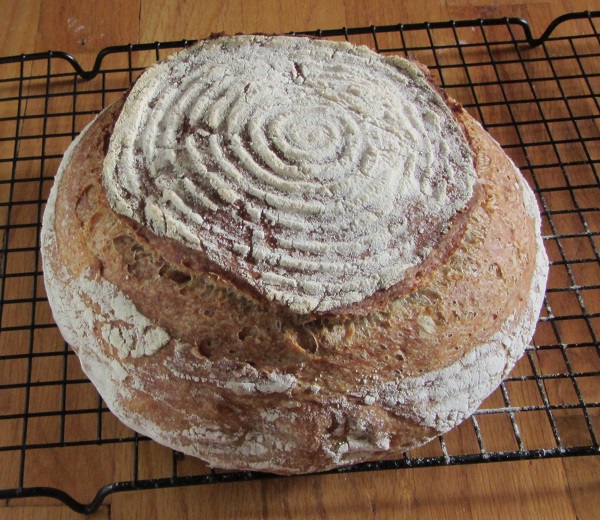
The dough was smooth and handled well after the 8am coil fold so I moved it to a covered banneton. At 9am I preheated the oven and our Le Creuset bread oven to 460F. At 10am the dough went onto a parchment and was slashed, then moved over to the bread oven. I reduced the temperature to 450F and baked the dough for 20 minutes covered, then 22 minutes uncovered. (The same time and process that I use for No Knead bread, though most times I’ll just go directly into the Le Creuset or a dutch oven rather than starting on parchment.) Cool on a baking rack.
The 84% hydration matches the Breadtopia recipe. The 1/4 tsp instant yeast matches my normal No Knead recipe. The bread measured 205F when I removed it from the oven which (again) is in-line with Breadtopia.
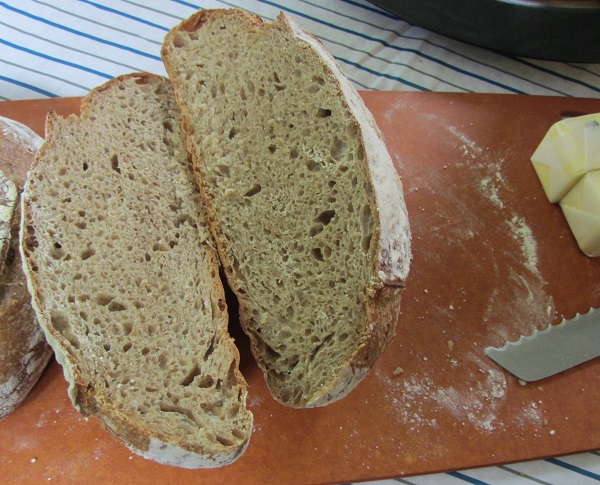
The bread was very moist. It had a decently open crumb, though it wasn’t quite as open as the pictures on Breadtopia. My feeling is that the dough could have possibly used another round or two of coil folds, but that was going to put the timing really close to when we needed to take it across town.
I was happy with the crust too, it had a nice bite to it but not “too much”. The next time around I’m going to try a little less flour in the banneton — I was probably too concerned with the dough easily releasing from the banneton so I may have overdone it a bit.
I don’t normally drop breads that I haven’t tested at all into a group setting, but I was reasonably confident everything had worked out and the bread was well received. So that was good.
The next time I’ll probably move the dough to the refrigerator after a shorter initial room temperature rise, then incorporate coil folds as soon as the dough will allow it. It might be the right answer is to do some Rubaud folds in the first hour prior to refrigerating overnight, then moving the dough back to the counter in the morning and using coil folds until the dough is ready.
Yecora Rojo is a Hard Red Spring wheat variety developed in the 1970’s. It’s my understanding that it’s used by some well-known bakeries and in flour blends for “artisan breads”. Last week I was buying wheat berries and Rogue de Bordeaux was not available, so I added Yecora Rojo to the Breadtopia shopping cart. I’m glad I did. It (predictably) functions well as an artisan bread flour. Based on one bake it’s not finicky to work with. The taste is not assertive and I think even people who Don’t Like Wheat Bread would eat it, especially if the percentage of Yecora Rojo was cut back to 20% or so.
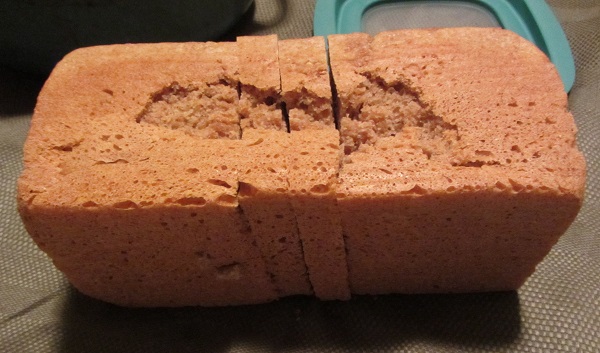
The last few loaves have wanted to stick to the sides of the loaf pan a little bit. This one took the sticking thing a little more seriously:
The pans themselves are no longer super duper new, and I haven’t been crazy fastidious about soaking the pans and cleaning out the old residue, so I probably deserved one that failed to release from the side. I did lightly oil the interior of the pan, but it may also need more oil than I’ve been using.
Another thing that might have contributed is the Red Fife flour combined with a longer bulk proof than usual — I let the bulk proof go a full two hours, followed by 45 minutes to an hour in the pan and the Red Fife might have started breaking down somewhat after that much time — I’ve read that Red Fife is prone to weakened gluten structure when given long proofing times. The crumb was more open than usual as well, which may be a sign of something, even if it’s just a looser crumb.
I’ve been experimenting with sometimes using Bread flour rather than AP flour and I’m leaning towards always using Bread flour going forward:
250g Bread flour and 250g fresh-milled whole wheat flour (Red Fife or Rogue de Bordeaux berries), (500g flour weight total). 375g water (75% hydration). 15g honey (3%), 15g olive oil (3%), and 15g (3%) powdered milk. 12g kosher salt (2.4% of the flour weight), 1.5 tsp instant (not rapid-rise) yeast.
Combine all ingredients. Knead on low speed for 8 minutes. (A prior hydration step is a potential and obvious improvement here.)
Cover and let rest one hour (two hours this time) for the dough to hydrate and proof.
Lightly oil the Pullman pan, pan lid, and a rubber spatula. Move the dough to the Pullman pan and spread it out with wet fingers or the spatula. Cover and let rise until 1/2″ from the top of the pan.
Bake at 350F, covered for 30 minutes then remove the cover and bake for another 25 minutes or until the loaf reaches 195-200F.
I own Flour Lab by Adam Leonti. On page 71 he presents his Yeasted Loaf recipe, where he suggests a wheat variety: “I like Red Fife”.
At the start of this process I didn’t consult the book, I just picked a Hard Red Winter Wheat from the pantry (Turkey Red) and then adjusted the ratios of the ingredients bake by bake looking for the most suitable bread for sandwiches. No matter what adjustments I made the bread was still vaguely crumbly and lacked the gluten structure and springiness to be a good sandwich bread.
So I got what I deserved. It’s always the better idea to Stand On The Shoulders Of Giants, then riff from there. And I know that, usually.
The bread above is made with Red Fife. It works great as a sandwich bread, and it has a more interesting taste profile than Turkey Red. Rouge de Bordeaux works great too, and to my taste it’s even more intensely flavored, aromatic, and interesting than the Red Fife. Both the Red Fife and the Rouge de Bordeaux taste even better after a couple of days after baking, which may be true for all whole wheat breads. Leonti specifically states in a few places to let the finished bread rest until the next day prior to cutting into it.
The recipe this time is intended to be as quick and easy as possible. I’m sure it can be improved but I was initially curious to see what Red Fife would do with no other steps than would be used with a quick same-day loaf:
250g AP flour and 250g fresh-milled whole wheat flour (Red Fife or Rogue de Bordeaux berries), (500g flour weight total). 375g water (75% hydration). 15g honey (3%), 15g olive oil (3%), and 15g (3%) powdered milk. 12g kosher salt (2.4% of the flour weight), 1.5 tsp instant (not rapid-rise) yeast.
Combine all ingredients. Knead on low speed for 8 minutes. (A prior hydration step is a potential and obvious improvement here.)
Cover and let rest one hour for the dough to hydrate and proof.
Lightly oil the Pullman pan, pan lid, and a rubber spatula. Move the dough to the Pullman pan and spread it out with wet fingers or the spatula. Cover and let rise until 1/2″ from the top of the pan.
Bake at 350F, covered for 30 minutes then remove the cover and bake for another 25 minutes or until the loaf reaches 195-200F.
Having poked around some bread forums, it seems I’m not alone in my experience that “Turkey Red Is Sort Of Crumbly And Maybe Not The Best Variety For Bread”. I’m not sure if I’m going to re-purchase it when I run out. For a Hard Red Winter Wheat it’s relatively neutral tasting, and I didn’t love the gluten structure. It may still be useful in situations where strong gluten or an assertive flavor is not desirable, so I’ll focus on using it other places before I make a final decision.
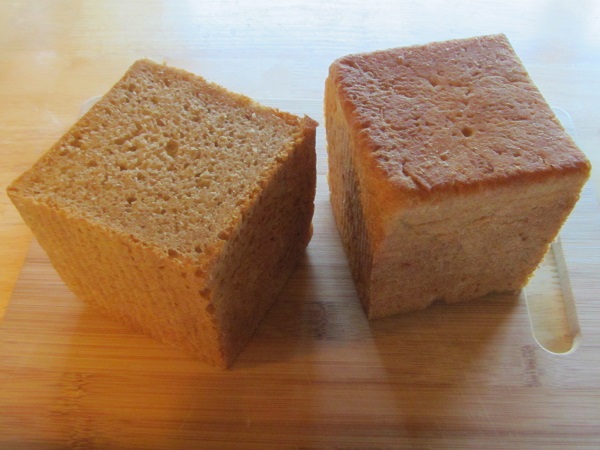
I’m pretty happy with the loaf at this point. It’s still vaguely more crumbly than I’d prefer, but the rest of it is good. The left-half has the crumb facing up:
It’s 250g AP flour and 250g fresh-milled whole wheat flour (heritage Turkey Red berries), (500g flour weight total). 375g water (75% hydration). 15g honey (3%), 15g olive oil (3%), and 50g (10%) powdered milk. 10g kosher salt (2% of the flour weight), 1.5 tsp instant (not rapid-rise) yeast.
As far as changes from where it started, it’s just been a continuous reduction in oil and honey from the original. The kneading has been cut way back. And the dough now goes directly from the mixing bowl to the Pullman pan. The current recipe:
Combine all ingredients. Knead on low speed for 1-2 minutes or until the dough comes together.
Cover and let rest one hour for the dough to hydrate.
Mix for 1-2 minutes. Cover and bulk rise until doubled.
Lightly oil the Pullman pan, pan lid, and a rubber spatula. Move the dough to the Pullman pan and spread it out with wet fingers or the spatula. Cover and let rise until 1/2″ from the top of the pan.
Bake at 350F, covered for 30 minutes then remove the cover and bake for another 25 minutes or until the loaf reaches 195-200F.
I think to a degree I’m at a bit of a inflection point for further improvements. I’ve tried a moderate amount of mixing and very little mixing, and the “little mixing” seems to work better. It may be that combining at least the flour with the water overnight in the refrigerator (or possibly all of the ingredients) may allow for a better finished product. Another obvious change would be to sift the biggest chunks of bran out of the whole wheat flour, though that’s something I don’t want to do, both for the loss of nutrients and the bit of hassle and things to clean up afterwards.
It may also be that Turkey Red isn’t the best grain from this application. I still have Rouge de Bordeaux and Red Fife to try out.
So it feels like more upcoming process changes, to what, I’m not sure. Which is a fine problem to have, relatively.
The newest formula is getting closer. The mouthfeel and taste are good. The crumb is still just a bit more crumbly than I’d prefer. An early morning picture of the top of today’s turkey sandwich:
It’s 250g AP flour and 250g fresh-milled whole wheat flour (heritage Turkey Red berries), (500g flour weight total). 375g water (75% hydration). 25g honey (5%), 15g olive oil (3%), and 50g (10%) powdered milk. 10g kosher salt (2% of the flour weight), 2 tsp instant (not rapid-rise) yeast.
Knead on low speed for 10 minutes. Cover and bulk rise until doubled. Flour the bench, the dough will be sticky. Pre-shape the loaf then move it to the Pullman pan. Cover and let rise until 1/2″ from the top of the pan. Bake at 350F, covered for 30 minutes then remove the cover and bake for another 25 minutes or until the loaf reaches 195-200F.
As for changes relative to the first attempts — I upped the milk powder and yeast and decreased the olive oil and honey. The increased milk powder is giving a better mouthfeel. The yeast is making the process a lot faster. The decreased honey is softening the crust, which is an improvement. I’ve decreased the oil and I haven’t missed it, so I left the quantity lower than the original 8% of flour weight.
I think the final piece of the puzzle may be either:
Combining the ingredients briefly, then letting the dough rest before mixing again — letting the fresh milled wheat hydrate before the actual kneading.
Kneading for a shorter time, about 4 minutes, then doing a series of folds in the bowl to promote gluten formation more gently than the mixer will do it.
I think the recipe part of the equation is very close. Now it’s the handling technique that needs to be better. That’s part of the fun of bread baking though — figuring out solutions. Which of course never ends.
600 grams of flour was too much. 400 grams of flour was not enough. This bake uses 500 grams of flour and adjusts the other secondary ratios somewhat.
The recipe uses 250g AP flour and 250g fresh-milled whole wheat flour, (500g flour weight total). 375g water (75% hydration). This time around I cut back on the “other stuff”: it uses 30g each of honey, olive oil, and powdered milk (all are 6% of the total flour weight, the old amounts had been 8%). 10g kosher salt (2% of the flour weight), 1 tsp instant (not rapid-rise) yeast. Bulk rise until doubled then move to the Pullman pan, cover and let rise until 1/2″ from the top of the pan. Bake at 350F, covered for 30 minutes then remove the cover and bake for another 25 minutes or until the loaf reaches 195-200F.
It’s sort of based on King Arthur’s A Smaller Pain De Mie. Or at least it was at the beginning of tinkering.
The newest version uses relatively less honey, olive oil, milk powder, and yeast. This is intended to make the end of the rise a little more predictable and controllable — with the earlier versions there wasn’t a ton of activity for the first 60 to 90 minutes, then things started to happen fast after that.
It should be more manageable but we’ll see how it tastes and ages after a few days. It may be the correct answer will be to restore “other stuff” to the original 8% and just cut back on the yeast and expect the whole pre-bake process to go slower and longer. I feel like it’s getting close to where it should be.
This time I used a total of 400 grams of flour and let the bread continue to proof to see how high it would rise. It never made it near the top of the Pullman pan and the bread wound up overproofed. It was otherwise tasty and fine, just not pretty. I’m still adjusting the quantity of flour and proofing time.
The formula is (again) based on King Arthur’s A Smaller Pain De Mie. (With some extensive modifications.) 200g AP flour, 200g whole wheat flour, (400g flour weight total). 300g water (75% hydration). 32g each honey, olive oil, and powdered milk (all are 8% of the total flour weight). 8g kosher salt (2% of the flour weight), 1 tsp instant (not rapid-rise) yeast. Bulk rise until doubled then move to the Pullman pan, cover and let rise until 1/2″ from the top of the pan. Bake at 350F, covered for 25 minutes then remove the cover and bake for another 22 minutes or until the loaf reaches 195-200F.
The baking times are longer than in the original recipe but that seems to be how long it takes.
The next bakes will center on 450-500 grams of flour. Hopefully that’s the “sweet spot”.
Many of years of blogging and this is my first post on a February 29th.
I recently purchased a pair of 9 x 4 x 4 Pullman Loaf Pans with the idea that I’d make sandwich loaves for lunches at work. The Pullman pans are good for other breads too but sandwich loaves were the main impetus for the purchase. Coincidentally.. on January 12 Dave at HappyAcresBlog posted about his year of bread baking and mentioned that in 2010 they’d decided to bake all of their own bread for the year and they’ve kept it up since then.
Which made me think, why not us? We have the materials and knowledge and it’s not really that time consuming. It would mean redirecting energy (or lack of energy) on Sundays but we’d gain the benefit of fresh baked healthy breads. It’d give me a reason to bake something with fresh milled wheat berries more regularly.
As of right now I’ve settled on a sandwich loaf with 50% AP flour and 50% fresh milled wheat. Today’s bread utilizes a Hard Red Spring wheat:
The small crack along the top is where I slashed the dough. As it turns out the bread doesn’t need a slash and won’t receive one next time.
The jumping off point for today’s formula is King Arthur’s A Smaller Pain De Mie. (With some extensive modifications.) 300g AP flour, 300g whole wheat flour, (600g flour weight total). Then to make it easy to remember: 450g water (75% hydration). 48g each honey, olive oil, and powdered milk (all are 8% of the total flour weight). 12g kosher salt (2% of the flour weight), 2 tsp instant (not rapid-rise) yeast. Bulk rise until doubled then move to the Pullman pan, cover and let rise until 1/2″ from the top of the pan. Bake at 350F, covered for 25 minutes then remove the cover and bake for another 15 minutes or until the loaf reaches 195-200F.
This is my 3rd or 4th attempt using these pans and it’s the first time the finished bread has gone all the way to the top of the lid. My feeling is that the previous attempts used too little flour, or I didn’t proof the dough long enough given that the house temperature sits in the high 60’s this time of year. This time I let the dough rise in a warm part of the kitchen near a heater vent and that seemed to help out quite a bit.
As for the upcoming iterations: It may be that closer to 500g of total flour will make a better loaf. I’ve also seen orange juice recommended for a small percentage of the water which is supposed to cut the “wheaty taste”, so that might be something to try just to see. How long to leave the bread covered in the oven will be another variable that needs to be looked at, the water needs to evaporate out, especially at the high hydration that I used on this bake.
Overall: Success with room for growth.
Late edit, February 24: 600 grams of flour is defintely too much. This week the dough rose much more than usual and it expanded in the oven so much that the dough extruded in a thin sheet about a foot long out of one end of the pullman pan. Which fortunately didn’t make a mess or catch on fire. 400-500 grams of flour is more the correct.
—-
The loaf pans are manufactured by USA Pan. They receive good reviews everywhere I’ve looked and they’re working well for us so far. The pans were sold as one for $42 or a pair for $45. We now own two pans.
We were recently invited to a dinner party that involved dishes from a variety of cultures and places, sort of focused on North Africa and the Fertile Crescent. We brought naan. Pictured is a triple recipe to generously serve ten people:
The white girl kitty inspecting the naan.
I’ve made naan or naan-like things a number of times and basically winged it with decent-to-good results. This bake was for a discerning crowd so I wanted to use an actual recipe as a starting point to help ensure things didn’t go too far off the rails.
Ultimately I chose between Kenji’s Grilled Naan recipe on Serious Eats and a King Arthur website recipe. Kenji’s recipe calls for using an outdoor grill, so I mostly went with the King Arthur recipe because we were cooking on a grill pan instead of live fire. I used Kenji’s recommendation of bread flour instead of a mix of flours.
First, the King Arthur formula as written:
180g King Arthur AP Flour, 90g King Arthur Bread Flour, 142g warm water, 71g Full-Fat Greek Yogurt, 28g melted ghee or butter, 1-1/2 teaspoons Active Instant Dry Yeast, 1 teaspoon granulated sugar, 1 teaspoon salt. Full recipe here. …After baking brush with butter and top with nigella seeds and cilantro.
My slight modification that includes honey and uses Baker’s Percentages:
270g King Arthur Bread Flour, 142g warm water (52% of flour weight), 71g Full-Fat Greek Yogurt (26%), 28g melted ghee (10%), 1-1/2 teaspoons Active Instant Dry Yeast, 2/3 teaspoon honey, 5g (scant 2%) salt. Combine all in a mixer for 6 minutes on low speed.
Cover and let rise until doubled, about 60 minutes.
Divide into ~100g balls. (The original recipe calls for 65g, which I felt were too small for that event.) Let the dough balls rest 20-30 minutes.
Preheat grill pan to medium/medium-high.
Very lightly oil a work surface roll out a dough ball to 8-10″ long. Then roll the next ball as the one on the stove is cooking. Resist the urge to roll out very thinly — the center may burn instead of bubbling.
Bake the first side about 45 seconds — until it the dough bubbles, then flip and bake another 45 seconds or until the naan is just cooked through. (Cooking them too long makes them tough.)
After baking brush with ghee and top with minced chives.
For transport we put a cooling rack on the bottom of a sheet tray, then piled on layers of naan with each level separated by parchment paper. We wrapped the entire thing in foil. Shortly before dinner the naan was reheated in a low oven while still wrapped in the foil.
Thoughts:
I’d never made ghee, but it’s super easy. There are tons of recipes online but basically you just heat butter until warm/very warm, skim the surface until the solids drop out, strain. Done. We heated a couple of smashed garlic cloves in the finished ghee for a little background sense of garlic.
The naan was well received at dinner, so that part went well. I think the King Arthur recipe calls for too much liquid — I wound up adding a few tablespoons of flour and then a pinch of salt to keep the balance. If I had it to do over again I would have held back about 1/3 of the water initially to see how the dough shaped up.
I sort of feel like that’s not-uncommon in bread baking and recipe writing — too much liquid in the formula that then combines with generous amounts of bench flour to compensate. As a rule I try to do the opposite and incorporate as little raw flour as possible, which then also helps maintain the balance of the recipe. That’s why in Step #4 it calls for a lightly oiled surface, rather than floured or heavily floured.
Ten people ate twelve of the fifteen naan. Little or No Leftovers = Successful Recipe. I’ll use this one again.




 FlatbreadGarden