Mythcrushers – The NJ Edition

By Iron Chef Leftovers

A friend recently posted a link to an article titled “11 Things Only People from New Jersey Understand.” Being a long-removed Jersey boy myself, I thought it was an interesting list, but one, alas that definitely had some misconceptions, even if it was written by a Jerseyite. What does this have to do with a blog on food, sports and games, you might ask? Well indulge me a minute.

2. There Are Certain Foods You Can Only Eat When You’re In New Jersey

The list of things I have to eat when I’m in New Jersey, and try not to eat anywhere else are:

  • Bagels
  • Pizza
  • Corn
  • Tomatoes
  • Salt Water Taffy

I’m a total Jersey food snob because the rest of the country just doesn’t make them the same. And then there’s the ultimate NJ dish that doesn’t even exist anywhere else…

Ok. I want to bust this myth completely since I have heard it all of my life and it is simply not true. First off, corn and tomatoes make no sense. Yes, NJ is called the Garden State for a reason, but you can get stellar corn and tomatoes IN SEASON just about anywhere these days. The in season label applies to NJ also. Let’s face it, unless you spend half your year in the southern hemisphere, there is about a 2 month window for getting good tomatoes, and rarely they are from the local meagmart. Any farmer’s market will carry great produce in season, or just do what Coltrane and I do – grow them yourself.

Anyone that says you can’t get great pizza or bagels outside of NY/NJ is just being a snob. I actually know people who would laugh at the idea of eating pizza and bagels outside of NYC as a silly concept, so there are levels of snobbery here. Everyone who grows up in NJ has their favorite pizza place, most likely one that is currently being run by the 4th or 5th generation of an Italian family. I can think of at least a half-dozen excellent, non-Neapolitan pizza places in Seattle that make a pretty good version of a NY/NJ pizza.  I have had some truly terrible pizza also, but that is another story. Is it exactly the same, no, but I never expect that someone is going to make a pizza exactly like Pompeii Pizza in Bayonne, NJ. Heck, none of the other pizza places in Bayonne (and there are a ton of them) make a pizza exactly like Pompeii. I guess what I am trying to say here is that, while pizza in NJ may be the best on the planet, there are plenty of excellent versions of it in other cities, you just need to spend time looking.  The same thing applies to bagels.

I will just skip salt water taffy – it isn’t something I particularly love to begin with and I have had equally uninspiring versions of it elsewhere.

3. The Mere Mention Of Taylor Ham, Egg, And Cheese On A Roll Activates Four Different Regions Of Your Brain

Taylor Ham is the single best brand of pork roll available on the market. Taylor literally invented it. For this reason, it is not appropriate to call it pork roll–you must call it Taylor Ham in homage to John Taylor. Calling it anything else is disrespectful to the master.

Taylor Ham is definitely something that you will not find at a restaurant/deli anywhere else in the country. Heck, you are hard pressed to find anyone outside of the NYC/NJ/Philly area that even has any idea what Taylor Ham is. It is, for lack of a better description, a bastardized version of Canadian Bacon (the meat, not the movie). Strangely, while I can’t remember seeing it on any menu anywhere I have ever been outside of NJ, I can occasionally get it and scrapple (a hyper-local Philly specialty) at Ballard Market in Seattle. I have no idea why, but I can if I want to make it at home.

9. The Best Time To Eat At A Diner Is 2 a.m. When You’re Drunk With Your Best Friends

There’s only one type of non-chain eatery that has consistently good food at any time of the day and that’s a New Jersey diner. I remember going to the Chester Diner at 2 a.m. after working the late shift at the Chester Movie Theater and meeting friends for a gyro and pancakes. And you know what, they would taste exactly (amazingly) the same if I went at 2 p.m. on a Sunday after church. It’s a marvel of modern Americanized Greek technology.

Diners are just the best. Period

I grew up a half block from a diner and yes, there were many drunken late nights with friends eating really crappy food at 2 AM. Diners don’t seem to exist much outside of the east coast and are pretty much non-existent on the west coast and I do miss them, especially when I want breakfast for dinner. Like pizza places, everyone in NJ has their favorite place that has been there forever and still probably has the 40 year old personal juke boxes mounted to the wall in the booths.

10. Worshiping Bruce Springsteen And Bon Jovi Is Just A Natural Part Of Growing Up

Ok, this has nothing to do with food and maybe things have changed in the 25 years since I moved from NJ, but Bon Jovi was always considered to be a bad joke, not an idol. The Boss however, that is a different story. Springsteen is just about as close to a god as you can get in the state. I have seen The Boss play in 7 different cities, and none of those concerts came close to the energy of the 4 hour marathon he played in 1993 in NJ on the Human Touch/Better Days tour in front of the home crowd. Did I mention that the show I went to happened to be the 8th of 10 shows in 12 days he played in NJ, and he played for 4 hours? Yep, it was the most energized concert I have ever seen. Either way, it should tell you where Springsteen ranks in the NJ idol list – he is The Boss. When you say The Boss in NJ, everyone knows who you are talking about. I can honestly say that I have never had a conversation with anyone in NJ about how great Bon Jovi is.
The Next Big Thing in Chocolate

By Iron Chef Leftovers

If you like chocolate, you should really pay attention to where your chocolate is being sourced. Most of it is poor quality, purchased in bulk and is produced with unethical labor practices. Fortunately, there has been an alternative that is catching on (finally) in the chocolate world called bean-to-bar. It isn’t a new concept, but one that is finally becoming more mainstream. Here is how it works in an overly simplistic way:

A chocolate company decides it wants to make a bar with beans sourced from say Ecuador. The chocolate maker goes to Ecuador and talks to farmers and selects some that they would like to work with. The chocolate maker and the farmers collaborate on producing the best quality crop (over quantity) they can produce. The chocolate maker purchases the higher quality product at a significantly higher price than the going bulk rate (as much as 8 times the going bulk rate for the best quality beans) and makes their bars from that cacao.

Basically bean-to-bar is a direct trade between the farmer and the chocolate maker. It has become hugely popular in the U.S. thanks to Theo Chocolates, but there are now dozens of chocolate makers doing the same thing, many of them very small producers. One of my favorites is Mindo out of Dexter, Michigan. The owners spend part of their year working directly with the farmers in Ecuador (all of their chocolate is sourced from there), so they have a truly personal relationship with the process.

The trend seems to be catching on elsewhere, as evidenced by a recent article in the UK paper The Telegraph:

No longer is it sufficient for a smart bar to proclaim – as Green & Black’s do – that its contents are merely organic. Nor will it raise much interest among the chocolati to declare that your bar is artisanal or hand-wrapped, or that the cocoa within comes from a single estate. Worthy though all these considerations are, they are being swept aside by the latest trend in chocolate: bean to bar.

Let there be no mistake. Organic is good, and compared to the sugary slop mass-produced by Cadbury and Hershey, Green & Black’s (owned by the multinational Mondelez) is decent stuff.

Single origin bars, whose beans come from a particular location, are now becoming hugely popular, and supermarkets are making their own. So long as the farmers producing the beans are fairly rewarded and decent labour standards are maintained in production, there is nothing sinister about this either. But as it becomes easier to buy “good” chocolate, so the search for the best becomes more refined. True connoisseurs now like to pursue products that are not concocted from bought-in-bulk chocolate, but in which the whole process, from the grinding of the bean to the moulding of the bar, has occurred in one spot, under the care of one group of people: “bean-to-bar” chocolate.

I have had many conversations with small chocolate producers over the years and they all believe their biggest challenge is trying to convince consumers that paying $6 for a 2 oz. bar of chocolate is something they should be doing. Their product is infinitely better than the mass produced crap, but the price point is a tough sell. How tough? Well take a look at what I found last year when looking at dark chocolate prices:

Type Producer Cost Per Bar Bar Size Cost Per Pound
Mass Produced Hershey’s $1.19 1.55 oz $12.28
Fair Trade/Organic Endangered Species $3.25 3.00 oz $17.33
Bean to Bar Mindo $2.75 1.05 oz $41.90
Bean to Bar Theo $4.00 3.00 oz $21.33
Farmer Owned Kallari $5.99 2.46 oz $38.96


Theo is large for an artisanal producer and gains a great deal in economy of scale when shipping cacao from its source back to the US. The transportation cost is actually the biggest cost to a chocolate maker and even with the scale, Theo costs twice what Hershey’s does.  There are other advantages that offset price – bean-to-bar producers are making chocolate that is infinitely better tasting (better taste means you eat less in one sitting) and they are improving the quality of life for the farmers that they work with. If you doubt me, come with me to the NW Chocolate Festival in September. I will introduce you to the people who are on the ground working directly with the farmers. They tell their story much better than I ever could.

If you really want to be on the cutting edge of chocolate, purchase it from a Farmer Owned Co-op, like Kallari or Grenada Chocolate Company. The farmers control the entire process from the bean to bar and all of the profits are invested directly back into the local communities where cacao is grown.

No-Fuss Roasted Potatoes

By Iron Chef Leftovers

Potatoes are not one of my favorite things to cook or eat since they act as more of a flavor vehicle for what they are cooked in rather than having a great deal of inherent flavor on their own. Mrs. Iron Chef however loves them so I do occasionally make them, but I am constantly looking for new ways to cook them.  I came across an easy, no-fuss, one pot recipe on America’s Test Kitchen that I figured was worth a shot. Basically it calls for braising the potatoes first and then searing them, but it didn’t involve even taking them out of the pot, and only a couple of ingredients, so it really doesn’t get too much easier than this.

The Software

1 lb. Red Potatoes, roughly 1 to 1 ½ inches in diameter, washed and halved

1 cup water

3 cloves of garlic, peeled

2 teaspoons of salt

3 tablespoons of unsalted butter, in 6 pieces

1 tablespoon, fresh squeezed lemon juice


The Recipe

Arrange the potatoes in the bottom of a skillet (don’t worry about over-crowding, it won’t matter, I used a 10 inch, straight sided skillet) so that all of the cut surfaces are in contact with the surface of the pan. Add the water (it should come up about half way on the potatoes, add more water if necessary), butter, salt and garlic to the pan. Turn burner on high and heat the skillet until the water comes to a boil. Reduce heat to medium and cover for about 15 minutes. Check if the potatoes are cooked after 15 minutes (a knife inserted should pull out easily), if they are not, cover until they are. Once the potatoes are done, remove the lid and remove the garlic to a bowl. Increase heat to medium high and continue cooking until the bottoms of the potatoes are golden brown – all of the water will evaporate leaving just the butter (this should take 10-15 minutes depending on your stove). While this is happening, mince the garlic and combine with lemon juice. Once the potatoes are done, remove from heat and toss in garlic and lemon. Season with salt and pepper to taste and serve.


Notes

I would recommend using a non-stick skillet for this process to keep the potatoes from sticking to the bottom of the pan. The recipe scales easily, just put enough potatoes to fit in the pan and add enough water to come up half way on the potatoes. You probably won’t need to add more butter unless you use something larger than a 12 inch skillet. Fresh rosemary, sage, thyme or oregano would work well with this recipe. Just mince them and add them at the end with the garlic.

Wine Reviews On CSE

By Iron Chef Leftovers

After much negative feedback and just a general lack of qualities in the reviews, we have decided to fire Larry LeCroc and have taken appropriate action to sack the parties responsible for hiring him in the first place.

They haav bean replaced weeth a noo stav to doo win revoos.

The staff responsible for sacking the wine reviews have been sacked. As it turns out, they were the same people responsible for the great credit fiasco a number of years ago. I need to do a better job of vetting our employees and I can assure you that this should never happen again.


Yes – I went a long way for this joke.

Taking a Chance on Wild Game

By Iron Chef Leftovers

I have to give some props to the Quebecois government. The French speaking part of Canada has the right mindset when it comes to food – they allow the production of unpasteurized milk cheese and allow the import of it (making it the only place that I know that you can legally get it in North America, although you still can’t transport it back across the border), it is about the only place in North America where you can find horse and seal on the menu and now they are allowing a trial period to let chefs serve wild game (critters actually hunted in the forest, not their farm raised cousins) in their restaurants.

From the Montreal Gazette:

…the plan will evolve gradually and under strict supervision by the wildlife and agriculture departments to ensure that no animal species is endangered and that food safety is assured. For now, only white-tailed deer from Anticosti Island in the Gulf of the St. Lawrence, home to more than 160,000 of the animals, will be allowed for sale. The squirrel, hare, muskrat and beaver, will come from all over the province, but will be available only for a short period during the fall hunting season. Blanchet said only species whose numbers were not endangered and which are known to be free of bacteria or illnesses harmful to humans were chosen for the pilot project.

There are a small number of restaurants that are participating in the trial period, most notably Toque, Au Pied de Cochon and Joe Beef. For those of you who are not familiar with the Montreal restaurant scene, those are arguably the 3 best restaurants in the city and the chef/owners of all 3 of those places are avid hunters/raging alcoholics/complete nut jobs. They have also long been on the leading edge of localvorism, nose to tail eating and sustainable food raising practices, so why not be on the bleeding edge when it comes to wild game?

You want a good reason for this:

Laprise (ed. Note: chef/owner of Toque) said allowing restaurants, and eventually specialty grocers and butchers, to sell wild game will also reduce waste. He cited figures indicating that only as little as 40 per cent of all meat from the 26,000 to 28,000 wild deer killed during the annual hunt is butchered and cooked. The rest is left in the woods or by the roadside and goes to waste.

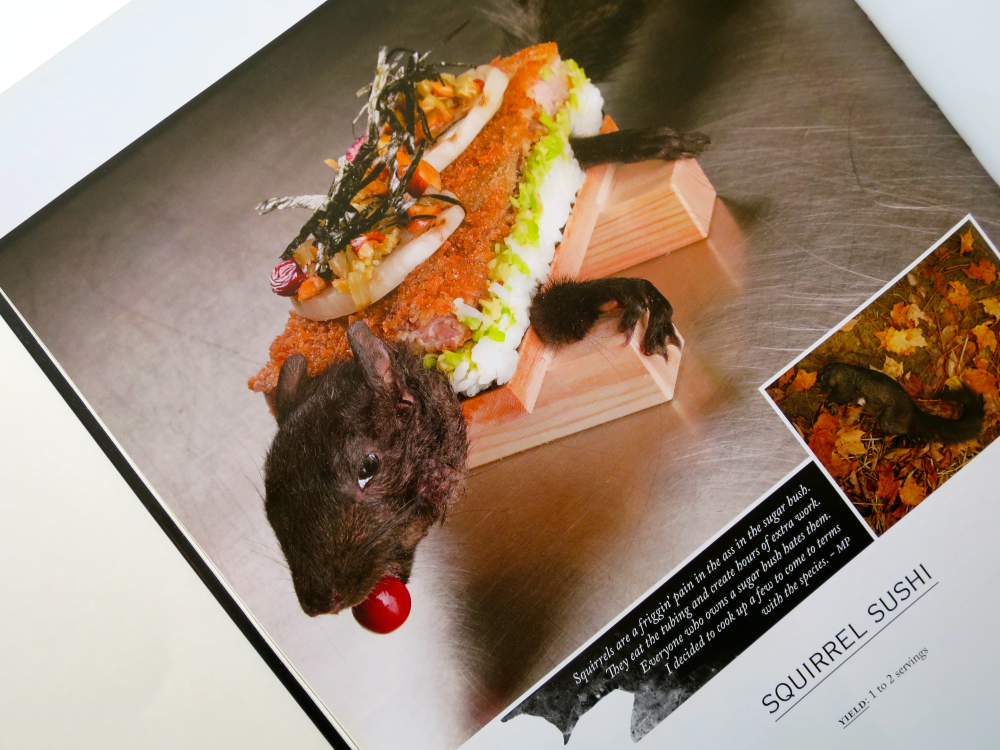
Of course, Martin Picard of the absolutely amazing Au Pied de Cochon and head psychopath of the Montreal food scene was already ahead of the game game when he published a recipe for squirrel sushi in his Sugar Shack cookbook:

The sushi dish, he wrote in the introduction to the squirrel recipe, was his way of getting even with the little rodents for all the damage they inflicted at his sugar shack.

It looks something like this:

squirrel-sushi


Idaho – Famous…Wines?

By Iron Chef Leftovers

I would have never guessed that Idaho isn’t just a wine region, they grow potatoes and have tons of outdoor activites too!

This funny video was put together by the Idaho Wine Commission. It is worth the 3 minutes of your time to watch it.

UK Restaurant Thefts

By Iron Chef Leftovers

I have head of thieves breaking into restaurants to steal booze, money and food (yep – there is a major black market for spendy ingredients), but furniture, and just the furniture, that is a new one:

A Thai restaurant has been “left one chair” after almost all its furniture was taken in an “unusual burglary”, police have said.

Thirteen tables and 25 chairs were taken from The Thai Cafe in Saltford, near Bath, between 12 and 15 January.

Police said there was “no clear explanation” for the theft, but the items may have been stolen “to order”.

Really? They left one chair? Why?

It gets a little more odd:

Mr Appleby, who took over the restaurant 10 years ago, said the theft was “weird” as no wine, beer or spirits had been taken.

“The chairs were quite old, 12 to 13 years old, they came with the cafe,” he said.

Hmmm. Maybe it is the New Yorker in me, but this sounds a bit fishy.

Chewy Chocolate Brownies

By Iron Chef Leftovers

I don’t generally like to bake, partially because I hate following recipes and partially because I usually end up eating too much of the finished product. However, when it comes to parties, it is nice to have something sweet on hand that can feed a large number of people easily, and brownies fit that bill very well. The better the chocolate used in these, the better the brownies will be. There are so few other ingredients that you will actually be able to taste the more subtle flavors that the chocolate will carry, so use one that you like the taste of when eating it on its own. The recipe is adapted from Cook’s Illustrated.

The Software

The Recipe

  1. Adjust oven rack to lowest position and heat oven to 350 degrees.
  2. Make a Foil Sling using the following steps: Cut 18-inch length foil and fold lengthwise to 8-inch width. Fit foil into length of 13 by 9-inch baking pan, pushing it into corners and up sides of pan; allow excess to overhang pan edges. Cut 14-inch length foil and fit into width of pan in the same manner, perpendicular to the first sheet (if using extra-wide foil, fold second sheet lengthwise to 12-inch width). Spray with nonstick cooking spray.
  3. Whisk cocoa and boiling water together in large bowl until smooth. Add unsweetened chocolate and whisk until chocolate is melted. Whisk in melted butter and oil. (Mixture may look curdled.) Add eggs, yolks, and vanilla and continue to whisk until smooth and homogeneous. Whisk in sugar until fully incorporated. Add flour and salt and mix with rubber spatula until combined. Fold in bittersweet chocolate pieces. (this may seem like a bunch of steps, but it comes together very quickly)
  4.  Scrape batter into prepared pan and bake until toothpick inserted halfway between edge and center comes out with just a few moist crumbs attached, 30 to 35 minutes. Transfer pan to wire rack and cool 1½ hours.
  5. Using foil overhang, lift brownies from pan. Return brownies to wire rack and let cool completely, about 1 hour. Cut into 2-inch squares and serve.


Notes

This is a very easy recipe and makes a big pan of chewy, dense, intensely chocolaty brownies, just prep everything in advance. These are nice with a small sprinkle of sea salt on top, but really just work fine on their own. I like using chocolate in the 70-85% range for this (my preferred chocolate is Kallari), but the original recipe calls for 60%, so you can use that. I wouldn’t use chocolate under 60% (the brownies will be very sweet) or over 85% (never tried this, but I suspect that the chocolate chunks won’t end up melting enough). The notes from the Cook’s Illustrated recipe:

For the chewiest texture, it is important to let the brownies cool thoroughly before cutting. If your baking dish is glass, cool the brownies 10 minutes, then remove them promptly from the pan (otherwise, the superior heat retention of glass can lead to overbaking). While any high-quality chocolate can be used in this recipe, our preferred brands of bittersweet chocolate are Callebaut Intense Dark Chocolate L-60-40NV and Ghirardelli Bittersweet Chocolate Baking Bar. Our preferred brand of unsweetened chocolate is Scharffen Berger. Leftovers can be stored in an airtight container at room temperature for up to 4 days.

Sausage Dressing without the Turkey

By Iron Chef Leftovers

I am not much of a traditionalist when it comes to Thanksgiving – I really don’t care for turkey (have had too many bad ones over the years and that is inexcusable – turkey is easy to cook, of course, I am there if you are going to serve wild turkey, either the bird or the booze), stuffing (especially the store bought stuff) or cranberry jelly. I would much rather have a traditional Thanksgiving of deer, game bird and small furry woodland creatures; pretty much what would have been served at the actual first Thanksgiving. I still get roped into making the traditional meal and my sister-in-law usually requests my stuffing, and lots of it for leftovers. The beauty of this stuffing recipe is that it doesn’t require it to be stuffed into a turkey cavity (the idea is that you butterfly the bird and put it on top of the tray of stuffing so the juices drip down), so you actually don’t need to make a turkey at all to enjoy stuffing (the directions are for if you aren’t cooking a bird with the stuffing). The plus side is that it is easy to make, produces a sufficient quantity (the recipe feeds 12 in theory) and reheats well. I adapted this from the original Cook’s Illustrated recipe.

The Software

  •  18 cups 1-inch challah or Italian bread cubes (from about 1 1/2 loaves)
  • 2 cups turkey stock or chicken stock
  • 1 cup half-and-half
  • 2 large eggs, beaten lightly
  • 1 ½ lbs mild Italian sausage
  • 3 cups onions, chopped fine – I prefer sweet onions here
  • 1 ½ cups celery, chopped fine
  • 2 tablespoons unsalted butter
  • 2 tablespoons minced fresh thyme leaves
  • 2 tablespoons minced fresh sage leaves
  • 3 medium cloves garlic, minced or pressed through garlic press
  • 1 ½ teaspoons table salt
  • 2 teaspoons ground black pepper


The Recipe

  1. Adjust one oven rack to upper-middle position and second rack to lower-middle position and heat oven to 250 degrees. Spread bread in even layers on 2 rimmed baking sheets and dry in oven 40 to 50 minutes.
  2. Place bread in large bowl. Whisk together stock, half-and-half, and eggs in medium bowl; pour over bread and toss gently to coat so bread does not break into smaller pieces. Set aside.
  3. Heat heavy-bottomed, 12-inch skillet over medium-high heat until hot, about 1 1/2 minutes. Add sausage and cook, stirring occasionally, until sausage loses its raw color, 5 to 7 minutes. With slotted spoon, transfer sausage to medium bowl. Don’t drain the fat. If there isn’t much in there, add a tablespoon of olive oil.  Add about half of onions and celery to fat in skillet; sauté, stirring occasionally, until softened, about 5 minutes. Transfer onion mixture to bowl with sausage. Return skillet to heat and add 2 tablespoons butter; when foam subsides, add remaining celery and onions and sauté, stirring occasionally, until softened, about 5 minutes. Stir in thyme, sage, and garlic; cook until fragrant, about 30 seconds; add salt and pepper. Add this mixture along with sausage and onion mixture to bread and stir gently to combine, trying not to break bread into smaller pieces.
  4. Spray disposable aluminum 12 by 16-inch roasting pan with nonstick cooking spray. Transfer dressing to roasting pan and spread in even layer. Cover pan with foil and refrigerate until needed. It should be good in the fridge for up to 24 hours. Remove from the fridge about 45 minutes before cooking.
  5. In a 400 degree oven, cook the dressing covered for 80 minutes covered, rotating the pan after 40 minutes. The internal temperature should be about 150-155 degrees. Uncover, increase heat to 450 degrees and cook until the surface starts to become golden (keep an eye on it, it can burn), about 10-15 minutes. Let stand for 5 minutes, plate and serve.

Notes

The original recipe called for just 12 oz. of sausage, which really didn’t seem like that much. I like the flavors Italian sausage brings to the party, but you could certainly use any sausage that you like. I would highly recommend using turkey stock if you are making this, even if you roast a bird on top of it, I think it has better flavor than chicken stock, plus then you can make turkey gravy to put over it. If you want to make it vegetarian or vegan, it is easy – I have made this using vegan sausage and it works. You just need to use oil in the pan for sautéing the sausage and veggies and replace the meat stock with veggie stock; everything else would be the same. I prefer Italian bread to challah just because it is easier to work with. Oh yeah, the recipe actually scales down pretty easily if you don’t want too much leftover stuffing.