A Focaccia, A Braided Challah, And Sort Of King Arthur Big Batch Quick Dinner Rolls

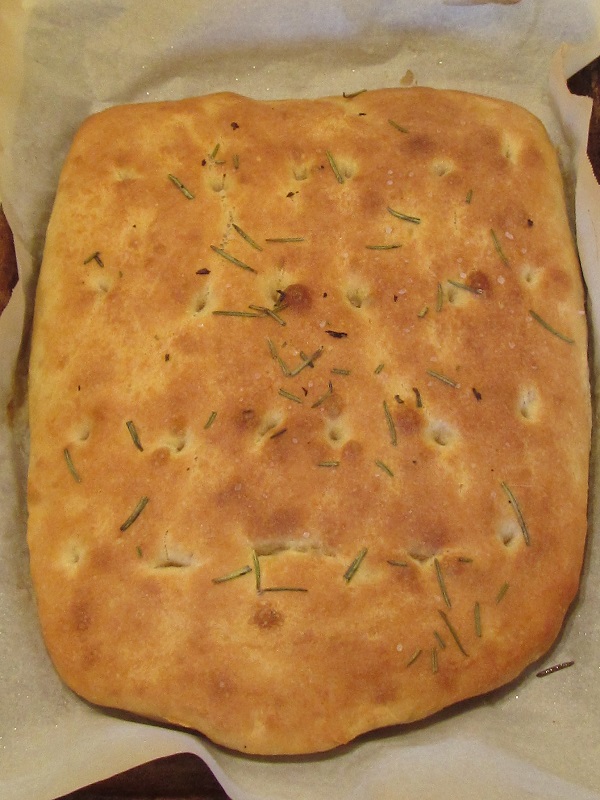
Three breads over three days. I started the day before the first bakes by making two poolishes.  One was made with AP flour, the other was bread flour. Each contained 600g flour and 600g water — 2400 grams in total. Both poolishes received a 24-hour rise on the counter. At that point I made the (below) challah and dinner rolls, but that didn’t use up all of the poolish. The remaining poolishes went into the refrigerator and three days later were used up in this focaccia:
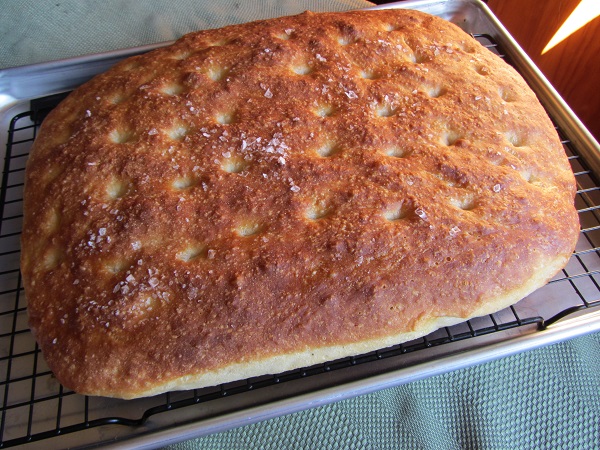
The leftover poolishes totaled 1000 grams; right around 500g of the AP poolish and 500g of the bread flour poolish. In theory that means what remained contained 500 grams of water and 500 grams of the mixture of flours. 

To that I added 500g bread flour, 250 grams water, 20 grams kosher salt, 30 grams olive oil, and 2 teaspoons of instant (not fast acting) yeast.  The bakers percentages come out to 75% hydration, 2% salt, 2% oil. Mix everything for 8 minutes, then cover and allow to rise for two hours. De-pan to an oiled and parchment-lined sheet tray. Oil the top of the dough, poke into the dough all over with your fingers, and cover and let rise another hour. Prior to baking sprinkle on flaky salt, rosemary, or whatever topping is preferred. Bake at 450F for 25-35 minutes. I used an additional sheet tray to the bottom to prevent the bottom from getting too dark.

Next up, but baked first in reality is the challah.
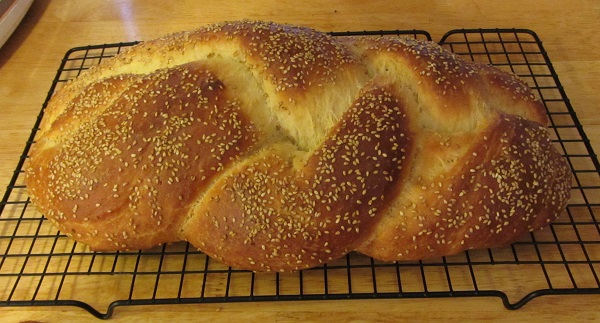
Historically I’ve used either a Michael Ruhlman recipe or a Peter Reinhart recipe. The link to the Ruhlman recipe that I’d refer to was broken so I went with: ~800g poolish (400g bread flour, 400g water), an additional 400g bread flour, 1 egg + 1 yolk (reserve white for egg wash), 50g water, 50g room temperature butter, 14g kosher salt, 2 teaspoon instant yeast. Mix for 8 minutes on low speed. Cover and let rise 1.5 hours. Divide into three braids about 18″ long. Braid. Cover and let rise 1 hour. Make an egg wash of the egg white + 1 TBP water. Brush over the challah, sprinkle on sesame seeds. Bake 30-40 minutes at 425F. I should have used a 2nd sheet tray under this one, the bottom was vaguely overdone though nobody complained.

Last up are the dinner rolls, which were based on this King Arthur Big Batch Quick Dinner Rolls recipe. The differences were that I was using an AP flour poolish. And I didn’t want them quick.
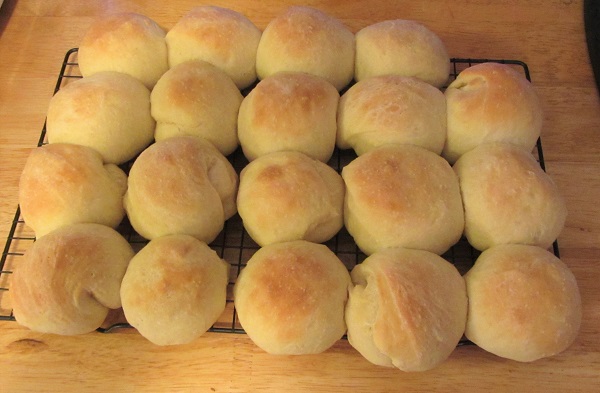
  1. minutes until a soft, smooth ball of dough is formed. The dough should feel elastic and slightly tacky to the touch.
  2. Lighly oil the dough and the bowl and let rise for 1-2 hours at room temperature or until the dough is full and puffy.
  3. You can place the rolls into one Silpat lined (or parchment lined) sheet tray.
  4. After the rolls are in the tray, cover with an inverted sheet tray and let rise at room temperature for another 1-1.5 hours, or until well rounded and full looking. Preheat the oven to 350°F.
  5. Bake the rolls for 20 to 25 minutes or until golden brown and an internal thermometer reads 190°F. You can brush the baked rolls with melted butter if desired. (I chose not to, since I wasn’t serving immediately. We reheated the rolls for serving.)
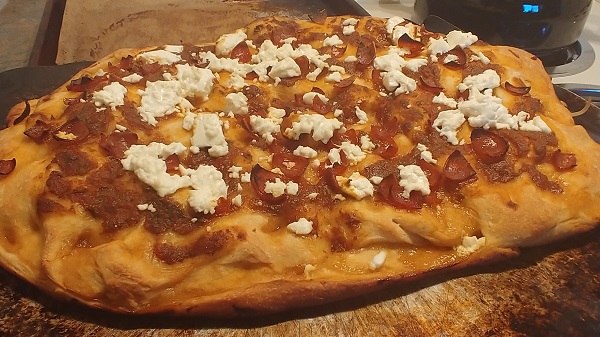
An Italian Tomato Pie – Pizza – Focaccia Made With Fresh Milled Wheat

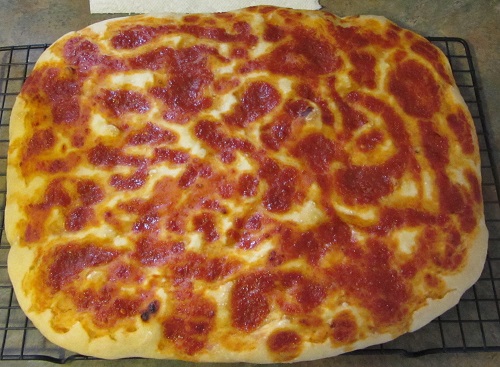
A weeknight dinner pizza loosely in the style of an Italian Tomato Pie / Focaccia:

Topped with cupping pepperoni, goat cheese, and a red sauce made from our garden’s tomato sauce, basil, and oregano. The dough was very airy and light with mostly small holes in the crumb. It was baked on a sheet tray with lightly oiled parchment paper, so the bottom got a nice crispiness. The top had just a little crunch too. It was definitely rustic.

The Ingredients:

400 grams AP flour. 100 grams Hard White Winter Wheat flour (milled in our Mockmill). 500 grams flour total.

315 grams room temperature water (baker’s percentage 63% hydration)

15 grams honey (3%)

15 grams extra virgin olive oil (3%)

10 grams kosher salt (2%)

2 teaspoons instant yeast (not rapid rise)

The Handling:

Combine all ingredients and mix on low speed for 6 minutes.

Briefly finish kneading and shaping the dough into a ball.

Lightly coat a bowl with oil, cover and let rise 45 minutes.

Stretch and fold the dough, re-form into a ball, cover and let rise another 45 minutes.

Line a sheet tray with parchment and lightly oil the surface of the parchment. Transfer the dough to the parchment and lightly stretch it out, leaving it 1/2 inch to 1 inch thick. 500 grams of flour won’t stretch all the way to the edges of the sheet tray and that’s ok.

Dimple the dough all over with your fingertips. Turn on the the oven to 450F. Cover and let rise one hour.

Top with the tomato sauce and pepperoni. Bake at 450F for 15-18 minutes, or until the top begins to brown and the dough feels like it’s near baked when tapped. It will feel somewhat rigid and hollow. Top with the goat cheese and cook another 3-5 minutes.

Let the pizza rest, then cut into squares.

Thoughts:

If the bottom had cooked any further than it did it would have been overcooked. Adding an extra sheet tray to the bottom half-way through the bake likely would have created a slightly less “done” result. It’s something to keep an eye out for next time.

For an improvised dough, the finished product came out pretty much like what I’d visualized, so I was happy with that. It was very rustic but light at the same time. There were just enough toppings to make it interesting but not so many that the dough didn’t shine through.

One nice thing about using white wheat berries is that they don’t announce themselves like red wheat berries do. It’s more of a subtle backstory that adds depth and “what is that flavor?”

At some point I’ll need to try a 2-3 day cold ferment instead of the weeknight-gotta-get-dinner-on-the-table room temperature approach.

Overall it was somewhat unusual and definitely enjoyable. Win.

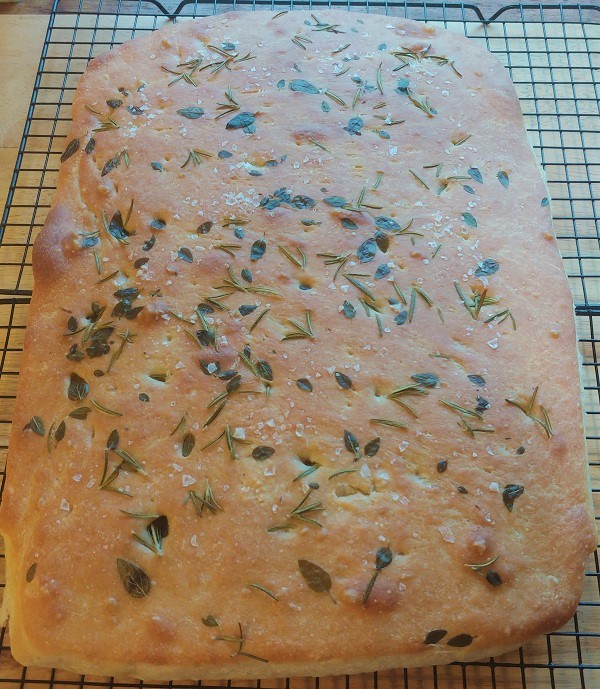
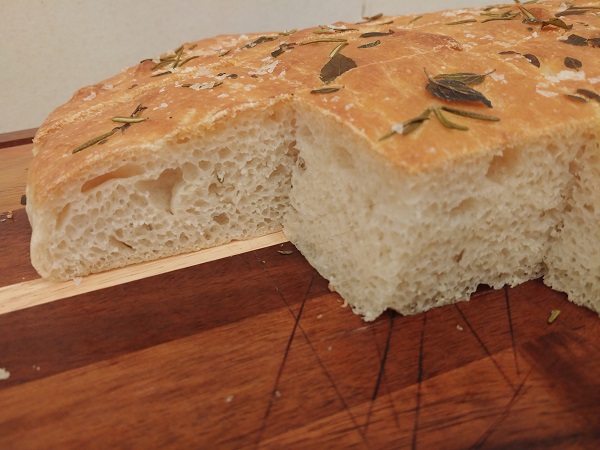
Herbed Focaccia With Poolish

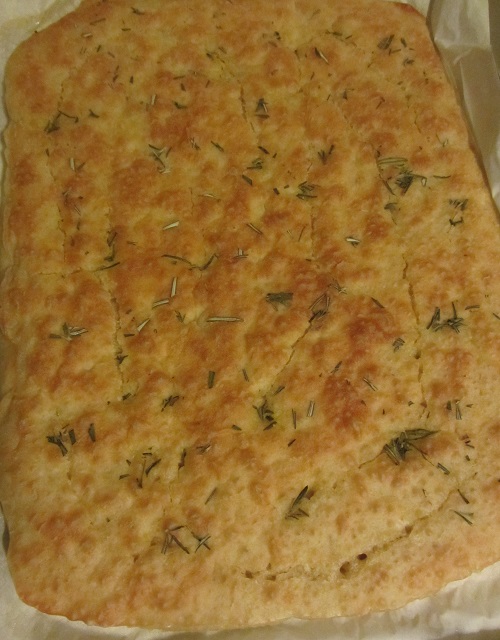
One of our holiday traditions is attending a pot luck / lasagna party hosted by a good friend of ours. I’ll typically make some sort of bread. (Search the bottom of the webpage for “epi”, “focaccia” or “fougasse” for some examples.) This year it was a festive herbed focaccia created using a room-temperature overnight poolish as the base:

One day ahead I started the poolish: 800 grams of bread flour. 800 grams cool water. A few grains of Instant (not fast-acting) Dry Yeast, about 1/16 teaspoon. Mix thoroughly, cover tightly, and let sit on the counter overnight.

The next steps need to start at least 6-8 hours before consumption. Most of it is hands-off, but all up it comes out to over four hours of preparation + cooling.

In the bowl of a stand mixer combine 200 grams of bread flour, 2 teaspoons of Instant Dry Yeast, 30 grams olive oil, 20 grams kosher salt. Mix that briefly then add the poolish and mix on low speed for 8 minutes. Cover.

The total baker’s percentage formula comes out to 1000g flour, 800 grams water (80% hydration), 30 grams olive oil (3% of the flour weight), 20 grams kosher salt (2% of the flour weight), yeast.

Bulk rise until doubled in volume – this will take 1 – 2+ hours depending upon the temperature of the house.

Once doubled transfer the dough to a parchment-lined-and-oiled 18 x 13 sheet tray.

Lightly coat the top of the dough with olive oil.

Using your fingers, poke the dough all over down to the base.

Sprinkle on fresh herbs of your choice. I used rosemary and thyme from our raised garden beds. Which were buried under snow, so that took a couple of extra minutes to pick through for good stuff.

Cover the dough and start the oven preheating to 450F.

Let rise one hour. Sprinkle the dough with flakey (Maldon’s) salt.

Bake for 25-35 minutes or until the internal temperature is at least 200F and the bread is pleasantly browned.

Another cell phone pic taken at the event. I cut it into squares to make self-serving easy.

Notes:

I accidently let the bulk rise much more than double. Between that and the starter poolish the dough was extremely loose and extensible. I sort of had to wrestle it into shape using a generous amount of oil to keep it from sticking to everything. Given a more correct rise time the dough should have been much more manageable.

I liked the festive appearance and the focaccia got nice feedback. I can see making this one again, though I think I may use a biga next time with the idea that it may make the dough more manageable in the shaping stage.

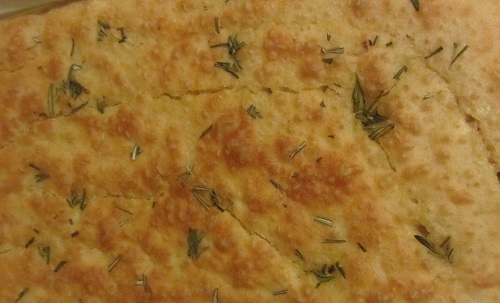
Bonus No Knead pic:

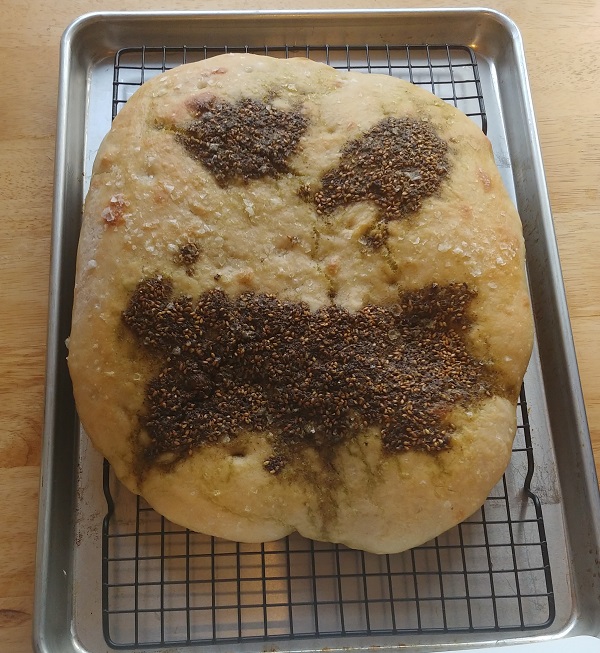
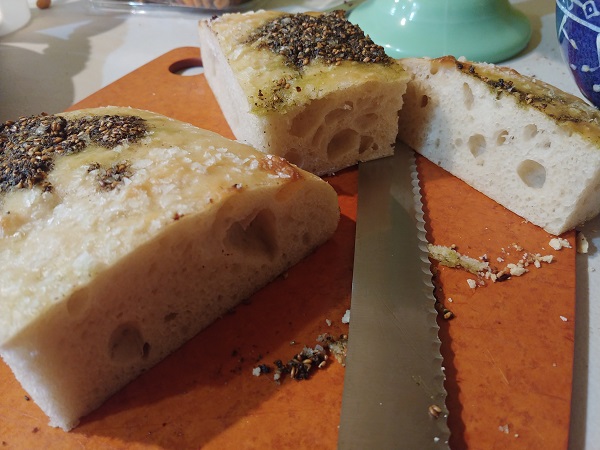
Day Of The Dead Focaccia

A simple focaccia for a Day Of The Dead Party-

The topping is olive oil, zaatar, and Maldon Sea Salt Flakes.

The hydration is 75%, which is not on the high end for a focaccia — the dough is sticky but can be handled with wet or oiled hands.

The formula:

  1. 800 grams King Arthur Bread Flour, 600 grams cold water, 16 grams kosher salt, 2 teaspoons Instant (not rapid-rise) yeast.
  2. Mix the dough for 8 minutes on low speed, then cover and move to the refrigerator for 2-3 days. The refrigerator step can be skipped if crunched for time, though the focaccia will taste better after an extended cold fermentation.
  3. Remove from the refrigerator at least 4-5 hours before you intend to serve the bread.
  4. As the dough returns to room temperature: About every 30 minutes to one hour work around the bowl, lift the dough from the sides and push/drop the dough back towards the center, taking care not to pull so hard that the dough tears.
  5. When the dough is near room temperature remove it from the bowl and place it on a baking sheet lined with oil-coated parchment paper. 3-4 tablespoons of olive oil should be plenty to coat the parchment. Spread out the dough without tearing it into a round/oval shape towards the edges of the sheet tray. If the dough fights back wait five minutes and try again.
  6. Cover (I use another inverted sheet tray) and let rise one hour. If using zaatar mix 4 tablespoons with 4 tablespoons olive oil and let it rest and hydrate.
  7. Preheat the oven to 425F. Using the tips of your fingers, dimple the dough all over, pushing down to the sheet tray. Spread a liberal amount of olive oil over the top, then top with the zaatar and a “healthy” sprinkle of flake salt. Cover and let rise one hour.
  8. Bake for 30-35 minutes at 425F, then remove to a cooling rack, taking care not to spill any residual oil on yourself or other things you’re attached to. If during baking the bottom of the dough is getting too dark add a second sheet tray underneath the first. For this bake I used two sheet trays for the entire time.

The focaccia was served at a friend’s house with a Day of the Dead menu and beer theme and the bread was a big hit — the zaatar “face” motif didn’t last very long. This focaccia would also be good if substituting other herbs or cheese for the zaatar — I was targeting a sort of scary pumpkin face sort of thing, and zaatar tastes good and stands up to other strong flavors which made it a good choice for this event.

I’ve made many focaccias and I’ve come the the conclusion that the most important element is patience. The bread will be fine without the long refrigerator rise or extra folds and multiple rises, but I think the end result is better when it isn’t rushed. Because this was a weeknight bread I brought the dough to work and stored it in the refrigerator there, then removed it around to my desk at 2:30pm to start warming up for a 7:00 dinner. Many recipes will call for “one hour out of the refrigerator then proceed…” , but that never seems like enough time for the dough to warm up to room temperature and the later rises don’t wind up very satisfactory. Give it time.

Focaccia, And The Twelve Steps Of Bread Baking Reduced To Four Activities

-A.J.

Authors write about “Twelve Steps” (or more) to baking bread, which sounds like a lot of processes:

  1. Scaling
  2. Mixing
  3. Bulk or Primary Fermentation
  4. Folding/Degassing
  5. Dividing/Scaling
  6. Pre-shaping
  7. Bench Rest
  8. Shaping/Panning
  9. Proofing/Final Fermentation
  10. Baking
  11. Cooling
  12. Storage/Eat


I “simplify” it in my head into four groups of “Activities”:

  1. Scaling
  2. Mixing
  3. Bulk or Primary Fermentation
  1. Folding/Degassing
  2. Dividing/Scaling
  3. Pre-shaping
  4. Bench Rest
  1. Shaping/Panning
  2. Proofing/Final Fermentation
  1. Baking
  2. Cooling
  3. Storage/Eat


At the end of each Activity there’s a natural rest break.


In effect then, Twelve Steps become Four Activities:

  1. Weigh and mix the dough, and let rest.
  2. Divide and shape the dough, and let rest.
  3. Shape/pan the dough, and let rest.
  4. Bake, cool, and eat.


That sounds pretty manageable, doesn’t it? If you don’t count the baking step it’s only three Activities. Easy.

I bring all this up because I’d gotten into the habit of skipping Activity #2 when making focaccia. I’d mix, then coax the loose dough into a parchment-lined tray, allowing for one rise in the tray.

And that was fine, sort of. The focaccia were well-received, though I thought they had the potential to be better. As it turns out, if you don’t skip an Activity that people having been doing for thousands of years the results improve! Behold the power of trial and error!

A two-pound focaccia from Easter dinner:

Cell phone pic, not color-adjusted.

A one-pound focaccia we ate with dinner last night:

170422 focaccia

Re-introducing the initial bulk fermentation gives a better crumb structure — the bread becomes more airy, with uniform bubbles throughout. I think that’s partly because the extra rest and handling means that the bubbles get redistributed more evenly. I’ve cut back on the oil too. The end result is a lighter, less oily focaccia.

Both breads:  70% hydration, 6% oil, 2% salt (not counting the pink salt), about 1% diastatic malt, baked at 425F for 24 minutes.

————————

Here’s a Cheap Seat Eats post from January of 2016 talking about a good result due to allowing for an initial 30-minute rise before transferring the dough to the tray. Which means I’ve re-re-learned something. That’s good, right? The biggest difference between that one and these two is that the oil percent for these two were 6% rather than the 3% in the 2016 post. That, and I allowed for a 30-minute pre-ferment in 2016. These two got ~1 hour.

A 100% hydration, 6% oil focaccia, August 2014.

Another 100% hydration, 4% oil focaccia, August 2014. 20-minute rest. Note the somewhat irregular hole structure.

80% hydration, 7% oil, September 2014. 1-hour rest.

70% hydration, 3% oil, December 2015. 1-hour rest. The crumb structure looks fairly tight, though that might just be the photo. It was served with stew, so I might have been targeting that result.

75% hydration, 8% oil, January 2014, topped with onions. No rest. The color isn’t very deep in the photo.

113% hydration, 9% oil, May 2013. 4-hour rest. Beranbaum’s recipe.

——————–

For a good, brief description of the Steps see this Reddit post.


What I Had In Mind Focaccia

by A.J. Coltrane

A two-hour focaccia:

150117 focaccia

I feel like this may have been the best “quick” focaccia yet.

The Tweaks:

  1.  3% olive oil in the dough. That’s lower than in oil than most of the focaccias I’ve made in the past. The crumb was lighter than in past attempts, and the bread got a lot more “lift”.
  2.  The dough was allowed to rest for 30 minutes before it was moved to the pan. I think this also improved the finished crumb structure.
  3.  A 450F oven. (Rather than 425F.)  The crust came out quite a bit browner and crisper as a result.

It made a terrific dinner with a bit of cheese and SeattleAuthor’s charcuterie:

150117 charcuterie

The formula:  400 grams Bread Flour, 280 grams room-temperature water (70% hydration), 12 grams olive oil (3%), 9 grams kosher salt (2.25%), 1 teaspoon instant yeast.

  1.  Combine ingredients in the mixer and mix on low speed for 10 minutes.
  2.  Lightly coat the dough and bowl with oil, cover, and let rest 30 minutes.
  3.  Line a 9 x 13 pan with parchment. Lightly oil the parchment.
  4.  Transfer the dough to the oiled parchment, pulling it gently to the edges of the pan.
  5.  Cover and let rise ~1.5 hours.
  6.  Drizzle the top with olive oil. I used a rosemary-oregano olive oil that we received as a holiday gift.
  7.  Oil your fingers and dimple the top.
  8.  Bake 22 minutes at 450F.  Remove to a cooling rack when done.


For comparison, here’s a 100% hydration, 6% olive oil focaccia from 2014. It couldn’t be dimpled because it was already collapsing under its own weight. It was baked at 425F and even with the higher oil content it was a lot lighter in color. Here’s another that was baked at 425F. And another. None of them are all that brown.


Tomato Focaccia

by A.J. Coltrane

I’ve read about a Roman bread that has tomato “painted” into the surface. (Thanks for the perfect word to describe it, Kurt.) I spent a little time looking for a picture of what I’m visualizing… I don’t know that I’ve found a “right” picture. Most of the recipes seem to include a tomato puree and/or paste within the dough. Some rub a finished bread with a cut tomato after it comes out of the oven, which I’m thinking is what I had in mind when starting this bread:

tomato focaccia 141101

The bloody end result was based around what’s become my default focaccia recipe:  300g AP Flour, 300g Bread Flour, 420g water, 36g olive oil, 14g kosher salt.  (That’s 70% hydration, 6% oil, and 2.33% salt by weight.) This time I omitted the honey, reduced the instant yeast to 3/8 teaspoon, and allowed for a 18 hour rise.

Note that it’s the same rise time, and ratio of yeast as goes into the No Knead Bread — the No Knead Bread uses 400g flour and 1/4 teaspoon of yeast.

The Tigerella tomato sauce was simmered with three smashed cloves of garlic and two thai bird chilis until fairly thick but still “drizzleable”. (We’d recently been to a cooking class where the chef used a little bit of heat to “focus” things. I think that it worked — there was just a faint hint of heat at the finish.)

The Rest Of The Recipe:

1.  Combine dough ingredients, mix on low speed for 10 minutes, and let rise 18 hours.

2.  Transfer the dough to a lightly oiled baking sheet let rise one hour. (I went with a one hour rise instead of two or three because I was looking for a denser finished product, and so that the dough would support the weight of the sauce.)

3.  Preheat oven to 425F.

4.  Drizzle on the cooled sauce. Note that a focaccia typically has olive oil on the surface. I didn’t use any oil this time.

5.  Bake for 15 minutes, turn the tray, and bake for another 12-15 minutes.

—–

I think the Reinhart book American Pie has the application I’m looking for. Maybe I’ll dig through it for the recipe. Maybe.

The GNOIF Big Sandwich Bread

by A.J. Coltrane

I’ve been making a sheet-tray sized sandwich for every GNOIF over at least the last two or three years. The bread components of those sandwiches have all been riffs on focaccia.

The most recent ratios:

Ingredient Measure Baker’s %
Flour 600g
Water 420g 70
Salt 14g 2.33
Honey 1 TBP
Instant Yeast 1.5 tsp
Olive Oil 36g 6

The “Flour” for the pictured bread is 50% Gold Medal unbleached AP flour and 50% King Arthur bread flour. I added a small amount of honey to try to improve the browning, which seemed to work ok. It’s largely the same process as “Potluck Focaccia” — I’ve settled into a preferred routine for focaccia it seems:

1.  Combine all ingredients in a mixer and combine on low speed for 10 minutes. Lightly oil a parchment lined sheet tray.
2.  Pour the dough into the sheet tray, gently coaxing the dough towards the edges of the pan. Cover and let rest 2 hours.
3.  Preheat oven to 425F.
4.  When the oven is hot, drizzle a small amount of oil on the dough. Gently coax the oil over the surface.
5.  Bake for 15 minutes, turn the tray 180 degrees and bake for another 10 minutes.

141004 focaccia

This one is roast beef and ham with swiss. The flavored mayo (which one guest mistook for mustard) included olive oil, salt, “Montreal Steak Seasoning”, and a healthy dose of horseradish. (The pungency of the horseradish is likely what crossed him up.)

There are now 14 posts that reference focaccia on CheapSeatEats. It still trails pizza, which gets at least a mention in 55 posts (though I’m sure there’s some overlap)… We clearly love us some flattish breads.


Pot Luck Focaccia

by A.J. Coltrane

Another variation on a high hydration focaccia, using this one as a jumping off point.

The goal this time was to make a focaccia that could stand on its own at a potluck. As compared to the linked (non-assertive) bread, this one features more salt, more oil, and the addition of rosemary to the top.

All I had in the house was AP flour. I would have preferred Bread Flour for this one, but I wasn’t going to make a trip to the store for it.

The recipe:

Ingredient Measure Baker’s %
AP Flour 500 g
Water 500 g 100
Salt 12 g 2.5
EV Olive Oil 30 g 6
Instant Yeast 1.5 tsp


1.  Combine all ingredients in a mixer and combine on low speed for 10 minutes. Lightly oil a parchment lined sheet tray.

2.  Let the dough rest for 20 minutes, then pour it into the sheet tray, gently coaxing the dough towards the edges of the pan. Cover and let rest 2 hours. Chop rosemary.

3.  Preheat oven to 425F.

4.  When the oven is hot, drizzle a small amount of oil on the dough. Sprinkle chopped rosemary on top.

5.  Bake for 15 minutes, turn the tray 180 degrees and bake for another 10 minutes.

If it’s a two-hour dough I’m always suspicious of the ability of the finished product to be interesting on it’s own. That’s not enough time for good stuff to happen, chemically speaking. On this variation I turned to the “volume knobs” of oil and salt — the oil was increased from 4% to 6%, and the salt was increased from 2% (the “standard”), up to 2.5% of the weight of the flour. The small amount of additional salt helps the bread stand up to other big flavors.

140828 focaccia

Something I ran into with both of these high-hydration doughs was that the raw doughs couldn’t support the weight of a drizzle of oil. This may be because the house was 80F+ on both attempts. Each time the top of the dough was saturated with tiny delicate bubbles. Spreading the oil around on the surfaces was out of the question. I wound up drizzling a thin stream of oil, which looks like little canals or “breaks” on the finished focaccia.

A close up:

140828 focaccia close up

(Rushed 5 a.m. photography. Not terrible, considering.)

What I think I learned:

1.   100% hydration doughs might not be the best idea when the house is over 80 degrees. Something like 75-80% hydration would have been “safer” way to go.

2.   The dough was basically a batter. The finished bread likely would have benefited from a pan smaller than a sheet tray. As it was, the edges were pretty thin, which could have led to uneven baking.

3.   When I initially pulled the bread out of the oven it was fairly pasty looking. At the risk of drying out the bread, I popped it back in for 4 minutes — that’s what gave it a better color.

Fortunately all of that worked out, though I had my doubts.

I think it’s time to steer back towards “sane hydration” land for a while.

Another Simple (3 Hour) Focaccia

by A.J. Coltrane

Served at this tomato tasting. Most recent Rosemary Focaccia here.

I’ve gradually been dialing back the amount of oil that I’ve been putting into focaccias…

Background:  When I started making focaccia I always measured the oil by volume. At some point I decided that seemed like a silly way to do it — if I already had the scale out, why dirty another measuring cup? My starting point for “oil by weight” was 10%+, as well as a pretty generous dose on top. The link above uses 8% oil. The focaccia below used only 4% with a very, very light drizzle of oil on top.

To go even further off track for a moment — I’m intending to do a post about how different bread types are related to each other based upon their contents. The thing is, I’m not entirely sure anymore what exactly I’m “making”. I have a starting idea, but that’s about it. Though I guess it really doesn’t matter so long as it tastes good.

The bread below uses 100% hydration — the weight of the water is equal to the weight of the flour. That’s among the highest hydration doughs that I’ve posted. This Berenbaum recipe used 113% hydration, but that’s (I think) the highest hydration dough I’ve done (and it uses 9% oil).

I was hoping to achieve a relatively spongy texture — lots and lots of little, fairly uniform holes. The ingredients:

Ingredient Measure Baker’s %
Bread Flour 520 g
Water 520 g 100
Salt 11 g 2
Olive Oil 20 g 4
Instant Yeast 1.5 tsp

Recipe:

1.  Combine all ingredients in a mixer and combine on low speed for 12 minutes. Lightly oil a parchment lined sheet tray.

2.  Let the dough rest for 20 minutes, then pour it into the sheet tray, gently coaxing the dough towards the edges of the pan. Cover and let rest 1.5 hours.

3.  Preheat oven to 425F.

4.  When the oven is hot, drizzle a small amount of oil on top of the dough.

5.  Bake for 15 minutes, turn the tray 180 degrees and bake for another 10 minutes.

That’s it. It’s seriously simple. The only “trick” is make sure that all of the flour incorporates into the dough — it will tend to want to stay on the sides of the mixing bowl. I used a spatula to scrape down the sides a couple of times during the mixing, then aggressively combined the remaining raw flour after removing the bowl from the mixer.140818 focaccia

Postmortem:  I feel like this one came out about as well as it could have for a 3-hour dough. Using bread flour rather than AP flour was (I believe) the right choice. Adding toppings (salt, herbs, or onion) might have made it more interesting, but the object was to complement the tomato tasting, and in that respect it was basically what I had targeted.

Multiple thumbs up.