Skillet Fried Potatoes

By Iron Chef Leftovers

This type of steamer basket works best. You can get them at Amazon.com for about $8.

I do entirely too much reading of cookbooks. These days, I am not really looking for recipe ideas, more just to learn techniques. One thing that I hate to cook, but Mrs. Iron Chef loves to eat are potatoes. For me, they really are just a vehicle for adding stuff to it, much like chicken breast, so you go from healthy to unhealthy in a hurry since potatoes don’t inherently have much taste. For my End of the World meal, I was making beef stew served in a can, which I thought about it, and what goes better with beef stew than potatoes (well, celery root puree, sun choke puree…just humor me here). I took a hybrid technique from Modernist Cuisine and Cook’s Illustrated to come up with this recipe. This really isn’t much more difficult to do than making regular potatoes, but you will get better texture on them and you can actually do stage one in advance and finish them when you are ready to serve. When you are done, you should end up with potatoes that are creamy on the inside and crispy on the outside. The only special equipment you really need is a steamer basket.

The Software
1 large Yukon Gold potato, cut into ¼ inch slices
2 tablespoons fat (bacon fat, duck fat, butter or olive oil all work well. See note below)
Salt and pepper

The Recipe

Stage 1 – Fill a large pot with water to just below the surface of the steamer basket. Heat water over high heat until steam is visible. Add the potatoes to the basket in a single layer. Cover the pot and steam for 13 minutes. Check the potatoes for doneness – you are aiming for them to be slightly al dente and they should have leached their starch to the surface, so they will feel tacky. Remove them to a plate lined with a couple of paper towels and dry. It is important that the potatoes are dry before starting stage 2.

Stage 2 – Heat a large (12 inch) skillet over medium-high heat for 5 minutes (don’t use non-stick here). Add the fat and heat over medium-high heat until it just begins to smoke. Test the heat of the fat by dipping the edge of one potato slice in the fat. If it sizzles immediately, the fat is hot enough and you can add the potatoes in a single layer. If they all won’t fit in the skillet, you can do stage 2 in multiple batches. If the fat is not hot enough, continue heating it until you can get your test to sizzle. You are really just browning/reheating the potatoes and looking to get a golden crust on each side, so you probably won’t need more than about 2 minutes of cooking time on each side, checking after 1 minute to see the progress. After both sides are browned, remove to a cooking rack or a plate with a paper towel, season with salt and pepper to taste and serve right away. It pairs nicely with this Beef Carbonnade recipe.

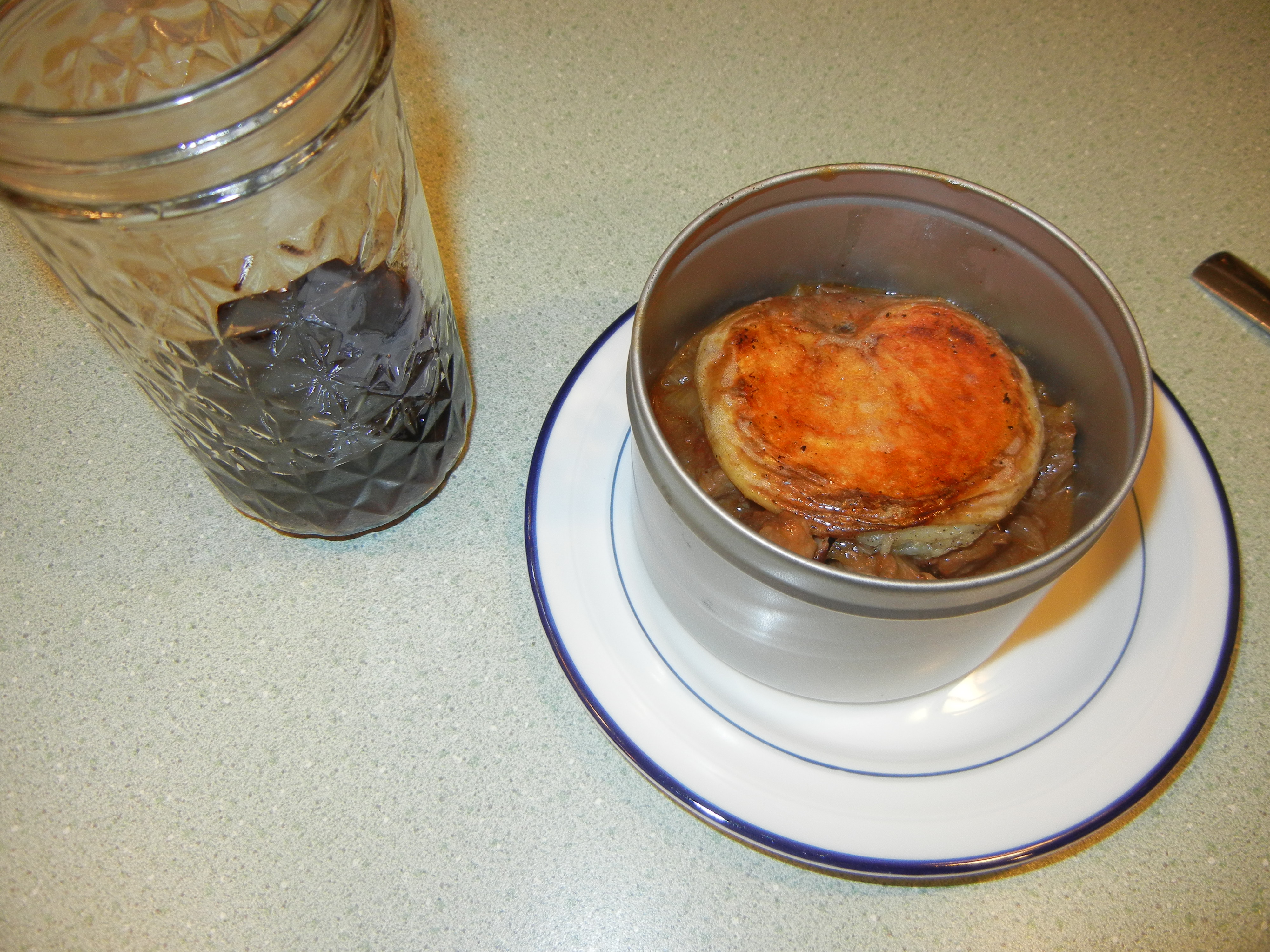
Your end result should look something like this. You can also get really classy and serve it in a can, like I did.

Notes
You really want the potatoes dry before putting them in the fat since hot fat + water = bad news. Your cooking time will really depend on what type of fat you use. Animal fats (butter, bacon fat, duck fat) have a lower smoke point than vegetable fats (olive oil, vegetable oil), so they will reach that stage quicker and take longer to brown the potatoes, which is why you really want to check them after about the first minute. You can actually skip stage 2 if you want and just serve the potatoes steamed. Just increase the cooking time to about 16 minutes in the steamer. This dish would also benefit from the addition of some fresh rosemary, sage or thyme.
Meal of the Apocalypse

By Iron Chef Leftovers

Well, the Mayans were wrong and what a better way to celebrate the fact than throwing a hedonistic feast in their honor. I will do this post in a couple of parts – this one with the menu, descriptions and any links to existing recipes that I used to make them (along with any tweaks) and a second set of posts with the remaining recipes (some of these are a pain to write out, so it will take a bit to get them out there). I really wanted to have fun with the meal, so I opted for simple preparations with fun plating and names. So, without further delay, I present to you “Meal of the Apocalypse”!

Cocktail: Heart of Darkness
I am pretty sure that I didn’t make this one up, but I have absolutely no idea where I would have come across it either. It is a champagne based cocktail, which are always delicious and refreshing and this takes about 1 minute to make.

The Heart of Darkness is looking a little lighter and more refreshing these days.

Here is what I wrote about the drink on my menu:
The story Heart of Darkness by Joseph Conrad is the inspiration for one of my favorite movies, Apocalypse Now. It seemed appropriate to make a drink based on that, given the theme of the night.

Since I like you, I will give you the recipe here.
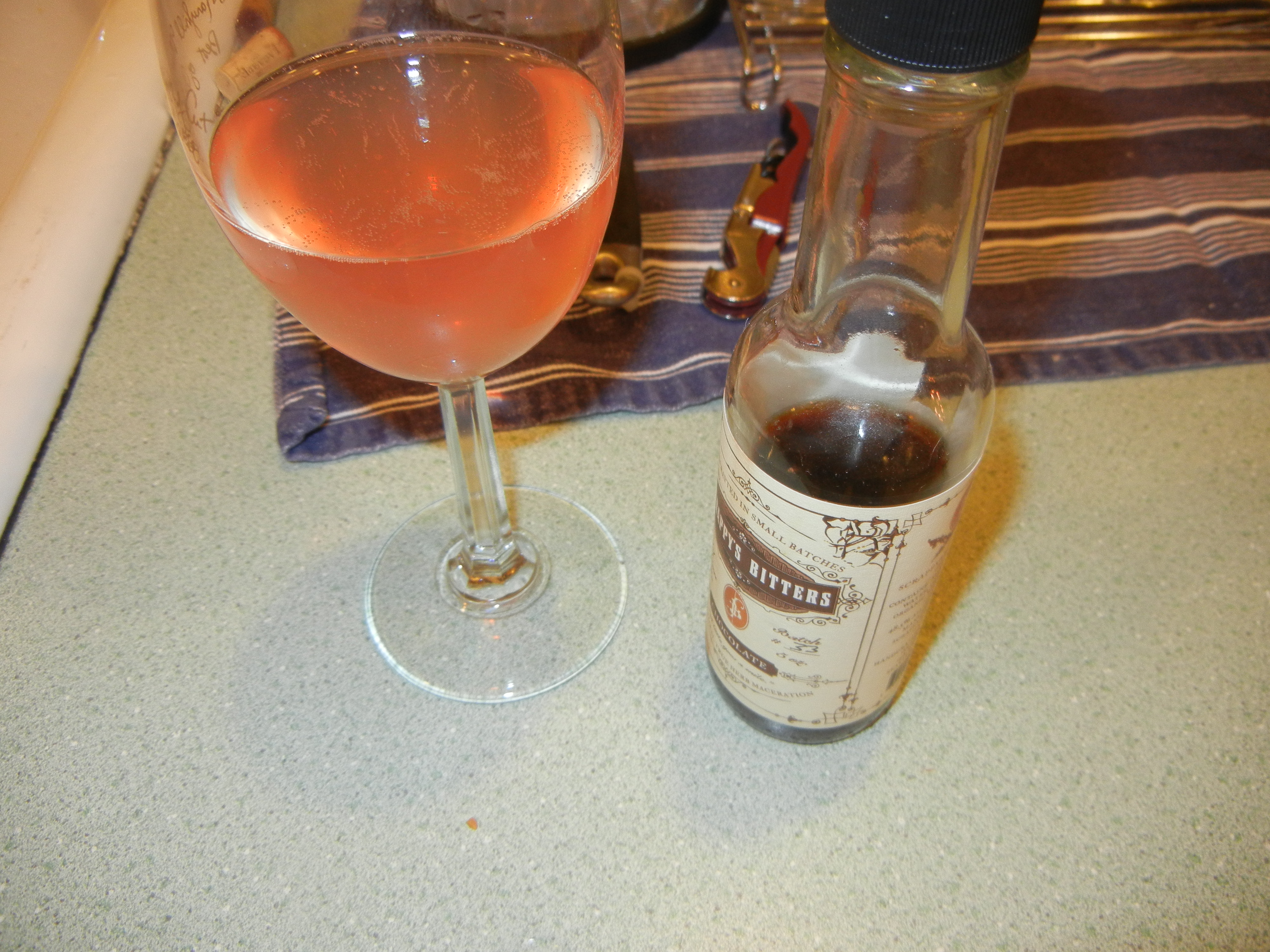
The drink is 1.5 oz. blood orange juice or soda, 4 oz. sparkling wine, 3 drops Scrappy’s Chocolate Bitters and a frozen strawberry, served in a wine glass.

I would recommend using a drier sparkling wine for this so that you don’t get overloaded with sweetness. I personally used Washington produced Treveri Pinot Gris sparkling wine in this version.

First Course: My Last Meal
Being Italian, it seemed logical to start off the meal with pasta. I did a meat ravioli with a taleggio, shallot and sous vide egg cream sauce and topped it with a sprinkle of guanciale, just because I could. It was decadent and over the top, but it pared nicely with the 2010 Wilridge Pinot Grigio, which has a bit of sharpness to it that cut the richness of the dish.

Since it seems I didn’t actually take a picture of the pasta, I give you one of the cats sunning himself on the couch. This was the general happy response to the pasta, so let’s just call this the after picture.

My notes on the dish:
One of the components of my last meal on earth, if I got to choose it, would be something that my dad made for me when I was growing up. This is my adult version of the meal that I enjoyed as a kid.

Second Course: The Mayan Slaughter
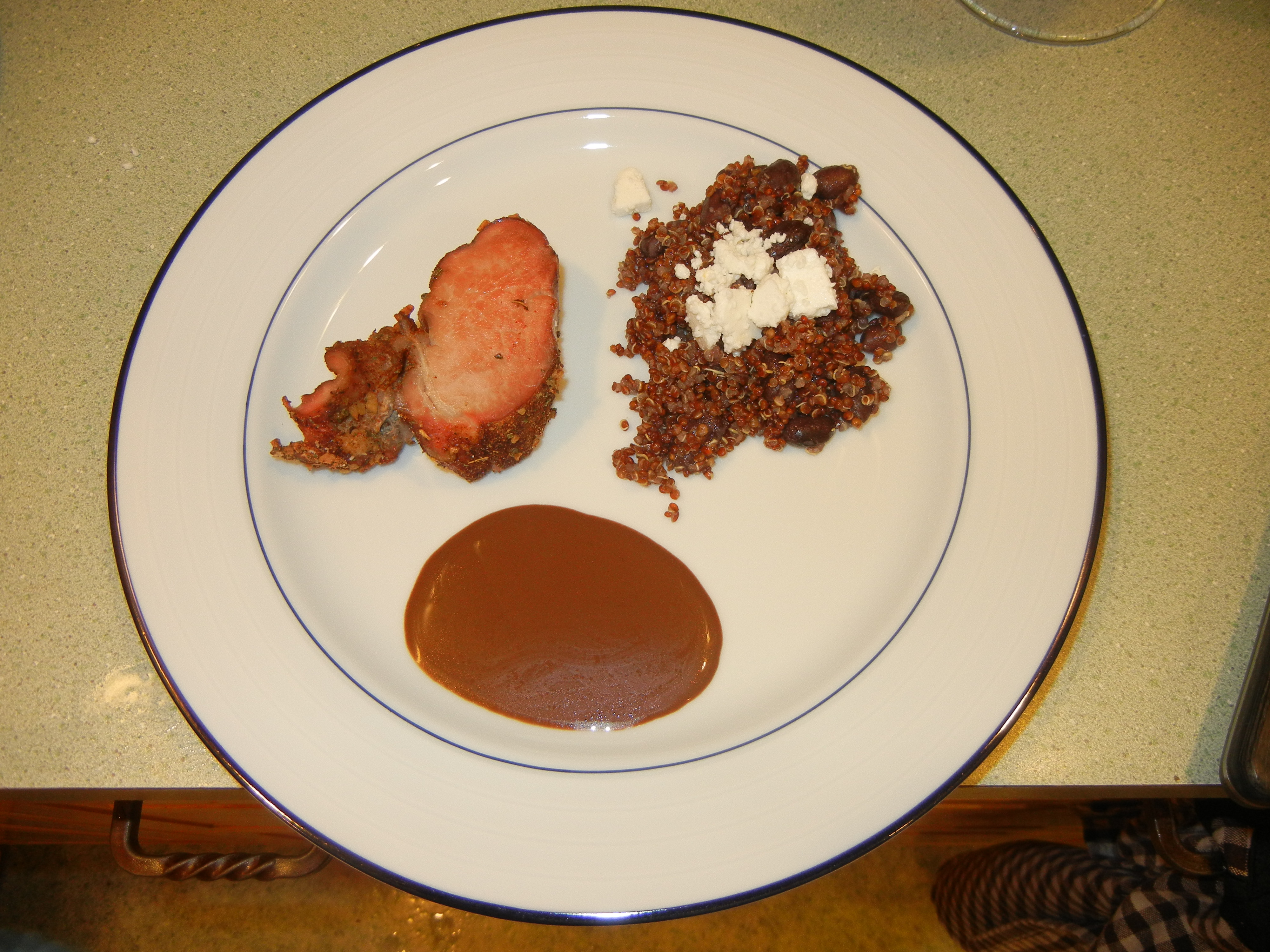
I wanted to make mole without making mole, so I basically took a bunch of the spices that are used in mole and made a spice rub for some pork tenderloins. Then to get the chocolate component of the dish, I made a chocolate gastrique as a side sauce that was meant to be eaten with the pork. I really felt like I nailed this one as the combination of the spices and the chocolate really reminded me of a mole, although a more complex one than you might expect since the fruit notes in the chocolate really came out. I served it with a toasted quinoa hash (quinoa, black beans, queso fresco) that I got the basic idea from Modernist Cuisine at Home. I pared this with a completely killer Argentinian Malbec from my cellar that a friend brought me back from Argentina – 2006 LaGarde Riserva Malbec.

Too bad the Mayans hadn’t actually invented this dish, they might be remembered for something other than they amazing grasp of astronomy and a faulty calendar.

There was one problem with calling this dish the Mayan Slaughter:
The Spanish brought pigs to the new world and they became a main protein of Mexican cooking well after the Mayans. A deconstructed mole sauce is a tribute to the Mayans, although the Mayans didn’t really invent it and quinoa is actually from South America. We will just ignore those little details.

Third Course: Side of the Road Salad
Just a simple salad of wild arugula, dandelion greens, truffle oil, 30 year old balsamic vinegar and alder smoked sea salt. I wanted to add some sun chokes to this, but my attempt at making a sun choke crouton didn’t work. I served this with a 2009 NHV Rose which wasn’t a fan favorite by itself, but worked well with the salad.

No picture of this since: A) salads are boring and B) I forgot to take a picture of it before I started eating.

My story about the salad:
You could, in theory, survive in Seattle eating nothing but foraged food (there are people who do this willingly), if you know where to look. This just proves that you can do it and still eat well.

Fourth Course: Raid the Emergency Supplies
This was one that I went really creative with the presentation. What better to celebrate the world not ending then with eating your stockpiles of emergency supplies? I made my Belgian Beef Carbonnade recipe, topped it with a potato slice and served it in a tin can. Of course, since I went with the really classy presentation in a can, I had to serve a great bottle of wine, in this case the 2001 Conti Sertoli Sforsato in a mason jar.

Here are my thoughts on this:
You should have a stockpile of emergency supplies including canned goods in the event of a natural disaster. If Dinty Moore beef stew tasted this good, I probably would be eating it every night. When serving stellar food in a can, it is only appropriate to serve a killer wine in a mason jar, just to keep it classy.

Dessert: Last in Line for the Human Sacrifice
I really needed to have a human sacrifice as part of this meal; it just seemed fitting and, after much debate, decided that it would be at the end of the meal. So how do you have a human sacrifice without killing an actual human? Well, you first take an altar made out of chocolate pudding. You then take a human made of a sugar cookie and place him on the altar. Then you take some raspberry blood and dot that on the plate. Then you take a spoon and kill your cookie man and enjoy. Just for the hell of it, you pair this with a Maison de Pagett Pillow Talk Vanilla Port. Human sacrifice has never been as fun or delicious as this one.

Our vicitm just before he meets his untimely end. In an interview just before the sacrifice, he was quoted as saying, “No thanks, I would rather be lost.”

The gory details:
A line from a George Carlin bit about being lost. No proper post-apocalyptic meal would be complete without a sacrifice at the end. There was also much debate among my friends about where in the meal the sacrifice belonged. We will try it here.

In case you were wondering, here is the actual Carlin bit.

Grill Roasted Beef Tenderloin

By Iron Chef Leftovers

Mrs. Iron Chef and I recently entertained her aunt, uncle and a couple of cousins, who had been on a whirlwind tour of the Pacific Northwest, and I decided that they needed a good, home cooked meal. Since there were 6 of us and the weather was nice, I thought that the meal called for a nice grill-roasted beef tenderloin. It is easy to cook, always a crowd favorite and doesn’t require a ton of prep. The below recipe and technique was taken from Cook’s Illustrated magazine and modified a bit by yours truly.

The Software
1 – 2 ½ lb. beef tenderloin, silver skin removed
1 tablespoon + 1 teaspoon kosher salt
1 tablespoon granulated garlic
1 teaspoon of olive oil
1 teaspoon ground black pepper
Soaked wood chips for smoking (optional)

The Prep
Remove any silver skin that may be on the roast. Pat dry and sprinkle1 tablespoon of salt on all sides of the roast. Wrap tightly in plastic wrap and return to the fridge for at least 4 hours (you can let it sit overnight if you want, it won’t hurt anything). When you are ready to fire up the grill, pull the meat out of the fridge and pat dry with paper towels. Rub with the oil and then sprinkle with garlic, salt and pepper to get even distribution. Tie the roast with 5 pieces of butcher’s twine spaced at even intervals to make the roast as uniform as possible. Let rest until you are ready to put on the grill.


A whole beef tenderloin – the two “wings” are called the chain meat. You want to get your roast from that end of the muscle and remove the chain meat before cooking.

The Grill
Gas grill – turn all burners on high for 15 minutes to preheat the grill. Add wood chips to your smoking box at this time. Once grill is heated, clean the grill grates. Turn off all of your burners except for your primary burner. Leave that on – you are looking to maintain about 300-325 degrees in the grill. For my grill it means leaving the primary burner just above medium high.

Charcoal grill – prep 6 quarts of charcoal and heat until covered in ash. Add the charcoal to the far side of the grill, not exposing more than half of the grill grate to direct heat (you are going to cook the meat off of direct heat). Add wood for smoking directly to the charcoal. Heat the grate for 10 minutes with the grill covered.

The Roast
Gas grill – put the meat on the grill about 8” from the edge of the primary burner (you don’t want to put in directly on the heat from the primary burner). Roast for 25 minutes, and then flip the meat over. Continue roasting until the meat reaches 125 degrees on a meat thermometer (that is medium rare). Remove from the heat to a plate and cover with foil. Let rest 15-20 minutes before cutting.

Charcoal Grill – Put the meat over the direct heat of the charcoal for about 2 minutes on each side to get a crust to form. Move the meat to be about 8” from the direct heat and cook on the first side for about 15 – 20 minutes. Turn over and continue cooking until the meat reaches an internal temperature of 125 degrees. Remove from the heat to a plate and cover with foil. Let rest 15-20 minutes before cutting.

Notes
If your fire starts to die down on a charcoal grill, add more charcoal. This recipe is easier on a gas grill (better temperature control), but tastes a ton better on a charcoal grill. I used a simple salt, garlic and pepper rub for this, but you can use any type of spice rub you would like. If you opt for tenderloin, you want to get a roast that is as uniform as possible and ask your butcher to remove the silver skin for you, it will save you 10 minutes of prep time. If you don’t want to use tenderloin, eye round also works in about the same amount of time. You could also easily substitute a boneless leg of lamb roast or a pork loin roast (not the tenderloin, it is too thin) and they will all cook in about the same amount of time. Tying the roast is essential to making it a uniform as possible – it will prevent some pieces from being more cooked than others. Serve with some roasted veggies and a nice chimichurri sauce.

Belgian Beef Carbonnade

By Iron Chef Leftovers

I really love things that are braised. Tender chunks of meat, rich unctuous sauces, loads of flavor, the ideal comfort food on a cold day. Braising’s dirty little secret is that you really should make it one day in advance and reheat it the next day. It gives the sauce a chance to infuse itself and increase the flavor.

One of my favorite braises is a classic Belgian dish, Beef Carbonnade. It uses an inexpensive cut of meat, a handful of ingredients and very little prep to produce what I think is the perfect example of what beef stew is. It also combines two of my favorite things – meat and beer. The below recipe was originally taken from Cook’s Illustrated and I have made a few modifications, most notably the amount of liquid used in the dish. My biggest problem with the recipe is that there was not enough sauce, so I took care of that. Also, the original recipe calls for equal parts of chicken stock and beef stock. I replaced that with only chicken stock and I think it actually turned out better. Then again, I was using my homemade stock, which is about 1000 times better than anything that you can get in a store.

Serve over rice, potatoes, pasta, frites or just in a bowl with some bread on the side. The leftovers will freeze nicely for 3-6 months.

The Software
3 1/2 pounds blade steaks, 1-inch-thick, trimmed of gristle and fat and cut into 1-inch pieces
Salt and ground black pepper
3 tablespoons olive oil
2 pounds yellow onions (about 3 medium), halved and sliced about 1/4-inch-thick (about 8 cups)
1 tablespoon tomato paste
2 medium cloves garlic, minced or pressed through garlic press (about 2 teaspoons)
3 tablespoons all-purpose flour
1 1/2 cups chicken stock
2 1/2 cups Belgian brown beer
4 sprigs fresh thyme leaves, tied with kitchen twine
2 bay leaves

The Recipe
Adjust oven rack to lower-middle position; heat oven to 300 degrees.
Dry beef thoroughly with paper towels, then season generously with salt and pepper.
Heat 2 teaspoons oil in large heavy-bottomed Dutch oven over medium-high heat until beginning to smoke; add about one-third of beef to pot.
Cook without moving pieces until well browned, 2 to 3 minutes; using tongs, turn each piece and continue cooking until second side is well browned, about 5 minutes longer.
Transfer browned beef to medium bowl.
Repeat with additional 2 teaspoons oil and half of remaining beef. (If drippings in bottom of pot are very dark, add about 1/2 cup of above-listed chicken or beef broth and scrape pan bottom with wooden spoon to loosen browned bits; pour liquid into bowl with browned beef, then proceed.)
Repeat once more with 2 teaspoons oil and remaining beef.
Add remaining 1 tablespoon oil to now-empty Dutch oven; reduce heat to medium-low.
Add onions, 1/2 teaspoon salt, and tomato paste; cook, scraping bottom of pot with wooden spoon to loosen browned bits, until onions have released some moisture, about 5 minutes.
Increase heat to medium and continue to cook, stirring occasionally, until onions are lightly browned, 12 to 14 minutes.
Stir in garlic and cook until fragrant, about 30 seconds.
Add flour and stir until onions are evenly coated and flour is lightly browned, about 2 minutes.
Stir in stock, scraping pan bottom to loosen browned bits;
Stir in beer, thyme, bay, browned beef with any accumulated juices.
Increase heat to medium-high and bring to full simmer, stirring occasionally; cover partially, then place pot in oven.
Cook until fork inserted into beef meets little resistance, about 2 – 3 hours.
Discard thyme and bay.
Remove about 2 1/2 cups of the sauce to a saucepan and reduce over medium heat by 1/2.
Add the reduced sauce back to the pot with the beef.
Adjust seasonings with salt and pepper to taste and serve to a grateful public. (Can be cooled and refrigerated in airtight container for up to 4 days; reheat over medium-low heat.)

Notes
You can probably use any low hop beer for this recipe, but I prefer to use either the Belgian beer Duval (about $8 for a 750 ML bottle) or the Trader Joe’s Vintage Brown Ale (about $4.50 for a 750 ML bottle). The Belgian beers are malty and sweet and will really enhance the sauce. You won’t use the entire thing, so drink with the meal. I have been contemplating trying this recipe with skipping the searing step for 2/3 of the beef. The meat that is above the liquid will brown during the braise, so it might actually save some time that would be used for searing. I would still want to sear 1/3 of it to build the fond in the bottom of the pan (the browned bits), because there is a ton of flavor in that. The recipe also originally called for 1 teaspoon of cider vinegar. I removed it since I didn’t think it really added anything to the braise.