Pullman Pan 50/50 Sandwich Loaf, Sticking To The Side Of The Pan With Conviction

The last few loaves have wanted to stick to the sides of the loaf pan a little bit. This one took the sticking thing a little more seriously:
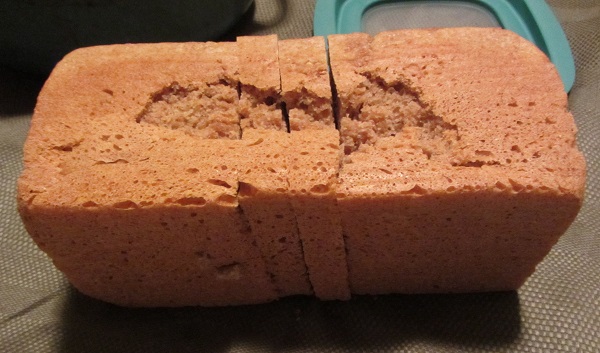
The pans themselves are no longer super duper new, and I haven’t been crazy fastidious about soaking the pans and cleaning out the old residue, so I probably deserved one that failed to release from the side. I did lightly oil the interior of the pan, but it may also need more oil than I’ve been using.

Another thing that might have contributed is the Red Fife flour combined with a longer bulk proof than usual — I let the bulk proof go a full two hours, followed by 45 minutes to an hour in the pan and the Red Fife might have started breaking down somewhat after that much time — I’ve read that Red Fife is prone to weakened gluten structure when given long proofing times. The crumb was more open than usual as well, which may be a sign of something, even if it’s just a looser crumb.

I’ve been experimenting with sometimes using Bread flour rather than AP flour and I’m leaning towards always using Bread flour going forward:

250g Bread flour and 250g fresh-milled whole wheat flour (Red Fife or Rogue de Bordeaux berries), (500g flour weight total). 375g water (75% hydration). 15g honey (3%), 15g olive oil (3%), and 15g (3%) powdered milk. 12g kosher salt (2.4% of the flour weight), 1.5 tsp instant (not rapid-rise) yeast.

Combine all ingredients. Knead on low speed for 8 minutes. (A prior hydration step is a potential and obvious improvement here.)

Cover and let rest one hour (two hours this time) for the dough to hydrate and proof.

Lightly oil the Pullman pan, pan lid, and a rubber spatula. Move the dough to the Pullman pan and spread it out with wet fingers or the spatula. Cover and let rise until 1/2″ from the top of the pan.

Bake at 350F, covered for 30 minutes then remove the cover and bake for another 25 minutes or until the loaf reaches 195-200F.


More edible mistakes. Happy Baking

Pullman Pan 50/50 Sandwich Loaf, the right grains make a big difference

I own Flour Lab by Adam Leonti. On page 71 he presents his Yeasted Loaf recipe, where he suggests a wheat variety: “I like Red Fife”.

At the start of this process I didn’t consult the book, I just picked a Hard Red Winter Wheat from the pantry (Turkey Red) and then adjusted the ratios of the ingredients bake by bake looking for the most suitable bread for sandwiches. No matter what adjustments I made the bread was still vaguely crumbly and lacked the gluten structure and springiness to be a good sandwich bread.

So I got what I deserved. It’s always the better idea to Stand On The Shoulders Of Giants, then riff from there. And I know that, usually.

The bread above is made with Red Fife. It works great as a sandwich bread, and it has a more interesting taste profile than Turkey Red. Rouge de Bordeaux works great too, and to my taste it’s even more intensely flavored, aromatic, and interesting than the Red Fife. Both the Red Fife and the Rouge de Bordeaux taste even better after a couple of days after baking, which may be true for all whole wheat breads. Leonti specifically states in a few places to let the finished bread rest until the next day prior to cutting into it.

The recipe this time is intended to be as quick and easy as possible. I’m sure it can be improved but I was initially curious to see what Red Fife would do with no other steps than would be used with a quick same-day loaf:

250g AP flour and 250g fresh-milled whole wheat flour (Red Fife or Rogue de Bordeaux berries), (500g flour weight total). 375g water (75% hydration). 15g honey (3%), 15g olive oil (3%), and 15g (3%) powdered milk. 12g kosher salt (2.4% of the flour weight), 1.5 tsp instant (not rapid-rise) yeast.

Combine all ingredients. Knead on low speed for 8 minutes. (A prior hydration step is a potential and obvious improvement here.)

Cover and let rest one hour for the dough to hydrate and proof.

Lightly oil the Pullman pan, pan lid, and a rubber spatula. Move the dough to the Pullman pan and spread it out with wet fingers or the spatula. Cover and let rise until 1/2″ from the top of the pan.

Bake at 350F, covered for 30 minutes then remove the cover and bake for another 25 minutes or until the loaf reaches 195-200F.


Having poked around some bread forums, it seems I’m not alone in my experience that “Turkey Red Is Sort Of Crumbly And Maybe Not The Best Variety For Bread”. I’m not sure if I’m going to re-purchase it when I run out. For a Hard Red Winter Wheat it’s relatively neutral tasting, and I didn’t love the gluten structure. It may still be useful in situations where strong gluten or an assertive flavor is not desirable, so I’ll focus on using it other places before I make a final decision.

Happy baking

Pullman Pan 50/50 Sandwich Loaf, the ingredients are sort of set?

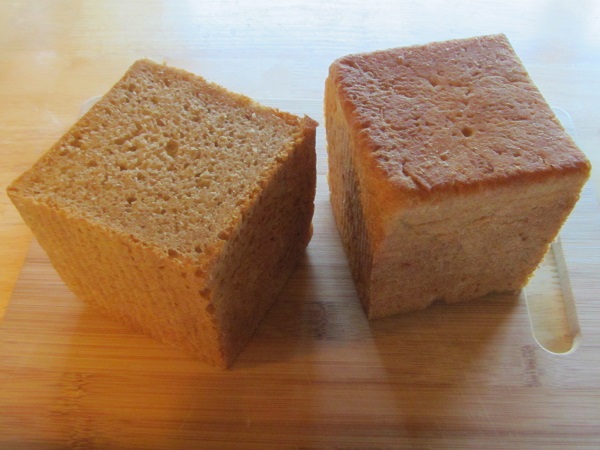
I’m pretty happy with the loaf at this point. It’s still vaguely more crumbly than I’d prefer, but the rest of it is good. The left-half has the crumb facing up:

It’s 250g AP flour and 250g fresh-milled whole wheat flour (heritage Turkey Red berries), (500g flour weight total). 375g water (75% hydration). 15g honey (3%), 15g olive oil (3%), and 50g (10%) powdered milk. 10g kosher salt (2% of the flour weight), 1.5 tsp instant (not rapid-rise) yeast.

As far as changes from where it started, it’s just been a continuous reduction in oil and honey from the original. The kneading has been cut way back. And the dough now goes directly from the mixing bowl to the Pullman pan. The current recipe:

Combine all ingredients. Knead on low speed for 1-2 minutes or until the dough comes together.

      Cover and let rest one hour for the dough to hydrate.

      Mix for 1-2 minutes. Cover and bulk rise until doubled.

      Lightly oil the Pullman pan, pan lid, and a rubber spatula. Move the dough to the Pullman pan and spread it out with wet fingers or the spatula. Cover and let rise until 1/2″ from the top of the pan.

      Bake at 350F, covered for 30 minutes then remove the cover and bake for another 25 minutes or until the loaf reaches 195-200F.

      I think to a degree I’m at a bit of a inflection point for further improvements. I’ve tried a moderate amount of mixing and very little mixing, and the “little mixing” seems to work better. It may be that combining at least the flour with the water overnight in the refrigerator (or possibly all of the ingredients) may allow for a better finished product. Another obvious change would be to sift the biggest chunks of bran out of the whole wheat flour, though that’s something I don’t want to do, both for the loss of nutrients and the bit of hassle and things to clean up afterwards.

      It may also be that Turkey Red isn’t the best grain from this application. I still have Rouge de Bordeaux and Red Fife to try out.

      So it feels like more upcoming process changes, to what, I’m not sure. Which is a fine problem to have, relatively.

      Happy baking

      Pullman Pan 50/50 Sandwich Loaf: Getting Closer

      The newest formula is getting closer. The mouthfeel and taste are good. The crumb is still just a bit more crumbly than I’d prefer. An early morning picture of the top of today’s turkey sandwich:

      It’s 250g AP flour and 250g fresh-milled whole wheat flour (heritage Turkey Red berries), (500g flour weight total). 375g water (75% hydration). 25g honey (5%), 15g olive oil (3%), and 50g (10%) powdered milk. 10g kosher salt (2% of the flour weight), 2 tsp instant (not rapid-rise) yeast.

      Knead on low speed for 10 minutes. Cover and bulk rise until doubled. Flour the bench, the dough will be sticky. Pre-shape the loaf then move it to the Pullman pan. Cover and let rise until 1/2″ from the top of the pan. Bake at 350F, covered for 30 minutes then remove the cover and bake for another 25 minutes or until the loaf reaches 195-200F.

      As for changes relative to the first attempts — I upped the milk powder and yeast and decreased the olive oil and honey. The increased milk powder is giving a better mouthfeel. The yeast is making the process a lot faster. The decreased honey is softening the crust, which is an improvement. I’ve decreased the oil and I haven’t missed it, so I left the quantity lower than the original 8% of flour weight.

      I think the final piece of the puzzle may be either:

      1. Combining the ingredients briefly, then letting the dough rest before mixing again — letting the fresh milled wheat hydrate before the actual kneading.
      2. Kneading for a shorter time, about 4 minutes, then doing a series of folds in the bowl to promote gluten formation more gently than the mixer will do it.

      I think the recipe part of the equation is very close. Now it’s the handling technique that needs to be better. That’s part of the fun of bread baking though — figuring out solutions. Which of course never ends.

      Happy baking

      A Pullman Pan 50/50 Sandwich Loaf: Searching For Goldilocks.

      600 grams of flour was too much. 400 grams of flour was not enough. This bake uses 500 grams of flour and adjusts the other secondary ratios somewhat.

      The recipe uses 250g AP flour and 250g fresh-milled whole wheat flour, (500g flour weight total). 375g water (75% hydration). This time around I cut back on the “other stuff”: it uses 30g each of honey, olive oil, and powdered milk (all are 6% of the total flour weight, the old amounts had been 8%). 10g kosher salt (2% of the flour weight), 1 tsp instant (not rapid-rise) yeast. Bulk rise until doubled then move to the Pullman pan, cover and let rise until 1/2″ from the top of the pan. Bake at 350F, covered for 30 minutes then remove the cover and bake for another 25 minutes or until the loaf reaches 195-200F.

      It’s sort of based on King Arthur’s A Smaller Pain De Mie. Or at least it was at the beginning of tinkering.

      The newest version uses relatively less honey, olive oil, milk powder, and yeast. This is intended to make the end of the rise a little more predictable and controllable — with the earlier versions there wasn’t a ton of activity for the first 60 to 90 minutes, then things started to happen fast after that.

      It should be more manageable but we’ll see how it tastes and ages after a few days. It may be the correct answer will be to restore “other stuff” to the original 8% and just cut back on the yeast and expect the whole pre-bake process to go slower and longer. I feel like it’s getting close to where it should be.

      Happy baking