Qvadriga: It’s turn-based chariot racing for your android phone!
Do you like old-school strategy games? Like, really old school?
Back in the dark ages of board games there existed Circus Maximus.
Published by Avalon Hill in 1979(!), Circus Maximus was cool because you could select and train your horses and riders, bribe the officials, and run your buddies off of the track, all for fame, glory, and riches in ancient Rome.
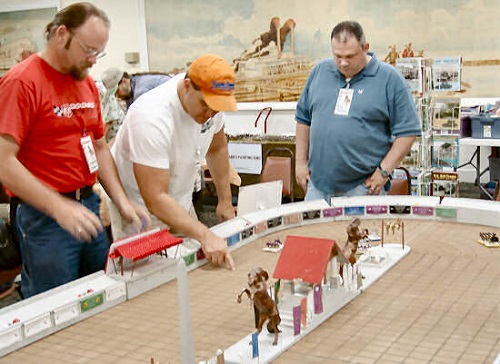
It’s been out of print forever, but it still has a passionate fan base. These guys are taking it waaay more seriously than I ever did:
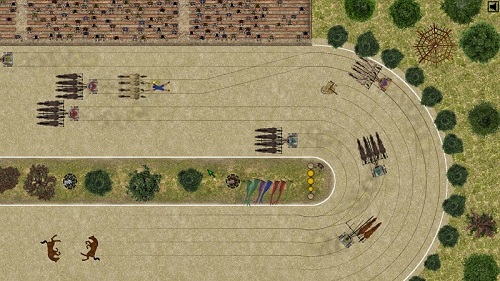
So I was really exited to see a sort-of-port for the phone – Qvadriga:
In Qvadriga you maintain a stable of four chariot teams. Your drivers can gain experience and become more skillful, assuming they survive. The game forces you to balance aggressiveness against keeping your drivers alive — go too fast around a tight corner and the chariot might break apart, leaving your driver dragging behind his horses. At that point you have to hope that he can get to safety before he gets run over. If the driver dies it takes a new hire a while to get competent… Plus you have to buy a new chariot to replace the one you broke, and the good ones aren’t cheap.
Anything goes, you can direct your driver to whip the other drivers, the other horses, or use his chariot to ram into anyone nearby. The game rewards weaving to cut off faster opponents.
There are two campaign modes, one of which allows you to resurrect a driver if he’s killed. The “Epic” mode doesn’t allow for resurrections. Ultimately the object is to become famous enough to be allowed admittance to the Circus Maximus, and then to have the driver with the most career wins of any driver still alive.
It’s $10 on the android store. I went ahead and forked out the $10 because I knew I’d get at least that much fun out of it.
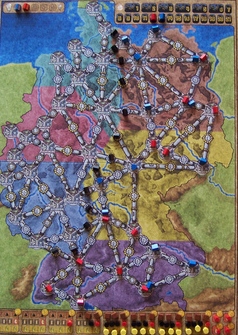
The Concept: Players bid on power plants, with more efficient plants becoming available over time. The object is to be the player that can power the most cities at the end of the game. In order to win it’s necessary to balance resource acquisition against city building and the spending on power plants.
Why I Like It: The bidding/forecasting element of the game can be intense. The action is relatively deterministic — there aren’t any dice rolls to screw you over if you’re planned well. The only randomness comes from the order that the power plants become available for auction. The game is rated #10 on boardgamegeek, which is no surprise since those voters tend to like games where they can control the outcome.
It’s not a super new game (2004), and it sat in our closet for a year before we got around to playing it, but now it’s one of my favorites, and it’s going to be a fixture at many GNOIFs to come.
Not sure where to grab a pint? Untappd shows you popular bars nearby and what’s on tap.
Discover What Your Friends Are Drinking
The best recommendations come from your friends, so find out where & what they drink.
Share What & Where You’re Drinking
Share reviews, ratings and photos of the beers you drink with your friends around the world.
Drink New Beers, Unlock Badges
Expand your palette by trying new & different beer styles and unlock achievements along the way.
Untappd has a fun “game” element to it. You get badges for drinking different types of beer. You get badges for drinking multiples of one type of beer. You get badges for drinking beer at odd hours. At one point my traveling companion got a badge for drinking on the ferry. “Ohoy Matey!” It makes casual beer drinking a potentially entertaining surprise.
Untappd has a lot of other neat features too. It’s a giant crowdsourced look at what everyone is drinking, and where. You can search by brewery — right now I can see that people are drinking Night Owl at the Elysian. It functions as a journal of what you’ve been drinking — it allows for comments and ratings, and you can save pictures too. We’ve shown this to a few people, most of the time they’ll cackle, then download it as fast as they can.
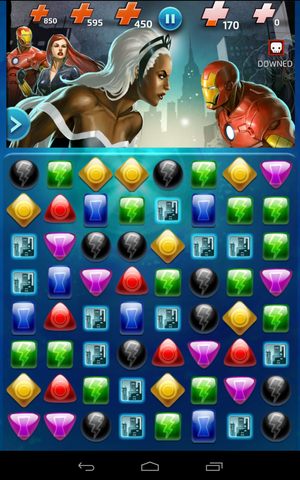
Marvel Puzzle Quest: Dark Reign uses Bejeweled-style tile matching and skins it as a superhero combat game.
To put it another way, you match (say) red tiles. After you’ve matched enough red tiles you can power a superhero ability, such as Iron Man’s Repulsor Blast — doing a great deal of damage to one target. Match a bunch of blue tiles and Black Widow will be able to heal allies. Spider Man can stun the opponent for a few turns given enough green matches. Other abilities include things like board manipulation, or placing counters on the field that blow up after a few turns, or… it’s a long list.
And it’s fairly addictive.
Heroes can get more powerful over time. Most of the loot rewards are either ISO-8 (experience points, basically), which is spent to level up the heroes,
or
“Covers”, which grant new heroes, or improve existing hero abilities. Naturally, the better covers are also more rare. Basic Iron Man is common, but somebody like Spider Man is pretty rare. To some degree you have to do the best that you can with what you have.
There’s a fairly long “story quest”, and each story “node” offers 3 or 4 potential loot drops, so to maximize the payout it’s a good idea to replay the nodes with the phat loot (or those that reward good covers). There also seems to be a never-ending deluge of new PvE and PvP content — In contrast to many other forms of online PvP, Marvel Puzzle Quest has you fight another player’s team, but not the players themselves. This is nice because you don’t have to wait on your opponent to move, and there’s none of the usual smacktalk. I can always do without the waiting and the smacktalk, so I like the way they’ve implemented PvP.
——
This was an “automatic download” for me. We’d gotten a ton of hours out of the original Puzzle Quest: Challenge of the Warlords and Puzzle Quest: Galactrix on the PSP. Challenge of the Warlords worked much the same way, except that it was skinned as a high-fantasy (swords and sorcery) questing game. Puzzle Quest: Galactrix was hexigonal, and featured starship combat.
I threw a little bit of money at this one to unlock additional slots for heroes ($20). It’s possible to pay without playing, but it will take a while to unlock a bunch of slots and have a good stable of heroes. I decided I liked the game enough that the devs deserved some money for a product that I enjoy. I’m ok with that on a limited basis.
Having said that here are two tips if you’re dead-set on not spending a dime:
1) ONLY spend Hero Points (coins) on additional hero slots. Important tip!
2) In Bold — Heroes I’d Keep If I Didn’t Want To Spend Money And Roster Space Is Tight:
1-Star Heroes (common): Iron Man, Storm, Black Widow. I got good mileage out of Juggernaut too. Every 1-star hero will get outgrown eventually. After a month of frequent gameplay I’m only using 2-stars.
2-Star Heroes (uncommon): Thor, Storm, Black Widow. (Storm and Black Widow are more powerful versions than the 1-stars.) If you have extra room then Ares, Wolverine, and Magneto are supposed to be solid. I think most casual players are using some combination of these six 2-star heroes.
3-Star Heroes (rare): Ragnarok is supposed to be good, as are Spider Man, Thor, Black Widow, and Magneto. I only have a couple of these covers, it’s going to be a while before they’re actually powerful enough to be playable.
4-Star Heroes: None, it’ll take too long to get the covers to be worthwhile.
Here’s a link I’m using for recommended builds. It predates the last big nerf, but a good starting point to minimize “wasted” covers.
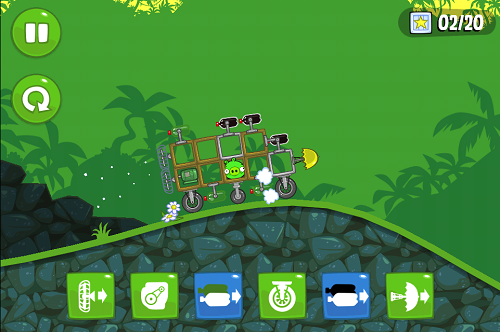
Bad Piggies. If you’re not already familiar, here’s a pic:
It’s another physics-based game by the same folks that created Angry Birds. The object is to build a very silly machine and pilot it to the finish line. Crossing the finish line in one piece is optional, usually. The vehicle in the picture above features two drive wheels, two fans to help push, a little engine in the back, an umbrella to pull things along, and pop bottles for extra “oomph” when needed. Will that build work? As likely as not, yes. Oftentimes you don’t know until you try. I’ve had some strange looking stuff succeed when the obvious solution failed.
It’s free. There are tons of popups that are easy to click through. I’d guess that the pay version removes the ads. I got a bunch of hours out of Bad Piggies before sort of hitting the wall a bit — the challenges can get very challenging.
It’s a little silly *and* can be sort of brain-twisting. If you liked Angry Birds, or you just think that building fanciful machines might be fun, give this one a download. Highly recommended.
I’m always looking for a good free game to play on the cell phone. Emphasis on “free”.
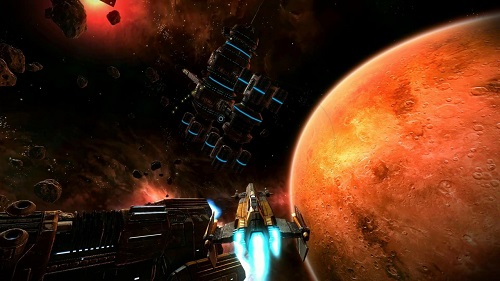
Galaxy On Fire 2 HD fits that bill. It’s a space opera/ combat/ trading game. You can fly your ship to many different star systems, shoot space pirates, and mine asteroids. You can trade with, and run missions for, the inhabitants of the space stations that you come into contact with. Better ships can be acquired. Weapons, armor, and many other ship components can be upgraded as well.
There’s a main quest storyline to save the universe from hostile aliens. (Of course.) If you don’t want to do that you can pick up mini-quests at space stations. “Kill the dread pirates.”, “Escort the freighters”, “Bring me some possibly-hard-to-find materials”. Fortunately there aren’t any “Kill Ten Rats” quests. The quests are mostly all quick and relatively engaging.
It *is* cool-looking.
Combat can be fun. Even “very fun”. Though sometimes the opponents are super over-powered and the game will suggest that you upgrade your ship. I tried that. It doesn’t often work. I’d suggest that you just run away and go find other opponents that you can beat up.
The mining mini-game is just ok, though it’s about the only reliable way to make money at the start of the game. After getting some money together I was able to leverage it into fleecing the locals when they wanted to trade, so no more grindy mining for me.
That’s the good.
The less good:
1. The main quest storyline is predictable, dumb, and fringe-sexist. I’ve seen young teenagers write better stuff.
2. Even though I put off the main storyline in an effort to get the biggest, baddest ship that I could — I still won the game with a mid-range ship. If I chose to I *could* log back in and make more money and eventually get the nasty ships. Maybe I’ll do it if I’m stuck in the car at some point with nothing else to do. Maybe. I’m going to guess that it’s possible to win the game with only a marginal ship upgrade, if any. Opportunity lost.
3. For no good reason that I can ascertain, there are four different “factions”, arranged in two pairs. Doing a quest for one faction will shift your standing towards them and away from the opposing faction. That means that I can’t just run whatever quest I see, I have to be continually balancing my faction standing. It’s an unnecessary complication that doesn’t add anything to the game.
4. The game crashes. A lot. After a while I made a point to save every time I docked at a space station. I’d guess the game would crash about after every 3rd save…every 20 minutes or so. No better way to break immersion than to be continually fiddling with the save game slots.
—
Summary: Galaxy On Fire 2 HD has gotten very good reviews. It’s on a lot of the “best games” lists. The price is right, and I got many hours of gameplay out of it.
It’s a “very good” game.
It may just be that my expectations are too high for free mobile gaming. Mostly Recommended.
Title: Small World — “It’s a World of SLaughter After All”
Game Type: Irreverent High Fantasy-Expansion/Territorial acquisition. Vaguely reminiscent of games like “Risk”. (Well, there’s a board with a map, and you’re trying to take it over. The similarities end there.)
Number of Players: 2-5
Complexity of Rules: Medium
Time to Play: 80 minutes
The Concept: It’s a silly (and tiny) fantasy world, populated by Flying Giants, Merchant Skeletons, Commando Halflings, Seafaring Ghouls, and so on. The mix of races and special abilities are randomly paired together each game. The players then “draft” their race and try to occupy as much territory as possible. When a race has been stretched as thin as it can go, or has taken too many casualties, then the player will put that race into “Decline” (retire it) and draft a new race, re-entering the fray with fresh troops. Game length is 10 turns or less, depending upon the number of players.
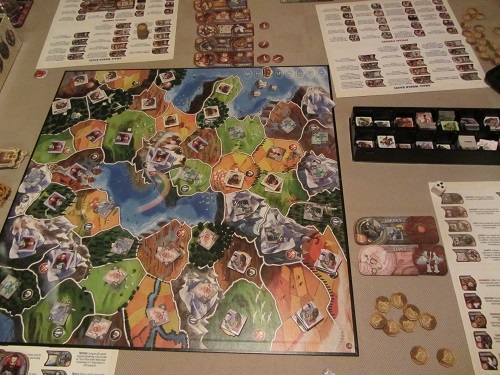
Mid-game chaos. Note the absence of unoccupied space.
Why I Like It: The silly approach to high fantasy is handled well. The artwork is well done. Selecting the races requires thought and a critical eye for the race/ability combos that may be advantageous at the moment. There’s a nice mix of strategy and somewhat chaotic gameplay — if you play with your brain turned off you likely won’t win. It’s fun to rampage across the countryside, wiping out your friends’ troops as you go. It’s also fun to yell stuff like “Pillaging Ratmen!” or “Alchemist Trolls!”, and have the whole table groan. Once everyone gets the hang of it the game moves right along.
Love Diablo 1 & II? You’ll *like* Diablo III, probably.
Diablo III is different.
1. Instead of a skill tree you get skills, then sub-skills to choose from. Evidently it was simplified because the developers felt that the skill tree concept was too complex for this day and age, or at least too complex for their target audience. I don’t know about that — there are many popular games that use skill trees, and as for me I enjoy having to pick between two trees, or two good skills within the same tree. Want 5 offensive skills and no defensive skills or buffs? Great! As it is now you can put any skill into any slot, then select the most optimal sub-skills to go with the build. If you’re not happy with the choices you can change for free, on the fly, at no cost. I think that the way they implemented it dumbs it down too much.
[In a related sidenote — in the modern era, most games that use skill trees allow you to respec (change your skill choices) for a nominal cost. Fallout doesn’t, and Diablo II didn’t either — you had to have a *really* firm idea of what you wanted the end result to look like, otherwise you’d re-roll. (Create another character and start over.) A patch changes the game balance? Tough! Go live with your sub-optimal build or re-roll!]
2. If you’re a long-time player there’s going to be a good chance that you won’t love the new plot. In my opinion the writers took some liberties with the canon that they should be left alone. I’ll leave it at that.
3. Diablo III is easy! Like, super easy! We played two-player split screen and defeated Diablo on Normal difficulty without drinking a potion. Some of the other boss fights end with the boss dead at about the same time that they finish monologuing. I think we finished Normal difficulty with over 100 healing potions each. There aren’t anymore super high dps baddies like the Death Knights, Raptors, or Succubus. Elemental effects as a group are relatively harmless except maybe the lava. This was probably a balance decision — the healing potions have a 30-second cooldown, so if you *did* want to spam potions you’d be screwed. I think they they erred too far of the side of low damage by the monsters all around.
For reference, I remember playing Diablo I & II with a buddy on the PC. For the really nasty boss fights one person would “drive” and click the spells, and the other guy would have his fingers over the number keys on the keyboard — each number key representing a healing potion — the driver would say “healing”, and the healer would use the next potion… it took too long to take your hand off of the mouse, find the next potion, and hit the key — you’d be long dead by then.
Heck, for that matter, if you died in Diablo I you’d drop all of your gear. Good luck fighting back to your corpse to retrieve it when you’re naked. Usually you had to re-gear from scratch. (People would outright rage quit Diablo I if it were released today.) Diablo III gives you a death timer that lasts a few seconds, then you can jump right back into action fully geared, the only cost of death being an insignificant gear repair fee.
In fact, all gear repair fees are insignificant. I don’t know why they bothered to implement that again, other than maybe “we had that feature last time!” It’s just one more fiddly thing to deal with that doesn’t add fun to the game. Repairs cost around 200 gold every 30 minutes of gameplay, which is basically the same as zero cost.
Related to that —
4. White drops (commons) are fairly literally valueless. At this point (level 50) we’ve got around 500,000 gold. Whites are worth about 9 gold at the vendor. The opportunity cost of picking up a White gives them a negative value if we do accidentally or intentional pick them up.
5. The maps are only vaguely random. The exits all tend to be in the same places game after game. Part of the fun of the other versions was finding the waypoints and the paths to the next zone. Not so this time.
6. Runes are gone. No more Runewords either. The devs insist that they kept the runes. The runes now are really what I was referring to as sub-skills, above. Can’t fool me. Opportunity missed.
———-
Overall those points come across as “things were better in the old days” gripes, and that’s fair — Diablo I & II had their irritating qualities. If I’d come across this game completely “cold” I’d probably like it somewhat more than I do. But I think that they took a fundamentally near perfect game in Diablo 2 and made it easier and dumber. A total overhaul wasn’t necessary, but that’s the route they picked.
And it took them thirteen years to do it.
Still, it’s prettier than the old ones. They fixed some of the worst of the problems from the Diablo III PC release from what I’ve heard. (No more auction house, no more required to be online to play… two truly awful decisions.) It remains a fun hack-and-slash high-fantasy game with random loot drops. If that’s your thing, and you can pick it up for around $20 you’ll get at least a few evenings out of it, and maybe more, so I’d say go for it.
Not exactly a ringing endorsement, but it *is* fun sometimes to run around and smash monsters.
Since we’re now in the holiday season, I thought it would be fun to compile a list of the top 10 games that we use as “gateway” games — games that are not found on the Fred Meyer Wall Of Games, but are not too hugely strange, complicated, or time consuming. Stuff that’s a little bit different but seems to be fairly universally enjoyed, even among people with limited boardgame experience.
There are no original thoughts, especially on the internet. Here’s boardgamegeek’s top 100 gateway games.
My top 10 is below, with boardgamegeek rank, approximate price, and a *very* brief explanation of the mechanic. For additional information, the links lead back to earlier “Recommended Game” posts on this website:
1. Ticket To Ride Europe (BGG #1 & #5, $45, 2-5 players) — Build railways across Europe by creating card sets of similar colors. Ticket to Ride easily won #1 on the BGG site. Ticket to Ride Europe got #5.
2. Gardens of Alhambra (BGG #26, $40, 2-4 players) — Place “plant” tokens around valuable buildings to block out the competition and win points. Somehow this hasn’t gotten a Recommended Game post yet — I’ll have to fix that. BGG link here.
3. Fluxx (BGG N/R, $15, 2+ players) — A somewhat wacky card game with continually changing rules and win conditions. Very fast to play.
4. Forbidden Island (BGG #11, $25, 2-4 players) — Work cooperatively to save four treasures from an island that is rapidly sinking.
5. Lost Cities (BGG #16, $22, 2 players) — Do you remember Rack-O? It’s sort of like that, but more interesting and better all around… Two players plan expeditions to one of five continents. The winner has the most valuable expeditions.
6. Guillotine (BGG #59, $18, 2+ players) — Off with her head! The nobles are all lined up to be beheaded. Manipulate the line so that you get to behead the most famous.
7. Dominion (BGG #25, $42, 2-4 players, up to 6 with expansions) — Card game where you create your deck as you go. If I had to pick one, it’s probably my favorite game on this list. It’s kind of hard to describe in just a few words, check out the link.
8. Mr. Jack Pocket (BGG #64, $22, 2 players) — Sherlock Holmes vs Jack the Ripper. Jack is one of nine suspects and it’s up to Holmes to figure out who. Players take turns moving the inspectors and changing sightlines down alleyways to try to hide and/or reveal suspects. A two player game that transports well and generally takes less than 30 minutes.
9. Citadels (BGG #52, $25, 2-8 players) — Each turn a player takes the role of one of eight midieval characters. The characters have different benefits and turn priorities. Collect gold and be the first to build eight buildings. The player with the most valuable buildings wins.
10. Rocketville (BGG N/R, $25, 3-5 players) — BGG hates this game. We like it. The board is divided into multiple neighborhoods. Win the majority of a neighborhood and receive points as a reward. The player with the most points wins. There’s some luck involved, but we always have fun.
It’s not a complete list, but it’s a good start. What else would you add to the list?
Game Type: Exploration/ Euro-style resource allocation, shares traits with the other Catan titles.
Number of Players: 2
Complexity of Rules: Low-Medium/ Medium
Time to Play: 60 minutes
The Concept: Each player controls a spaceship. In the quote box is further explanation from boardgamegeek (I can’t improve on it, so here it is) –
Players explore randomly shuffled decks of cards [ed: star sectors] looking for potential colonies, good trading deals, opportunities to help planets, and either avoid or combat pirates. Players can upgrade their ships’ systems, including weapons to combat the pirates, thrusters to be able to explore further each turn, scanners to see (and avoid) cards that are coming up, and several others. Victory Points are earned by establishing colonies, building upgraded ship’s systems, having the most friendship points, and having the most hero points. The first player to 10 Victory Points wins.
Why I Like It: Like many of the other Catan and Euro games, it’s about the tradeoff between what you have, what you want, what you need now, and what you’re building towards. As the sectors are explored, the pirates get bigger and nastier, and the danger ramps up.
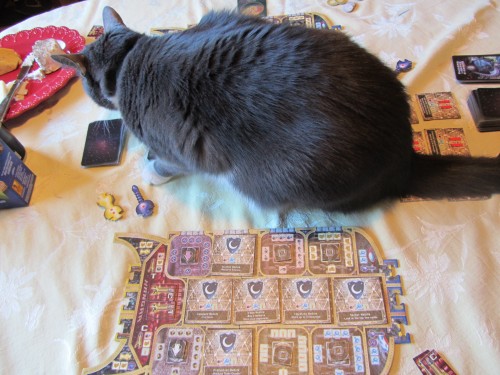
The game features good-sized cardboard cutouts that represent the ships. You can see it in the picture below. The yellow token attaches to the back of the ship and represents an engine. The blue pointy token goes in the front and represents cannons. The arrows in the middle of the ship point to how much of a particular resource that you have. The squares represent different bays of the ship that can be upgraded for a cost. There are also the Colony and Trade pods at the back. Collect resources by exploring the sectors and upgrade as you think is appropriate. .
The boy cat was interested in playing too:
Starship Catan is now out of print. The going rate on ebay is $22-34. We recently purchased a 2nd copy on ebay with the idea of keeping one “nice” copy. As it turns out, the one purchased on ebay is in better shape, so it’s now the “keeper”. Highly recommended.



 FlatbreadGarden