Roasted Tomato Pizza

by A.J. Coltrane

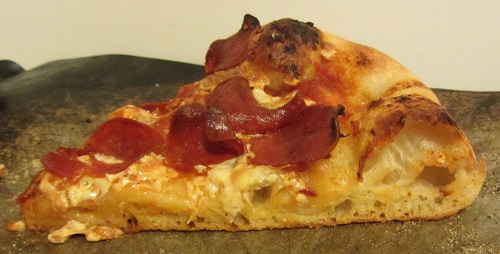
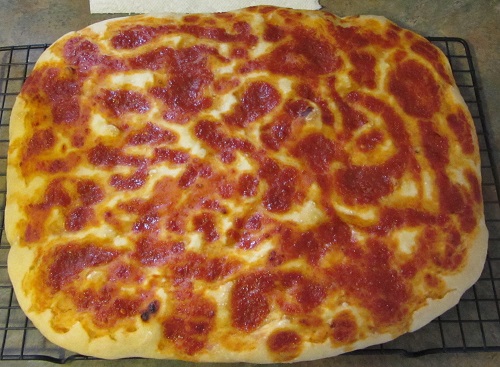
We had a hodge-podge of tomatoes left over from our tomato tasting on Wednesday, so Thursday night was pizza night featuring the stragglers. (Mostly Roma, Oregon Spring, and Sweet Million.)

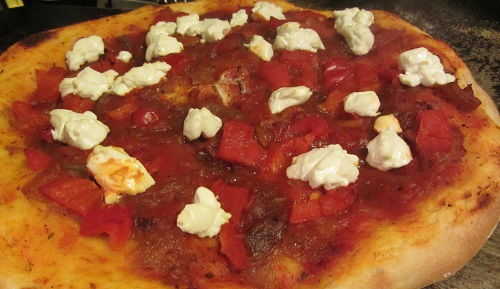
I cut the tomatoes into pieces, then roasted them with a little salt and olive oil as part of warming up the oven:  425F for about 15 minutes. Roasting removed the worst of the liquid. The tomatoes were then lightly pureed, and:

150813 pizza

Very simple – Roasted tomatoes, sopressata, and parmesan. The pizza really didn’t need anything else.

———————-

In the “it’s a small world” category, NW Edibles did a roasted tomato post today too, though she roasts hers at 250F for 3 to 7 hours(!)

Grilled Flatbread With Pesto And Goat Cheese

by A.J. Coltrane

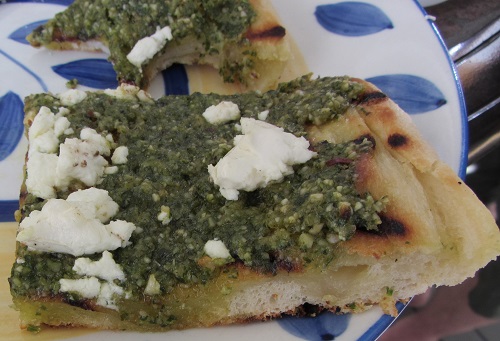
Or Pesto and Goat Cheese Grilled Flatbread? It definitely featured pesto:

150720 pesto flatbread

The dough formula:  400g Bread Flour, 240g vaguely warm water, 9g kosher salt, 8g extra virgin olive oil, 1.5 tsp instant yeast. (60% water, 2.25% salt, 2% oil)

Those are very “normal” ratios. It was basically a grilled pizza dough. Or focaccia. Take out the oil and it’s a baguette dough. Normally I’d use 1 tsp of yeast, but this was the same “company-coming-over-soon” night where things needed to be ready quickly. The “extra” yeast ensured that the dough would be ready for dinner, and it allowed for additional reshaping, leading to a lighter end result.

For the grilling process:  I stretched out the dough and tossed it onto the grill over medium heat. After a few minutes I brushed the top with olive oil and flipped it over. I  brushed the new top lightly with oil, then spread on the pesto. When the flatbread looked like it was about done we scattered goat cheese over the whole thing.

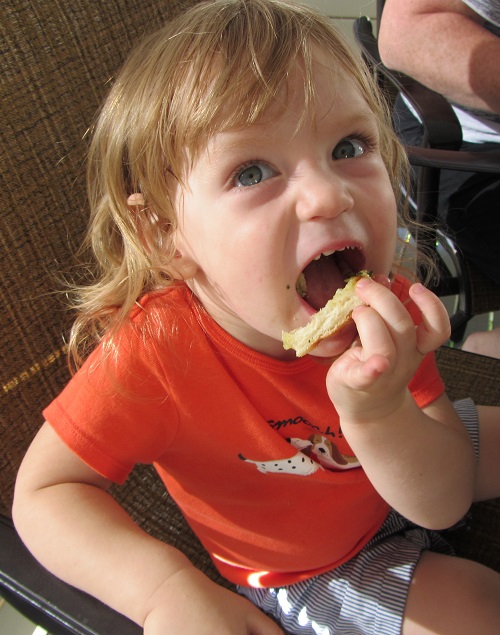
What follows is the first picture on this blog of an actual human that we know personally. This one happens to be a very short female:

15720 kid1

Not my child. She belongs to the dinner guests. Though she’s small, she almost single-handedly ate a 1.5 pound flatbread. Anytime short people will eat food without complaint I’ll call it a victory.

I also think I learned a little something about pesto in the process. Something like this FN recipe is a “standard” pesto. It calls for 2 cups packed basil, 1/2 cup grated Pecorino, and 1/4 cup pine nuts. I used ~2 cups packed basil, ~3/4 cup grated parmesan, and ~3/4 cup buzzed toasted pine nuts.

I like it way more with the additional cheese and (especially) pine nuts. I feel like it’s more earthy and complex with the balance tilted away from the basil. Hopefully the “lesson” sticks.

“00” Flour Pizza

by A.J. Coltrane

Another “00” flour pizza.

300 grams flour. ~62% hydration. 2% salt. A glug of olive oil. A splash of hard cider. Eight minutes in the mixer. Two days in the refrigerator.

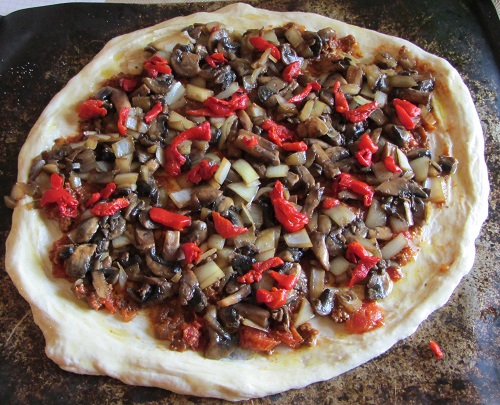
Prior to baking:

150423 pizza

Toppings: A whole bunch of lightly sauteed mushrooms, some lightly sauteed sweet onion, and roasted red pepper on a thickened bolognese.

The “00” flour was super stretchy again. There was no way it was going from the baking peel to the baking stone. I decided to make it less interesting and form the pizza on a baking sheet. The baking sheet went onto a pizza stone in a preheated 500F oven.

The pizza baked for 9 minutes, then parmesan was added and the pizza was allowed to bake another 5-6 minutes.

150423 cooked pizza

The small amount of less-melted parmesan was added after the pizza came out of the oven.

The crust was actually darker than it looks in the picture. I’d brushed the crust with olive oil before baking, and it improved the color and taste.

Despite the large amount of toppings the pizza came out crisp, and with a good snap the crust. I think it helped that the toppings were precooked — they didn’t dump a bunch of water onto the pizza.

Overall it was very tasty, and very filling without making me feel bloated. Two thumbs up.

A Quick Pizza

by A.J. Coltrane

In between watching and recording 30-something college basketball games over the last few days — a two-hour pizza happened:

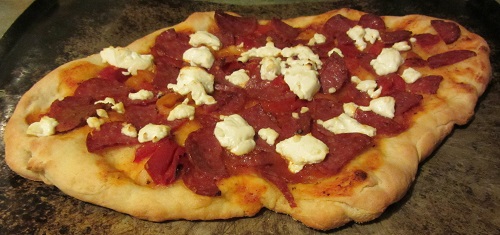
Goat cheese, roasted red pepper, and soppressata.
Goat cheese, red sauce, roasted red pepper, and soppressata.

50% bread flour, 50% “oo” flour, 60% hydration with a splash of white wine. 2% kosher salt. Baked on a stone preheated to 500F.

The “oo” flour continues to be super extensible. I thought maybe cutting in some bread flour would make it more controllable. It didn’t seem to have much impact.

As for other possible improvements — I think maybe I need to be slightly freezing the meat before slicing it. It would benefit the pizza if the soppressata was even thinner than I’ve been able to get it.

Overall though, I feel like I’m really starting to get the hang of the pizza peel and stone. It’s resulting in better pizza crusts. The pizza peel isn’t now as intimidating as I used to think it was.

More “00” Flour Pizza

by A.J. Coltrane

I’m continuing to work through the 22 pounds (10 kg) of “00” flour that Iron Chef Leftovers gave me. That’s actually more than it sounds like — a typical pizza uses ~300 grams of flour.

150225 pizza

Caramelized onions, roasted red peppers, red sauce with a little sausage, and feta. The onions are hiding under the sauce, away from the heat.

The dough formula:  350g flour, 210g water (60% hydration), 7g kosher salt, 10g olive oil, 1 tsp instant yeast, and a splash of white wine. Baked in a 500F oven on a baking stone for 12 minutes total. The cheese was added with 4 minutes to go.

The post-mortem:  350 grams of flour makes for a fairly thick pizza. Most likely I’ll cut it back to 250-275 grams next time.

The “00” flour is crazy extensible. The dough was kneaded for 10 minutes, and did a “stretch and fold” on it probably 20 times after removing it from the mixer and it was still super duper stretchy. This time I patted it out on the counter, then carefully tossed it between my hands. There were some really thin places in the finished dough, so I clearly need more work on technique.

The pizza was very light and airy, which was probably partly due to all the “stretch and folds”, and partly the “00” flour. It was fully cooked, though next time I think I’ll let it go another 2-3 minutes for more color and snap. The caramelized onions really “made” the pizza. Tasty!

Bonus girl cat pic. She’s nestled in somebody’s lap, and on her favorite blanket to knead. Check out those claws:

150225 girl cat

Pizza alla DiGiorno

by A.J. Coltrane

We had guests last night and I figured I’d make what might be most strongly identified as “normal pizza”.

Actually, two pizzas. The recipe:

Ingredient Measure Baker’s %
Bread Flour 600g
Water 318g 53
White Wine 60g 10
Salt 15g 2.5
Sugar 1 TBP
Instant Yeast ½ TBP
Olive Oil 15g 2.5

Directions:

1.  Mix all ingredients on low speed for 10 minutes. Cover and let rise two hours.

2.  Divide the dough and shape into two balls. Cover and let rise one hour.

3.  30 minutes into the 2nd rise, place a baking stone in oven and preheat for 30 minutes at 500F.

4.  Lightly coat a baking peel with semolina. Shape the dough, and place onto the peel. Top the dough (sauce, then cheese, then pepperoni).

5.  Bake the pizza for 12 minutes.

Pizza one:

141221 pizza 1

Pizza one crumb:

141221 pizza 1 crumb

Pizza two:

141221 pizza 2

Pizza two crumb:

141221 pizza 2 crumb

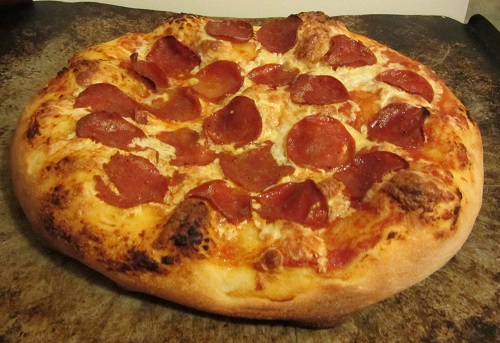
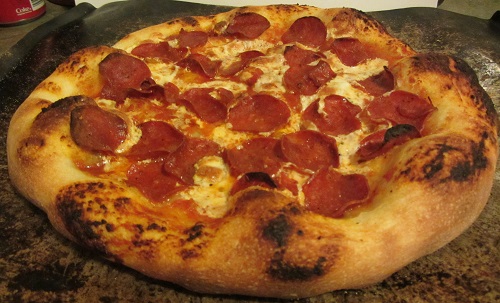
Pepperoni, shredded mozzarella, home made red sauce made from home grown tomatoes (with garlic, oregano, minced onion, salt. And butter! Ssshh! Thanks, Marcella Hazen!)

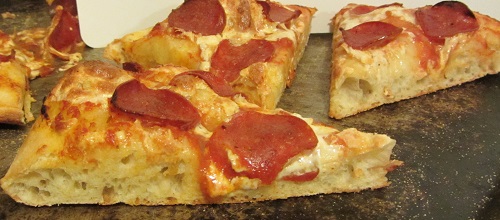
Overall they were nice, light pizzas. The cornicione (crusts) were especially airy, with large pockets running through the perimeter of each. (The blackened areas show the location of the air pockets.) The first pizza came out somewhat wet. The liquid had been exuded by the cheese. We corrected that, and the (drier) 2nd pizza had much more concentrated flavors, in addition to not being wet, so… double bonus. In the future we’ll do a more thorough job of drying the mozzarella on paper towels.

From a technique standpoint, the biggest change is the use of the baking stone. I think that a long time ago I had trouble transferring the dough from the peel to the baking stone and then avoided using the peel for years.

I think that’ll be a new “thing” for a while.


Pizza Shaping

by A.J. Coltrane

I think the weakest part of my pizza-making process is the last part — shaping the final dough. Here’s the last one:

141213 pizza

It’s a 62% hydration bread flour dough with peppers from the garden, onions, goat cheese, and a jarred marinara. (300g bread flour. 62% water, 4% oil, 2.3% salt. Baked on a perforated pizza pan.)

In this case I floured the counter and patted/stretched out the dough, never lifting it from the surface. The crust came out crisp and crusty. The cornicione (edge) was only slightly poofier than the rest of the crust.

My suspicion is that after patting the dough out on the counter it might benefit from being picked up and stretched.

Which is a good excuse to make another pizza.

Tomato Focaccia

by A.J. Coltrane

I’ve read about a Roman bread that has tomato “painted” into the surface. (Thanks for the perfect word to describe it, Kurt.) I spent a little time looking for a picture of what I’m visualizing… I don’t know that I’ve found a “right” picture. Most of the recipes seem to include a tomato puree and/or paste within the dough. Some rub a finished bread with a cut tomato after it comes out of the oven, which I’m thinking is what I had in mind when starting this bread:

tomato focaccia 141101

The bloody end result was based around what’s become my default focaccia recipe:  300g AP Flour, 300g Bread Flour, 420g water, 36g olive oil, 14g kosher salt.  (That’s 70% hydration, 6% oil, and 2.33% salt by weight.) This time I omitted the honey, reduced the instant yeast to 3/8 teaspoon, and allowed for a 18 hour rise.

Note that it’s the same rise time, and ratio of yeast as goes into the No Knead Bread — the No Knead Bread uses 400g flour and 1/4 teaspoon of yeast.

The Tigerella tomato sauce was simmered with three smashed cloves of garlic and two thai bird chilis until fairly thick but still “drizzleable”. (We’d recently been to a cooking class where the chef used a little bit of heat to “focus” things. I think that it worked — there was just a faint hint of heat at the finish.)

The Rest Of The Recipe:

1.  Combine dough ingredients, mix on low speed for 10 minutes, and let rise 18 hours.

2.  Transfer the dough to a lightly oiled baking sheet let rise one hour. (I went with a one hour rise instead of two or three because I was looking for a denser finished product, and so that the dough would support the weight of the sauce.)

3.  Preheat oven to 425F.

4.  Drizzle on the cooled sauce. Note that a focaccia typically has olive oil on the surface. I didn’t use any oil this time.

5.  Bake for 15 minutes, turn the tray, and bake for another 12-15 minutes.

—–

I think the Reinhart book American Pie has the application I’m looking for. Maybe I’ll dig through it for the recipe. Maybe.

The GNOIF Big Sandwich Bread

by A.J. Coltrane

I’ve been making a sheet-tray sized sandwich for every GNOIF over at least the last two or three years. The bread components of those sandwiches have all been riffs on focaccia.

The most recent ratios:

Ingredient Measure Baker’s %
Flour 600g
Water 420g 70
Salt 14g 2.33
Honey 1 TBP
Instant Yeast 1.5 tsp
Olive Oil 36g 6

The “Flour” for the pictured bread is 50% Gold Medal unbleached AP flour and 50% King Arthur bread flour. I added a small amount of honey to try to improve the browning, which seemed to work ok. It’s largely the same process as “Potluck Focaccia” — I’ve settled into a preferred routine for focaccia it seems:

1.  Combine all ingredients in a mixer and combine on low speed for 10 minutes. Lightly oil a parchment lined sheet tray.
2.  Pour the dough into the sheet tray, gently coaxing the dough towards the edges of the pan. Cover and let rest 2 hours.
3.  Preheat oven to 425F.
4.  When the oven is hot, drizzle a small amount of oil on the dough. Gently coax the oil over the surface.
5.  Bake for 15 minutes, turn the tray 180 degrees and bake for another 10 minutes.

141004 focaccia

This one is roast beef and ham with swiss. The flavored mayo (which one guest mistook for mustard) included olive oil, salt, “Montreal Steak Seasoning”, and a healthy dose of horseradish. (The pungency of the horseradish is likely what crossed him up.)

There are now 14 posts that reference focaccia on CheapSeatEats. It still trails pizza, which gets at least a mention in 55 posts (though I’m sure there’s some overlap)… We clearly love us some flattish breads.


A Quick Weeknight Pizza

by A.J. Coltrane

A big disadvantage of preparing a two-hour dough is that it’s not enough time for enzymes to liberate natural sugars from the flour. The flavor suffers as a result, and the color is rarely as nicely carmelized as seen on longer-rise doughs.

Last week’s Batali dough got me thinking about adding sugar, or honey, to a quick mid-week pizza. The formula below is influenced by that last recipe, omitting the wine but increasing the water content:

Ingredient Measure Baker’s %
AP Flour 400g
Water 260g 65
Salt 9g 2.25
Honey 1 TBP
Instant Yeast 1.5 tsp
Olive Oil 1 TBP

That’s a lot of flour — the same amount as goes in the No-Knead breads, or even two medium size pizzas. For a single pizza I’ll more often use 200 or 300 grams of flour, scaling back the other ingredients as needed. This was a thick pizza:

140909 pizza

Chopped fresh tomatoes, mozz, basil. The crust was finished with an herbed olive oil. (A post on that later, it’s a nice local producer. We purchased the oil at the farmer’s market.)

The recipe:

1.  Knead all ingredients at low speed for 10 minutes. Let rise two hours. Preheat oven to 500F.

2.  While the oven is preheating, halve the tomatoes across the equator and squeeze out the worst of the juice. Chop the tomatoes, basil, and mozz.

3.  Very lightly oil a pizza pan, apply the stretched dough. Top the dough with the chopped tomatoes.

4.  Bake for 10 minutes. At the 10 minute mark sprinkle on the mozz.

5.  Bake for 6 minutes. Remove from the oven and strew on the basil. Lightly brush the crust with olive oil.

The pizza would have been improved by using somewhat less flour, and possibly by swapping out the AP flour for Bread flour. Marinating the tomatoes in garlic would have been good too.

I was fairly happy with it overall. I think it’s the “right track” for quick weeknight dinners.