Risotto Made Easy(er)

By Iron Chef Leftovers

Making risotto seems like a daunting task for someone who has never done it before and there is always the potential for doing something incorrectly and ending up with a big pile of mushy rice. I was lucky growing up in an Italian household – risotto was a staple for special meals and from a very early age, I was lucky enough to watch my dad make it, so I was able to lean by doing it without ever having to use a recipe. Over the years, I have had a number of people ask me for the “recipe”, and they have always been disappointed that there isn’t one. My standard response has always been, come over and I will show you how to make it. Over the years, as I have increased my knowledge of the science of cooking, I have made changes to the way that I make my risotto. I learned that you don’t need to constantly stir it and with a little tweaking, risotto went from something that I made only on weekends to something that I can make for a weeknight dinner. Below is an attempt to put together a repeatable recipe. While I did measure everything out, so much of this is by feel, that it may take you a couple of tries to get it right. Of course, you can always come over and I can show you how to make it…

The Software
3/4 cup Arborio Rice
3 cups chicken or vegetable stock
1/4 cup dry white wine
1/3 cup yellow onion, diced
2 tablespoons olive oil
2 cups warm water
1/3 cup grated parmegiano reggiano
2 tablespoons butter
1 pinch of saffron, steeped in 1/4 cup hot water
salt
pepper

The Recipe

Steep the saffron in hot water for 10 minutes

Heat the chicken stock in a saucepan. You are looking for it to be warm before you use it (around 120 degrees), so bring it up to temperature and hold on the stove over low heat to keep warm. Add the saffron and water to the pot.

In a saucier or sauté pan, heat the olive oil over medium heat for 3 minutes. Add the onions and cook until they start to soften and become translucent (about 7 minutes), stirring occasionally. You are not looking to brown the onions; so if they start to brown, lower the heat.

Add the rice to the onions (yes, you read this right). Toast the rice in the pan for 2-3 minutes, stirring every 30 seconds. DO NOT SKIP THIS STEP; IT IS CRITICAL TO THE RICE TURNING OUT PROPERLY.

Add the white wine to the pan to deglaze and stir.

Once the liquid is absorbed lower the heat slightly and add 1/4 of the chicken stock to the rice. Stir. It doesn’t have to be 1/4 exactly, so don’t worry about measuring it, just guess. It won’t hurt you to put more or less in. Cook for 5 minutes or until most of the liquid is absorbed.

Repeat this process with the remaining liquid, adding it in 3 more times and stirring after the liquid is added. If the rice is sticking to the bottom of the pot badly, lower the heat.

Once you have added the last batch of stock to the rice, add the water to the pot that contained the stock and heat it. This is necessary in case more liquid needs to be added to the rice.

After MOST of the last addition of stock is added, you are going to check for doneness. The only way to check is by tasting it. The rice should be soft with just a hint of toothiness – if it is at all crunchy, it is not done. If you are at that stage, add 1/3 of the water and continue cooking the same way as with the stock until you are done.

When the rice is fully cooked and there is still a small amount of liquid in the rice, reduce heat to medium low and add the cheese and butter, stirring constantly until both are incorporated. Taste and add salt and pepper to taste.

Serve immediately.

Notes
There are several critical components to this dish. The rice you use is important – you need to use Arborio rice that mentions superfino on the package. If you don’t use Arborio rice, you will not get the creamy texture that is the trademark of risotto and superfino indicated that the rice is a high grade. Using rice that is not superfino grade can lead to a mushy meal. Chicken or veggie stock are my recommendations, but you can use any stock you would like (or even just water) – just be warned beef stock will impart a very strong flavor to the rice. The saffron really is optional, but it does impart a golden color and earthiness to the rice. This recipe will feed 4 as an appetizer or 2 as an entrée with some leftovers for seconds. This is really a base recipe. I will be posting a few of my favorite variations, but once you get this one down, feel free to experiment to your hearts content.

Belgian Beef Carbonnade

By Iron Chef Leftovers

I really love things that are braised. Tender chunks of meat, rich unctuous sauces, loads of flavor, the ideal comfort food on a cold day. Braising’s dirty little secret is that you really should make it one day in advance and reheat it the next day. It gives the sauce a chance to infuse itself and increase the flavor.

One of my favorite braises is a classic Belgian dish, Beef Carbonnade. It uses an inexpensive cut of meat, a handful of ingredients and very little prep to produce what I think is the perfect example of what beef stew is. It also combines two of my favorite things – meat and beer. The below recipe was originally taken from Cook’s Illustrated and I have made a few modifications, most notably the amount of liquid used in the dish. My biggest problem with the recipe is that there was not enough sauce, so I took care of that. Also, the original recipe calls for equal parts of chicken stock and beef stock. I replaced that with only chicken stock and I think it actually turned out better. Then again, I was using my homemade stock, which is about 1000 times better than anything that you can get in a store.

Serve over rice, potatoes, pasta, frites or just in a bowl with some bread on the side. The leftovers will freeze nicely for 3-6 months.

The Software
3 1/2 pounds blade steaks, 1-inch-thick, trimmed of gristle and fat and cut into 1-inch pieces
Salt and ground black pepper
3 tablespoons olive oil
2 pounds yellow onions (about 3 medium), halved and sliced about 1/4-inch-thick (about 8 cups)
1 tablespoon tomato paste
2 medium cloves garlic, minced or pressed through garlic press (about 2 teaspoons)
3 tablespoons all-purpose flour
1 1/2 cups chicken stock
2 1/2 cups Belgian brown beer
4 sprigs fresh thyme leaves, tied with kitchen twine
2 bay leaves

The Recipe
Adjust oven rack to lower-middle position; heat oven to 300 degrees.
Dry beef thoroughly with paper towels, then season generously with salt and pepper.
Heat 2 teaspoons oil in large heavy-bottomed Dutch oven over medium-high heat until beginning to smoke; add about one-third of beef to pot.
Cook without moving pieces until well browned, 2 to 3 minutes; using tongs, turn each piece and continue cooking until second side is well browned, about 5 minutes longer.
Transfer browned beef to medium bowl.
Repeat with additional 2 teaspoons oil and half of remaining beef. (If drippings in bottom of pot are very dark, add about 1/2 cup of above-listed chicken or beef broth and scrape pan bottom with wooden spoon to loosen browned bits; pour liquid into bowl with browned beef, then proceed.)
Repeat once more with 2 teaspoons oil and remaining beef.
Add remaining 1 tablespoon oil to now-empty Dutch oven; reduce heat to medium-low.
Add onions, 1/2 teaspoon salt, and tomato paste; cook, scraping bottom of pot with wooden spoon to loosen browned bits, until onions have released some moisture, about 5 minutes.
Increase heat to medium and continue to cook, stirring occasionally, until onions are lightly browned, 12 to 14 minutes.
Stir in garlic and cook until fragrant, about 30 seconds.
Add flour and stir until onions are evenly coated and flour is lightly browned, about 2 minutes.
Stir in stock, scraping pan bottom to loosen browned bits;
Stir in beer, thyme, bay, browned beef with any accumulated juices.
Increase heat to medium-high and bring to full simmer, stirring occasionally; cover partially, then place pot in oven.
Cook until fork inserted into beef meets little resistance, about 2 – 3 hours.
Discard thyme and bay.
Remove about 2 1/2 cups of the sauce to a saucepan and reduce over medium heat by 1/2.
Add the reduced sauce back to the pot with the beef.
Adjust seasonings with salt and pepper to taste and serve to a grateful public. (Can be cooled and refrigerated in airtight container for up to 4 days; reheat over medium-low heat.)

Notes
You can probably use any low hop beer for this recipe, but I prefer to use either the Belgian beer Duval (about $8 for a 750 ML bottle) or the Trader Joe’s Vintage Brown Ale (about $4.50 for a 750 ML bottle). The Belgian beers are malty and sweet and will really enhance the sauce. You won’t use the entire thing, so drink with the meal. I have been contemplating trying this recipe with skipping the searing step for 2/3 of the beef. The meat that is above the liquid will brown during the braise, so it might actually save some time that would be used for searing. I would still want to sear 1/3 of it to build the fond in the bottom of the pan (the browned bits), because there is a ton of flavor in that. The recipe also originally called for 1 teaspoon of cider vinegar. I removed it since I didn’t think it really added anything to the braise.

NY Strip with Blue Cheese, Bacon and Crispy Onions

By Iron Chef Leftovers

Early on in the cooking process, the bacon and sacuce are not yet in their happy places.

Mrs. Iron Chef loves bacon wrapped tenderloin. While I love cow, this is probably my least favorite part of the animal – it has very little flavor, is very expensive and can be picky to cook with since you don’t have any protection from overcooking because of its lack of fat. Personally, if you are talking supermarket cuts, give me a nice bone-in rib eye. This past Valentines Day, I wanted to do steak, but I didn’t want to do tenderloin, so I went with my compromise cut – the New York strip. It has a fair amount of fat, so it is a little more forgiving to cook, has a more beefy flavor and is still fairly tender. In case you are unaware, the strip is the muscle the run parallel to the tenderloin on the back of a cow – when you get a t-bone steak, the larger side is the strip, and the smaller is the tenderloin. This is the recipe that I came up with – it is pretty simple to put together, cooks relatively quickly and really looks impressive when done.

The Software
2 NY strip steaks, 6-8 oz each
5 strips of bacon, cooked crispy, fat reserved
1 cup chicken stock
1/2 cup dry red wine
1/4 cup Marsala or port wine
2 tablespoons of cognac
1/2 onion, sliced thin
3 oz blue cheese
1 oz butter
salt
pepper

The steaks after being salted for 10 minutes. See how much liquid has come out of them?

The Recipe

The Steak
About 30 minutes before cooking, remove the steaks from the fridge and season on each side with salt. Put the steaks on a wire rack over a plate. This is going to draw out water from the meat and will lead to a better sear.
Cook the bacon in a large skillet until brown and crispy. Crumble after it is cooked.
Remove from the pan and reserve the fat. Wipe out any brown bits that remain.
Pat the steaks dry with a paper towel.
Heat the skillet on medium-high heat, adding 1 tablespoon of bacon fat until barely smoking.
Add the steaks carefully.
Cook on the first side for 4 minutes. DO NOT MOVE THE STEAKS UNTIL THE 4 MINUTES IS UP.
Flip and reduce heat to medium and cook to desired doneness (it will be roughly 4 minutes for medium rare).
Remove to a plate with the side that you cooked first facing up.
Allow the steaks to rest for 8 minutes.
Wipe out any fat and hit the pan with a shot of wine and deglaze. Add to the sauce.

The Sauce (this can be made ahead of time and stored in the fridge)
In a medium saucepan, combine the stock, wine and port over medium heat.
Reduce the contents by 2/3 this should take about 30 minutes or so.
When ready to serve, over low heat, whisk in the butter and any accumulated juices from the steak.
Taste and adjust the seasonings.
Spoon over steak.

The Onions
In a heavy bottom pan add 3 tablespoons of bacon fat over medium heat. Add the onions and a pinch of salt and cook until they become crispy, stirring occasionally, making sure they do not begin to burn. This should take about 20 minutes or so.

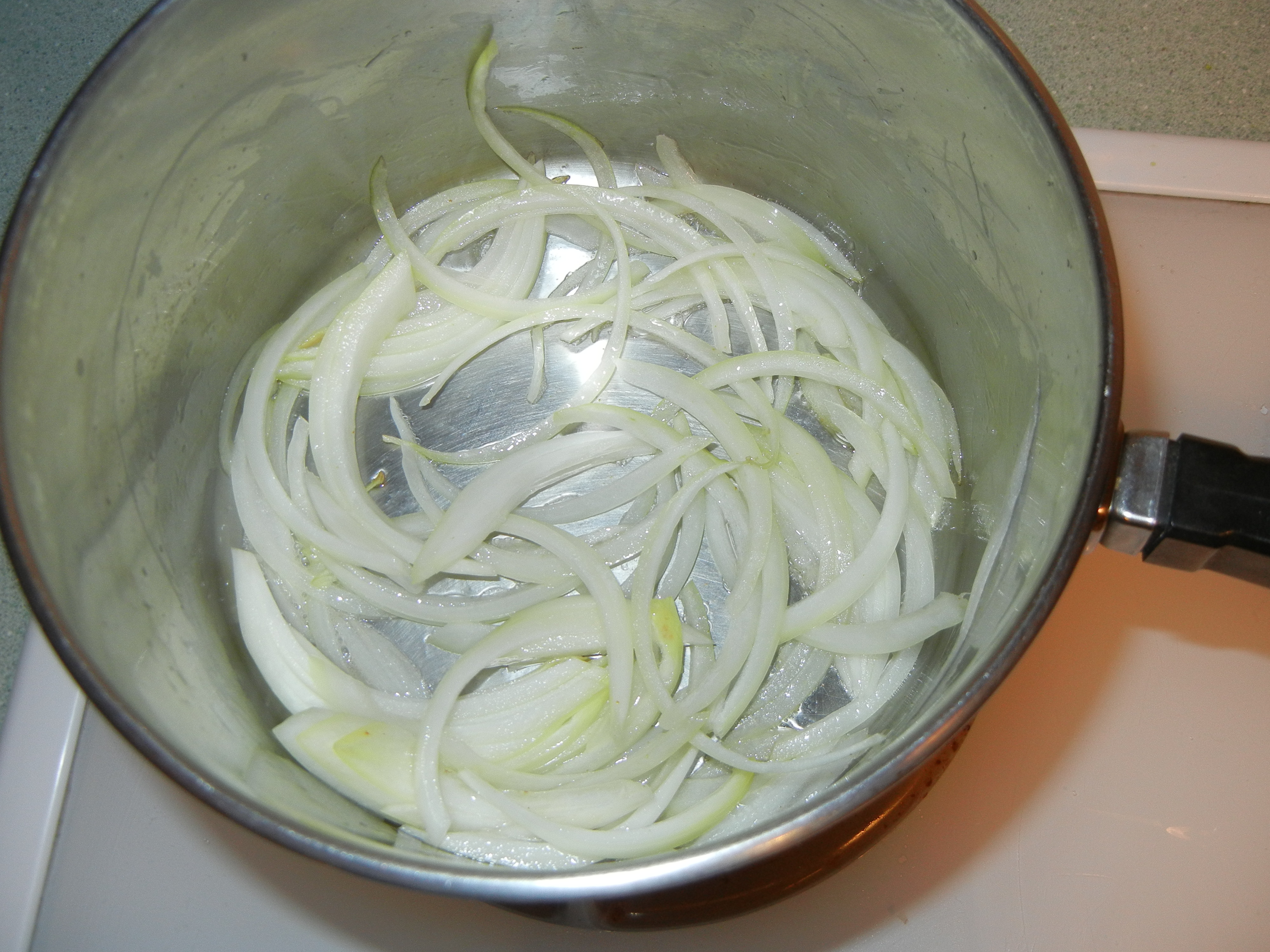
Onions on their way to crispy goodness.

The Assembly
Heat your broiler and adjust the top rack to the position just below the broiler element.
In a bowl, take the blue cheese and mash with the back of a spoon until soft and spreadable.
Place the steaks in a broiler safe pan and spread the cheese on top. You should have about 1/8 inch layer on the steaks – you also don’t need to worry about going to the edge, the melting cheese will take care of that for you.
Place the steaks under the broiler for 2 minutes, until the cheese is melted and bubbly. Check it after 1 minute and every 30 seconds after that – it can go from bubbly to burnt in a hurry.
Remove the steaks to a plate. Drizzle with sauce (and any melted blue cheese from the pan) and top with crispy onions and bacon crumbles.
Serve to a happy wife.

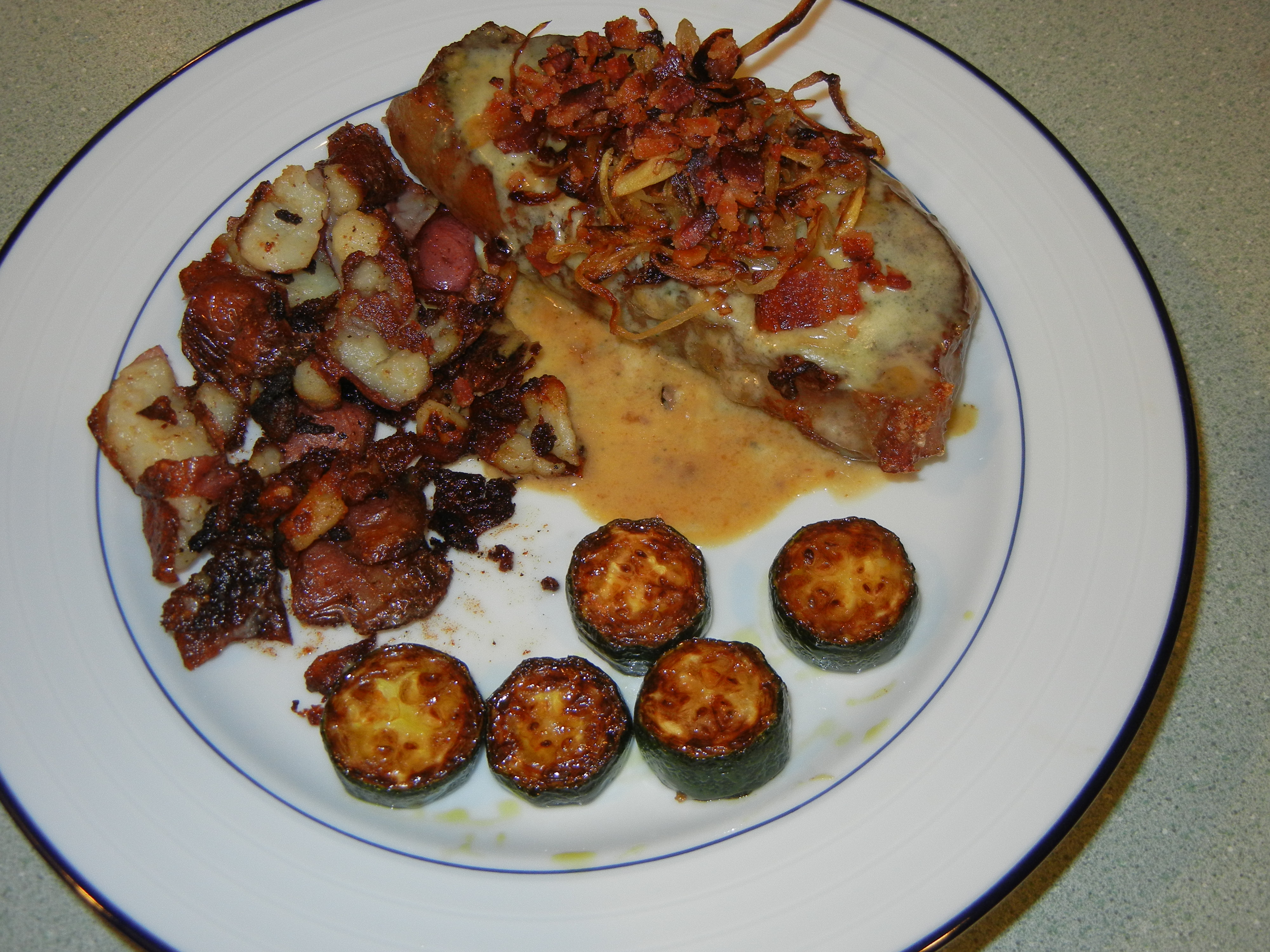
The final product. I am drooling on my keyboard as I am typing this.

Notes
I use Point Reyes Blue out of California. I consider this to be the best cheese on the planet and I love the balance of smoky, sweet and pungent that it brings to the dish. You can use just about any blue cheese you want, depending on your tastes. I also highly recommend using a grass fed beefsteak for this – they have a more pronounced beef flavor that blends well with the blue cheese and bacon. You want the beef as dry as possible before you sear it – it will form a much better crust this way. You don’t need to worry about pre-heating the broiler; since you are using the broiler just to melt the cheese you don’t need to get the entire oven hot to do it. If you don’t want to use the broiler, you could do this on the stovetop in a pan with a lid, but I would highly recommend only cooking the steak on the second side for 2 minutes before trying to melt the cheese. A blowtorch is also effective in doing this (I am not joking – try it sometime). I served this with some skillet-fried potatoes and seared zucchini medallions, but you can use whatever sides you would like. Be careful adding salt to the sauce – the blue cheese might be salty and you might end up over salting everything.

I’m Coo Coo for Coq au Vin

By Iron Chef Leftovers

Coq au vin is the perfect example of how French peasant food has become haute cuisine – a dish that is traditionally made with an old rooster so that it does not go to waste has become a $20 a plate staple in most French bistros. Traditionally the dish not only calls for an old rooster (good luck finding one of those today), but involves marinating the bird in wine for several days and a long, slow braise to produce a delicious, rich, filling and nutritious meal. I have several recipes for coq au vin, all of which are a multi-day process, except for this one. It comes from the 10th edition of the Betty Crocker Better Homes  and Gardens New Cookbook. While the end result of this dish is not as rich and flavorful as a more traditional recipe, the prep and cooking time is significantly less and it could easily be put together and made for dinner in one night (It can be done, start to finish in less than 2 hours).

The Software
2 1/2 pounds of chicken parts, skin on
2 tablespoons olive oil
12 –18 pearl onions or shallots, peeled
1 1/4 cup red wine, preferably Burgundy or a lighter Pinot Noir
1 cup thinly sliced mushrooms
1 cup thinly sliced carrot
2 cloves garlic, minced
1/2 teaspoon dried marjoram
1/2 teaspoon dried thyme
1 bay leaf
2 tablespoons flour
2 tablespoons butter, softened
2 slices bacon, cooked and crumbled
3 tablespoons parsley
Salt
Pepper

The Recipe
In a 12-inch skillet, heat oil over medium-high heat until shimmering. Don’t use a non-stick skillet for this.
Season the chicken and add to the pan, skin side down.
Note: You want about 1/2 inch of space between the pieces. If there is not enough space, brown the chicken in 2 batches.
Cook for approximately 8 minutes until it begins to brown and flip cooking for another 8 minutes.
Remove the chicken from the pan, drain off the fat and reserve two tablespoons, being careful not to lose any fond on the pan.
Add the 2 tablespoons of fat back to the pan and reduce the heat to medium.
Add mushrooms, carrot and onions and sauté for about 5 minutes.
Add garlic, parsley, marjoram, thyme, bay leaf and wine and bring to a boil.
Once at a boil, add the chicken, reduce heat and simmer covered on medium-low until the chicken is done, about 35-40 minutes.
When chicken is cooked, remove from the pan to a plate and discard bay leaf. Leave the vegetables and wine in the pan. Increase heat to medium.
In a separate bowl combine the flour and butter and mash with the back of a spoon until a smooth paste is formed.
Whisk the paste to the sauce and stir until it begins to thicken and bubble.
Cook for one additional minute after it begins to bubble and taste. Add salt and pepper as needed.
Turn off the heat and return the chicken and any accumulated juices to the pan for 2 minutes.
Server over a bed of noodles using the remaining parsley and bacon as a garnish.

Notes
Most of this recipe is copied as is from its original source with a couple of modifications in techniques added by yours truly. The original recipe calls for chicken parts – breast, drumstick and thighs, but I would highly recommend only using thighs – they are fairly uniform, they are much harder to dry out and will produce the best flavor in this dish. I prefer shallots to pearl onions in this dish, as I like their flavor more. You need about 1 – 1/1/2 cups of sliced shallots for this dish. Traditionally this isn’t served over anything, but it works well with egg noodles, fettuccini, rice (really good over risotto) or mashed potatoes. The searing of the chicken could probably be done ahead of time and then everything thrown into a slow cooker – I have never tried it, but it is a braise, so it should work. There are a few techniques with this that I would love to try at some point so be on the lookout for the variations of this recipe some time in the future.

How Not to Make Banana Bread

By Iron Chef Leftovers

I don’t have a great ego when it comes to cooking, but I am pretty good at it. Contrary to what some people think, I really couldn’t be a professional chef nor would I want to – I enjoy cooking and it is my relaxation. Baking on the other hand is not something I am good at – where I excel in cooking a savory dish is that I know how flavors work together, I can improvise and improve a recipe on the fly and I can adjust the dish during the cooking process to correct it, baking it’s the opposite. I hate that you can’t tell if you got it right until the finished product comes out of the oven and by that point it is too late to do anything about it. Don’t get me wrong, I understand the science behind baking and why ingredients do what they do, but I hate the lack of improvisation that baking delivers.

Why do I mention this, well up until a few weeks ago, my greatest culinary failure had been a tiramisu that I forgot to add the egg whites. I realized this after I put the entire thing together, when it was too late to add the egg whites, but fortunately, I was able to save it by putting in some cream and running it though an ice cream machine and I ended up with tiramisu ice cream. It turned out to be edible at least.

A few weeks ago, I had a few bananas that were well past being edible (they were black), perfect for banana bread. I remembered there was a really easy recipe for it on cooksillustrated.com, so I went there to grab it. Instead of printing it out, I wrote down the ingredients. Unfortunately, Mrs. Iron Chef came home as I was doing this and I got distracted. I picked up where I left off and this is what I wrote down:

My ingredients list. Any idea what I missed?

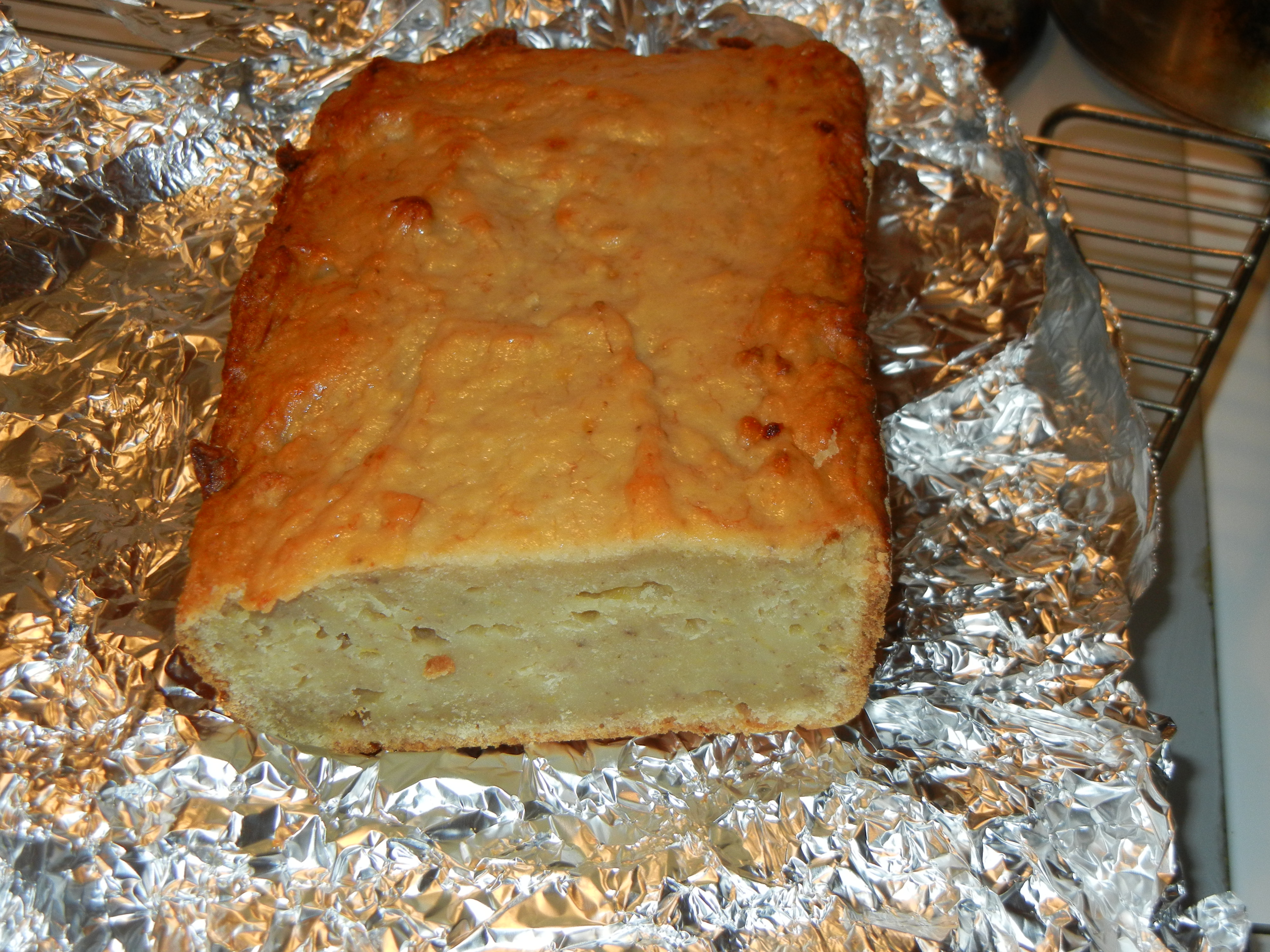
I looked at the ingredients list and thought it looked a little strange, but I figured that it was right, so I proceeded to put everything together and bake the bread. It smells wonderful in the house the entire time it is baking. After and hour I check for doneness and pull it out of the oven and think, it looks a little odd. I finally pull it out of the pan and onto the rack and think, it looks really flat. I let it cool, it settles and looks like this:

I know at this point I screwed it up. I taste it and it tastes good, but the bread is so dense that it is practically inedible. You could probably build a house with this thing it is so dense.

So what did I screw up? I left out one simple but very important ingredient – the leavening agent, in this case, baking soda. The leavening is what causes baked goods to rise by adding gas to the batter as it cooked. When you don’t you get something that is dense enough to collapse in on itself and form a black hole.

I believe I can actually see the gravity well forming in this banana bread brick.

In case you are wondering, here is the actual recipe, and I do recommend it. It is quick to assemble and produces pretty good banana bread. From cooksillustrted.com:

Makes one 9-inch loaf

Greasing and flouring only the bottom of a regular loaf pan causes the bread to cling to the sides and rise higher. If using a nonstick loaf pan, on which the sides are very slick, grease and flour sides as well as the bottom.

Ingredients

* 2 cups unbleached all-purpose flour
* 3/4 cup granulated sugar
* 3/4 teaspoon baking soda
* 1/2 teaspoon table salt
* 1 1/4 cups toasted walnuts , chopped coarse (about 1 cup)
* 3 very ripe bananas , soft, darkly speckled, mashed well (about 1 1/2 cups)
* 1/4 cup plain yogurt
* 2 large eggs , beaten lightly
* 6 tablespoons unsalted butter , melted and cooled
* 1 teaspoon vanilla extract

Instructions

1. Adjust oven rack to lower middle position and heat oven to 350 degrees. Grease bottom only of regular loaf pan, or grease and flour bottom and sides of nonstick 9-by-5-by-3-inch loaf pan; set aside. Combine first five ingredients together in large bowl; set aside.

2. Mix mashed bananas, yogurt, eggs, butter, and vanilla with wooden spoon in medium bowl. Lightly fold banana mixture into dry ingredients with rubber spatula until just combined and batter looks thick and chunky. Scrape batter into prepared loaf pan; bake until loaf is golden brown and toothpick inserted in center comes out clean, about 55 minutes. Cool in pan for 5 minutes, then transfer to wire rack. Serve warm or at room temperature.

An Easy Wheat/ White Bread

by A.J. Coltrane

An improvised bread. I would highly recommend using a scale instead of measuring cups when baking breads —  the process becomes dead simple, really nearly impossible to screw up. Once you have a feel for what the baker’s percentages should be (the relative weight of the ingredients), recipes aren’t necessary anymore.

Ingredient Baker’s Percentage Weight Approx Volume
Bread Flour 75 300g 2-1/4 cups
Wheat Flour 25 100g 3/4 cup
Water 65 260g 1 cup + 5 tsp
Sea Salt 2.5 10g 1.5 tsp
Yeast 1.75 7g 2 tsp
Sugar 1.5 6g 1.5 tsp

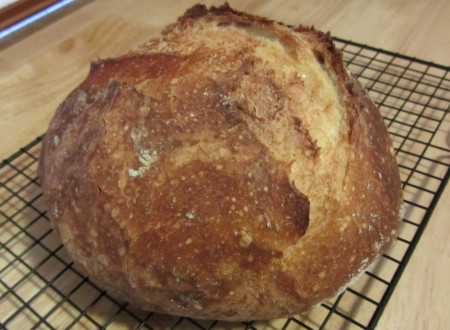
Process:  I kneaded the ingredients for six minutes in the kitchenaid, covered the bowl with a towel, and allowed the dough to rise for a couple of hours. I put a Le Crueset in the oven to preheat with the oven to 450 degrees. (This is the same process that I use for the Lahey No Knead method, referenced many times on this site.) The bread was set in the pot, slashed, then allowed to bake, covered, for 22 minutes. The lid of the pot was removed and the bread was baked for another 20 minutes.  The bread was then moved to a cooling rack.


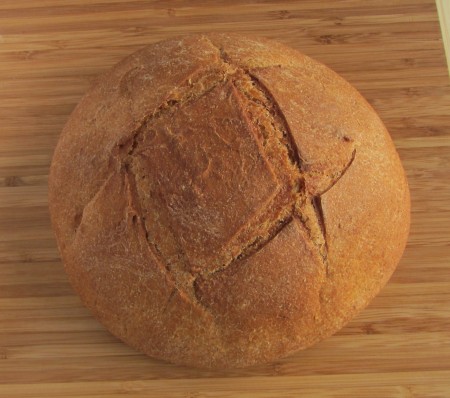
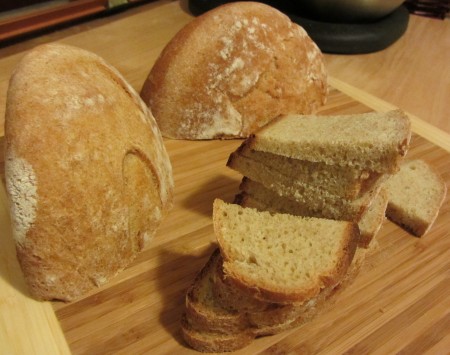
The postmortem:  25% of the bread flour was swapped out for wheat flour. The combination of the wheat flour, the 65% hydration, and the sugar made for a relatively dense interior. I think the bread may have benefitted from the slashing going a little deeper than it did — it may have allowed a little more expansion in the oven. Still, it tasted good, and was virtually no work, so I’ll call that a win.

Pizza Bianca — A Sizeable Superbowl Sendup

by A.J. Coltrane

A Superbowl sendup on the Roman “Pizza Bianca”, inspired by this recipe, created by J. Kenji Lopez-Alt at Serious Eats. He describes his process here. Here’s the photo from Serious Eats:

Kenji's Pizza Bianca. Check out his process at Serious Eats.
A little bit of background:  The Pizza Bianca I’m referring to is created at Antico Forno in Rome. It’s a flatbread about 2 meters long; made with olive oil, salt, and rosemary. The baker scrunches up the dough like an accordian onto a peel, then shimmies the dough out to its full expanse in the oven. The pizza is sold by length, rather than by the slice.

That sounds good to me, though I don’t have an oven that’s six feet across.

What I do have is a grill that’s 24″ x 18″. It’s my biggest cooking surface, and I thought that for the Super Bowl it’d be fun to make a flatbread the size of the grill.

Here are the two formulas, Kenji’s is the “Original” in the center column (Baker’s Percentage definition here):

Weight in Grams Original Sizeable
Flour 500, Bread Flour 800, AP Flour
Water 375 544
Salt 10 16
Yeast 5 5
Olive Oil 1/4 cup 3/8 cup
Rosemary 1 TBP, minced 1.5 TBP, minced
     
     
Baker’s Percentage Original Sizeable
Flour 100 100
Water 75 68
Salt 2 2
Yeast 1 0.63
Olive Oil 10.6 10
Rosemary 1 TBP, minced 1.5 TBP, minced

Kenji’s uses a 75% hydration and an overnight rise, since his is based around the Lahey No Knead recipe. I decided in advance that if I used a hydration that high then I’d be unlikely to get *that* much wet, oily, dough onto the grill without a mishap. I cut back the hydration to a more manageable 68% and allowed for a three day rest in the refrigerator. (My “regular” pizza dough is 60% hydration.)

Sizeable.

The recipe:

Use a spatula to combine all of the ingredients above in a large bowl, cover with plastic wrap. Leave the dough in the refrigerator for 3 days in total, folding the dough (in the bowl) a couple of times per day. Remove the dough from the refrigerator about 4-5 hours before it’s time to grill. (If the dough is threatening to rise too much then either go ahead and grill it, or fold it again to buy another hour or two.) Flour a work surface and roll the dough out to into a 16″ x 22″ rectangle.

Arrange the dough so the long dimension goes from left to right. Generously brush both the dough, and the back of an inverted sheet pan, with olive oil. Fold the dough in half (left to right) to transfer it to the sheet pan (see below).

Further explanation:  The 16″ side of the dough (what *was* the short side) goes lengthwise on the sheet pan, the “long” side of the dough (which is now 11″, because it’s folded in half) sits folded across the short dimension of the sheet pan. The “inside” of the dough has now already been oiled. The bottom on the dough is now sitting on oil. All that remains is to oil the new top. Preheat the grill to medium.

To transfer to the grill:  Pick up the dough (still folded in half) and rapidly move it over to the grill, then unfold the dough and carefully try stretch it out a little if it needs it. When the dough stiffens up, shows some color on the bottom, and feels about half cooked then it’s time to flip the monster. I slid a cheap pizza pan under the dough and flipped it over. I used the same pan to remove the finished pizza from the grill — the pan was smaller than the pizza, but it worked ok overall. Hot pads are recommended, the pizza will be lava hot. I used a pizza cutter to score the pizza, to try to make it easier for everyone to tear off a piece. As part of a nice Super Bowl layout this easily fed 10 people with leftovers — it’s basically the same size as two large pizzas, combined.

Pasta all’amatriciana

By Iron Chef Leftovers

I like incredibly simple meals. One of the simplest and tastiest is pasta all’amatriciana. It has a whopping 5 ingredients – guanciale (essentially pork jowl bacon), tomatoes, pepper flakes, cheese and pasta (well, technically 6 if you count the pasta water) and takes probably 20 minutes to prepare. The recipe that I used was stolen (with a few modifications) from Jennifer McLagan, James Beard Award winning cookbook author, who pilfered it from another cookbook. The only thing that I really did differently was used cappelini instead of bucatini since Mrs. Iron Chef doesn’t like thick pasta. It worked, but it would have been better with thicker pasta as the thin pasta really does absorb more of the sauce. Either way, this was a pretty killer dish.

Note – I converted the measurements from metric, but I used the metric measures when I made this, so it might be a little off. I also left the metric measurements in there if you are so inclined.

The Software
6 oz (175 g) guanciale – sliced into 1/4 inch lardons
2 cups of diced roma tomatoes
1/2 teaspoon red pepper flakes
2 tablespoons grated Parmiggiano Reggiano
2 tablespoons grated Pecorino-Romano (plus extra for topping the pasta)
16 oz (400 g) pasta
1 cup reserved pasta water

The Recipe
Cook the pasta until al dente (time depends on the type of pasta), reserving 1 cup of the pasta water. Cook the guanciale over medium heat until browned, stirring occasionally, about 10 minutes. DO NOT DRAIN THE FAT FROM THE PAN. Add the tomatoes. Cook over medium heat for about 5 more minutes. Add about 1/2 of the pasta water and cook for 2 more minutes. If the sauce is still too thick, add more of the pasta water (it should be slightly watery). Add the pasta and cheese, stir to combine. If the sauce looks too thick, add a bit more pasta water, if not, serve with some grated cheese and ground black pepper.

Notes
If you like more heat, add more red pepper. If you can’t find guanciale, use really fatty pancetta or bacon and you may need to add some olive oil to the pan for additional fat. It won’t be as good, but it will work in a pinch. Use your judgment in adding the water – my tomatoes were very dry so I needed more water that I thought I would. You can add less. Canned tomatoes would probably work if you drained them before adding them to the guanciale. I didn’t take a picture of the sauce, but here is what it should look like before you put the pasta in (I am linking rather than posting my pictures because Chef McLagan is a professional and, frankly, hers was much prettier than mine).

No Knead Bread — What Happens When It’s Slashed

by A.J. Coltrane

Jim Lahey’s No Knead Bread doesn’t need to be slashed.

Usually though, it comes out looking something like this:

Or these:

This is a lucky outcome, from an appearance standpoint:


But here’s what I got the first time I put it in the pot, then slashed it:

The nice thing is that the attractive slash and rise in the last photo represents a reproducible result. Note that the shape is a little more “regular” too — the bread didn’t just crack organically.

Which looks most appetising?

—–

Postscript:  Four different photos of bread using four different photo techniques, and the last picture uses the newer camera. The first bread obviously used more flour for proofing, and the left of the twin breads used a non-preheated pot. Still, at this point the baking has a more predictable outcome than I get from the photography — there are a lot more hours invested in the baking to date.

A Very Agreeable Bread

by A.J. Coltrane

Here’s a typical french bread recipe (scaled to “15 servings”)

  • 3 cups all-purpose flour
  • 1-1/4 (.25 ounce) packages active dry yeast
  • 3/4 teaspoon salt
  • 1 cup warm water (110 degrees F/45 degrees C)

This is the same basic ratio of flour to water (3:1) as my “go to” pizza dough recipe. 3 cups of flour weighs about 375-400 grams (I’ve been using Lahey’s 400 grams as standard). 1 cup of water weighs 237 grams. Expressed as a baker’s percentage, the water weight is about equal to 60-63% of the flour weight.  (By rounding the water up very slightly to 240 grams:  240/400 = .60)

The beauty of using weights instead of volumetric measures is that it removes all of the variables from the paragraph above, and removing variables leads to more consistent results. Baking is enough of an inexact science as it is, without intentionally introducing variables into the process.

So here’s the point:  When using baker’s percentages a “classic” french bread formula would be called out as “60-2-2”. For every 100 parts flour the formula calls for 60 parts water, 2 parts salt, and 2 parts yeast. Everybody knows what french bread “is”, and that makes for a good jumping off point to try other things:

Ingredient Original French Bread Percentage Approx French Bread Volume French Bread Weight Agreeable Bread Weight
White Flour 100 3 cups 400g 300g
Wheat Flour 0     100g
Water 60 1 cup 240g 268g
Salt 2 1-1/4 tsp 8g 8g
Yeast 2 2 tsp 8g 8g

What happened here, exactly? I replaced 1/4 of the white flour with wheat flour, and I increased the hydration from 60% to 67% by adding 28 grams of water — about two tablespoons. The end goal was a slightly more rustic, somewhat “wheaty” bread. I also added two tablespoons of butter to the dough because there was butter in the fridge and I felt like adding it.

To bake the bread I used the Lahey “covered pot” technique (30 minutes covered, 15 minutes uncovered), decreasing the baking time from 45 minutes down to 40 (only 10 minutes of uncovered baking) —  the hydration of the Agreeable bread was 67% rather than the 75% in Lahey’s “no knead” dough; there was less water to cook out.

If I had to do over again I would have removed the pot lid 5 minutes sooner, to try to get a little more color on the crust. Slashing the dough may have also produced a slightly more open crumb, a “better” result — 60% hydration doughs pretty much always get slashed, and high hydration (75%) doughs basically never get slashed (they’ll often collapse into the slash); there’s a point in between there where slashing the dough is a good thing. Now I just have to figure out what that “point” is.

In any event, the Agreeable Bread went well with Saint Andre cheese, and it made a good breakfast sandwich too.